

Executive imposter syndrome is the persistent fear of being exposed as a fraud despite clear evidence of capability, and it is most common at the top rather than the bottom of an organisation. Identity collapse is the framework this article proposes for why: the gap between the self-concept your old role built and the one your new role demands.
Two groups feel it hardest: senior leaders newly arrived in the C-suite, and former executives building a coaching or consulting practice.
Competence appears to have little to do with it. Senior leaders routinely report both confidence in their ability and a persistent fear of being found out, because those answer different questions. Competence answers: Can I do this? Identity answers: Am I the kind of person who does this?
Key Takeaway:
- Identity collapse describes the gap between the self-concept built by your previous role and the identity demanded by a new one. It can intensify executive imposter syndrome during C-suite transitions or when former corporate leaders launch coaching and consulting businesses, even when their competence remains strong. [1]
- Why it happens: Professional titles, established teams, and organizational recognition once reinforced a leader’s sense of belonging. After a promotion or career transition, those external signals disappear, making it harder to trust existing skills and experience. The article reports that 71% of US CEOs experience imposter symptoms, while 85% consider themselves fully competent in their roles. [1]
- Recognize the compensation pattern: Imposter syndrome can drive over-preparation, excessive work, undercharging, and reluctance to delegate. These behaviors may produce short-term results while reinforcing the belief that success comes from extra effort rather than genuine capability. Identify specific recurring behaviors, such as rewriting every proposal multiple times, instead of relying on vague labels like low confidence. [1]
- What to do: Stop waiting to feel confident before acting in your new role. Define your vision independently of your former corporate identity, eliminate activities that consume time without creating value, build systems that support delegation, address limiting behavioral patterns, and reposition your expertise around the problems you solve. Structured coaching and cognitive reframing have shown promising results in research involving medical trainees, although executive-specific trials are still lacking. [1]
- When to rethink the approach: Identity-focused coaching is most relevant when established expertise and a viable business already exist, but persistent self-doubt continues to limit pricing, delegation, or growth. It is less useful when the primary challenge is still choosing a service or finding initial customers. If symptoms involve significant anxiety or depression, seek support from a qualified mental health professional rather than treating business coaching as clinical care. [1]
Bottom Line: Executive imposter syndrome is not necessarily a sign of incompetence; it may reflect a mismatch between your established capabilities and your evolving professional identity. Stop trying to prove your worth through more work, identify the behaviors that keep you stuck, and build the systems, positioning, and habits that support the role you want to lead.
What Is Identity Collapse?
Identity collapse describes the gap between the self-concept your old role built and the one your new role demands. The title changes overnight. The internal operating system doesn’t.
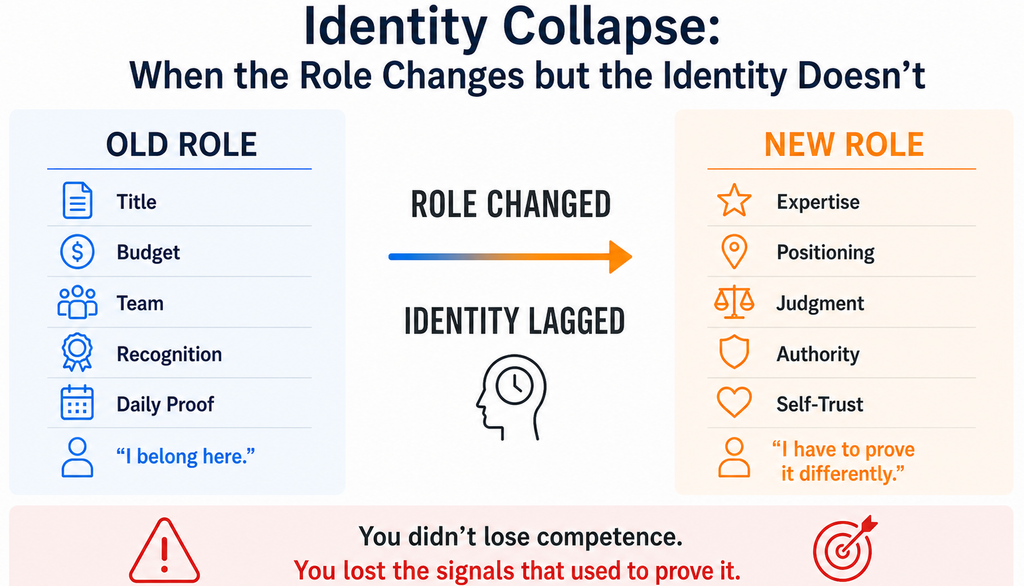
A note on evidence boundaries, stated once and applying throughout. Research establishes three things: that imposter feelings are widespread and intensify with seniority, that they carry real consequences, and that executive transitions are a high-risk period. Identity collapse is the explanatory framework this article uses to connect those findings for senior leaders. It is not a diagnostic category, and no study has tested it as a mechanism. Where the line between evidence and argument matters below, it’s marked.
For twenty years an organisation told you who you were: a title, a budget, a team, and a hundred daily signals that you belonged in the room. Then you left, or got promoted past the point where any of it applies, and the signals stopped.
You didn’t lose your competence in the elevator on the way out. You lost the thing that used to do your believing for you.
Why Seniority Doesn’t Protect You From Imposter Syndrome
Executive imposter syndrome runs highest among the people with the most evidence of capability.
Korn Ferry’s Workforce 2024 Global Insights Report, a survey of 10,000 professionals from entry level to CEO across six markets, found that 71% of US CEOs experience symptoms of imposter syndrome in their role, compared with 65% of other senior executives and 33% of early-stage professionals. Earlier research reported by Wharton’s executive faculty puts it near 70% of executives at some career point.
Read that carefully, because it’s a cross-sectional snapshot rather than proof that any individual’s doubt worsens with each promotion. What it does establish is that seniority offers no protection, and that something about senior roles is associated with more of this, not less.
The proposed explanation: every promotion moves you further from work you can objectively verify and closer to work judged by feel, vision, judgement, presence, and whether people follow you. There’s no scoreboard for that. It’s also why self-doubt often shows up loudest right after a win rather than after a failure.
Leadership-transition research has repeatedly identified the first year or two as a particularly vulnerable window for new executives, where adaptation matters more than technical expertise a pattern visible across derailment and transition-failure studies, though these are practitioner datasets rather than peer-reviewed trials.
Why Competence Doesn’t Cure Imposter Syndrome
Here’s the finding that should end the collect-more-evidence approach. In that same Korn Ferry survey, 85% of CEOs said they were totally competent in the role while 71% reported imposter symptoms.
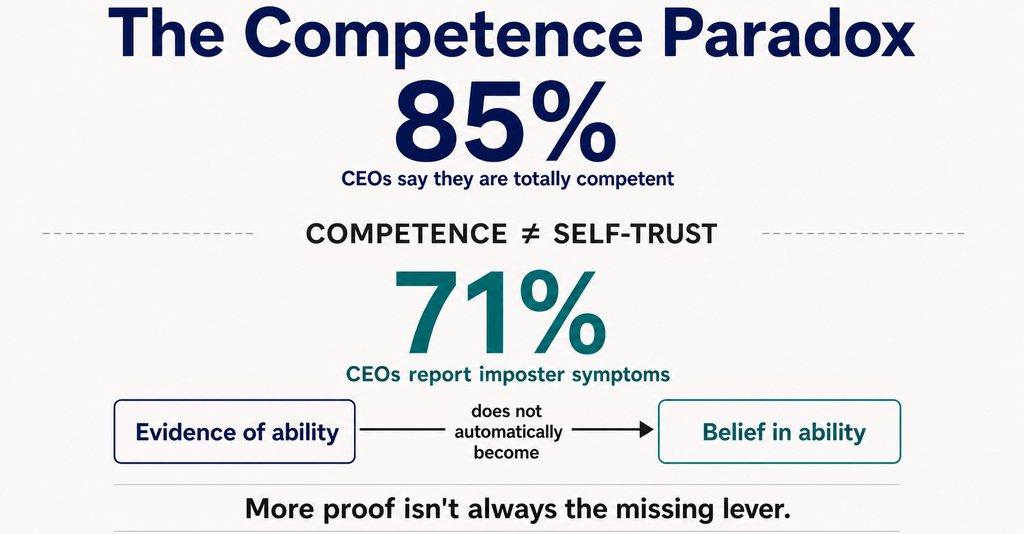
Competence judgements and imposter feelings move independently. So competence isn’t the lever.
What is? Until recently, the honest answer was nobody knows. A 2020 systematic review in the Journal of General Internal Medicine pooled 62 studies covering more than 14,000 participants and found imposter feelings widespread and reliably linked to burnout, anxiety and reduced job satisfaction but identified no published treatment evaluations at the time it was conducted.
That has since changed, and the direction matters. A 2024 systematic review in BMC Medical Education examined six studies, including four randomised controlled trials. Two of those trials showed significant reductions in imposter symptoms against control groups. The authors concluded that structured programmes, particularly those incorporating coaching and cognitive reframing, can effectively reduce imposter syndrome.
One caveat that matters: every trial studied medical trainees, not executives. Nobody has tested this on former VPs building consulting practices. But the shape of what worked is telling. Not affirmations. Not a wins journal. Structured, facilitated work on how you interpret your own results.
Why Ex-Corporate Leaders Feel Like Frauds When They Start Coaching
Two collapses happen at once here.
Inside the company, your credentials were legible. “VP of Operations at a firm everyone’s heard of” opened doors and let people skip deciding whether to take you seriously. Outside, that sentence is a line on a website nobody reads. The market doesn’t care where you worked. It cares what you solve.
And it’s crowded. The International Coaching Federation counted 122,974 coach practitioners worldwide in 2025, up 15% in two years and 54% since 2019. You went from a place where your position was assigned to one where it’s earned in front of strangers, every time.
Take Tom (name changed). Twenty years of hard-won expertise, genuinely excellent at the work, effectively invisible not for lack of credibility, but because credibility that isn’t positioned reads as nothing at all. He rebuilt his positioning around his own story and methodology, and moved from undercharging for long engagements to premium rates for focused ones.
Twenty years of expertise, invisible. Then, positioned properly, the right clients came to him.
Tom and Jennifer below are practitioner case examples, not controlled evidence that this approach produces these outcomes.
James knows this route from the inside. Fourteen years at IBM, Lenovo and Novell taught him the skills that carry you to a senior level and almost nothing about the shift from operator to owner. By his fifth business, he was working 80-hour weeks on anxiety medication and calling it success. That’s his story, not a forecast for yours.
The Compensation Behaviour: Why You Overwork Instead
If evidence doesn’t settle the question, effort becomes the substitute and effort has no ceiling.
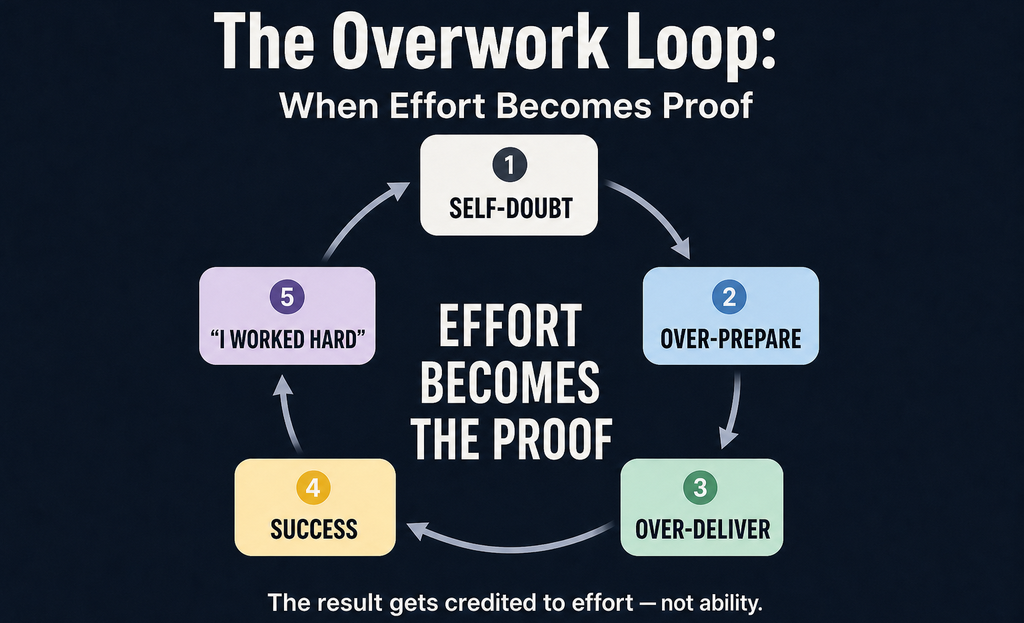
Research on the impostor phenomenon consistently names over-preparation and avoidant coping as core behavioural signatures. You say yes to everything. You over-deliver because disappointing someone feels unbearable. You rewrite the proposal four times.
And it works; that’s the cruel part. The work lands, the client is happy, and the attribution literature suggests what happens next: the result gets filed under effort rather than ability. The next project starts from the same deficit.
From here on, this is James’s position rather than a research finding. His framing is deliberately blunt: You’re stuck BECAUSE you’re working 60 hours. Your 60-hour week may not be a symptom of the plateau so much as something helping maintain it. You can’t delegate, because handing the work over removes the proof. You undercharge, because the price would have to be defended by someone who believes they’re worth it.
Why Cognition Alone Doesn’t Shift Identity
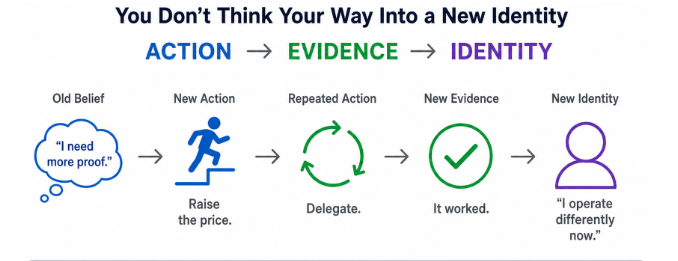
You don’t reason your way into a new self-concept. You act your way in.
Herminia Ibarra’s work on the authenticity paradox found that when we’re unsure of ourselves in a new setting, we retreat to familiar behaviours and styles, precisely the ones that worked in the role we just left. Waiting to feel like the new version of yourself before acting like them means waiting indefinitely.
Note what this converges with: the intervention trials that moved the needle used coaching and cognitive reframing structured, external, practised. Not solo deliberation.
Jennifer (name changed) knew this from the inside. Extraordinary background, real expertise, badly underpriced and completely aware of it. She could construct the business case for raising her rates in her sleep. She could not make herself do it. Within 60 days of deep reconditioning work, she’d doubled her prices and more than doubled her revenue.
Doubled her prices in 60 days. The strategy was never her problem. Her programming was.
The first move is diagnosis: naming the specific programming that’s running, concretely. Not “I have confidence issues.” More like: I rewrite every proposal four times and have never once sent the first draft. That’s a pattern you can change, and it leads into what authentic leadership actually requires.
Who Should Use This Approach And Who Should Avoid It
This is for you if: you’ve left a senior corporate role, or are about to, and are building a coaching, consulting, or practitioner business. You have real expertise and a track record. You’re working 50–60+ hours and the results don’t match the effort. You can name what you avoid: the price increase, the delegation, the bold offer and reasoning with yourself hasn’t worked.
This is not for you if you’re pre-revenue and still deciding what to sell. Identity work has nothing to grip until there’s a business attached to it. Skip it too if you want a positioning tweak without touching the psychology; that’s a rebrand, and there are cheaper ones.
An honest boundary: imposter feelings sit close to anxiety and depression in the research, and this is business coaching, not clinical care. If what you’re carrying is heavier than a career transition, start with a qualified professional.
Confidence-Building vs. Identity Rewiring
Two broad approaches, described by what they target rather than by proven results. This is a practitioner framework, not a comparative evidence base; no head-to-head trial exists.
| Particulars | Confidence-Building | Identity Rewiring |
|---|---|---|
| Primary target | Perceived confidence | Underlying self-concept |
| Typical approach | Build evidence and reassurance | Identify and change recurring patterns |
| Core assumption | Doubt reflects insufficient evidence | Doubt persists despite evidence |
| Potential limitation | May not address recurring identity patterns | Requires bigger behavioural and structural change |
| Typically applied to | Situational nerves: a big pitch, a first keynote | Chronic patterns that survive every win |
The 2024 trial evidence sits closer to the right-hand column coaching and reframing rather than reassurance, though it was conducted in a different population.
Data & Findings
- 71% of US CEOs experience symptoms of imposter syndrome in their role, compared with 65% of senior executives and 33% of early-stage professionals. Korn Ferry Workforce 2024 Global Insights Report, 10,000 professionals, six markets
- 85% of CEOs in the same survey say they are totally competent in the role; competence judgements and imposter feelings move independently
- 62 studies, 14,161 participants link impostor phenomenon to burnout, anxiety and lower job satisfaction; no treatment evaluations existed at the time of that 2020 review Journal of General Internal Medicine
- Two of four randomised trials reduced imposter symptoms significantly, with coaching and cognitive reframing identified as active components. BMC Medical Education, 2024, medical trainees
- 39% of Canadian employees report often or always feeling burned out, up from 35% in 2023. Mental Health Research Canada, Mental Health in the Workplace 2025, 5,008 employed adults, with Canada Life
- 122,974 coach practitioners worldwide, up 15% since 2023, ICF Global Coaching Study 2025
None of these measures identity collapse directly. They establish prevalence, consequences, the competence paradox, and early intervention evidence. Connecting them into a single mechanism is the argument of this article, not a finding.
The 5 Shifts to Freedom: Where Identity Gets Rebuilt
The method James uses is The 5 Shifts to Freedom, and it works because of its mechanism: The 3 Pillars: Performance Psychology, Freedom-First Business Strategy, and Freedom-First Business Structure.
Strategy without psychology is another unfinished course. Psychology without strategy is feel-good material that doesn’t pay for anything. Structure without both is a prettier prison.
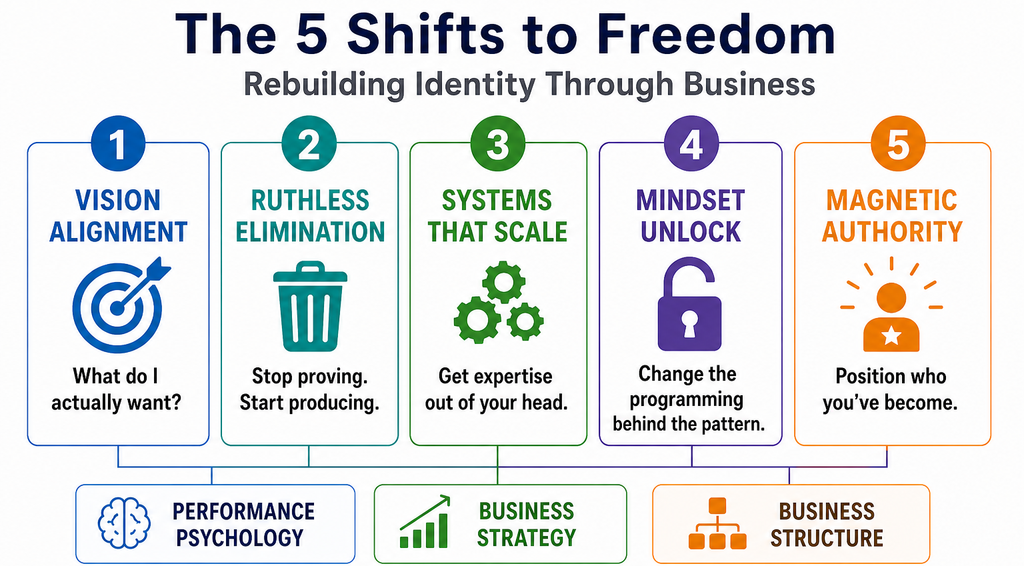
Vision Alignment:
Define what you actually want, separately from what the corporate version of you was trained to want.
Ruthless Elimination:
Cut the 80% of activity absorbing your time and energy. Much of it exists to prove something rather than produce something.
Systems That Scale:
Get your expertise out of your head so the business stops depending on your availability.
Mindset Unlock:
Work directly on the programming behind not delegating, not raising prices, not stopping.
Magnetic Authority:
Rebuild positioning around who you’ve become, so the right clients recognise you without you convincing anyone.
Here’s the proof that matters most. James now works 25–35 hours a week. He’s home for dinner with his phone in another room, trains in martial arts twice a week, and takes a 36-minute nap without apologising for it. Not because he earned a rest; working less is how the scaling happened.
Frequently Asked Questions
Is identity collapse the same thing as imposter syndrome?
Not quite. Imposter syndrome is the documented experience of persistent fear of exposure despite clear evidence of capability. Identity collapse is the framework this article uses to explain why it intensifies in senior and post-corporate roles: the distance between who your old role made you and who your new role requires. Treat it as an explanatory model, not a clinical finding.
How long does executive imposter syndrome last after leaving a corporate role?
There’s no established timeline. Transition research points to the first year or two as the highest-risk window, but nothing indicates the pattern resolves on its own when treated as a confidence problem. The intervention evidence that exists involved structured programmes rather than time.
Does more experience make imposter syndrome better or worse?
The prevalence data shows imposter symptoms are markedly more common among CEOs and senior executives than early-career professionals. That’s a snapshot across groups rather than proof that any individual worsens over time but it does mean experience isn’t protective.
Can executive imposter syndrome actually hurt my business, or is it just uncomfortable?
Research links it to burnout, anxiety and reduced job satisfaction. The commercial consequences chronic undercharging, inability to delegate, over-delivering on every engagement are what James sees consistently in practice rather than something a study has measured in business owners.
Will raising my prices fix the feeling?
Unlikely on its own. If the self-concept hasn’t shifted, a higher price tends to become something you feel obliged to justify through more over-delivery. The available trial evidence suggests the reframing work is what moves imposter symptoms; the pricing change is better understood as a result than a treatment.
I’m still in the C-suite and haven’t left. Does any of this apply?
Yes. The prevalence data covers sitting executives, not just leavers: 71% of CEOs and 65% of senior executives. Each step up removes another layer of verifiable proof, and addressing that before a transition is easier than during one.
The Bottom Line
You spent twenty years becoming excellent at something, then walked into a room where none of the old signals work. That disorientation isn’t evidence that you don’t belong. It’s evidence that your identity hasn’t caught up to your capability and on the limited research available, that’s changeable.
What it doesn’t respond to is more effort.
Book a 30 minutes Freedom Blueprint Call. We’ll find the one thing that’s actually keeping you stuck. No pitch unless you ask for one.