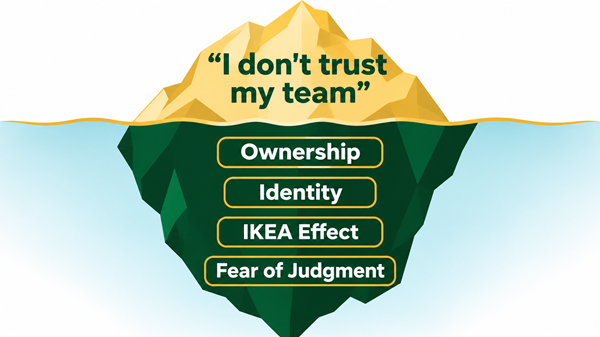
Most founders don’t hate delegating because their team is weak. The deeper driver is often psychological ownership: the business feels like part of you, so handing off work feels like handing off a piece of yourself. Three other forces can stack on top. Your identity may depend on being needed. Effort can make your own work feel better than it is. And you may fear that someone else’s mistake will reflect on you. None of this is a character flaw, and “subconscious” here simply means patterns you act on without noticing.
The research is early and mostly qualitative, so treat it as a lens, not a diagnosis. The practical move is to test which reason is yours with small, low-risk experiments, then choose a handoff that fits it instead of forcing a generic system you’ll quietly undermine.
Key Takeaway:
- Founders often struggle with delegation because the business feels like an extension of their identity. Four underlying drivers can make letting go difficult: psychological ownership, the need to feel indispensable, effort-justification, and fear of judgment. These patterns can cause founders to take tasks back even when their team is capable.
- The four psychological barriers work differently. Ownership makes delegation feel like losing control; identity makes being needed feel essential; the IKEA effect makes founders overvalue work they create themselves; and fear of judgment makes them worry that someone else’s mistakes will damage their reputation. [1]
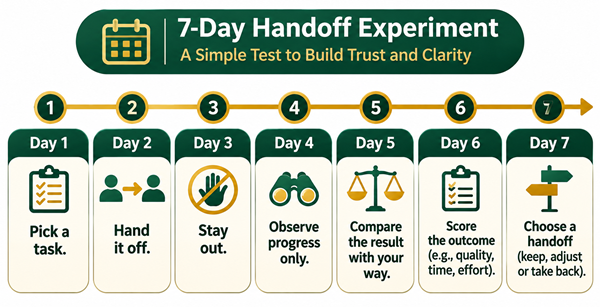
- What to do: Run a seven-day delegation experiment using one recurring, low-risk task. Delegate an actual decision, stay completely out of the process, compare deliverables against client requirements, or establish a written quality standard with a 48-hour feedback window. Track your reactions to identify the real barrier.
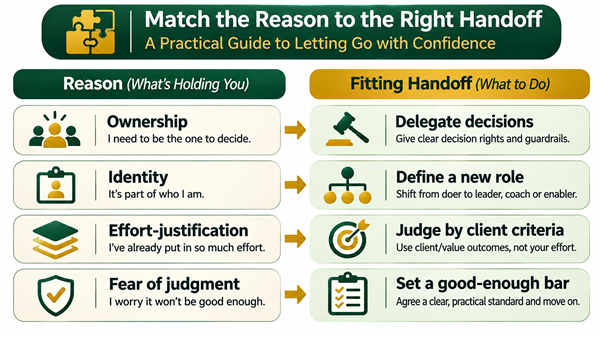
- Choose the handoff strategy that matches the problem: delegate decision-making to address ownership, redefine your leadership role to address identity, evaluate outcomes instead of personal preferences to overcome effort-justification, and establish clear quality standards to reduce fear of judgment.
- When to be cautious: These psychological explanations are useful starting points, not proven diagnoses. The supporting research is mostly small-scale and qualitative. If an employee is genuinely unreliable, address performance first. Maintain qualified oversight for legal, financial, tax, safety, and compliance responsibilities.
Bottom Line: Founders often struggle to delegate because of their relationship with the business, not simply because they lack trust in their team. Identify your underlying barrier, test one small handoff for seven days, and start measuring leadership success by the results your team delivers, not by how much work you personally control.
Why “Just Trust Your Team” Never Works
You’ve heard the advice. Write a process, hire good people, let go. Most delegation articles land on trust, unclear scope, time cost and identity, then suggest starting with one small task. That’s sensible. It also skips a question: if the advice is that simple, why do smart founders keep taking work back?
A leadership development firm’s data suggests the skill itself is rare. In research from DDI reported by SHRM, only 19% of rising leaders had the delegation skills needed to prevent burnout. That’s vendor research, so read it as a signal, not a verdict. But skill gaps don’t explain why a founder who trains someone well still redoes the work at 11 p.m.
That gap is where the hidden reason lives. You aren’t failing at a technique. Something underneath the technique keeps pulling the work back to your desk.
What “Subconscious” Really Means Here
Let’s be careful with the word. “Subconscious” isn’t a precise scientific term, and nobody can read your mind from an article. Here it means something modest: habits of thought and feeling you act on before you notice them. You feel a flicker of tension when someone else sends the client email. You rewrite it “just a little” before it goes out. You call that quality control.
Those moments are data. James R. Elliot, an NLP Board Designated Trainer with more than 20 years of experience, teaches people to treat them that way: notice the pattern, ask a precise question, and test a different response. That’s the spirit of the rest of this article. We won’t diagnose you. We’ll run small experiments.
The Delegation Lab Notebook
Think of this as a lab notebook. You’ll write four hypotheses about why you hold on. Each one gets a signal to watch for, a seven-day experiment, something to observe and a question to ask yourself. At the end, a results log shows which hypothesis explains the most. You may find one clear winner, or a blend. Both are useful.
Pick one real task for the experiments. Choose something recurring and low-stakes, like a weekly client update or a report. Use the same task for all four so the results compare cleanly.
Entry 1: Ownership
| Hypothesis A: “It’s mine, so only I can do it.”Signal: You say “my business,” “my clients,” “my way” when you talk about small decisions. Handing off a task feels like losing territory.Why it might be true: Researchers who study founders describe psychological ownership, the feeling that something is yours. In a qualitative study of 30 founders and 14 hired managers, the authors argue that founders need to recalibrate that ownership to delegate decision-making successfully. Earlier work by the same lead author looked at five technology start-ups through the lens of ownership and territoriality.Seven-day experiment: Hand off one decision, not just one task. Say out loud: “You own this, and I’ll back your call.” Don’t review it first.Observe: How strong is the urge to step back in? When does it peak? What do you tell yourself in that moment?Question to ask (meta-model): “Who says only I can do this? What would happen if someone else did it?” |
Entry 2: Identity
| Hypothesis B: “I’m valuable because I’m needed.”Signal: You feel a small drop, almost a loss, when a task runs fine without you. Busy feels like proof you matter.Why it might be true: Founders often fuse the business with who they are. A Stanford undergraduate study of 37 founders explores attachment to the venture and the process of uncoupling from it. It’s small and qualitative, but it matches what many founders describe.Seven-day experiment: Pick the task and stay completely out of it. Then write down what you did with the time. Notice how it feels to be unneeded for one thing.Observe: Did you feel relief, or a gap? Did you invent a reason to check in?Question to ask (Logical Levels): “Is this about my behavior, or about who I think I am? What’s my role when I’m not the one doing it?” |
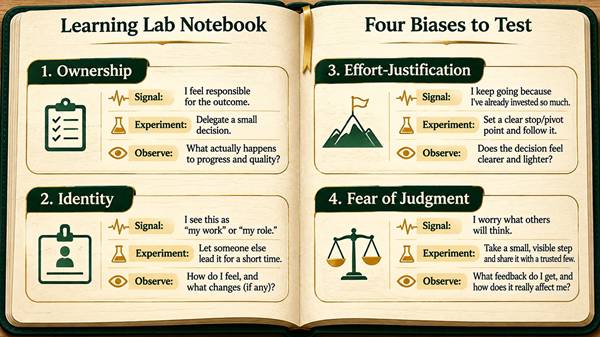
Entry 3: Effort-Justification (The IKEA Effect)
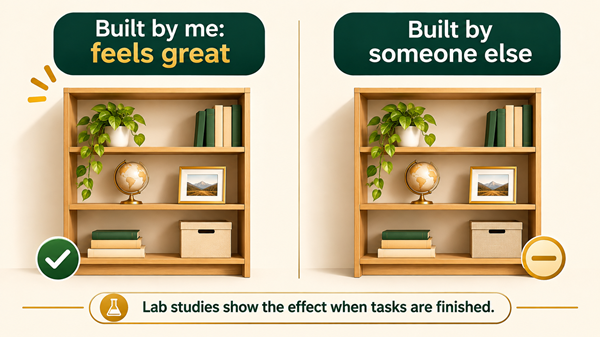
| Hypothesis C: “I built it, so my way is better.”Signal: You defend your old workflow even when someone shows a faster one. Your own templates feel more polished than anyone else’s.Why it might be true: In a series of studies on the IKEA effect, people who built things themselves valued them about as highly as experts’ work, and expected others to agree. The effect showed up only when they finished the task successfully. These were lab tasks like folding origami, not business decisions, so the link to founders is an inference.Seven-day experiment: Ask a colleague to build the same deliverable their way. Then compare the two with a short checklist of what the client actually needs, before you look at who made which.Observe: Does your version win on the client’s criteria, or only on your preferences?Question to ask (chunking up): “What’s the purpose of this task? Does my method serve that purpose better, or does it just feel familiar?” |
Entry 4: Fear of Judgment
| Hypothesis D: “If it goes wrong, it reflects on me.”Signal: You can picture the awkward email from a client. You review work not because it’s weak, but because your name is on it.Why it might be true: When your reputation and the business sit close together, every handoff carries a small risk of embarrassment. This is a common-sense reading of founder experience, not a finding from the studies above.Seven-day experiment: Set a “good enough” bar in writing with your team member. Delegate with a 48-hour feedback window. Share the one thing you worried about, and let them respond.Observe: What did you picture going wrong? How likely was it, honestly? What actually happened?Question to ask (future pacing): “If this goes slightly off, what’s the real cost and how would I fix it? Can I handle that?” |
Your Results Log
After seven days, score each hypothesis from 0 to 3 on how strongly it showed up. Keep notes brief. The pattern matters more than the numbers.
| Hypothesis | Strength (0 to 3) | What I noticed | Handoff that fits |
| A: Ownership | Delegate decisions, not only tasks | ||
| B: Identity | Define a role beyond doing | ||
| C: Effort-justification | Judge by the client’s criteria | ||
| D: Fear of judgment | Set a good-enough bar and a feedback window |
| Want a second pair of eyes on your results?If your log shows a blend and you can’t tell what’s driving it, talk it through. Book a 30-minute connection call and bring your notes. |
A Hypothetical Example: Maya
This is an invented example for illustration, not a real client.
Maya runs a small design studio. She keeps rewriting the weekly client updates her project manager sends. She believes the problem is trust in her team. She runs the four experiments on that one task.
Ownership scores a 1: she can hand off the update without much strain. Identity scores a 2: when the update goes out unedited and nobody mentions her, she feels oddly flat. Effort-justification scores a 3: when she compares both versions against the client’s checklist, the manager’s version covers everything, and hers is just longer. Fear of judgment scores a 1.
Maya’s main reason isn’t trust. It’s that her own work feels better than it is, and that she likes being the polish. Her handoff changes. She stops reviewing for style, starts reviewing against the client’s checklist, and spends the freed hour on a business development call. Real change usually takes 3 to 6 months of practice, so a single week is a start, not a cure.
Data & Findings
The research behind this article is useful but limited. Here’s what each source shows and where it stops.
| Source | What it shows | Caveat |
| Zhu, Smith & Brown (2023) | Founders recalibrating psychological ownership is tied to successful delegation of authority. | Qualitative, 30 founders and 14 managers. Shows a process, not how common it is. |
| Zhu (2018) | Studies delegation in new ventures through ownership and territoriality. | Five tech start-ups. I only read the abstract. |
| Norton, Mochon & Ariely | Self-made work gets valued highly, but only when completed. | Lab tasks, not business decisions. |
| Davidson (2023) | Explores founder attachment and uncoupling. | 37 founders, qualitative, student publication. |
| DDI via SHRM | Only 19% of rising leaders show strong delegation skills. | Vendor research. Not peer reviewed. |
None of these studies proves that one hidden reason drives every founder. Together they point in a similar direction, which is why the notebook asks you to test instead of assume.
Who Should Use This Approach
- Founders who keep taking work back even after good training.
- Owners who feel guilty or uneasy when a task runs without them.
- Leaders whose team has stopped bringing decisions to them, or stopped caring about the work.
- Anyone who wants a quick, low-risk way to learn what’s behind their habits.
Who Should Avoid This Approach
- Founders with a genuinely unreliable hire. Fix the hiring or performance issue before looking inward.
- Anyone delegating legal, safety, tax or compliance work. Keep qualified oversight in place.
- People in real distress about work or life. This article isn’t medical, psychological or legal advice. A licensed professional can help. In the US and Canada, you can call or text 988.
Frequently Asked Questions
Why do founders hate delegating?
Often because the business feels like part of them. Skill gaps and trust play a role, but ownership, identity, effort-justification and fear of judgment can sit underneath. The experiments above help you tell which one is yours.
Is fear of delegating the same as perfectionism?
They overlap. Perfectionism is one way fear of judgment shows up, but Hypothesis C shows another path: your own work can feel better than it is simply because you made it.
What is the IKEA effect in business?
It’s the tendency to value what you built yourself more than it may deserve. In lab studies, the effect appeared when people finished their creations. Applying it to founders is an inference, so test it with the comparison experiment.
How do I stop micromanaging without losing quality?
Set a clear “good enough” bar tied to what the client needs, add a short feedback window, and review against that bar instead of your preferences. Quality usually holds when the standard is explicit.
Can NLP help with delegation?
NLP offers practical questions, like chunking up to the purpose of a task or challenging a rule such as “only I can do this.” Use them as thinking tools. They aren’t therapy and they aren’t a guarantee of results.
Conclusion
The hidden reason you hold on usually isn’t a flaw in your team or your discipline. It’s something about how you relate to the business you built. Take decisive action this week: run one experiment on one task, write down what you notice, and pick the handoff that fits. Courageous Action starts small. When you’d like help reading your results, book a 30-minute connection call.
Unleash Your Power: Stand Out, Take Action, and Create the Success You Want.