Imposter syndrome in senior business consultants is a pattern of doubting your expertise and fearing exposure as a fraud, even with years of proven results. It isn’t a recognized clinical diagnosis, and the research is mixed: a 2020 systematic review of 62 studies found prevalence estimates from 9% to 82%, depending on the screening tool, and no published studies testing treatments. For senior consultants, doubt tends to spike at predictable moments, such as new-industry pitches, steering committees and fee conversations.
A practical fix is to meet each trigger with evidence instead of willpower: keep a proof file of real outcomes, challenge the vague thought behind the doubt, and rehearse one specific response. If the feelings come with persistent anxiety or low mood, talk with a licensed professional.
Key Takeaway:
- An effective imposter syndrome fix starts with recognizing self-doubt as a pattern, not proof of incompetence. Even experienced business consultants can question their expertise despite years of successful client outcomes. Research estimates its prevalence between 9% and 82%, depending on how it is measured. [1]
- Why it happens: Imposter feelings often intensify during six high-pressure consulting moments: client pitches, project kickoffs, diagnosis, executive meetings, fee conversations, and project closures. These situations trigger negative thoughts that cause professionals to discount their experience and achievements. [1]
- The practical fix: Build a proof file documenting three things: the situation, the action you took, and the result you achieved. Combine this with NLP techniques such as chunking, meta-model questions, and positive-state anchoring to challenge vague self-doubt with specific evidence. [1]
- Distinguish imposter feelings from real skill gaps. If you have strong evidence of past success but dismiss it, focus on rebuilding confidence through evidence. If feedback reveals a specific weakness, address it through targeted training, mentoring, or practical experience. [1]
- When to seek help: This approach requires consistent practice rather than an overnight solution. Persistent anxiety, low mood, or burnout that affects daily life warrants support from a licensed mental health professional. The proof-file and NLP framework is a practical approach, not a clinically proven treatment. [1]
Bottom Line: The most practical imposter syndrome fix is to replace vague self-doubt with documented evidence of your abilities and achievements. Build a proof file, challenge negative assumptions, and prepare for high-pressure situations. Confidence grows when you consistently recognize and act on what you can actually deliver.
Why the Doubt Gets Louder as You Get Senior
You’ve led the engagements, earned the repeat clients and heard “great work” more times than you can count. And still, some mornings, a quiet voice asks when they’ll figure out you’re guessing. That voice is common, and it’s exhausting.
Seniority raises the stakes. Clients pay for your judgment, juniors look to you for answers, and few peers admit they feel unsure. Silence makes the doubt feel personal when it’s often shared. In KPMG’s 2020 survey of 750 executive women, 75% said they had experienced imposter syndrome at some point. That sample was narrow and sponsor-run, so read it as a signal, not a verdict.
The research on how widespread it is stays unsettled. A 2020 systematic review in the Journal of General Internal Medicine pooled 62 studies and reported estimates from 9% to 82%, largely depending on the screening tool. If you want a wider foundation first, our guide to mastering self-doubt is a good companion. For the leadership side, see leadership skills for senior executives.
Here’s the encouraging part. A pattern can change with practice. The next section shows exactly where it shows up in a consulting engagement and what to do there.
The Engagement Timeline: Six Moments Where Doubt Strikes
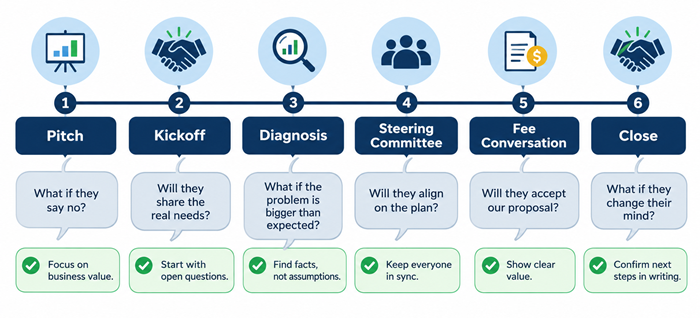
Doubt rarely arrives at random. It clusters around six phases of a typical engagement. Each phase below gives you the trigger, the thought that usually follows, a reframe and a two-minute move. Pick the phase that hurts most and start there.
Phase 1: The Pitch
Trigger and thought. A client in a sector you haven’t served asks for your approach. The thought: “They’ll realize I don’t know this industry.”
Reframe and move. Chunk up. What is the client really buying? Your method for diagnosing and structuring problems, which travels across sectors. Before the meeting, write one sentence naming a past problem with the same shape that you solved. Say it early.
Phase 2: The Kickoff
Trigger and thought. You’re the outside expert in a room full of client experts. The thought: “Everyone here knows more than I do.”
Reframe and move. They know their business. You know how to structure the question. Those are different jobs, and the client needs both. Prepare two questions only an outsider with your experience would ask, and open with them.
Phase 3: The Diagnosis
Trigger and thought. The data contradicts your hypothesis. The thought: “I got it wrong, so I’m exposed.”
Reframe and move. Changing a hypothesis when the data changes is the job, not a failure. Try a meta-model question on yourself: wrong compared to what? Then say it aloud to the team: “The data shifts my view. Here’s the revised one.” Watch how clients respond. It usually builds trust.
Phase 4: The Steering Committee
Trigger and thought. An executive challenges your recommendation. The thought: “They can see through me.”
Reframe and move. A hard question usually signals engagement, not exposure. Pause, then ask one clarifying question before you answer. Challenge the thought too: who exactly sees through you, and what evidence says so? For more on speaking with presence under pressure, read how NLP enhances communication skills for leaders.
Phase 5: The Fee Conversation
Trigger and thought. You’re about to state your number. The thought: “I’m not worth that.”
Reframe and move. The fee reflects the value of the outcome, not how worthy you feel that day. Write the client’s outcome next to your number, state the fee clearly, then stop talking. If you’re shaping or repositioning a practice, our guide to starting a management consulting business covers the business side.
Phase 6: The Close
Trigger and thought. The client praises the work. The thought: “They were just being kind,” or “I got lucky.”
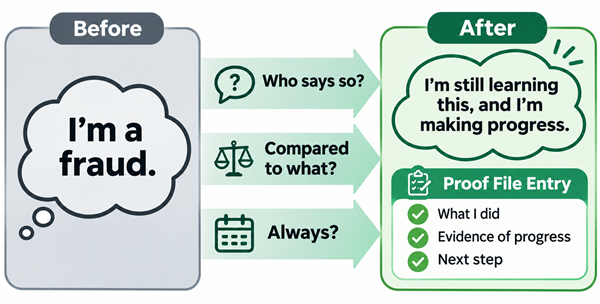
Reframe and move. Discounting praise deletes your own evidence. Within a day of every close, add an entry to your proof file: what was asked, what you did, what changed. Two minutes is enough.
| WANT HELP BUILDING YOUR OWN TIMELINE? Bring your toughest phase to a short call and map it with someone who teaches this daily. Book a 30-minute connection call. |
The 4-Step Proof File Framework
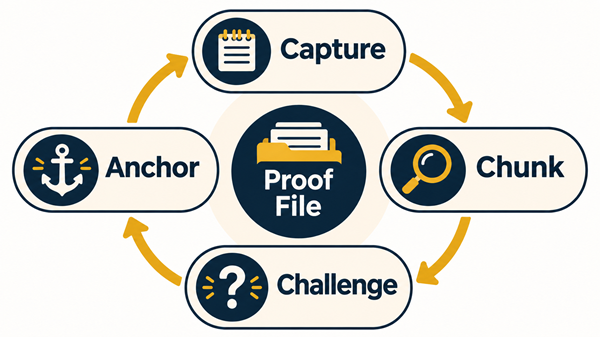
The Proof File Framework is a four-step routine that replaces a vague feeling with specific evidence. James R. Elliot, an NLP Board Designated Trainer with more than 20 years of experience, teaches tools like these as skills you practice, not pep talks.
Step 1: Capture
Record outcomes while they’re fresh. Use three lines: the situation, what you did, and the result. Keep client feedback in your own words, not theirs.
Step 2: Chunk
Break “I’m a fraud” into specifics. Chunk down: which skill, which meeting, which moment? Then chunk up: what outcome do I want to deliver here? Specific doubts can be tested. A global label can’t.
Step 3: Challenge
Ask meta-model questions of the thought: who says so, compared to what, and always? Then read your proof file entries aloud and notice what the evidence says.
Step 4: Anchor
Recall a moment you delivered at your best, step into it fully, and pair it with a small physical cue, such as pressing thumb and finger together. Use the cue before your next high-pressure moment. Our post on NLP exercises to boost daily confidence walks through related practice.
Mike L. came to James struggling with self-doubt, second-guessing and anxiety that were affecting his work and relationships. After working through confidence techniques, he reported speaking with people more confidently and feeling calmer mentally. He isn’t a consultant, but the pattern is familiar, and results build with consistent practice, usually over three to six months.
Imposter Pattern or Real Skill Gap?
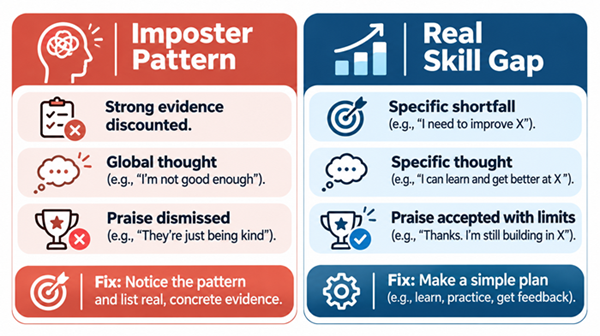
Not every doubt is imposter doubt. Sometimes you really do have a gap, and naming it is a strength. The table below helps you tell the difference so you choose the right fix.
| Signal | Imposter pattern | Real skill gap |
| Evidence | Strong proof exists, but you discount it | Feedback or results point to a specific shortfall |
| The thought | Global: “I’m a fraud” | Specific: “I haven’t led a turnaround before” |
| Response to praise | Dismissed as luck or politeness | Accepted, with honest limits noted |
| Best next move | Proof file, challenge questions, anchoring | Training, a mentor or a stretch project |
Who Should Use This
- Experienced consultants whose results are strong but who dismiss them.
- Independent consultants and partners who feel the doubt most at pitches, board rooms and fee talks.
- Anyone willing to log outcomes for a few minutes a week and practice for several months.
Who Should Avoid This
- Anyone whose anxiety, low mood or exhaustion persists or affects daily life. A licensed professional is the right first step.
- People looking for a quick fix. This is practice-based and builds over time.
- Anyone whose doubt points to a real, specific gap. Close that gap with training or mentoring first.
Data & Findings
Here is what the available evidence supports, and where it falls short. We did not find consulting-specific prevalence data.
- Bravata et al. (2020): A systematic review of 62 studies and 14,161 participants, searching Medline, Embase and PsycINFO through May 2018. Prevalence ranged from 9% to 82% depending on the tool and cutoff. It was linked to depression, anxiety, burnout and lower job satisfaction, and no published studies evaluated treatments. The authors note heterogeneous studies and possible publication bias.
- A critique of the evidence: One commentary argues that samples skew young and toward students, and that workplace links are correlational, so they can’t show which causes which. It’s an opinion piece, not a peer-reviewed study.
- Origin: The term goes back to a 1978 paper by Clance and Imes, which, according to one secondary account, drew on their clinical work with high-achieving women rather than a formal study. We couldn’t access the original.
FAQs
Is imposter syndrome a real diagnosis?
It’s described as a pattern of self-doubt, not a formal diagnosis like depression. It can occur alongside anxiety or low mood, and those can be treated by a licensed professional. Seek one if the feelings persist.
Why do senior consultants feel it despite proven results?
Higher stakes, fewer peers to compare notes with, and constant new contexts all feed it. Research on seniority specifically is thin, so treat this explanation as a reasonable pattern, not a proven cause.
Can a proof file really help?
It gives your mind specific evidence to work with instead of a vague label. No study we found tests it directly, so judge it by your own results over a few months.
How long does it take to feel different?
Most people notice small shifts within weeks and steadier change with three to six months of regular practice. Timelines vary, so avoid promising yourself a fixed date.
Should I tell my clients or team how I feel?
You don’t have to tell clients. A trusted peer, mentor or coach is often a safer place to say it out loud. In KPMG’s survey, most respondents turned to a mentor when doubting a new role.
Conclusion
Imposter doubt doesn’t mean you’re guessing. It means you’re a capable person meeting predictable moments without a plan. Take decisive action on one phase this week: build your first proof file entry and prepare one reframe. When you’d like a partner for it, book a 30-minute connection call.
Unleash Your Power: Stand Out, Take Action, and Create the Success You Want.