
Toronto professionals attract premium clients without cold outreach by building five places where trust forms before a sales conversation: a referral circle of peers who serve the same clients, a speaking stage, curated networking, a clear website and profile, and content that shows how you think. Each takes consistent effort over months, not days. Cold email also carries legal weight in Canada.
Canada’s anti-spam law restricts unsolicited commercial electronic messages and sets maximum penalties of up to $1 million for individuals and $10 million for corporations, so get legal advice before you use it. In one study of a German bank, customers referred by other customers had higher margins and lower churn than customers acquired other ways. Start with one room and 30 days of focused effort. This isn’t legal advice.
Key Takeaway:
- Attracting premium Toronto clients without cold outreach starts with building trust before the sales conversation. High-value clients prioritize expertise, credibility, and proven relationships over unsolicited sales pitches. Focus on five trust-building channels: referral partnerships, public speaking, curated networking, a professional website, and consistent educational content.
- Referral marketing creates stronger client relationships through credibility and reciprocity. Build relationships with 5 to 8 complementary professionals, such as accountants, lawyers, financial advisors, and HR leaders. Clearly explain your ideal client, the problem you solve, and how partners can introduce you. One German bank study found referred customers had approximately 25% higher margins and 18% lower churn, although these findings are not specific to coaching or consulting.
- Position yourself as an expert through speaking, networking, and content. Deliver practical workshops or industry presentations, consistently attend one or two relevant professional groups, and publish useful articles, podcasts, or videos. These activities allow potential clients to experience your expertise and communication style before contacting you.
- Optimize your website and professional profiles to convert referrals and visibility into qualified inquiries. Clearly communicate who you help, what problems you solve, the outcomes your process supports, and how prospects can book a conversation. Use one specific ideal-client statement across your website, networking introductions, and content to maintain consistent positioning.
- Start with one acquisition channel and follow a 30-day action plan: define your ideal client in Week 1, prepare your first activity in Week 2, start conversations or publish content in Week 3, and evaluate results in Week 4. Track conversations started, calls booked, and paid engagements. Allow 3 to 6 months of consistent effort before judging results. Be cautious with cold email because Canada’s Anti-Spam Legislation (CASL) restricts unsolicited commercial electronic messages and carries significant penalties. Seek Canadian legal advice before launching an outreach campaign.
Bottom Line: Attracting premium Toronto clients is about building credibility and trust before asking for a sale. Choose one of the five relationship-driven channels, communicate your ideal-client positioning clearly, and commit to consistent action for 3 to 6 months. Let your expertise and reputation generate qualified opportunities instead of relying on cold outreach.
- Source: Unleash Your Power – Attracting Premium Toronto Clients Without Cold Outreach
- Source: Government of Canada – Canada’s Anti-Spam Legislation
What Cold Outreach Really Costs a Toronto Professional
A premium client is someone who pays for expertise and outcomes, not the lowest price. That’s our working definition here. These clients usually want to know who you are before they hear what you sell. A cold message asks for attention and trust at the same moment, and you haven’t earned either yet.

There’s also a legal side. BDC explains that CASL prohibits sending unsolicited commercial electronic messages, sending them without an unsubscribe mechanism and your contact information, making false or misleading claims in them, and collecting email addresses through third parties without consent. It also says the CRTC can fine individuals up to $1 million and corporations up to $10 million, though the page doesn’t say whether that’s per violation.
The Government of Canada’s consent guidance describes two routes. Express consent means someone agreed, verbally or in writing, to receive your messages, and it lasts until they withdraw it. Implied consent can come from a recent business relationship, generally up to 2 years, or up to 6 months after an inquiry. A published email address can count too, but only if the message relates to the person’s role and the address doesn’t carry a “no unsolicited messages” notice.
Neither page gives a separate rule for business-to-business cold email, and phone calls fall outside the message rules but may face others. This is general information, not legal advice. Ask a Canadian lawyer before you build an outreach plan.
None of that means outreach never works. It means premium clients and a legal gray area make a poor pair. The better question is where trust can form without you asking for it.
Cold Outreach Compared With the Five Rooms
The table below is my judgment, not measured data. It shows how each route tends to feel for a solo professional building a premium practice. Your results will differ.
| Route | Time to first result | How much you control | Main risk | Premium fit |
| Cold outreach | Fast to try, slow to trust | High on sending, low on replies | Legal exposure and a transactional feel | Low to medium |
| Room 1: Referral Circle | Months | Medium | Slow start, depends on partners | High |
| Room 2: The Stage | Weeks to months | High | Takes preparation and nerve | High |
| Room 3: The Table | Months | Medium | Spreading yourself too thin | Medium to high |
| Room 4: The Front Door | Months | High | Vague positioning | Medium to high |
| Room 5: The Library | Months | High | Inconsistent publishing | Medium to high |
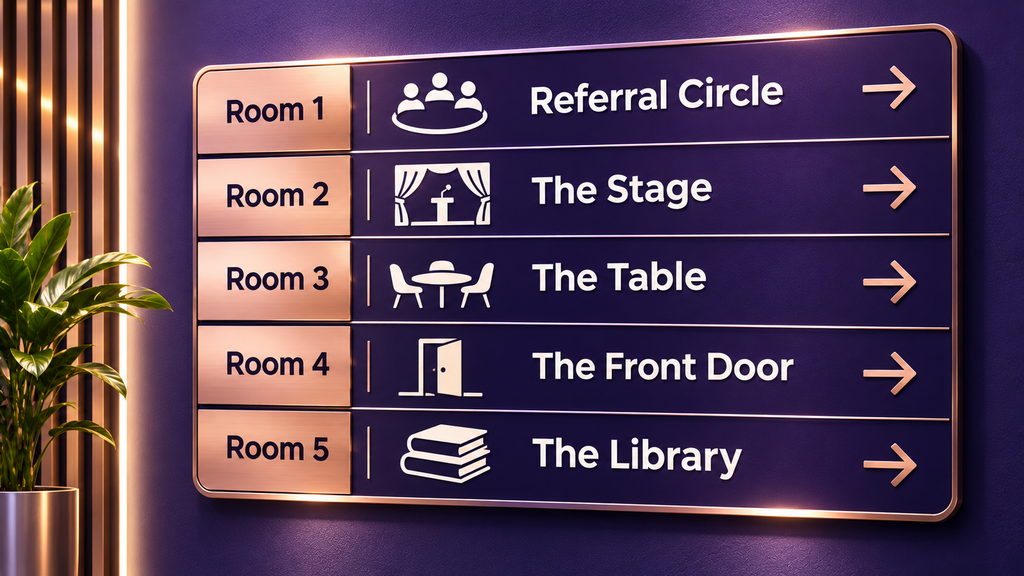
Five Rooms Where Premium Clients Find You
Think of your practice as a building. Clients rarely walk straight into the sales office. They pass through rooms where they learn who you are, what you stand for and whether people they trust vouch for you. Build these on purpose, and the sales conversation gets easier.
| ROOM 1 | THE REFERRAL CIRCLE: Peers who serve the same clients List five to eight professionals who work with your ideal clients but don’t compete with you. Accountants, lawyers, financial advisors, HR leaders and recruiters are examples. Meet them one at a time, learn how they work and give before you ask. A referral works best when your partner can describe your ideal client in one sentence, so write that sentence and share it.The evidence is encouraging but narrow. A study of a German bank found referred customers earned about 25% higher margins and left about 18% less often than customers acquired other ways, and their six-year value ran about 16% higher. It covers one bank, one year and consumer banking with a paid referral reward, and it doesn’t test coaching or consulting. Treat it as a reason to try, not a forecast.Make the referral easy to give. Share a short description of who you help, one example of the problem you solve and a plain way for a partner to introduce you, such as a two-line note they can forward. Then keep the loop warm: thank partners, tell them how the introduction went and refer business back to them when it fits. Rapport grows through reciprocity, which is also a core idea in NLP.For the how-to, see our guides to mastering referral marketing and the 5 core ways to maximize your referrals. |
| ROOM 2 | THE STAGE Speaking where decision-makers listen A talk lets a room of potential clients watch you think for an hour. Offer a practical workshop or panel for an industry group, a company lunch-and-learn or a professional association. Teach one useful idea well. You don’t need a pitch slide. Premium clients tend to hire the person who made the problem clearer.Compelling Presence, one of James R. Elliot’s 5 Pillars, shows up here. James is an NLP Board Designated Trainer with more than 20 years of experience, and he teaches that presence is a skill you can practice. If nerves hold you back, start with our piece on NLP for public speaking anxiety and explore corporate keynote speaking. |
| ROOM 3 | THE TABLE Curated networking, done consistently Pick one or two groups and show up often. Frequency builds familiarity faster than a different event every week. The Toronto Region Board of Trade is one example. Its membership page describes member events and committees, but that’s the organization’s own marketing, and the page shows no member count or pricing, so ask what you’d get before you join. Industry associations and smaller professional groups can work just as well.Go with a goal: meet three people, learn what each one needs and follow up within two days. For more ideas, read how to build a business network. |
| ROOM 4 | THE FRONT DOOR A website and profile that make the fit obvious When a referral or a talk sends someone to look you up, your online presence either confirms the decision or undermines it. Say plainly who you help, what changes for them and how to book a conversation. Avoid vague promises. Results vary, so describe your process and your approach, not guaranteed outcomes.Use the same ideal-client sentence from Room 1 as your headline test. If a stranger can’t tell whether the page is for them in ten seconds, rewrite it. You can see how we describe a local service in our business coach in Toronto page. |

| ROOM 5 | THE LIBRARY Content that sells while you sleep Articles, a podcast or short videos give people a way to hear your thinking before they ever call. Choose one format you can keep up. Consistency matters more than polish. Confident Communication, another of the 5 Pillars, grows with repetition. Plan on 3 to 6 months of steady practice before you judge the results.For ideas, see impactful podcasting secrets and how video marketing can change your business. |
A 30-Day Starter Plan
Don’t open all five rooms at once. Take decisive action in one.
Week 1. Write your ideal-client sentence and pick one room.
Week 2. Do the first real piece of work in that room: draft a talk outline, list your referral partners or outline your first article.
Week 3. Have your first conversations or publish your first piece.
Week 4. Review what happened, write down what you learned and decide what to repeat. If you want a thinking partner for this plan, you can book a 30-minute connection call.
Track three simple numbers for that month: conversations started, conversations that moved toward a call and calls that turned into a paid engagement. Small counts are fine. The point is to see which room produces the warmest conversations, so you can decide where to spend the next quarter. Courageous Action doesn’t mean doing everything. It means choosing one clear step and taking it.
What We Don’t Know
No source here measures how long it takes Toronto coaches and consultants to win premium clients, or which room works best. The referral study is about banking. The CASL pages are general information. Your own testing is the real evidence, so pick a room, track what happens and adjust

Frequently Asked Questions
How long does it take to attract premium clients without cold outreach?
Plan on 3 to 6 months of consistent practice in one room before you judge it. That’s a realistic frame, not a guarantee. Referrals and speaking can bring conversations sooner when you already have relationships.
Is cold email legal in Canada?
CASL restricts sending unsolicited commercial electronic messages, with exceptions for consent and certain relationships. The rules are detailed, and penalties can be high, so talk to a Canadian lawyer before using cold email. This isn’t legal advice.
What counts as a premium client?
Here, it means a client who values outcomes and expertise over the lowest price, and who’s ready to invest in real change. It isn’t only about a high fee.
Do referrals really bring better clients?
In one study of a German bank, referred customers had higher margins and lower churn. It’s one setting and not coaching, so treat it as encouraging, not proof for your practice.
Which room should I start with?
Start where you already have strength. If you know people who serve your clients, start with the Referral Circle. If you speak well, start with the Stage. If you write easily, start with the Library.
Conclusion
Premium clients don’t need a cold message. They need a reason to trust you before they call. Build one room well, give it 3 to 6 months of steady effort and let your reputation do the introducing. This week, write your ideal-client sentence and choose your first room.
Unleash Your Power: Stand Out, Take Action, and Create the Success You Want.
Ready to choose your first room?
Book a 30-minute connection call with Unleash Your Power. Bring your ideal-client sentence and we’ll map your first 30 days together. Book your 30-minute connection call