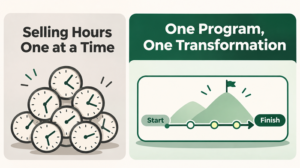
Hourly pricing caps your income at the hours you can sell, and it frames your work as time instead of results. A high-ticket program packages a defined outcome, a set timeline and support into one price, so your income stops depending on how many hours you work. Start by calculating your ceiling: billable hours times your rate, minus the hours you can’t sell. Then choose a package shape.
An intensive suits a short, specific result. A program suits a larger change with support. A partnership suits ongoing needs. Surveys suggest consultants who price on value tend to land larger projects, but those surveys come from sellers of training, so treat them as hints, not proof. Packaging also carries risks, such as underpricing and scope creep, so write the terms down and review your price after your first few clients.
Key Takeaway:
- High-ticket programs help coaches and consultants move beyond hourly pricing by selling a defined outcome, timeline, and ongoing support for one fixed price. This model focuses on the value clients receive rather than the time spent delivering services.
- Why it works: Hourly pricing creates an income ceiling based on billable hours and encourages clients to focus on time instead of results. Packaging services around a specific transformation makes the offer more valuable and creates opportunities to increase revenue without constantly adding working hours.
- Choose the right package structure: An intensive works best for a specific result within a short timeframe, a structured program supports longer-term changes, and a partnership provides ongoing guidance. A strong program includes a clear outcome, defined timeline, practical support, and measurable milestones.
- How to price your program: Calculate total delivery time, including preparation and client support, then multiply it by your hourly rate to establish a minimum price. Consider the value of the outcome, test your pricing with actual clients, and review it after your first three engagements.
- When to be cautious: Fixed-price packages can lead to underpricing, scope creep, reduced service quality, and unclear expectations. Clearly document what is included, establish boundaries for additional work, and avoid promising guaranteed outcomes.
Bottom Line: High-ticket programs shift your business from selling hours to delivering defined client transformations. Package a result clients genuinely value, price it strategically, and establish clear delivery terms to build a more profitable and scalable coaching or consulting business.
The Ceiling Math
You can sell only so many hours. That fact sits behind every hourly business, and most owners never write it down. Take five minutes and do it now.
| Ceiling formula: Weekly billable hours x working weeks x hourly rate = yearly ceiling. |
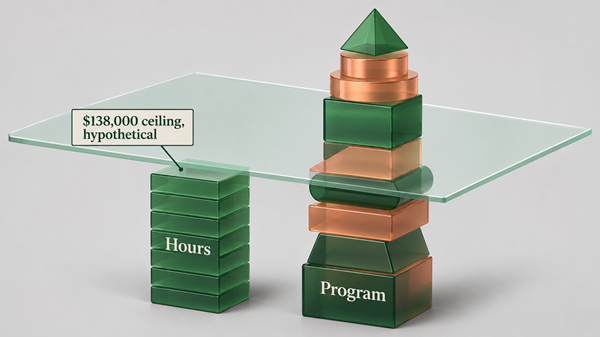
Here’s a hypothetical. Say you can honestly sell 20 client hours a week, because prep, admin and marketing eat the rest. You work 46 weeks a year at $150 an hour. That’s 20 x 46 x $150, which equals $138,000. That’s your ceiling, and you only reach it if every hour sells every week.
Check the 20 hours honestly. Track one normal week and count the hours you actually sold, not the hours you hoped to sell. Most people discover their real number sits lower than their guess, and that gap is the first reason the ceiling feels tighter than the math suggests.
Now you have three ways to raise it. Work more hours, which drains you. Raise your rate, which has a limit before clients push back. Or change what you sell. Packaging is the third path, and it’s the only one that doesn’t cost you more time.
Four Leaks in the Hourly Model
Leak 1: The Income Cap
The Journal of Accountancy piece makes the point plainly: hourly billing limits revenue to the hours a practitioner can work, while value pricing can raise income without adding hours. The article dates to 2014 and leans on consultant opinion, so I treat it as an argument, not a measurement.
Leak 2: It Rewards Slowness
If you get faster, you earn less. Think Insights argues that hourly pricing rewards the time a task takes instead of the value it produces. That piece has no data behind it, but the incentive problem is easy to see in your own calendar.
Leak 3: It Frames the Sale as Effort
When you quote hours, the client’s mind goes to hours. They ask whether you can do it in fewer. The conversation shifts from what changes for them to how little time you’ll take.
Leak 4: It Invites Haggling
A rate is easy to compare and easy to squeeze. A program with a clear outcome is harder to compare, because the client isn’t buying an hour. They’re buying a result and the support to reach it.
Three Package Shapes
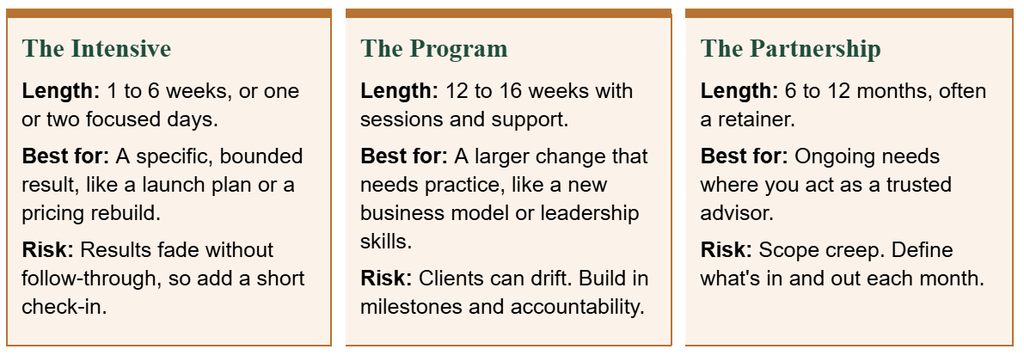
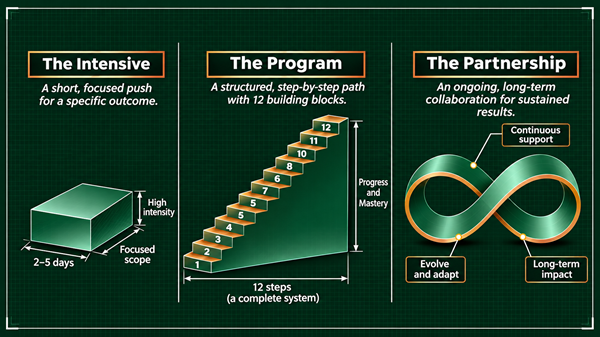
Not every offer should be a 16-week program. Pick the shape that matches the result you deliver.
The Shape Chooser
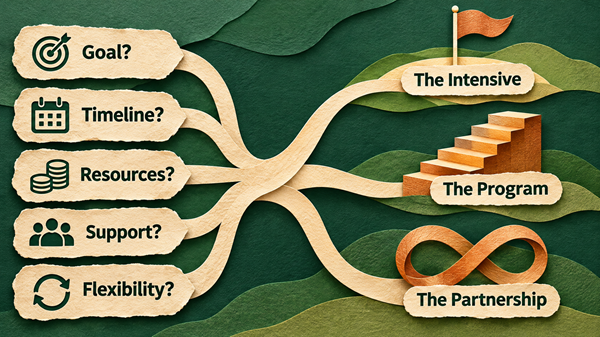
Answer five questions. Tally which shape comes up most.
| If your answer is… | Then lean toward… |
| Clients need one clear result in a few weeks | The Intensive |
| Clients need to build a new skill or habit | The Program |
| Clients need you available as their needs change | The Partnership |
| Your best results come from regular accountability | The Program |
| You love deep focus but dislike long engagements | The Intensive |
Many coaches and consultants end up with a ladder: an intensive as a way in, a program as the core and a partnership for the clients who want to keep going.
| Not sure which shape fits you? Talk it through with someone who’s helped others package their work. Book a 30-minute connection call and bring your current offer. |
What Goes Inside a Program
A program isn’t a discount bundle of sessions. It has four parts, and each one answers a question your client is already asking.
▸ The outcome: What will be different for them at the end? Say it in one sentence, without promising a specific result.
▸ The timeline: How long does it run, and what happens in each stage?
▸ The support: Sessions, between-session contact, tools or templates that help them practice.
▸ The milestones: Checkpoints that show progress and let you adjust early.
Here’s the mindset piece. Many practitioners price from the Behavior level: “I did this for an hour, so I charge for an hour.” NLP’s Logical Levels invite you to move up to Identity and Purpose: “I’m the person who helps clients fix this problem, and here’s what that’s worth to them.” The work you deliver doesn’t change. The way you describe it does, and so does the conversation you’re ready to have.
From Hourly Rate to Program Price
Everything in this section is a hypothetical example, not real client data.
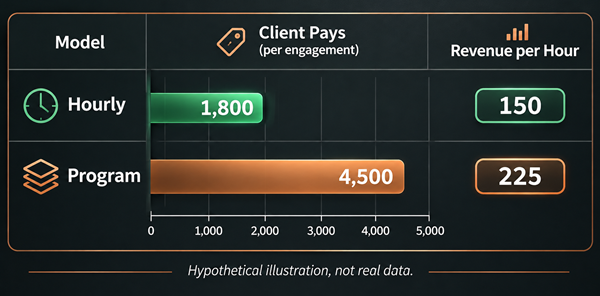
Alex is a business coach who bills $150 an hour. A typical client uses about 12 hours over three months, so an hourly client pays around $1,800.
Alex designs a 12-week program. It includes eight sessions, a workbook, email support between sessions and a final review. Alex’s time cost is about 20 hours, counting prep and support. At $150 an hour, that’s a floor of $3,000. Alex then asks the question NLP trainers like James R. Elliot use to chunk up: what is this result worth to the client? A client who fixes a pricing problem could gain far more than $3,000 within a year. Alex prices the program at $4,500.
| Particulars | Hourly | Program |
| Client pays | $1,800 | $4,500 |
| Alex’s time | 12 hours | 20 hours |
| Revenue per hour | $150 | $225 |
| Client sees | Hours | A defined result |
Notice that Alex’s time goes up, but revenue per hour rises too, and the client buys a result. Alex still has to sell the program and deliver it well. A price is a hypothesis you test, not a promise.
The Risks and How to Manage Them
Packaging isn’t free of downsides. The Journal of Accountancy article warns about underpricing, cutting corners to stay inside a fixed fee, and client suspicion when prices change.
▸ Underpricing: Use your hourly rate as the floor. Review the price after three clients and adjust.
▸ Scope creep: Write down what’s included and what isn’t. Offer add-ons for extras.
▸ Cutting corners: Protect the quality of delivery. A great program with fewer clients beats a rushed one.
▸ Unclear expectations: Say what you’ll do and what the client needs to do. Don’t promise specific outcomes.
This is where Confident Communication matters. State your price, your scope and your terms calmly, then stop talking. Courageous Action means making the offer before you feel completely ready.
Data & Findings
| Source | What it shows | Caveat |
| Consulting Success fee study | Nearly 1,000 consultants. Pricing models: project 30%, hourly 29%, retainer 16%, value-based 15%. 51% of value-based users land $10K+ projects versus 39% of hourly billers. | Publisher sells coaching. Sampling isn’t described. Correlation, not causation. Mostly North America. |
| Journal of Accountancy (2014) | The billable hour measures inputs. Value pricing can lift revenue but carries underpricing risk. | Archived. 2012 survey data. AICPA affiliation. Largely consultant opinion. |
| Think Insights (2022) | Argues hourly pricing rewards slowness. | No data. Opinion. |
None of these proves that packaging raises your income. They point the same way, but the people behind them mostly sell training or advice on pricing. Test the idea with your own clients over 3 to 6 months of practice.
Who Should Package Now
▸ Coaches and consultants who’ve delivered the same result to several clients.
▸ Owners whose calendars are full but whose income has stopped growing.
▸ Professionals who dread quoting hours or negotiating rates.
Who Should Wait
▸ New practitioners with no clients yet. Deliver a few sessions first to learn what you repeat.
▸ Anyone whose work courts or regulators require time-based billing. Check the rules first.
▸ Practitioners who can’t yet describe a specific result. Clarify the outcome before you set a price. This isn’t legal or financial advice.
Frequently Asked Questions
Why should I stop selling hourly rates?
Hourly pricing caps income at the hours you can sell and ties your earnings to time instead of results. It doesn’t mean hourly is wrong for every case, but it limits growth.
What is a high-ticket program?
It’s a defined outcome, delivered over a set period with support, for one price. There’s no fixed dollar threshold, so “high-ticket” depends on your market.
How do I price a program if I only know my hourly rate?
Estimate your total time, multiply by your rate for a floor, then price above it based on the value of the result. Test, then adjust after your first few clients.
Which is better: a package of sessions or a program?
A bundle of sessions still sells time. A program sells an outcome with a timeline, support and milestones. Many coaches start with bundles and move toward programs.
What are the risks of fixed pricing?
The main ones are underpricing, scope creep and unclear expectations. Write down what’s included, review your price after a few clients and avoid promising specific results.
Conclusion
Hourly pricing keeps you tied to the clock. A well-built program lets you charge for the result and the support behind it. Take decisive action this week: calculate your ceiling, then sketch one package shape. When you’d like a partner to refine it, book a 30-minute connection call.
Unleash Your Power: Stand Out, Take Action, and Create the Success You Want.