Inner money blocks are automatic beliefs about money, worth and deserving that push coaches to underprice, discount on the spot and put off fee increases. You loosen them through three conversations: one with yourself to test the belief, one with your body to build a calm pricing state, and one with the client to deliver a clear fee.
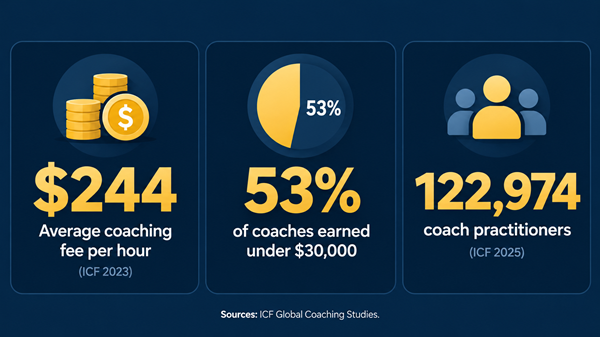
The ICF’s 2023 study put the average coaching hour at about $244 worldwide, and more than half of coaches earned under $30,000 a year, so pricing deserves a hard look. Money-script research links avoidance, worship and status beliefs to lower income and net worth, though those findings are correlations. Doubling your fees is a goal, not a promise. Expect results to build over three to six months of steady practice.
Key Takeaway:
- Money blocks are automatic beliefs about money, self-worth, and deserving that can cause coaches to underprice their services, offer unnecessary discounts, or delay fee increases. Identifying and questioning these beliefs is the first step toward confident pricing.
- Four common money scripts influence financial decisions: avoidance, worship, status, and vigilance. Avoidance can trigger discounting, while excessive vigilance can make coaches postpone necessary price increases. Research links some of these beliefs with lower income and net worth, although these relationships are correlations, not proof of causation. [2]
- How to remove money blocks: Work through three conversations. First, challenge limiting beliefs by asking, “Who says?”, “Always, or only sometimes?”, and “Compared to what?” Second, use NLP anchoring to associate a calm, confident physical state with stating your fee. Third, communicate your price clearly without apologizing, over-explaining, or offering unsolicited discounts.
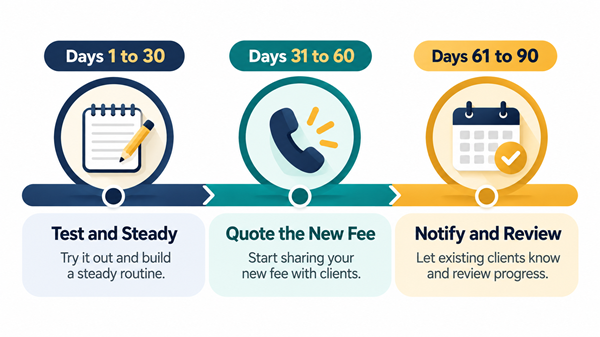
- What to do: Follow a 90-day fee-increase plan. Spend the first 30 days examining beliefs and practicing confident pricing. During days 31–60, test your new rates with new prospects and track conversion rates. During days 61–90, give existing clients approximately 30 days’ written notice and honor their current package fees until renewal.
- When to rethink your pricing: Not every pricing problem is a money block. If you cannot clearly communicate client outcomes, discovery calls rarely convert, or your costs and capacity do not support your target fee, address the underlying business issues. Doubling your coaching fees is a possible goal, not a guaranteed outcome.
Bottom Line: Raising your coaching fees starts with changing how you think about money, how confidently you communicate your value, and how consistently you stand behind your pricing. Challenge your money blocks, practice stating your fee without hesitation, and introduce increases strategically while protecting existing client relationships.
- Source: Unleash Your Power – Remove Money Blocks to Raise Your Coaching Fees
- Source: Klontz et al. – Money Beliefs and Financial Behaviors: Development of the Klontz Money Script Inventory
The Discovery Call That Ended in a Discount
Picture a call that’s going well. The prospect leans in, asks what working together looks like, and you give your fee. Then you hear yourself add, “but we can adjust it if that’s a stretch.” Nobody asked you to.
This is a composite scene, not one specific client, and you may have lived some version of it. That doesn’t make you bad at business. An old belief spoke before you did. In more than 20 years as an NLP Board Designated Trainer, James R. Elliot has watched capable people hold themselves back with beliefs they never examined. A belief you can name is a belief you can test, and the self-doubt that often sits underneath responds to the same approach.
Which Money Block Is Steering Your Pricing?
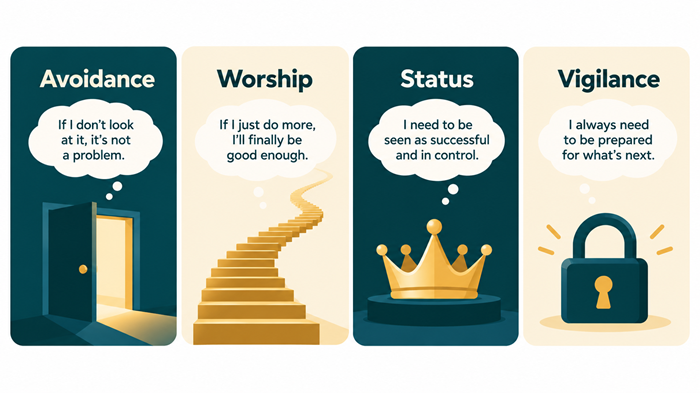
Psychologists who study money beliefs grouped them into four patterns called money scripts. In a 2011 study of 422 adults, Brad Klontz and colleagues asked people to rate 72 money beliefs and found four distinct patterns. Klontz and Britt later described them as avoidance, worship, status and vigilance. Most people lean on one or two.
The sentences and fee effects in the table are illustrations of how each script can show up in a coaching practice. They aren’t findings from the studies.
| Script | What it can sound like | What it can do to your fees | Your first move |
| Avoidance | “Money is a bit dirty. Who am I to charge that?” | Vague pricing, quick discounts, dodging money talk | Say your fee out loud daily with no softening words |
| Worship | “More money will fix it, and there’s never enough.” | Taking any client, packing the calendar, overwork | Set a weekly client cap and a client-fit filter |
| Status | “My fee shows what I’m worth.” | Pricing for image, copying rivals, spending ahead of income | Price from the result you deliver and your costs |
| Vigilance | “Be careful, save, keep it private.” | Waiting too long to raise fees for fear of losing a client | Test the new fee with a few new prospects first |
Vigilance is the script tied to higher income in the research, yet it can still stall a fee increase, because caution slides into waiting. To spot your own sentences, start with our guide on how to identify limiting beliefs.
What Does the Research Say About Money Beliefs and Coach Fees?
Here’s the evidence, along with what each source can’t tell you.
| Source | What it found | What it can’t tell you |
| ICF Global Coaching Study 2023 | Average fee of $244 an hour worldwide and $272 in North America. Average coaching income of $52,800 worldwide and $67,800 in North America. 53% of coaches earned under $30,000. Based on 13,146 coach practitioners, with data gathered in late 2022. | These are averages across every kind of coach. Income also depends on hours worked and client load, so fees alone don’t explain it. |
| ICF 2025 study release | 122,974 coach practitioners, up 15% since 2023, and $5.34 billion in industry revenue. | More coaches means more competition. The release says nothing about what any one coach should charge. |
| Klontz and colleagues, 2011 | Four money-belief patterns across 422 adults. In the later summary by Klontz and Britt, avoidance, worship and status link to lower income or net worth, and vigilance to higher. | A convenience sample the authors call unrepresentative. The links are correlations, not proof that beliefs cause lower income. |
| Shiv, Carmon and Ariely, via Stanford GSB | In a placebo pain study, 85% of people who believed their pill was expensive reported less pain, against 61% for the cheap-pill group. | It tested pills and energy drinks, not coaching. The write-up gives no sample size. |
| ICF mindset article by Gaelle Lecourt, 2018 | A practitioner’s view that self-worth, money beliefs and low fees feed overwork and clients who cancel. | It’s expert opinion with no data behind it. |
None of this shows that clearing a block doubles anyone’s fees. It does show that pricing involves beliefs, and that beliefs can be examined. For the earning side, see our guide to life coaching income and earnings.
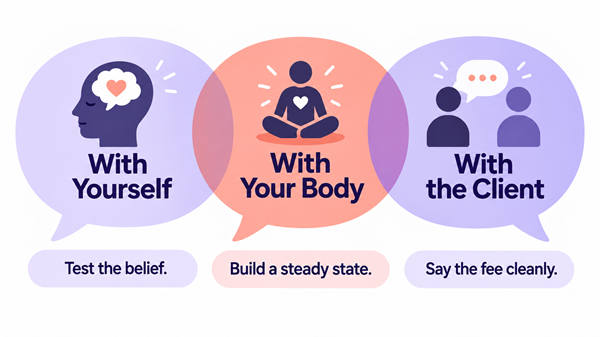
How Do You Loosen a Money Block? Three Fee Conversations
Each conversation prepares the next, so take them in order. Give each one a week or two before you move on.
Conversation 1: With Yourself. Test the Belief
Start by writing the exact sentence that plays in your head when you state a fee. It might be “People like me don’t charge that” or “Nobody will pay that right now.” Then question it with three NLP meta-model challenges: Who says? Always, or only sometimes? Compared to what?
Many blocks look less solid under those questions, because they often rest on one old experience that grew into a rule. For a fuller method, read our post on overcoming limiting beliefs with NLP.
Darren G. came to James with a well-paying job and a stubborn sense that promotions, raises and a business of his own were out of reach. After working through his goal blocks, he reports a shift in how he thinks and acts.
Practice Round: Write your fee sentence and answer the three questions in writing. Then rewrite the belief as something you can test, such as “Clients who reach [result] with me will pay [fee].” Keep the page where you’ll see it before calls.
Conversation 2: With Your Body. Build a Steady Pricing State
A belief on paper is only half the work. Many coaches feel a tight chest or rushed words when they say a number. That’s your state, and you can train it.
NLP anchoring pairs a calm, certain feeling with a small physical cue. Recall a time you felt solidly sure of yourself, relive it with all your senses, and press thumb and forefinger together at the peak. Repeat for a week, then fire the anchor right before you say your fee.
Mike L. came to James with self-doubt, second-guessing and a mind full of noise. He now describes speaking with confidence at work and listening more clearly.
Practice Round: Say your fee out loud ten times with the anchor, and record yourself. Listen for apologetic tones or a trailing voice. Then say it once more and stay silent for five full seconds. That pause is where most coaches rescue the price, so practice staying quiet. NLP tools build with practice, and they don’t replace professional care for persistent anxiety.
Conversation 3: With the Client. Say the Fee Cleanly
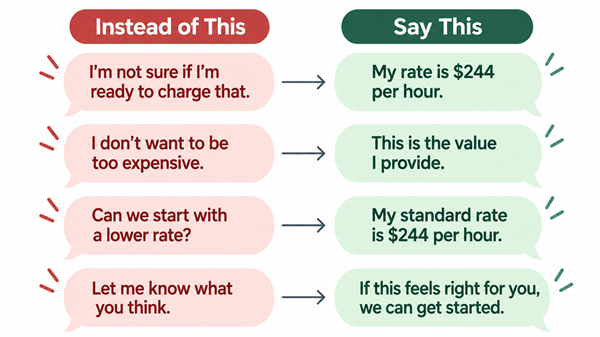
Soft phrasing tells a client the number is negotiable. Swap the habits on the left for the lines on the right.
| Habit | Instead of this | Say this |
| Softening | “I usually charge $200, but I can do less.” | “The investment is $200 per session.” |
| Apologizing | “Sorry, my rates are going up.” | “Starting March 1, my fee is [new fee]. I’m giving you notice so you can plan.” |
| Over-explaining | Five minutes of reasons before the number. | One sentence on the result, the fee, then a pause. |
| Discount reflex | “I can knock something off.” | “At that budget, here’s the smaller option that fits.” |
The last row protects your value. A smaller package keeps your rate intact, while a discount hints that the first number was inflated.
Lecourt also suggests pricing by results: ask clients what they achieved and what it would have cost them not to invest. She also says to know your numbers, because low fees push coaches toward more clients and more hours. Here’s a simple illustration, not a benchmark. Twelve clients a week at $150 brings in $1,800. At $225, eight clients bring in the same $1,800, which hands you four sessions back each week.
Will Good Clients Leave When You Charge More?
Some might. Lecourt’s view is that low fees tend to attract clients who cancel more and respect your time less, though that comes from her experience, not a study. The Stanford write-up of the placebo research points the other way on expectations: people who believed they paid more reported more pain relief, and the effect was largely non-conscious. Those were pills, not coaching, so read it as a sign that price shapes expectations, not proof that a higher fee improves your results.
Protect yourself with data. Track your yes-rate on discovery calls for 60 days after the change. If it drops sharply, the issue may be how clearly you explain the result, not the fee.
Your 90-Day Fee Plan
- Days 1 to 30: Hold Conversations 1 and 2. Write your belief sentence, run the three questions, practice your anchor and say the fee aloud daily.
- Days 31 to 60: Quote the new fee to every new prospect. Tally calls, yeses and objections. Make sure your marketing shows outcomes, and use our guide on promoting your life coaching business if it doesn’t.
- Days 61 to 90: Give existing clients written notice, ideally 30 days, and honor the old fee through the end of their current package. Review the numbers and decide your next step.
A big jump can come in stages rather than all at once.
Is It a Money Block or a Real Pricing Problem?
Not every low fee is a mindset issue. Check both lists.
It’s likely a money block when:
- You discount before anyone objects.
- You know your results are strong, yet saying the fee feels uneasy.
- You’ve put off raising fees for more than a year.
- Money talk leaves you guilty or resentful.
It’s likely a business issue when:
- You can’t state the result a client gets.
- Few discovery calls reach a yes, even at modest fees.
- Your costs and capacity don’t add up at any price you can picture.
- Real financial hardship is in the picture, for you or the client.
If money worries feel heavy or constant, a financial adviser or a mental health professional is the right partner. This guide supports your pricing, not your treatment.
Frequently Asked Questions
What is a money block for coaches?
It’s an automatic belief about money, worth or deserving that shapes your pricing without you noticing. Examples include thinking high fees are greedy or that you haven’t earned the right to charge more.
How do I know if I’m undercharging?
Common signs include discounting before any objection, saying yes on nearly every call, resenting sessions, and a full calendar with thin income. Use the ICF averages only as context, since they blend every type of coach and market.
Can I really double my coaching fees?
Some coaches can, especially when their fees sit far below what their results support, but nothing guarantees it. We found no study showing that removing a money block doubles fees. Treat doubling as a goal, and test it in stages.
How long does it take to loosen a money block?
Many people notice the sentence in their head shift within a few weeks of practice. Lasting change in how you price tends to take three to six months of steady work, and the pace varies from person to person.
Should I tell existing clients before I raise my fee?
Yes. Written notice of about 30 days, plus honoring the fee on their current package, keeps trust intact. Explain the upcoming change clearly, give clients time to plan, and apply the new rate when they renew or purchase their next package.
Conclusion
Your fee is a sentence you say out loud, and you’ve been saying the old one for a while. Test the belief behind it, steady your state, and deliver the new number cleanly. Start Conversation 1 this week and take decisive action on one fee. If you’d like guided support with your pricing and your confidence, explore business coaching with James R. Elliot.