
NLP sales rapport works best as a set of trust-building habits, not a bag of tricks. Research on negotiation found that subtle, strategic mimicry helped pairs reach deals when both sides could gain, and that trust explained the effect. Other NLP claims, such as reading eye movements or matching sensory language, have little or no research support, so skip them.
The practical approach is to match a buyer’s pace and tone lightly, ask precise questions that uncover what they actually need, and describe the outcome in their terms. Corporate deals involve several people, so build trust with each one, not only your main contact. Keep it honest: if you wouldn’t be comfortable explaining what you’re doing, don’t do it. The studies are small and mostly use student negotiators, so treat these moves as practice to test, not guaranteed results.
Key Takeaway:
- NLP sales rapport works best when it builds genuine trust rather than relying on persuasion tricks. Research suggests that subtle, strategic mimicry can improve negotiation outcomes when both parties benefit, with trust explaining the effect. However, these findings do not prove higher close rates in corporate sales. [1]
- Effective rapport begins with light mirroring: naturally matching a buyer’s pace, volume, and energy without copying gestures. Research found better negotiation outcomes in certain settings, but the evidence comes from small studies involving student negotiators. Treat mirroring as a practice to test, not a guaranteed sales technique. [1]
- Use meta-model questions and chunking to uncover the buyer’s actual needs. Challenge vague statements with specific questions, connect immediate problems to broader business goals, and translate the answers into outcomes the buyer values. These are useful discovery tools, although direct research supporting their effectiveness in sales remains limited. [1]
- Corporate sales require stakeholder-level rapport, not just a strong relationship with one champion. Identify everyone influencing the decision, understand their individual priorities, give each person a fair hearing, and build proposals around shared business interests rather than price alone. [1]
- Avoid unsupported NLP techniques such as reading eye movements, matching sensory language, and using anchoring or pressure tactics. Before using any rapport technique, ask whether you could explain it to the buyer, whether both sides benefit, whether your claims are truthful, and whether the buyer can freely say no. [1]
Bottom Line: Mastering NLP sales rapport for premium corporate deals means earning trust through active listening, subtle communication adjustments, precise discovery questions, and genuine stakeholder understanding. Choose one evidence-informed technique, test it on your next sales call, and refine your approach over 3 to 6 months rather than relying on manipulation or guaranteed closing formulas.
What the Research Does and Doesn’t Say
James R. Elliot, an NLP Board Designated Trainer with more than 20 years of experience, teaches NLP, so a disclosure belongs up front: some of what NLP teaches has solid backing, some has none, and you deserve to know which is which. We’ll grade each move in this article so you can choose.

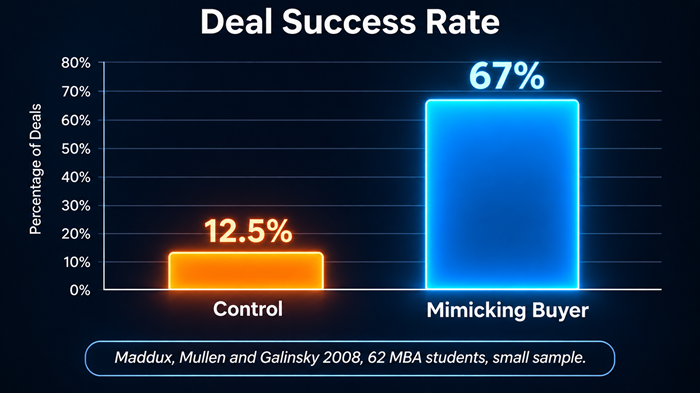
Start with what supports rapport behavior. In Maddux, Mullen and Galinsky’s 2008 experiments, negotiators who strategically mimicked a partner’s posture and mannerisms did better. In one study of 104 MBA students, pairs with a mimicker earned higher joint gains, and the person being mimicked didn’t lose out. In another, with 62 MBA students in a gas-station sale, deals closed in 67% of pairs where the buyer mimicked versus 12.5% of control pairs. Trust in the buyer explained the link. Rapport and liking didn’t.
Read the limits as carefully as the results. The samples were small and came from one school. Mimicry was instructed, not natural. The trust finding rested on a borderline statistical test. And in a price-only negotiation, with nothing to trade, mimicry made no difference. It helps when both sides can find a better deal together.
Now the other side. A 2019 critical review by Passmore and Rowson concluded that NLP’s unique practices are “poorly supported by research evidence.” Three studies found no support for eye-movement cues, and the older reviews of matching people’s preferred sensory language found little backing. The review also notes that Bandler and Grinder’s claims about rapport and matching never went through normal scientific testing.
| GRADE A Tested in negotiation research. Use with care. | GRADE B Widely taught and plausible, with thin or indirect evidence. Try and track results. | GRADE C Popular but unsupported. Skip it. |
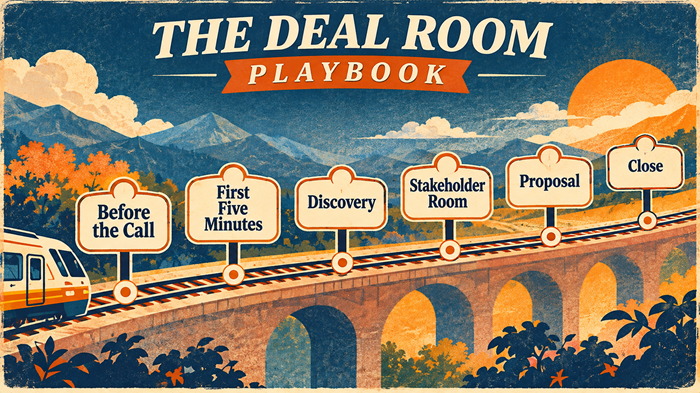
The Deal Room Playbook
Follow one deal from the first prep session to the signature. Each stage lists a move, its evidence grade, an ethics check and a sample line.
| STAGE 1 OF 5 Before the Call | |||
| You can’t build trust if you arrive scattered. Spend ten minutes on the buyer’s world and your own state. | |||
| Move | Grade | Ethics check | Sample line |
| Research the buyer’s priorities and recent news | B | Use it to ask better questions, not to flatter. | “I saw your team is expanding into two new regions. How is that affecting hiring?” |
| Settle yourself with a short routine | B | It’s for your calm, not their reaction. | Breathe, recall a past strong call, then walk in. |
| STAGE 2 OF 5 The First Five Minutes | |||
| Senior buyers decide quickly whether you’re worth their time. Show that you listen before you pitch. | |||
| Move | Grade | Ethics check | Sample line |
| Match their pace, volume and energy lightly | A | Stay natural. Never copy gestures obviously or mock. | If they speak slowly and carefully, slow down. |
| Use their words for their problem | B | Reflect accurately. Don’t twist their meaning. | “You called it a retention problem, so let’s start there.” |
| Read eye movements or match sensory words | C | Skip it. No solid evidence. | Not applicable. |
| STAGE 3 OF 5Discovery | |||
| Premium deals go to the person who understands the problem best. This is where NLP’s questions earn their keep. | |||
| Move | Grade | Ethics check | Sample line |
| Meta-model questions to sharpen vague statements | B | Ask because you want clarity, not to corner them. | “You said it never works. Never? What’s one time it did?” |
| Chunk up to the real goal, then down to detail | B | Follow their priorities, not your pitch. | “What does fixing this give the company, and what would we do first?” |
| Look for shared interests, not just price | A | Share some of your own constraints too. | “What matters more here, speed or flexibility?” |
| Want to practice these moves with a trainer? If you’d like feedback on your discovery questions or your first five minutes, book a 30-minute connection call and bring a recent call you want to improve. |
| STAGE 4 OF 5 The Stakeholder Room | |||
| Corporate deals rarely rest on one person. Your champion may love you while finance, legal or IT stay quiet. | |||
| Move | Grade | Ethics check | Sample line |
| Ask your champion who else shapes the decision | B | Be open about why you’re asking. | “Who else will want to weigh in, and what will they care about?” |
| Give each person their own question and a fair hearing | B | Treat quiet people as seriously as loud ones. | “What would make this an easy yes for you?” |
| Light mimicry with each person in the room | A | Keep it subtle. Drop it if it feels forced. | Adjust your pace for each speaker. |
| STAGE 5 OF 5 Proposal and Close | |||
| By now you’ve earned the right to propose. Make the next step clear and the outcome vivid. | |||
| Move | Grade | Ethics check | Sample line |
| Future pace the result in their words | B | Describe only what you can deliver. | “Picture the first quarter after rollout. What’s different for your team?” |
| Name the next step and date | B | Give them room to say no. | “Shall we set the sponsor review for the 14th?” |
| Anchoring or pressure tactics | C | Skip it. It damages trust. | Not applicable. |
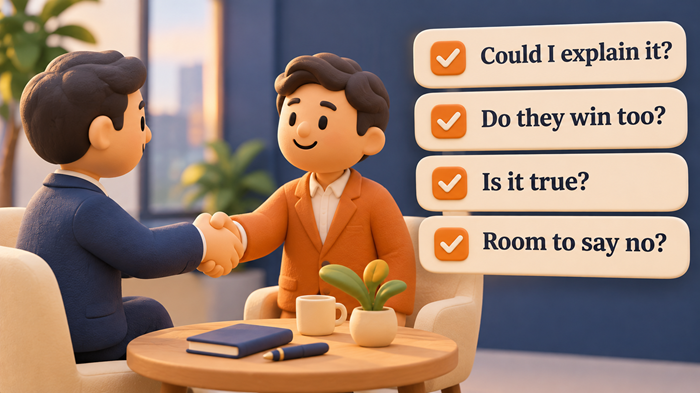
The Line Between Rapport and Manipulation
Rapport helps the buyer decide well. Manipulation helps you win at their expense. Use these four questions to check yourself before any call.
▸ Could I explain this move to the buyer? If you’d feel embarrassed, don’t use it.
▸ Does the buyer win too? The research suggests mimicry works when both sides can gain.
▸ Is my claim true? Describe only results you can deliver.
▸ Do they have room to say no? Pressure erodes the trust that drives the deal.
This is where Confident Communication and Compelling Presence meet. You show up as someone who listens fully, speaks plainly and leaves the buyer in charge of the decision.
A Hypothetical Walkthrough: Sam
This is an invented example for illustration, not a real client.
Sam sells leadership training to mid-sized companies. Before a call with an operations director, Sam reads the company’s news and writes three questions. In the first five minutes, Sam slows down to match the director’s careful pace and uses her word, “handoffs,” for her problem.
In discovery, she says managers “never” coach their teams. Sam asks, “Never? When did one do it well?” That question leads to a story about one manager who changed a whole team. Sam asks what the company would gain if every manager did that. The answer, lower turnover, becomes the center of the proposal.
Then Sam asks who else cares. The director names the finance lead. Sam meets her separately, asks what would make the investment easy to defend, and builds a one-page summary for her. Sam doesn’t read eye movements or pressure anyone. The deal still takes weeks, but each person in the room has been heard.
Data & Findings
| Source | What it shows | Caveat |
| Maddux, Mullen & Galinsky (2008) | Mimicry raised joint gains (104 MBA students) and deals (67% vs 12.5%, 62 students). Trust mediated the effect. | Small samples, one school, instructed mimicry, borderline test (p = .047), no effect in price-only negotiation. |
| AMA summary | Summarizes the same study for practitioners. | Secondary source. |
| Passmore & Rowson (2019) | NLP’s unique claims are poorly supported. Eye-cue evidence is negative. | Review of a thin literature by business school coaching researchers. |
| Prospeo | A vendor view that meta-model questions and basic mirroring are the defensible parts of NLP in sales. | Sales data vendor. Promotional. Unsourced stats. |
None of this proves that NLP raises close rates in corporate sales. No study I found tested that directly. The playbook is a structured way to practice honest rapport and see what works for you.
Who Should Use This Playbook
▸ Consultants, coaches and salespeople who sell to companies with several decision makers.
▸ Sellers who feel pressure to sound polished and want a more genuine approach.
▸ Teams that want a shared, honest language for discovery and rapport.
Who Should Skip It
▸ Anyone hoping for a guaranteed script or hidden influence tricks. This isn’t that.
▸ Sellers in transactional, price-only deals, where the research found mimicry didn’t help.
▸ Anyone in regulated sales, such as finance or insurance. Follow your compliance rules first. This isn’t legal advice.
Frequently Asked Questions
How does NLP help build rapport in sales?
It offers practical habits: matching a buyer’s pace, asking precise questions and describing outcomes in their words. Some of these have research support, and some don’t, so grade each one and test it yourself.
Does mirroring work in sales?
Research found that subtle, strategic mimicry helped negotiators, mainly when both sides could gain. The studies were small and used student negotiators, so treat it as a promising habit, not a guarantee.
Is NLP scientifically proven?
Reviews find that NLP’s unique practices are poorly supported by research, with eye-cue claims faring worst. Some ideas overlap with well-supported communication skills, such as asking open questions.
How do I build trust with senior corporate buyers?
Do your homework, listen first, ask precise questions and describe only what you can deliver. In the mimicry research, trust was what explained the results.
Where’s the line between rapport and manipulation?
Ask whether you could explain your move to the buyer, whether they win too and whether they have room to say no. If any answer is no, change your approach.
Conclusion
You don’t win premium corporate deals with tricks. You win them by earning trust with each person in the room, asking better questions and promising only what you can deliver. Take decisive action this week by choosing one move from the playbook and testing it on your next call. When you’d like a trainer’s feedback, book a 30-minute connection call.
Unleash Your Power: Stand Out, Take Action, and Create the Success You Want.