
NLP for Public speaking anxiety is something almost everyone has experienced at some point. That nervous feeling before you step in front of a crowd, your palms getting sweaty, your mind racing with thoughts of failure. You’re not alone many people struggle with the fear of speaking in public, but the good news is, there are tools that can help. One such tool is NLP, or Neuro-Linguistic Programming.
Public speaking anxiety affects millions of people worldwide. Whether it’s a presentation, meeting, or stage performance, the fear of judgment can trigger nervousness, shaking, or even panic.
The good news is that this fear is not permanent. Neuro-Linguistic Programming (NLP) offers practical techniques to rewire your mental patterns and help you feel calm, confident, and in control while speaking.
In this guide, you’ll learn exactly how NLP works and the most effective techniques you can use to overcome public speaking anxiety step by step.
Key Takeaway:
- Neuro-Linguistic Programming (NLP) provides a structured mental framework to conquer public speaking anxiety by rewiring how the brain processes fear, perfectionism, and stage fright. [1]
- Mechanisms: Public speaking anxiety stems from fear of judgment, triggering physical stress responses like elevated heart rate and mental blanking. NLP alters these neurological pathways by modifying the connection between thought patterns (neuro), internal dialogue (linguistic), and behavioral responses (programming). [1]
- Core Methods: Essential techniques include Reframing (reinterpreting nervousness as performance excitement), Anchoring (pairing physical gestures with calm states), Visualization, and Future Pacing (mentally rehearsing successful delivery and handling unexpected challenges). [1]
- What to do: Challenge negative self-talk, perform 4-4-4 deep breathing before speaking, set up physical anchors (e.g., pressing thumb and forefinger together), and gradually simulate speaking in realistic practice environments. [1]
- When to be cautious: NLP techniques require consistent repetition rather than serving as an overnight fix. They cannot replace thorough speech preparation, and severe phobias may require dedicated coaching or deeper therapeutic intervention. [1]
Bottom Line: NLP transforms public speaking anxiety by cognitive reframing, visualization, and bodily anchoring. Consistent mental practice redirects physiological stress into focused energy for confident, impactful speeches.
What is NLP?
Neuro-Linguistic Programming (NLP) is a psychological approach that focuses on how thoughts, language, and behavior are connected. It helps individuals change negative patterns by reshaping mental associations and emotional responses.
In the context of public speaking anxiety, NLP works by:
- Reprogramming fear-based triggers
- Creating positive emotional states
- Building confidence through mental conditioning

Overcoming NLP for Public Speaking Anxiety
Anchoring Confidence
Anchoring is a technique where you associate a physical action (like pressing your fingers together) with a confident emotional state.
How to do it:
- Repeat several times to strengthen the anchor
- Recall a moment when you felt extremely confident
- Fully relive that feeling
- Apply a physical trigger (e.g., touch fingers)
Reframing Fear
Instead of seeing public speaking as a threat, NLP reframing helps you view it as an opportunity to share value and connect with others.
Visualization Technique
Visualize yourself speaking confidently, clearly, and successfully. This trains your brain to expect positive outcomes.
Swish Pattern
Replace negative mental images with positive ones quickly to break fear patterns.
State Control
Control your emotional state through breathing, posture, and focus before speaking.
Positive Self-Talk
Replace thoughts like “I’ll fail” with “I am prepared and confident.”
Pattern Interruption
Break anxiety loops by shifting attention instantly (movement, breathing, or mental shift).
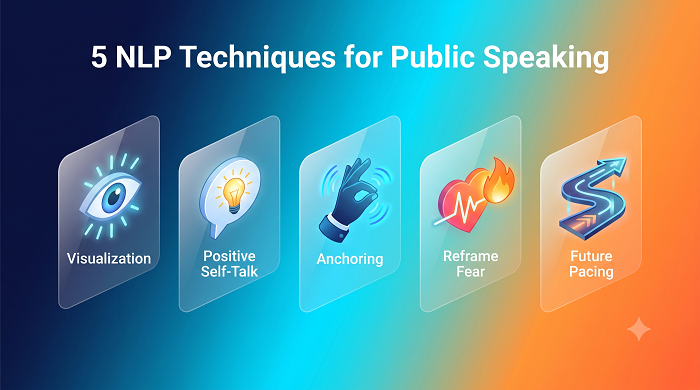
Five NLP Techniques for Public Speaking Anxiety
Here are five NLP techniques that can help you overcome public speaking anxiety:
Visualization
Picture yourself stepping onto the stage with confidence. Imagine your speech going smoothly your voice clear and your words flowing effortlessly. Visualization helps you mentally rehearse success, reducing anxiety and making the experience feel familiar and comfortable.

Positive Self-Talk
What you tell yourself matters. If your inner voice says, I’m terrible at this, you’re reinforcing fear. Replace those negative thoughts with positive affirmations: I’m prepared, I’ve got this, or I’m an excellent speaker. This shift in self-talk boosts your confidence and helps you focus on success.
Anchoring Calmness
Find a simple gesture, like touching your thumb and forefinger together, while feeling calm and confident. Over time, your body will associate this gesture with relaxation. Before your speech, use this same gesture to trigger calmness and confidence.
Reframing Fear into Excitement
Anxiety and excitement share the same physical symptoms quick heartbeat, butterflies in your stomach. Instead of seeing these as signs of fear, reframe them as excitement. This mindset shift helps you tap into the empowering energy of excitement, making you feel more motivated and in control.
Future Pacing
Mentally rehearse your next speaking engagement. Visualize yourself handling any challenges with ease, staying calm, and answering questions smoothly. This technique helps you feel more in control and turns public speaking into a manageable, even enjoyable, experience.
These NLP techniques are simple yet effective tools to help you manage anxiety and become a more confident public speaker. Let’s look at how to apply them in your next speaking event.
Applying NLP to Overcome Public Speaking Anxiety
Identify and Challenge Negative Beliefs
The first step in overcoming public speaking anxiety is understanding where your fear comes from. What are you afraid of? Are you worried about judgment or making a mistake? Once you identify these beliefs, you can challenge them. For instance, if you think you’re not good enough to speak in front of an audience, replace that thought with: “I have valuable insights to share.” Reframing these negative beliefs will shift your mindset and reduce anxiety.
Use Visualization Techniques
Visualization is a powerful NLP tool. Before stepping onto the stage, close your eyes and picture yourself delivering a successful speech. Imagine yourself engaging confidently with your audience, handling challenges with ease. The more vivid your visualization, the more your mind will associate public speaking with success instead of fear, calming your nerves before you even begin.
Anchor Calmness and Confidence
Anchoring is a physical trigger you can use to help calm your nerves. For example, practice touching your thumb and forefinger together while in a relaxed, confident state. Over time, your body will associate this action with calmness, and you can use it right before speaking to trigger that feeling of confidence.
Practice and Rehearse with NLP Techniques
The key to making NLP work is regular practice. Use visualization before your speeches, practice positive self-talk, and anchor your confidence. The more you incorporate these techniques into your routine, the more natural they will become. With consistent practice, you’ll feel less anxiety and more confident during public speaking.
NLP for Managing Pre-Speech Nerves
Pre-Speech Relaxation Exercises

Before stepping onto the stage, take a moment to calm your nerves using simple NLP relaxation techniques. Close your eyes, breathe deeply, and focus on releasing tension in your body. Visualize yourself in a calm place, free from distractions. This will help you shift focus away from anxiety and into a relaxed, centered state.
Breathing Exercises
Breathing exercises are a great way to activate your body’s relaxation response. Try this: breathe in slowly through your nose for a count of four, hold for four, and exhale for four. Repeat this process a few times. Slowing your breath helps lower your heart rate, calm your nerves, and prepare you mentally for public speaking.
Additional Tips for Overcoming Public Speaking Anxiety
Public speaking anxiety is common, but it doesn’t have to hold you back. Here are five practical tips to help you manage your nerves and perform with confidence:
The Power of Repetition
Practice makes all the difference. The more you rehearse, the more familiar you become with your material. This reduces anxiety and makes your delivery feel more natural.
Simulate Speaking Environments
Practice in settings that mimic real speaking situations. Start with family or friends, then move to larger groups. Gradually building this exposure will help reduce the intimidation of speaking in front of others.
Mindfulness and Meditation
Taking a few moments to center yourself before speaking can work wonders. Try mindfulness exercises or meditation to calm your mind, reduce anxiety, and stay present.
Exercise and Physical Activity
Exercise boosts mood and reduces anxiety. Whether it’s a quick walk, some stretches, or a full workout, staying active helps calm your nerves and improves focus before speaking.
Anchor Confidence with NLP
Using NLP anchors like pressing your thumb and forefinger together can trigger calmness and confidence right before your speech. With practice, this gesture will help you stay grounded and confident when it’s time to speak.
By combining these practical tips with NLP techniques, you’ll be well on your way to overcoming public speaking anxiety and speaking with confidence. Keep practicing, stay consistent, and remember: the more you work on it, the easier it will get.

Frequently Asked Questions
Can NLP really help with public speaking anxiety?
Yes, NLP (Neuro-Linguistic Programming) can be effective for reducing public speaking anxiety because it focuses on changing how your brain processes fear. Techniques like anchoring and reframing help replace negative emotional responses with confidence and control. While results vary, many people experience noticeable improvements with consistent practice.
How long does it take for NLP techniques to work?
Some NLP techniques, such as anchoring and breathing-based state control, can produce immediate short-term results. However, for long-term confidence and lasting change, regular practice over days or weeks is recommended. The more consistently you apply these techniques, the stronger the mental conditioning becomes.
What is the fastest NLP technique to reduce speaking anxiety?
Anchoring is often considered the fastest NLP technique for reducing anxiety. It works by linking a physical trigger (like pressing your fingers together) to a confident emotional state, allowing you to quickly access that feeling before or during a presentation. Many people combine anchoring with deep breathing for even faster results.
Is NLP better than CBT for public speaking anxiety?
NLP and CBT (Cognitive Behavioral Therapy) serve different purposes. NLP is often faster and more practical for immediate confidence-building, while CBT is more structured and effective for addressing deep-rooted anxiety patterns over time. For best results, some individuals combine both approaches depending on their level of anxiety.
Why do I feel anxious when speaking in public?
Public speaking anxiety is usually caused by a fear of judgment, past negative experiences, or lack of confidence. Your brain may associate speaking situations with danger, triggering a stress response. NLP helps by breaking these negative associations and replacing them with positive, empowering patterns.
Conclusion
Overcoming public speaking anxiety is possible with the right tools, and NLP offers powerful techniques to help you gain control of your fear. By reframing your thoughts, visualizing success, and using anchoring to trigger calmness, you can break free from the grip of anxiety and speak with confidence. Remember, the key to mastering public speaking is consistent practice. The more you incorporate these techniques into your routine, the more natural they will feel, and the less anxiety you’ll experience.
Public speaking is a skill that anyone can improve. So, embrace these NLP strategies, put them to work in your next speaking engagement, and watch how your confidence soars. You have everything it takes to conquer your fears now it’s time to show the world your true potential. You’ve got this!
If you want personalized help to overcome public speaking anxiety, consider working with a professional NLP coach who can guide you step by step.