
Standard mindset tactics often fail under high business stress because they depend on the part of your mind that stress quiets. Research summaries suggest acute stress weakens the prefrontal functions behind working memory and attention control, which are the same skills affirmations, willpower and on-the-spot reframing ask you to use. One study found that repeating a positive statement made people with low self-esteem feel worse, and a large replication found the “willpower tank” effect close to zero.
The practical fix is to prepare in calm. Write if-then plans, simplify decisions, reset your body first and take one small step. These ideas come from lab studies, not founders in crisis, so test them in low-stakes moments before you rely on them. If stress feels unmanageable, a licensed professional can help.
Key Takeaway:
- Standard mindset tactics often fail under high business stress because they rely on working memory and attention control, which acute stress can weaken. This is not a lack of discipline or mental strength; it is a limitation in how the brain handles pressure. [1]
- Why tactics backfire: Forced affirmations and positive thinking can increase internal resistance when statements conflict with how you actually feel. Similarly, relying on willpower or making complex decisions during a crisis places extra demands on an already strained mind. [1]
- What works instead: Prepare before pressure hits. Create if-then plans for predictable crises, establish decision-making defaults, use checklists, and postpone major reversible decisions for 24 hours when possible. These systems reduce the need for difficult in-the-moment thinking. [1]
- Reset before reacting: Pause for two minutes, slow your breathing, stand up or take a short walk, then identify one practical 10-minute action. Practice stress-management techniques during low-pressure situations so they become easier to access when challenges arise. [1]
- When to rethink: Research on mindset tactics largely comes from laboratory studies rather than founders experiencing real business crises. Treat these strategies as practical tools to test, not guaranteed solutions. If stress becomes unmanageable or affects daily functioning, seek qualified professional support. [1]
Bottom Line: Mindset tactics often fail under pressure because stress weakens the very thinking skills they depend on. Stop relying on willpower in the moment. Build if-then plans, decision-making systems, and simple recovery habits while you’re calm so you can respond more effectively when business stress hits.
What Stress Does to Your Thinking
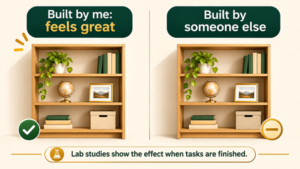
You’ve probably lived this. Last quarter you sat down on a calm Sunday, wrote an affirmation, felt great. Then a key client left on Tuesday and none of it held. You still had the mindset knowledge. What changed was the state you were in.
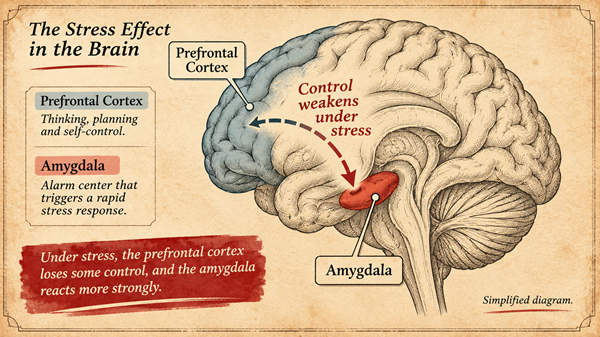
A summary of Amy Arnsten’s 2009 review in Nature Reviews Neuroscience describes how even mild, acute, uncontrollable stress can quickly impair the prefrontal cortex, the region behind working memory and attention regulation. Under stress, it explains, the amygdala’s alarm circuits gain strength while top-down control weakens, and attention shifts toward whatever grabs it. That’s a review of basic neuroscience, and I read a secondary summary, not the full paper. It doesn’t study founders. But it fits what many business owners describe: when the pressure spikes, careful thinking gets harder.
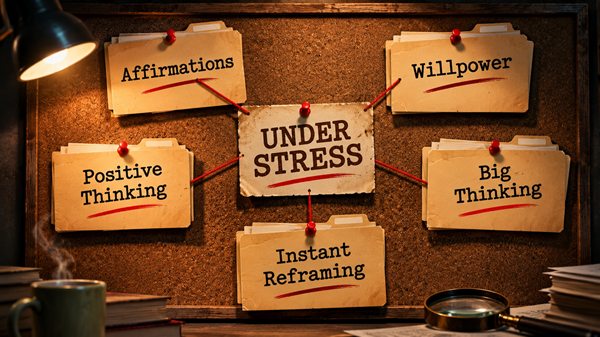
So here’s the problem. Most popular mindset tactics ask you to use careful, top-down thinking at exactly the moment it’s hardest to reach. Let’s open five case files.
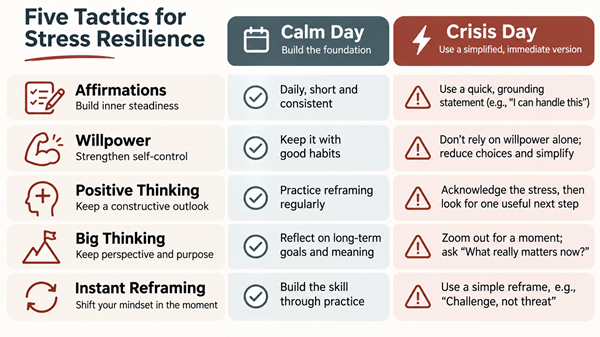
| FILE 01 | Affirmations | |
| The promise: Repeat a positive statement and you’ll start to believe it. | ||
| WORKS ON A CALM DAYWhen stakes are low and the statement feels believable, it can feel encouraging. | BREAKS UNDER STRESSUnder stress, doubt gets louder. A statement that clashes with how you feel invites an argument from your own mind. | |
| The evidence: Wood, Perunovic and Lee (2009) had students repeat “I am a lovable person.” Those with high self-esteem felt better afterward. Those with low self-esteem felt worse. The samples were 249, 68 and 116 students, and the effects were small, so this isn’t proof about founders. It does show that a positive line isn’t automatically helpful. | ||
| Do this instead: Use specific, believable statements tied to evidence: “I’ve lost a client before and rebuilt.” Or skip the statement and name one action you’ll take next. | ||
| FILE 02 | Willpower | |
| The promise: Just push through. Grit gets you there. | ||
| WORKS ON A CALM DAYOn routine tasks with low pressure, effort and habit carry you. | BREAKS UNDER STRESSWhen stress weakens top-down control, relying on self-control means relying on a weakened system. And the popular “willpower tank” explanation has taken a hit. | |
| The evidence: A multilab replication of the ego-depletion effect by Hagger and colleagues (2016) pooled 23 labs and 2,141 participants and found a small effect (d = 0.04) with an interval that included zero. That challenges the idea that willpower drains like a battery. It doesn’t prove self-control doesn’t matter. It tested one kind of task. | ||
| Do this instead: Stop relying on in-the-moment effort. Remove decisions in advance with defaults, calendars and a pre-set response to common problems. | ||
| FILE 03 | Forced Positive Thinking | |
| The promise: Stay optimistic and good things follow. | ||
| WORKS ON A CALM DAYIt can lift your mood when the situation is manageable and the optimism feels earned. | BREAKS UNDER STRESSWhen the problem is real and serious, forced positivity feels fake, and you may hide the information you need. | |
| The evidence: In the same Wood study, 116 students considered “I am a lovable person” either only in ways it was true, or in ways it was and wasn’t true. People with low self-esteem felt worse when they focused only on the positive than when they took a balanced view. Again, students and a single statement, so treat it as a hint. | ||
| Do this instead: Name what’s true, what’s hard and one next step. A balanced view often feels more honest and easier to act on. | ||
| FILE 04 | Big Thinking in the Moment | |
| The promise: Journal it out. Rebuild the strategy while the fire’s burning. | ||
| WORKS ON A CALM DAYWith time and a clear head, reflection and planning are valuable. | BREAKS UNDER STRESSWorking memory takes a hit under stress, so complex planning and big decisions get harder exactly when you try them. | |
| The evidence: The Arnsten summary links stress to weaker working memory and attention control. For a practical fix, a review of 94 tests by Gollwitzer and Sheeran (2006) found that if-then plans, which spell out when and how you’ll act, improved goal attainment (d = .65). That work mostly covers personal goals, and I read only the abstract. | ||
| Do this instead: Park big decisions for 24 hours when you can. Keep a one-page crisis checklist, written while calm, for the decisions that can’t wait. | ||
| FILE 05 | Instant Reframing | |
| The promise: Tell yourself stress is good for you and it will be. | ||
| WORKS ON A CALM DAYPracticed ahead of time, a different view of stress can change how you respond. | BREAKS UNDER STRESSTrying to reframe from scratch mid-crisis asks a lot of a strained mind. A new belief needs practice first. | |
| The evidence: Crum, Salovey and Achor (2013) ran three studies and found that people’s views of stress can be shifted with short film clips, and that a stress-is-enhancing mindset related to moderate cortisol reactivity and a greater desire for feedback. I read only the abstract and don’t know who took part. It’s early evidence, not a guarantee. | ||
| Do this instead: Practice your preferred view of stress on small, low-stakes pressure first, such as a tight deadline. Build the habit before the big moment. | ||
| Which file sounds like you?If you recognized yourself in two or more, a short conversation can help you plan your stress-proof routine. Book a 30-minute connection call and bring your toughest recent week. |
The Stress-Proof Stack
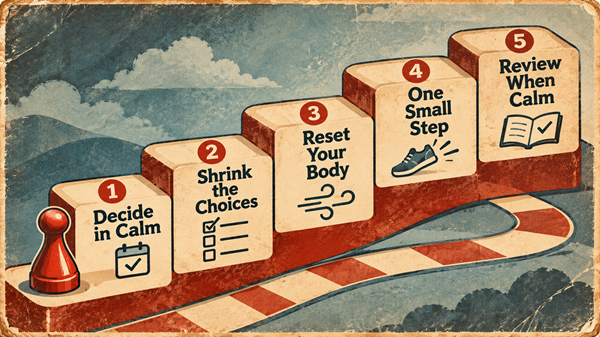
Every fix above shares one idea: do the thinking early. Build five layers while you’re calm, so that when stress spikes, you aren’t asking your strained mind to invent a plan.
| Layer 1: Decide in calm | Write if-then plans for your three most likely crises. “If a key client threatens to leave, then I call within an hour and listen first.” |
| Layer 2: Shrink the choices | Set defaults for recurring decisions and a 24-hour rule for big, reversible ones. |
| Layer 3: Reset your body first | Before you decide, pause for two minutes. Slow your breathing, stand up or walk. Practical and low risk, though I found no founder studies testing it. |
| Layer 4: One small step | Pick the next 10-minute action. Momentum matters more than the perfect plan. |
| Layer 5: Review when calm | Within a few days, ask what worked, what didn’t and which plan to update. |
James R. Elliot, an NLP Board Designated Trainer with more than 20 years of experience, teaches practices like anchoring and state management, which fit naturally into Layer 3. The research on specific NLP techniques is limited, as Passmore and Rowson’s 2019 review notes, so treat them as practice tools to test, not proven fixes. The principle behind them, preparing your state before the pressure arrives, is what counts. For routines you can practice, see our guides on NLP tools for stress management and stress management in business.
A Hypothetical Example: Marcus
This is an invented example for illustration, not a real client.
Marcus runs a small software consultancy. When his largest client threatened to leave, he told himself to stay positive, repeated a line about abundance and stayed up rewriting his strategy. By morning he’d sent a defensive email he regretted.
Three months later, after a similar scare, he follows his stack. His if-then plan says to call within an hour and listen. He takes two minutes to breathe before dialing, writes the next step on a sticky note and holds big decisions until the next day. The client still pushes back, but Marcus responds calmly and keeps the relationship. Habits like these usually take 3 to 6 months of practice, so he treats his first try as a start.
Data & Findings
| Source | What it shows | Caveat |
| Arnsten (2009) summary | Acute, uncontrollable stress impairs prefrontal functions such as working memory and attention regulation. | A review of basic neuroscience, read through a secondary summary. Not founder-specific. |
| Wood, Perunovic & Lee (2009) | Repeating a positive statement made low-self-esteem participants feel worse. | 249, 68 and 116 students. One statement. Small effects. Read via news coverage. |
| Hagger et al. (2016) | 23 labs, 2,141 participants, ego depletion effect d = 0.04. | One task type. It challenges the depletion model, not self-control in general. |
| Crum, Salovey & Achor (2013) | Stress mindset can be shifted and relates to cortisol reactivity and feedback seeking. | Abstract only. Participants unknown. Early evidence. |
| Gollwitzer & Sheeran (2006) | If-then plans improved goal attainment across 94 tests (d = .65). | Mostly personal goals. Abstract only. |
None of these studies tested founders under high business stress. The article connects findings from labs and reviews, so treat the stack as a set of ideas to test on low-stakes days.
Who Should Use This Approach
- Founders who’ve noticed their usual mindset habits vanish when pressure rises.
- Owners facing a known high-stress stretch, such as a launch, a layoff or a funding deadline.
- Leaders who want a calmer, more consistent response to crises.
Who Should Get Other Support
- Anyone whose stress feels unmanageable, constant or tied to low mood, panic or sleep problems. This article isn’t medical or mental health advice. A licensed professional can help. In the US and Canada, you can call or text 988.
- Anyone facing legal, tax or financial trouble. Get qualified advice alongside any mindset work.
- Teams in real danger, such as safety-critical work. Follow your formal procedures first.
Frequently Asked Questions
Why doesn’t positive thinking work when I’m stressed?
Stress seems to weaken the careful, top-down thinking that positive tactics rely on, and forced positivity can clash with how you feel. One study found that people with low self-esteem felt worse after repeating a positive statement.
Do affirmations work for business owners?
Sometimes, mainly when they’re specific, believable and low-stakes. The research I found used students, and it didn’t test founders, so test them yourself and drop them if they feel hollow.
Is willpower a limited resource?
The idea that willpower drains like a battery has weaker support after a large replication found an effect near zero. That doesn’t mean self-control is easy. It means structure and defaults help more than raw effort.
How do I make better decisions under pressure?
Decide the common ones in advance with if-then plans and a short checklist. Pause for two minutes before big choices and, when you can, wait 24 hours.
Can I change how I think about stress?
Early research suggests views of stress can shift and may relate to how the body responds. Practice the new view on small pressures first, and don’t expect it to hold the first time in a crisis.
Conclusion
Your mindset tools didn’t fail because you’re weak. They failed because they asked a strained mind to do hard work. Take decisive action this week by writing one if-then plan for your most likely crisis. When you’d like help building your own stack, book a 30-minute connection call.
Unleash Your Power: Stand Out, Take Action, and Create the Success You Want.