Busy founders often avoid free time because stillness can feel unsafe to the subconscious mind. When work has become tied to identity, status, and a sense of control, slowing down can register as a threat, and staying busy brings quick relief. Research fits this pattern. In a well-known 2014 study, many people struggled to spend 15 minutes alone with their thoughts, and some chose to shock themselves rather than sit quietly.
Other research finds that people see busyness as a sign of status, and that some people feel anxious when they relax. Subconscious threat response is a coaching lens for this pattern, not a clinical diagnosis. The practical goal is to teach your system that rest is safe, using small, repeated experiences of stopping and nothing going wrong. If the unease is persistent or severe, talk with a qualified professional.
Key Takeaway:
- A subconscious threat response may explain why busy founders feel restless, guilty, or anxious when they have free time. When work becomes tied to identity, status, and control, slowing down can feel uncomfortable, making constant activity a way to escape difficult thoughts or emotions. This is a coaching concept, not a clinical diagnosis. [1]
- Why it happens: Quiet time can bring unfinished decisions, financial worries, and self-doubt to the surface, while a packed schedule provides a sense of control and social status. Research suggests that some people struggle with unstructured thought and feel uncomfortable when relaxing, although these findings have limitations and do not prove that every busy founder is avoiding something. [1]
- How to recognize it: Healthy drive moves you toward goals you genuinely value, while avoidance pushes you away from uncomfortable feelings. Notice whether an empty calendar brings relief and curiosity or restlessness, guilt, and an urge to invent more tasks. Look for a consistent pattern rather than judging yourself based on one difficult day. [1]
- What to do: Practise the five-step Safe to Stop framework: notice your physical and emotional signals, identify what you fear will happen if you stop, reframe rest as useful rather than unproductive, begin with five minutes of screen-free downtime, and record what you feared versus what actually happened. Gradually increase the duration as you build evidence that taking a break does not automatically lead to negative consequences. [1]
- When to be cautious: This approach requires repeated practice, not a quick fix. If persistent anxiety, depression, panic, or other symptoms interfere with daily life, consult a qualified healthcare or mental health professional. Address genuine business emergencies first, and do not treat the subconscious threat response concept as a diagnosis. [1]
Bottom Line: Constant busyness is not always a sign of ambition; sometimes, it is a way to avoid discomfort when work stops. Start with five minutes of intentional rest, challenge the fears that arise, and track what actually happens to gradually build a healthier relationship with downtime.
What Is a Subconscious Threat Response?
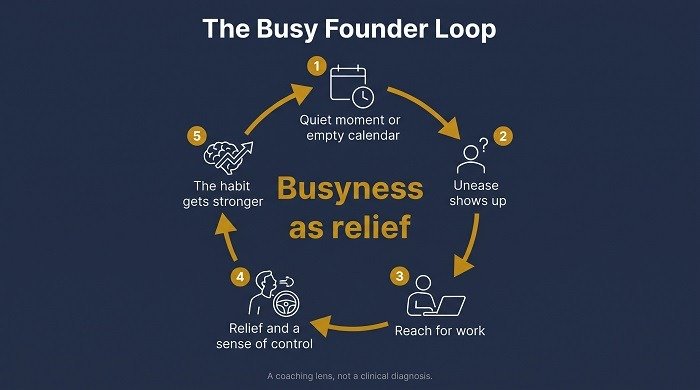
A subconscious threat response is the automatic reaction your mind has to something it reads as unsafe, before you’ve had time to think about it. For many founders, the trigger isn’t danger in the usual sense. It’s an empty calendar, a quiet evening, or a day with nothing urgent on it.
The term is a coaching lens, not a clinical diagnosis, and researchers don’t use it as a standard label. It describes a pattern that studies point to from several angles: stillness feels uncomfortable, busyness feels rewarded, and work becomes the fastest way to feel in control. In my 20+ years as an NLP trainer, I’ve seen this pattern in leaders who are otherwise decisive and capable.
Why Does Free Time Feel So Uncomfortable for Busy Founders?
Start with the research on stillness. In a 2014 study in Science, Timothy Wilson and colleagues asked participants to sit alone in a bare room and think for 6 to 15 minutes. According to a summary from the British Psychological Society, most people found it hard to concentrate and didn’t enjoy it, and the result held in a community sample of adults averaging 48 years old.
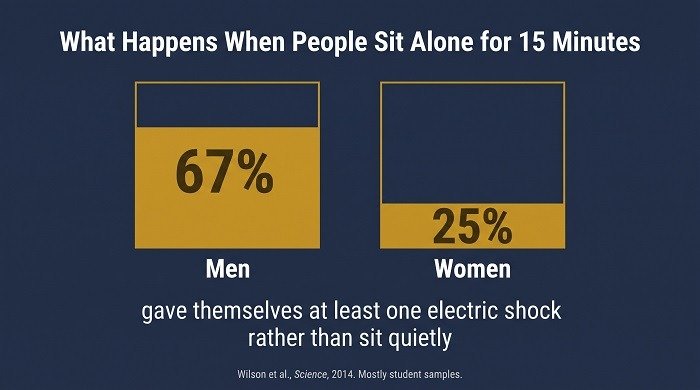
The most striking test gave participants a way to shock themselves. About 67% of men and 25% of women did so at least once during 15 minutes of quiet thought, even though they’d earlier said they would pay to avoid a shock of that strength. The researchers noted that controlling your thoughts is hard without training, which may explain why meditation appeals to so many people. Most samples were students, and the authors called for testing in broader groups.
A second line of research looks at relaxation itself. University of Cincinnati researcher Christina Luberto developed a measure of relaxation sensitivity. It covers discomfort with physical relaxation, unease when thoughts slow down, and worry about looking lazy. People who scored high also tended to fear arousal in general. The findings were preliminary and came from 300 undergraduates, so treat them as a pointer, not proof.
For a founder, that mix is familiar. A free afternoon means the mind goes quiet, and what arrives is rarely restful: unfinished decisions, money worries, self-doubt. Staying busy keeps that noise out.
Why Does Busyness Feel Like Status and Safety?
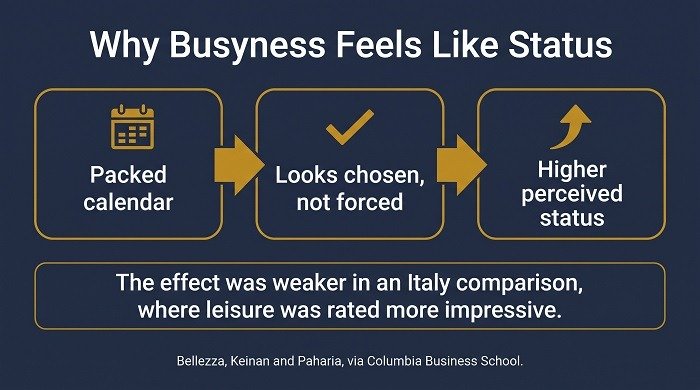
Researchers Silvia Bellezza, Anat Keinan, and Neeru Paharia studied this in a paper on the conspicuous consumption of time. According to a Columbia Business School summary, people in their experiments gave higher status to those with packed schedules. Busyness signals that your time and skills are scarce, and it only earns status when it looks chosen.
Culture plays a part. In a comparison of the US and Italy, Italian respondents rated a man with a leisurely lifestyle as more impressive than a man with a full schedule. The authors link this partly to how closely work is tied to identity in the US.
Put that together and a founder’s calendar becomes a scoreboard. Every packed day earns quiet approval from peers, investors, and yourself, and stopping risks losing that signal. Lubcheck L. came to James feeling constantly compared with other people. As he learned to stop measuring himself against them, his confidence grew and his anxiety eased. If this sounds familiar, the pattern in are you on a treadmill may feel close to home.
What Does Constant Motion Cost a Founder?
In a 2015 survey by researchers at UC San Francisco and UC Berkeley, 49% of 240 entrepreneurs reported at least one mental health condition, and nearly a third reported two or more, according to SiliconANGLE’s report. The conditions named were ADHD, bipolar disorder, depression, anxiety, and substance use. The sample was small and the report describes no comparison group, so it can’t show that entrepreneurship causes these conditions.
Rest may also matter for the quality of your thinking. A 2022 study in Molecular Psychiatry used electrical stimulation during awake brain surgery. In 9 patients, stimulating default network areas reduced creative fluency on an alternate uses task, while stimulating other areas did not. The sample was tiny and the setting unusual, so it doesn’t prove that quiet time boosts ideas. It adds to evidence that the default network plays a part in creative thinking.
The cost often shows up quietly: decisions made on autopilot, little time to think beyond the next fire, and a body that rarely switches off. For practical tools, see NLP for anxiety in Toronto entrepreneurs and this guide to staying energized to avoid burnout.
How Can You Tell Drive From Avoidance?
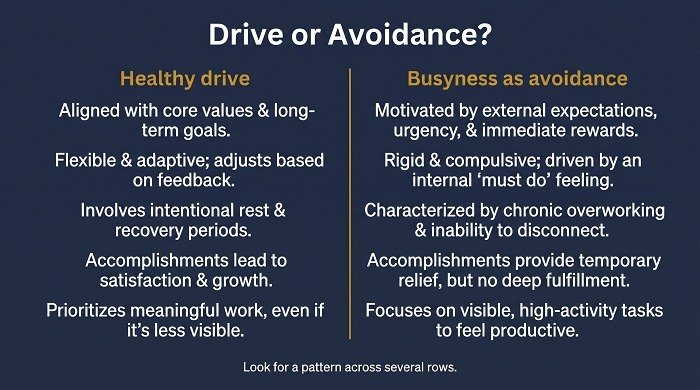
Drive and avoidance can look the same from the outside, because both produce long hours and visible output. The difference is what happens when the work stops.
| Signal | Healthy drive | Busyness as avoidance |
| When the calendar clears | You feel relieved or curious | You feel restless or guilty, or you invent tasks |
| Source of motivation | Pulled toward a goal you chose | Pushed away from a feeling you’d rather not have |
| Rest | You enjoy it without justifying it | You feel you must earn it, or you cut it short |
| Quiet moments | Thoughts wander and settle | You reach for your phone or inbox within minutes |
| Self-worth | Doesn’t depend on today’s output | Rises and falls with how much you got done |
| Flexibility | You can drop a task that no longer matters | Every task feels urgent |
No single row proves anything. Look for a pattern across several.
The 5-Step Safe to Stop Framework
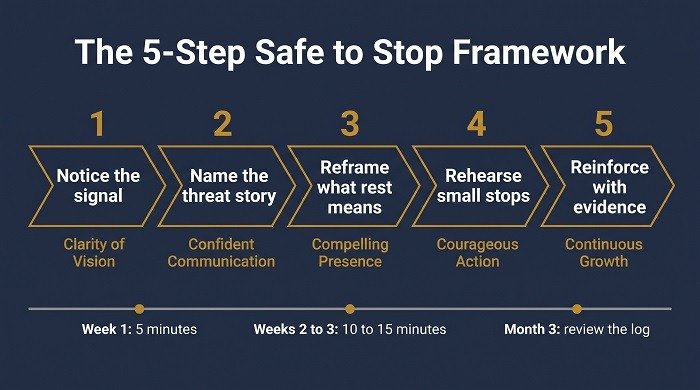
Your system learns safety through experience, not argument. These five steps give it small, repeatable experiences of stopping. They map to the five pillars of Massive Success that guide James’s work.
Step 1: Notice the Signal
Catch the first sign of unease when work pauses, such as a tight chest, a reach for your phone, or a sudden urge to check email. Note when it appears and rate its strength from 1 to 10. You can’t change a pattern you haven’t seen. This is Pillar 1, Clarity of Vision.
Step 2: Name the Threat Story
Finish this sentence honestly: “If I stop, then…” Common endings are “I’ll fall behind,” “People will think I’m lazy,” or “Something will go wrong.” Saying the story out loud takes it out of the background. Try This: set a 2-minute timer and write every ending to that sentence without editing. This is Pillar 2, Confident Communication.
Step 3: Reframe What Rest Means
Replace the story with one that’s true and useful. Rest can be part of the work that keeps your judgment sharp. NLP reframing asks what else a pause could mean, then tests it. “If I stop, I fall behind” might become “If I stop for 20 minutes, I think more clearly afterward,” and you check that against your own results. The practice in the power of reflection can help here. This is Pillar 3, Compelling Presence.
Step 4: Rehearse Small Stops
Start with 5 minutes of nothing scheduled, then build toward 15. Sit without a screen, walk without a podcast, or look out a window. Expect the urge to bolt, because that’s the response you’re retraining. Try This: tonight, leave your phone in another room for 10 minutes, notice what shows up, then note that nothing broke. This is Pillar 4, Courageous Action.
Step 5: Reinforce With Evidence
Keep a short log of what you did during each pause, what you feared, and what actually happened. After two to three weeks, review it. Mike L. came to James with anxiety, second-guessing, and a mind that was never quiet. After working through NLP techniques, he reports that the constant noise eased and he can enjoy life more. With practice, many people notice the urge to bolt weaken within 3 to 6 months. This is Pillar 5, Continuous Growth.
Who Should Use This?
- Founders who feel restless or guilty when their schedule clears
- Leaders whose sense of worth rises and falls with daily output
- People who’ve tried taking time off and cut it short or spent it working
- Anyone ready to practise small changes and track what happens
Who Should Avoid This?
- People with persistent anxiety, depression, panic, or other symptoms that interfere with daily life. Start with a doctor or licensed mental health professional.
- Anyone in the middle of a genuine emergency, such as a cash crisis or a team in trouble. Handle that first, then come back to rest.
- Anyone looking for a quick fix. Retraining a response takes repeated practice.
- Anyone who wants to treat this article as a diagnosis. It’s a lens, not a clinical tool.
FAQs
What is a subconscious threat response?
It’s the automatic reaction your mind has to something it reads as unsafe, before conscious thought. In coaching, the term describes how stillness or an empty schedule can trigger that reaction in busy founders. It’s a coaching lens, not a clinical diagnosis.
Why do busy founders avoid free time?
Several things stack up. Quiet time can be uncomfortable for many people, busyness earns social status, and work gives a quick feeling of control. When identity is tied to output, stopping can feel like losing something.
Is avoiding free time the same as being driven?
Not always. Both produce long hours, but drive pulls you toward a goal you chose, while avoidance pushes you away from a feeling. A useful test is how you feel when the work stops: relieved and curious, or restless and guilty.
Is this a sign of anxiety?
It can overlap with anxiety. Research on relaxation sensitivity links unease with relaxing to a general fear of arousal, though that work was preliminary. A busy schedule alone isn’t a diagnosis. If your unease is persistent or affects daily life, talk with a qualified professional.
How long does it take to feel comfortable with downtime?
With practice, many people notice change within 3 to 6 months. Timing varies with your starting point and how consistently you practise small stops.
What’s a good first step?
Schedule 5 minutes with no screen and nothing to do. Notice the urge to bolt, let it pass, and write down what you feared and what happened. Build up slowly from there.
Conclusion
Busy founders aren’t broken or lazy when free time feels hard. Their system learned that motion brings relief, status, and control, and that lesson can change with small, repeated proof that stopping is safe. Start with five minutes this week and compare what you feared with what actually happened.
If you’d like support, book a conversation about business coaching in Toronto and take decisive action on how you lead and how you rest. Your transformation starts today, so take the first step.