
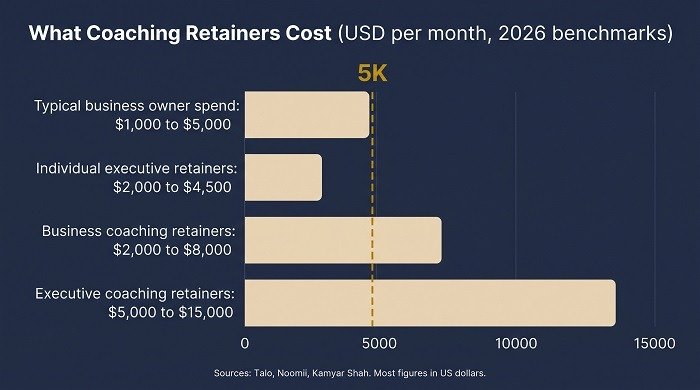
Many coaches now price leadership work as monthly retainers instead of hourly sessions. Published 2026 benchmarks put business coaching retainers at roughly $2,000 to $8,000 per month and executive coaching at $5,000 to $15,000, so a $5,000 retainer sits at the top of one range and the start of the other. At that level you typically get weekly one-on-one sessions, support between sessions, and a development plan tied to specific leadership behaviours. Confidence is one of the main things the investment is meant to build. Leaders who trust their ability to handle unfamiliar situations decide faster, speak with more authority, and steady their teams through change. Coaching that builds that self-belief with practical NLP tools, not motivation alone, is what makes a retainer worth paying. Most published figures are in US dollars, so compare Toronto quotes in CAD and confirm what each retainer includes.
Key Takeaway:
- Business coaching prices in Toronto vary by coach, service, and engagement model. Published 2026 North American benchmarks suggest business coaching retainers of $2,000 to $8,000 per month and executive coaching retainers of $5,000 to $15,000. These figures are generally in USD, and no reliable Toronto-specific public survey establishes local average fees. Confirm currency, taxes, and inclusions before comparing quotes.
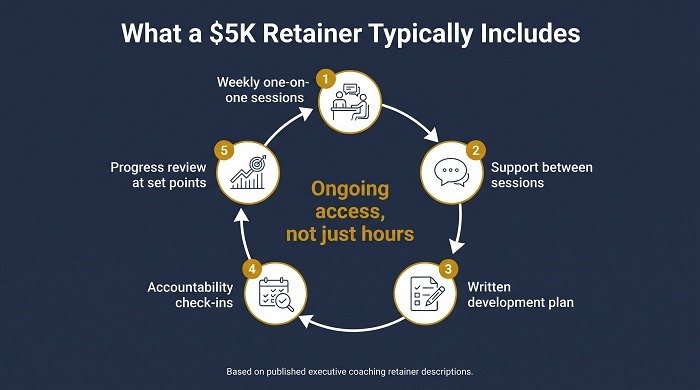
- Why monthly retainers matter: Leadership development requires consistent practice, feedback, and accountability rather than isolated conversations. A $5,000 monthly executive coaching retainer may include weekly one-on-one sessions, between-session support, and a structured development plan with measurable leadership goals. Always confirm the actual deliverables in writing.
- How to evaluate coaching ROI: Identify a specific leadership challenge, such as indecision, communication difficulties, or self-doubt. Practise new behaviours in real situations, collect feedback, and measure progress at 30 and 90 days. Confidence built through successful experience, known as self-efficacy, is more useful than relying on motivation alone.
- Choose the right pricing model: Hourly coaching suits a specific problem, a three-to-six-month package supports a defined goal, and a monthly retainer provides ongoing access and accountability. Group coaching can reduce costs but offers less individual attention. Compare credentials, coaching methods, session frequency, progress measures, cancellation terms, and support between sessions rather than choosing by price alone.
- When to rethink the investment: Coaching may not solve problems rooted in a broken revenue model, weak operations, or an unclear business strategy. Historical ROI studies suggest coaching can deliver substantial value in some settings, but they do not guarantee results for every client. Confirm that the real challenge is one coaching can address and that you can commit to practising between sessions.
Bottom Line: A $5,000 monthly business or executive coaching retainer can be worthwhile when it targets a clearly defined leadership gap and delivers measurable behavioural change. Before hiring a Toronto business coach, verify the fee in CAD or USD, agree on specific outcomes, and establish how progress and return on investment will be evaluated.
- Source: Unleash Your Power – Toronto Business Coach Pricing: The Shift to $5K Retainers
- Source: International Coaching Federation – Coaching Industry Research and Insights
How Much Does a Business Coach Cost in Toronto?
No reliable public survey breaks out Toronto coaching fees on their own, so the best guide is the wider North American market, where most figures are quoted in US dollars. Kamyar Shah’s 2026 breakdown puts business coaching at $200 to $500 per session or $2,000 to $8,000 per monthly retainer. It puts executive coaching at $500 to $3,000 per session or $5,000 to $15,000 per month.
Other guides land lower. Noomii’s 2026 guide lists individual executive retainers at $2,000 to $4,500 per month, and Talo reports that most business owners pay $1,000 to $5,000 per month. For context, the ICF’s 2023 global study shows an average coaching rate of about $244 per hour worldwide.
The spread is wide because the products differ. A $1,000 retainer and a $5,000 retainer rarely buy the same amount of access, preparation time, or accountability. A Toronto coach quoting in CAD adds one more variable, so ask for the currency and the inclusions in writing.
Why Are Coaches Moving From Hourly Rates to Retainers?
Retainers fit how leadership change actually happens. One hour a month rarely shifts a habit, while steady contact over several months can. The International Coaching Federation’s blog argues that retainers keep clients supported all month and protect coaches from burnout, which helps them deliver consistent work.
There’s a practical benefit for clients too. A flat monthly fee removes the temptation to skip a session to save money, and a hard week is exactly when coaching helps most. You also stop paying for the clock and start paying for an agreed result.
Retainers have a downside. If the contract doesn’t spell out outcomes, you can end up paying for access you don’t use.
What Does a $5K Monthly Retainer Include?
Kamyar Shah describes retainers in the $5,000 to $15,000 range as typically including weekly one-hour sessions, accountability check-ins between sessions, and structured development plans tied to leadership competencies. Lower business coaching retainers usually mean biweekly or monthly sessions focused on the business model, revenue strategy, and operating systems.
When you review a proposal at this level, look for these items:
- Weekly or biweekly sessions with a stated length
- Support between sessions, and how quickly the coach responds
- A written plan built around behaviours you can observe
- Progress reviews at set points, such as 30 and 90 days
- Assessment or 360 feedback where it fits your situation
Ask what the coach does between sessions. Preparation and follow-up are part of what you’re paying for.
Why Does Confidence Matter So Much in Leadership?
Leadership research has linked confidence to performance for years. A Journal of Leadership & Organizational Studies paper notes that researchers and practitioners agree confidence is integral to leader success. It also describes leader efficacy, a leader’s belief in their ability to organize people and resources, as a core outcome of development training.
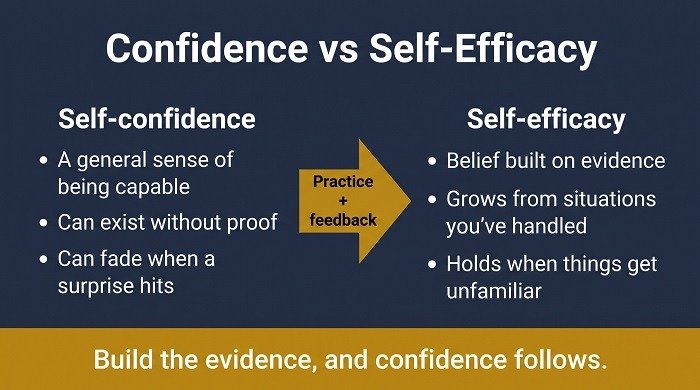
A distinction helps here. ZRG Partners points out that self-confidence is a general sense of being capable, while self-efficacy is belief built on evidence that you’ve handled hard things before. Confidence can exist without proof. Efficacy is the proof.
That’s why chasing a confident feeling often fails. A leader who has only pumped themselves up goes quiet when the first real surprise arrives. A leader who has practised handling surprises, with feedback, has something solid to stand on. One leadership article from AIM reports that formal learning combined with immersive experience builds leader self-efficacy, and it recommends 360 feedback and role play as starting points.
What Stops Leaders From Feeling Confident?
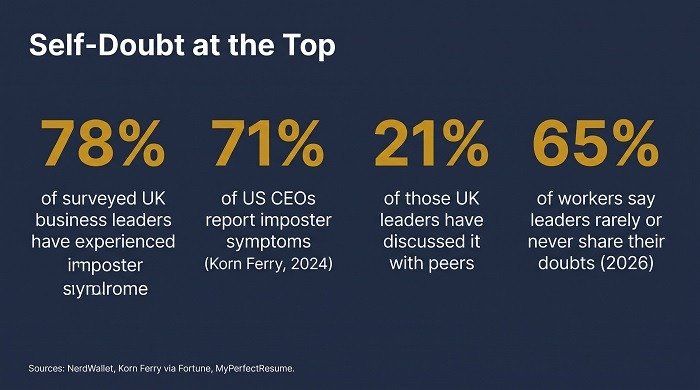
Self-doubt is common at the top. A NerdWallet survey of 500 UK business leaders found 78% had experienced imposter syndrome, and 59% had considered leaving a job because of it. In the US, a 2024 Korn Ferry survey reported by Fortune found that 71% of CEOs say they have imposter syndrome.
Starting a new role was the most common trigger in the NerdWallet data, at 57%. Only 21% of those leaders had talked about it with peers. Silence keeps the doubt private and makes it feel like a personal flaw.
A 2026 MyPerfectResume survey adds the pressure behind it. 66% of workers feel they need to look more confident than they are, and 65% say leaders rarely or never talk about their own doubts.
I once felt invisible in meetings, so I know how heavy that quiet doubt can feel. The tools that changed it were practical ones, and they work for leaders at any level. Mike L. came to James struggling with self-doubt, second-guessing, and anxiety that spilled into his career. After working through NLP techniques that quieted the mental noise, he started speaking to people with confidence and now communicates assertively at work.
If self-doubt is your sticking point, start with this guide to mastering self-doubt.
How Do Coaching Pricing Models Compare?
Hourly billing suits a single problem, packages suit a defined project, and retainers suit leaders who want ongoing change. Group coaching lowers the cost but gives up direct attention.
| Model | Typical range (USD, published) | Best for | Trade-off |
| Hourly or per session | $150 to $500 per hour for business coaching (Talo) | One-off decisions and trial sessions | No continuity between sessions |
| 3 to 6 month package | $3,000 to $25,000 (Talo) | A defined goal with an end date | Fixed term, less flexible |
| Monthly retainer | $2,000 to $8,000 business; $5,000 to $15,000 executive (Shah) | Ongoing behaviour change | You can pay for access you don’t fully use |
| Group coaching | $1,500 to $5,000 per participant (CareerMinds) | Managers building skills at scale | Less direct attention time |
Figures come from published guides, not Toronto-specific surveys. Sources: Talo, Kamyar Shah, CareerMinds.
Is a $5K Retainer Worth It?
It can be, when the engagement targets a specific leadership gap and you measure it. The evidence is encouraging but dated. A MetrixGlobal case study of 43 leaders at one Fortune 500 company reported a 529% return, rising to 788% when retention benefits were counted. A Manchester Inc. study summary of 100 executives reported a return of almost six times the cost, with 53% of executives reporting productivity gains.
Read those numbers carefully. They come from single studies, the MetrixGlobal work dates to 2001, and the participating companies chose to measure. They show coaching can pay back. They don’t show that every retainer will.
Kamyar Shah also warns that some founders spend heavily on coaching that solves the wrong problem, when the real issue is the revenue model or operations. Ask the ROI question before you sign. Our guide to measuring ROI from business coaching shows how.
Darren G. felt stuck despite a well-paying job, blocked from promotions, raises, and the idea of starting his own business. After James helped him find and clear his goal blocks, his thinking and behaviour shifted, and his relationships improved as well. In his case, the barrier was belief, not ability. Results vary from person to person.
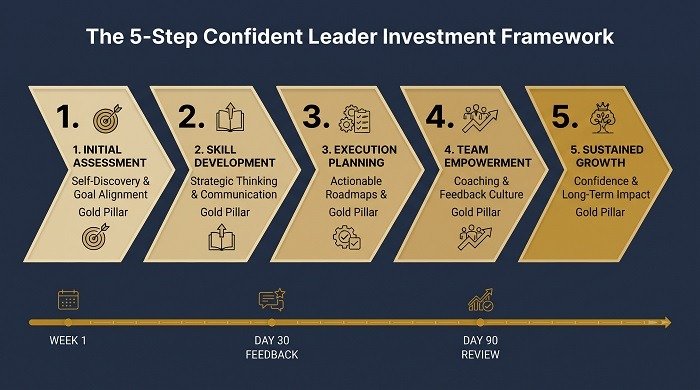
The 5-Step Confident Leader Investment Framework
Use these five steps to get value from any coaching retainer, whoever you hire. They map to the five pillars of Massive Success that guide James’s work.
Step 1: Clarify the Gap
Name one leadership situation where doubt costs you most, such as a board update or a hard conversation with a direct report. Write down what you’d do differently if you trusted yourself there. This is Pillar 1, Clarity of Vision.
Step 2: Reframe the Belief
Name one leadership situation where doubt costs you most, such as a board update or a hard conversation with a direct report. Write down what you’d do differently if you trusted yourself there. This is Pillar 1, Clarity of VisioFind the belief behind the hesitation, then test it. NLP reframing turns a thought like “they’ll see I don’t belong” into a question you can answer with evidence. This is Pillar 2, Confident Communication.
Step 3: Practise Live
Take the new behaviour into a real meeting within a week. Small, repeated reps build self-efficacy faster than insight alone. Try This: before your next meeting, rehearse your opening two sentences out loud, then deliver them as planned. For more exercises, see these NLP exercises to boost daily confidence. This is Pillar 3, Courageous Action.
Step 4: Track Visible Change
Agree on two behaviours others can observe, like speaking first on your topic or making the call without a second review. Ask one trusted colleague for feedback at 30 days. This is Pillar 4, Compelling Presence.
Step 5: Review and Extend
At 90 days, compare what changed against Step 1, then renew, adjust, or stop. With practice, many leaders see shifts within 3 to 6 months. Try This: at the end of each week, write down one moment you handled well and what you did. That record becomes your evidence. See how NLP improves leadership skills in Toronto for more. This is Pillar 5, Continuous Growth.
Who Should Use This?
- Leaders in a new or bigger role, where doubt tends to peak
- Founders moving from managing tasks to leading people
- Executives with a clear communication or decision-making gap
- People ready to practise between sessions, not only talk during them
Who Should Avoid This?
- Businesses whose real problem is the revenue model or operations. Shah’s analysis notes that coaching can’t fix a business that is broken at that level.
- Anyone who wants information more than behaviour change. A course or a book costs far less.
- Leaders who can’t commit to regular sessions and practice between them
- Anyone sold on a monthly number with no written outcomes
How Do You Compare Toronto Business Coaches?
Start with credentials and fit. A 2026 Toronto coaching guide from Noomii suggests looking for recognised credentials such as ICF or EMCC, and for a coach with a track record in your type of business. Then compare each retainer line by line: sessions, support, plan, measurement, and exit terms.
James R. Elliot brings proven strategies from 20+ years as an international NLP trainer and Board Designated Trainer. His business coaching in Toronto work centres on practical tools for confident, decisive leadership.
FAQs
How much does a business coach cost in Toronto?
There’s no public Toronto-specific survey, so use the North American benchmarks. Most business owners pay $1,000 to $5,000 per month, business coaching retainers run $2,000 to $8,000, and executive retainers run $5,000 to $15,000. Most published figures are in US dollars, so confirm currency and taxes in any quote.
Is a $5,000 monthly coaching retainer normal?
It falls inside published ranges. It’s at the top of the business coaching range and the start of the executive range. Whether it’s right for you depends on what the retainer includes and what outcomes are written into the agreement.
What’s the difference between confidence and self-efficacy?
Confidence is a general sense of being capable, and it can exist without evidence. Self-efficacy is belief in your ability for a specific kind of task, built from experience handling it. Leaders who build self-efficacy tend to stay steady when situations are unfamiliar.
How long does it take to build leadership confidence?
With practice, many leaders notice shifts within 3 to 6 months. Timing varies with your starting point and how often you practise in real situations, not only in coaching sessions.
Can coaching help with imposter syndrome?
Coaching can help leaders understand self-doubt and manage it, and it’s common even among CEOs. If the doubt is intense or affecting your health, talk with a mental health professional as well.
What should a coaching contract include?
Look for session frequency and length, support between sessions, written outcomes, progress review dates, cancellation and renewal terms, and the currency and taxes that apply.
Conclusion
A $5,000 retainer is worth what it changes in how you lead. The benchmarks show it’s a recognised price point, and the research shows that confidence built on evidence holds up when pressure rises. Start with one situation where doubt costs you most, then choose a coach who will help you practise it, measure it, and put it in writing.
Ready to talk it through? Book a conversation about business coaching in Toronto and take decisive action on the leader you want to be. Your transformation starts today, so take the first step.