
Business coaching has become an essential tool for companies looking to boost performance, improve leadership, and tackle challenges more effectively. But how do you measure the success of these coaching efforts? Simply put, the Return on Investment (ROI) of business coaching shows you whether the time and money spent on coaching are paying off.
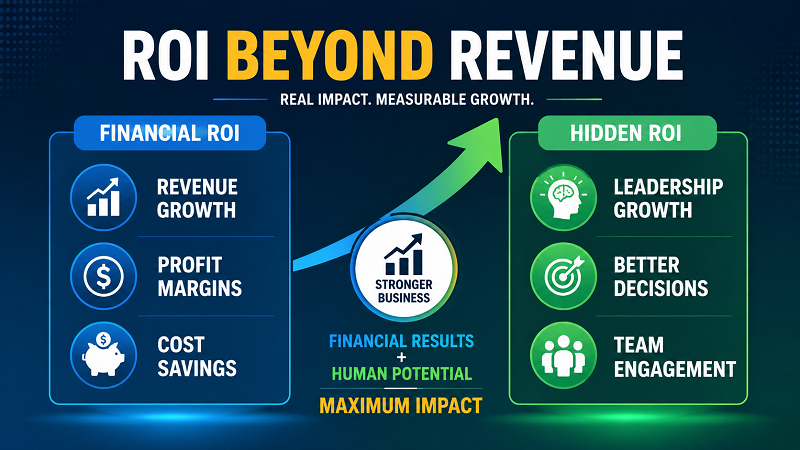
Measuring ROI from business coaching goes beyond just numbers. While financial metrics like revenue growth or cost savings are easy to track, there’s also the less tangible side: higher employee engagement, stronger leadership skills, and improved morale. So, how do you bring all these elements together and determine what the coaching actually contributed?
In this guide, we’ll explore the key metrics you can use to measure ROI from business coaching, share real-world examples, and address common challenges in evaluating success.
Let me show you how to assess whether your business coaching efforts are truly worth it.
Key Takeaway:
- Business coaching ROI is multi-dimensional—it includes both financial outcomes (revenue growth, cost savings) and intangible gains like leadership effectiveness, employee engagement, and decision-making quality. Relying only on profit metrics underestimates true impact. [1]
- Mechanism: Coaching drives internal changes first—improving mindset, communication, and leadership—which then translate into measurable outcomes like productivity gains, reduced turnover, and long-term business performance improvements. [1]
- How to measure: Combine quantitative metrics (revenue, profit margins, efficiency, retention rates) with qualitative data (employee satisfaction, leadership assessments, feedback surveys) to capture a full ROI picture. [1]
- What to do: Set clear baseline metrics before coaching, track progress consistently using performance data and surveys, and review results over time to connect improvements directly to coaching interventions. [1]
- When to be cautious: ROI can be hard to isolate due to delayed results, intangible benefits, and multiple influencing factors—avoid short-term judgment and instead measure across defined timelines with consistent benchmarks. [1]
Bottom Line: Business coaching ROI goes beyond revenue—track both financial and behavioral metrics over time to accurately measure impact and make smarter investment decisions.
- Source: Unleash Your Power – How to Measure ROI from Business Coaching
- Source: Unleash Your Power – Coaching Insights

Understanding Business Coaching and Its Benefits
Business coaching is a collaborative process that helps individuals and organizations achieve their goals by focusing on personal and professional growth. It’s more than just advice or training; it’s about guiding leaders, teams, and businesses through challenges, fostering development, and improving performance. Business coaching often involves working one-on-one with executives, managers, or entire teams to build key skills, improve communication, and enhance decision-making. It’s designed to empower individuals with the tools they need to succeed and drive the organization forward.
Here are some of the key benefits of business coaching:
- Improved Leadership: Coaching helps leaders sharpen their skills, making them more effective in guiding their teams and making strategic decisions.
- Enhanced Decision-Making: With the right guidance, leaders can approach challenges with a clearer mindset, leading to better decisions that impact the company’s growth.
- Increased Productivity: Coaching enables individuals to focus on their strengths, streamline their processes and ultimately boost productivity.
- Better Communication: Coaches help improve communication skills, ensuring that messages are conveyed clearly and effectively, leading to fewer misunderstandings within teams.
- Employee Engagement: Business coaching fosters an environment of personal growth, which can lead to more motivated and engaged employees.
- Conflict Resolution: Coaches provide tools to handle conflicts efficiently, reducing tensions and promoting a healthier workplace environment.
- Goal Setting and Accountability: Coaching helps set clear, actionable goals and holds individuals accountable, which can increase both individual and team performance.
- Stronger Company Culture: By focusing on leadership development, business coaching can strengthen company values, fostering a positive and supportive work culture.
These benefits combine to create lasting change, helping organizations become more efficient, resilient, and successful in achieving their goals.
What Is ROI in Business Coaching?
Return on Investment (ROI) in business coaching measures the value a business gains compared to what it spends on coaching. This includes both direct financial returns and indirect improvements that can be translated into monetary value.
According to a 2026 industry report by the International Coaching Federation, organizations report an average ROI of 5x to 7x when coaching outcomes are properly tracked and aligned with business goals.
ROI Formula:
ROI (%) = [(Total Benefits – Total Coaching Cost) ÷ Total Coaching Cost] × 100
Example:
If coaching costs $5,000 and generates $25,000 in revenue and savings:
ROI = (25,000 – 5,000) ÷ 5,000 = 400% ROI
How Do You Measure ROI from Business Coaching Step-by-Step?
1. Define Clear Business Goals
Set measurable targets before coaching begins:
- Revenue growth
- Productivity improvements
- Leadership performance
- Customer retention
2. Establish Baseline Metrics
Track current performance:
- Monthly revenue
- Conversion rates
- Employee output
- Operational efficiency
3. Track Progress During Coaching
Measure ongoing improvements:
- KPI tracking (weekly/monthly)
- Leadership behavior changes
- Team engagement

4. Quantify Financial Impact
Convert improvements into money:
- Revenue growth = direct gain
- Time saved = cost savings
- Reduced turnover = hiring savings
5. Calculate Final ROI
Apply the ROI formula using total gains vs total cost.
What Metrics Should You Track for Coaching ROI?
| Metric Category | Key Indicators | Business Impact |
|---|---|---|
| Financial | Revenue, profit margins | Direct ROI |
| Productivity | Output, efficiency | Cost savings |
| Leadership | Decision-making, alignment | Long-term growth |
| Retention | Turnover rate | Reduced hiring costs |
| Customer | Retention, satisfaction | Stable revenue |
Hard ROI vs Soft ROI: What’s the Difference?
| Type | Description | Examples |
| Hard ROI | Direct financial gains | Revenue increase, cost reduction |
| Soft ROI | Indirect performance gains | Leadership, confidence, communication |
Key Insight:
Soft ROI often drives long-term revenue growth, even though it’s harder to measure immediately.
How ROI Is Calculated in Real Businesses
Business coaching ROI is calculated by comparing pre-coaching and post-coaching performance across financial and operational metrics. All improvements, including revenue growth, cost savings, and efficiency gains, are converted into monetary value. These are then compared against the total coaching investment to determine ROI percentage. This structured approach ensures both direct and indirect benefits are captured.
Why Business Coaching ROI Is Often Underestimated
Most businesses underestimate coaching ROI because they fail to quantify intangible improvements such as leadership development, decision-making speed, and team alignment. These factors significantly impact long-term profitability. When properly measured, these “soft gains” can contribute more than 50% of total ROI over time.
How Long Does It Take to See ROI from Business Coaching?
- 1–3 months: Improved clarity, decision-making, productivity
- 3–6 months: Revenue growth, efficiency gains
- 6–12+ months: Leadership transformation, scalable systems
According to Harvard Business Review, companies that integrate coaching into leadership development see sustained ROI growth over 12–18 months.
Common Mistakes When Measuring Coaching ROI
- Not setting clear goals
- Ignoring baseline data
- Tracking only revenue (ignoring soft ROI)
- Stopping measurement too early
- Not linking coaching results to business KPIs

Overcoming Challenges in Measuring ROI from Business Coaching
Measuring the ROI of business coaching can be tricky. It’s not always about simple numbers. Some changes are hard to see right away, and some don’t have an easy way to be measured. But that doesn’t mean it’s impossible. Think of it like trying to measure how much a plant has grown. Some parts of it might be hidden beneath the soil, but with the right tools and patience, you’ll see it grow over time.
Here are some of the most common challenges businesses face when measuring ROI from coaching and how to tackle them:
Measuring Intangible Benefits
Not everything that coaching improves can be counted or directly tied to profits. Things like improved communication, better team morale, and stronger leadership aren’t easily measured by a spreadsheet. So, how do you track these kinds of benefits?
Solution: Use surveys and feedback to gauge employee satisfaction and engagement. You can also track progress through regular performance reviews or 360-degree feedback to see if leadership and team dynamics are improving. These tools give a clearer picture of softer, but valuable, outcomes.
Long-Term Impact vs. Short-Term Results
Some benefits of business coaching take time to fully show up. You might not see immediate financial growth, but that doesn’t mean the coaching didn’t work. It’s like planting seeds you won’t see the flowers right away.
Solution: Track progress over time. Set up benchmarks for both short-term and long-term goals, so you can compare where you are before, during, and after coaching. This way, you’ll get a better sense of how coaching affects long-term performance, even if the results aren’t instant.
Linking Coaching to Business Outcomes
How do you know if an increase in sales or a decrease in employee turnover is because of coaching or other factors? It can be tough to make a direct connection.
Solution: To isolate the impact of coaching, try using control groups or tracking multiple variables over time. For example, compare teams that received coaching with those that didn’t. This will help show the direct effects coaching had on the business.
Different Coaching Styles and Variations
Coaching isn’t a one-size-fits-all solution. Different coaches use different methods, and every individual or team may respond differently. This can make it harder to measure consistent results.
Solution: Standardize how you measure success. Even though coaching styles vary, you can still use consistent metrics to track progress, such as leadership assessments or productivity metrics. Make sure you have clear goals set out from the start, and evaluate whether the coaching met those objectives.
Lack of Clear Metrics
One of the biggest barriers to measuring ROI is not knowing what to measure. Without a clear set of metrics, you’re left guessing about whether the coaching is working.
Solution: Set clear, measurable goals from the start. Whether it’s improving productivity by a certain percentage, enhancing employee satisfaction or increasing leadership effectiveness, having specific targets to aim for makes it easier to measure whether coaching was a success.

FAQ: Measuring ROI from Business Coaching
How do you prove business coaching ROI?
You prove business coaching ROI by establishing clear baseline metrics before coaching begins and then comparing them with post-coaching performance. This includes tracking revenue growth, productivity improvements, cost savings, and leadership effectiveness. The key is converting both tangible and intangible improvements into financial value, so you can apply a clear ROI formula and demonstrate measurable business impact.
What is a good ROI for business coaching?
A strong ROI for business coaching typically ranges from 300% to 700%, depending on how well the coaching is implemented and tracked. However, high-performing organizations often exceed this range when they integrate coaching deeply into leadership and operational systems. The more aligned coaching is with business goals, the higher the return tends to be.
Can soft skills be measured in ROI?
Yes, soft skills can be measured in ROI by linking them to business outcomes. For example, improved leadership can increase team productivity, better communication can reduce errors, and stronger decision-making can accelerate growth. These improvements can be translated into financial gains such as increased revenue, reduced costs, and higher employee retention.
How often should ROI be measured?
ROI should be tracked continuously, ideally on a monthly basis, to monitor progress and make adjustments in real time. A more comprehensive ROI evaluation is typically done every 3 to 6 months to assess overall impact. Long-term ROI tracking (6–12 months or more) is essential to capture the full value of leadership and strategic improvements.
Is business coaching worth the investment?
Business coaching is worth the investment when it is structured, goal-driven, and properly measured. Companies that track ROI effectively often see significant improvements in revenue, efficiency, and leadership capability. Beyond financial returns, coaching also builds systems and skills that create long-term, sustainable business growth.
Conclusion
Measuring ROI from business coaching isn’t always a straightforward process, but it’s essential for understanding the true value of these investments. From tangible metrics like revenue growth and employee retention to the more intangible benefits like improved leadership and communication, business coaching can have a significant impact on both individuals and the organization as a whole.
Business coaching ROI is not just about immediate revenue gains. It’s about building better leadership, stronger systems, and smarter decision-making. Businesses that measure ROI correctly gain a competitive advantage and scale faster over time.
So, the next time you invest in business coaching, take the time to track and measure the results. With the right approach, you’ll not only be able to see the financial returns but also the lasting improvements in leadership, employee engagement and organizational performance. Business coaching can truly make a difference but only if you measure its impact properly.
Now that you know how to track ROI, it’s time to start implementing these strategies and see how your business coaching efforts pay off.