
Sleight of Mouth is a set of conversational reframing patterns used to answer an objection by shifting the frame around it rather than arguing its content. Instead of debating whether your fee is too high, you change what the fee is compared to. The patterns are associated with Robert Dilts, who worked to codify how skilled communicators respond to challenges, and are widely taught in Neuro-Linguistic Programming as an objection-handling tool.
Each pattern targets a different part of a stated belief: the intention behind it, the definition of its terms, the consequences of holding it, the size of the frame around it, or an exception to it. Used well, a pattern turns a wall into a question.
The limit is not the vocabulary. Most people who learn these patterns still fold in high-stakes rooms, because the reaction that fires first is not linguistic. It is physiological, and it was installed long before the meeting.
You already know what to say.
That’s the strange part. You’ve read the objection-handling posts. You have responses saved somewhere. Then the client’s ops lead says, “Honestly, this feels expensive for what it is,” and you hear yourself offering an extra workshop nobody asked for.
Key Takeaway:
- Sleight of Mouth is a set of conversational reframing patterns that defuse objections by changing the frame around a belief rather than arguing with its content. The approach can redefine terms, explore consequences, identify intent, narrow the issue, or introduce exceptions to shift the conversation.
- The pause often matters more than the perfect response. When challenged, people tend to speed up and become more defensive, so pausing before answering creates space to regulate your reaction and respond with a useful question instead of an impulsive defence. [1]
- For common objections, reframe the missing comparison instead of immediately discounting or over-explaining. For example, when someone says “It’s too expensive,” ask whether they mean the fee itself or the cost of continuing with the current situation. This turns a vague objection into something specific that can be examined.
- What to do: Pre-decide one response for your four most common objections, preferably as a question, then rehearse those responses aloud until they feel natural. Practice the emotional state as well as the words so the response remains accessible when pressure rises.
- When to be cautious: Reframing should not be used to force a prospect into a decision or disguise a legitimate objection. If the price, value, timing, or fit is genuinely wrong, the goal should be to clarify the issue rather than talk the person out of their judgment.
Bottom Line: Effective objection handling is less about memorizing clever lines and more about staying composed enough to change the frame of the conversation. Pause, ask better questions, and rehearse your key responses until they remain available when the pressure is real.
- Source: Unleash Your Power – Sleight of Mouth: How to Defuse Objections Under Pressure
- Source: Gong Labs – Sales Conversation Research
What Is Sleight of Mouth?
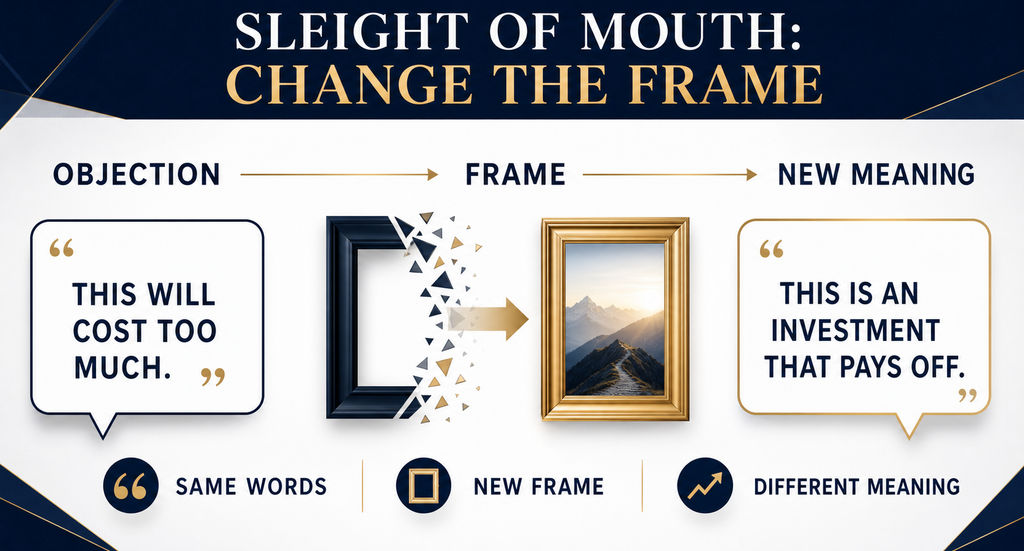
Sleight of Mouth is a collection of verbal reframing patterns for responding to objections, criticism, and stated beliefs. Rather than contesting whether a claim is true, each pattern changes the frame it sits in, which changes what it means.
The patterns are generally credited to Robert Dilts, who, with Todd Epstein, set out to codify how Richard Bandler, one of NLP’s co-founders, handled challenges in conversation. Worth being straight about provenance: that account comes largely from within the NLP community’s own literature, not independent scholarship. Treat it as the field describing itself.
The underlying principle has support well outside NLP. Amos Tversky and Daniel Kahneman showed in their 1981 work in Science that the same decision, described two ways, produces predictably different preferences. Frame isn’t decoration. Frame is part of the decision.
So when a prospect says your programme is expensive, they haven’t reported a fact. They’ve reported a comparison and you don’t yet know what they’re comparing it to.
Why Objections Derail Experienced Consultants
Here’s the thing to understand before any of the patterns are useful: when you feel challenged, your state changes before you choose your words. The words come out of whatever state you’re already in.
You can watch it in behaviour. Analysis of recorded sales conversations by Gong found that speaking pace jumps when someone is rattled by pushback from around 173 words a minute to roughly 188. Nobody decides to talk faster. It happens, and the room hears it.
Something else is happening across the table. A 2025 meta-analysis in Human Communication Research pooling 33 studies found that high-pressure, freedom-threatening language reliably increased both anger and counterarguing and both were associated with worse persuasion outcomes.
Read those together and you have the whole problem. Pushback speeds you up. Speed reads as pressure. Pressure produces more pushback. That’s not a communication gap; it’s a loop, and you’re powering it.
Why the First Three Seconds Beat the Best Pattern
The most useful move in objection handling isn’t a sentence. It’s the gap before it.
Gong’s analysis of 67,149 recorded sales meetings found that higher performers pause noticeably longer after an objection than elsewhere in the conversation the opposite of the instinct to fill silence. Stated precisely: the data shows longer pauses, not a specific count.
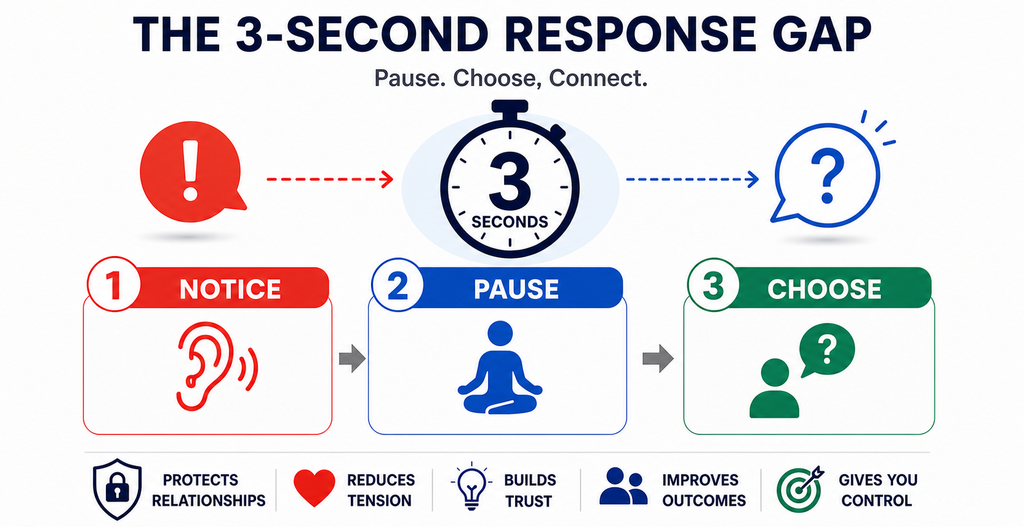
The practical version I teach is a count of three. That’s an editorial device, not a lab result. Three seconds is simply long enough to let the physical reaction crest before your mouth commits you to something.
What you do inside the pause matters too. Naming an emotion privately appears to change how it’s processed: Matthew Lieberman’s 2007 study in Psychological Science found that putting feelings into words reduced amygdala response and raised activity in a prefrontal region tied to regulation. In the room, that’s a silent, unglamorous note to yourself that stung a bit and then you speak.
Try this in your next call: count to three, then make the first thing out of your mouth a question rather than an answer. Harvard research by Karen Huang and colleagues found that asking questions, follow-up questions especially, increases how much people like the asker, because it reads as responsiveness. The pause buys the question. The question buys everything else.
The Sleight of Mouth Patterns, Translated Into Real Rooms
Most articles list fourteen patterns with abstract examples. Here are the ones that earn their place in a client meeting, matched against what you’re probably doing instead. Every response in the right-hand column is a question or a reframe, never a defence.
| Objection you hear | What most people do | Pattern | What it sounds like |
|---|---|---|---|
| “It’s too expensive.” | Discount, or justify the fee line by line | Redefine | “Expensive compared to what: the fee, or the twelve months this has already been running?” |
| “We’ve tried something like this before.” | Frantically differentiate yourself | Counter-Example | “What was different about the one time something did stick?” |
| “Now isn’t the right time.” | Manufacture urgency | Consequence | “If nothing changes for two more quarters, what does that actually cost you?” |
| “The team won’t adopt it.” | Defend the plan | Intent | “So what you’re protecting is adoption. What would make this easy for them to say yes to?” |
| “This feels risky.” | Reassure, at volume | Chunk Down | “Which part specifically: the timeline, the budget line, or who owns it?” |
| “I need to think about it.” | Push for the close | Another Outcome | “Makes sense. What’s the one thing you’d need to be certain of before it’s an easy yes?” |
| “You’re too small to handle this.” | Oversell your capacity | Meta Frame | “Fair concern. The question underneath it is whether this gets senior attention. Want to walk through how it’s staffed?” |
For the wider context, I’ve written separately on negotiating with NLP and how objections show up in sales conversations.
Read that column out loud. None of it is clever deliberately. Clever is what people reach for when they’re anxious, and rooms can tell.
What to Say When They Say “It’s Too Expensive”
Take the most common one properly, because the failure here is rarely verbal.
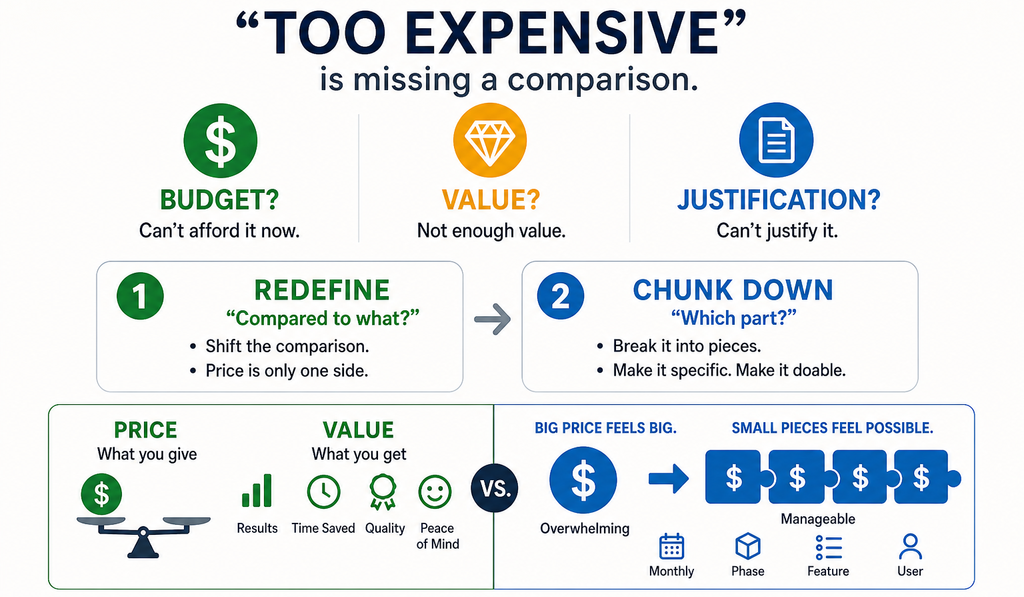
“Too expensive” is a comparison with a missing half. It might mean the budget isn’t there, or that they don’t yet see what they’re buying, or that somebody upstairs will make them justify it. Three objections wearing the same coat.
Redefine separates cost from price: “When you say expensive, the fee, or what it costs to keep solving this the way you’re solving it now?” Chunk Down gets specific: “Which part of the scope is carrying the weight for you?”
Both are simple. Both are available to you right now. And most people reading this will still discount next time, because the objection isn’t being answered by their strategy; it’s being answered by the programming underneath the pushback.
I know how that goes. For years my answer to any hesitation was to add another deliverable, another call, a slightly quieter number. Not because it was good business. Because disappointing someone in real time felt unbearable. That reflex built a business that took eighty hours a week to run, and I called it success right up until it wasn’t.
Why Sleight of Mouth Fails for Most People Who Learn It
Because the patterns are strategy, and strategy runs downstream of psychology.
Concretely: you can memorise every pattern in Dilts’ book and still do what you always do: over-deliver so nobody’s unhappy, undercharge so nobody pushes back, stay agreeable so the meeting stays pleasant. Those aren’t opinions. They’re reflexes that fire faster than vocabulary and hand your mouth a script you didn’t choose.
Jennifer (name changed) is the cleanest example I have. Extraordinary background, deep expertise, badly undercharging; she knew she should raise her prices and could not make herself do it. Not an information problem; she had the numbers. What changed it was deep reconditioning work, not affirmations. Within 60 days, she’d doubled her prices and more than doubled her revenue. Same expertise, same market, different self-concept.
Doubled her prices in 60 days. The strategy was never her problem. Her programming was.
There’s a second route: have fewer objections aimed at you at all. Tom (name changed) had twenty years of hard-won expertise and was invisible in his market, so every conversation opened with him justifying himself. Positioning rebuilt around his own story and methodology made him specific enough that the right clients recognised themselves immediately and he moved from long undercharged programmes to premium rates for focused engagements.
Twenty years of expertise, invisible. Then positioned properly, and the right clients came to him.
This is the mechanism behind the 5 Shifts to Freedom: performance psychology first, then freedom-first strategy, then freedom-first structure. Strategy without psychology is another unfinished course. Psychology without strategy is feel-good fluff that doesn’t pay the bills. You need both, which is why fourteen patterns on their own don’t survive contact with a real boardroom.
How to Make the Patterns Available Under Pressure
Availability under pressure is a rehearsal problem, not a memory problem. You don’t need to recall the pattern; you need it to arrive uninvited. Three things do most of the work.
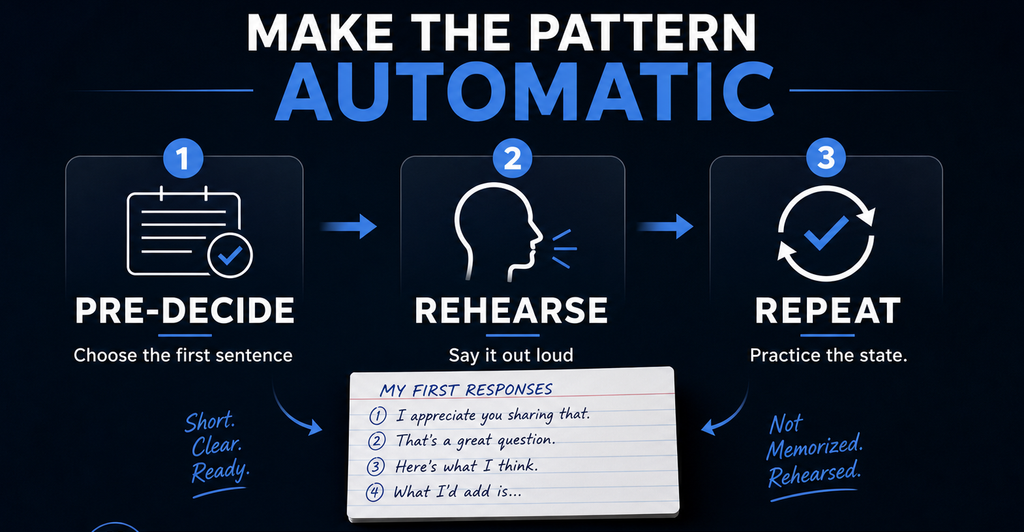
Pre-decide, don’t improvise: Take your four most common objections and write the exact first sentence you’ll say to each, usually a question. Pre-deciding removes the moment of choice, and that moment is where the old reflex gets in.
Rehearse out loud, badly, on purpose: Say them to an empty room until they bore you. Boring means the words have stopped carrying tension.
Rehearse the state, not just the script: Recall a meeting where you got pushed and folded, sit with the physical feeling, then run your sentence. You’re building the link between that feeling and this response, which has to exist before you’re in the room. More on language that lands with a room.
Try this before your next high-stakes meeting: write the four sentences on one index card, read them once in the car, then put it away. You won’t need it. That’s the point.
Is Sleight of Mouth Manipulation?
It can be, and the distinction is worth stating rather than hand-waving past.
The patterns are ethically neutral, the way a question is. What determines their character is the outcome you’re steering toward. Use a reframe to get someone to a yes they’ll regret and that’s manipulation, also bad business, since you’ll spend six months managing a client who was talked into it.
The honest test: the goal isn’t to make someone say yes. It’s to change the quality of the conversation. A reframe that helps a buyer see the comparison they’re actually making is a service, even when the answer is no. One designed to bypass their judgment isn’t.
There’s a practical argument too. Recall the reactance research: pressure generates anger and counterarguing, and both work against you. Manipulation isn’t just ethically shaky; it performs worse. If pushback in your world escalates rather than resolves, start with when disagreement turns into conflict.
The 6 Psychological Hacks, Applied Under Pressure
These are performance mechanisms for keeping yourself effective when the room gets hard, not techniques for operating on somebody else’s mind. Here’s what each does in a meeting.
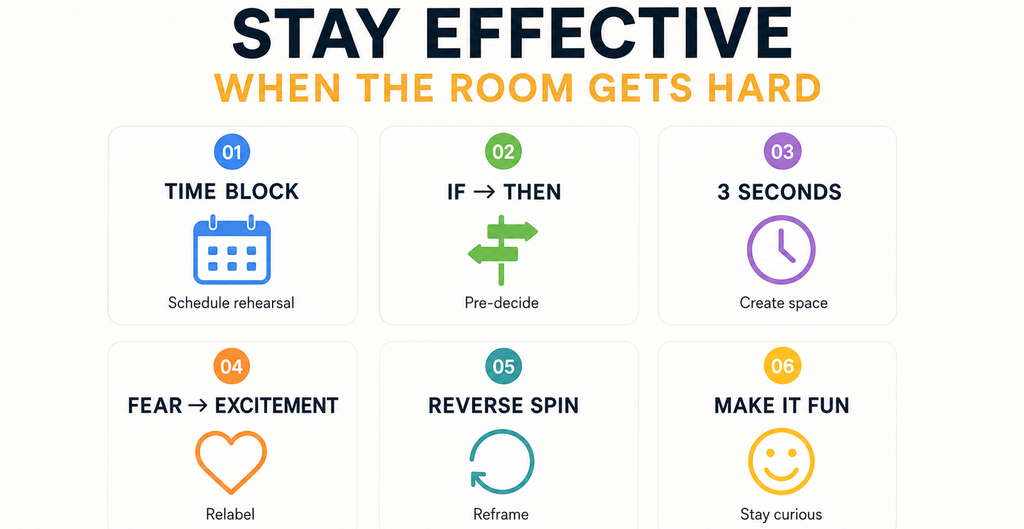
Time Blocking: Rehearsal only happens if it’s scheduled. Twenty minutes before the meeting that matters.
Implementation Intentions: If they say X, I say Y. Written, single sentence, decided in advance. Highest-leverage item here.
The 3-Second Rule: Count three before responding. The gap is where your judgement lives.
Fear to Excitement: Fear and anticipation feel nearly identical in the body. Relabel it and you keep access to your thinking.
Reverse Spin: Turn the objection’s direction. This is the pattern work itself, running on a nervous system that isn’t braced.
Make It Fun: Curiosity beats combat. Be genuinely interested in why they said it and you’ll ask a better question than any script gives you.
Who Should Use This?
- Consultants and coaches who lose the room on price, scope, or credibility despite knowing their material cold
- Practitioners who go quiet or over-explain when a decision-maker pushes back
- Anyone who has added scope, dropped price, or agreed to a call they didn’t want purely to make the discomfort stop
- People who learned objection-handling frameworks and watched them evaporate under pressure
Who Should Avoid This?
- Anyone after a scripted line that closes deals regardless of fit. Buyers detect it.
- Anyone whose objections are accurate. If the price really is wrong for the value, reframing is avoidance.
- Anyone hoping to take the patterns and skip the psychology of the exact failure described above.
- Anyone whose real problem is who’s in the room. If the wrong prospects keep showing up, positioning is the bottleneck, not language.
Data & Findings
| Finding | Source | What it means for you |
|---|---|---|
| Across 67,149 recorded sales meetings, higher performers paused longer after objections than at other points | Gong Labs | The pause distinguishes top performers; it isn’t a stylistic preference |
| Typical speaking pace runs ~173 words per minute; rattled responders accelerate to ~188 | Gong | State leaks through pace before it shows in content |
| Naming feelings reduced amygdala response and raised activity in a prefrontal region tied to regulation | Lieberman et al., 2007, Psychological Science | Silently naming the reaction is a usable in-room tool |
| 33 studies: freedom-threatening language increased anger and counterarguing; both linked to worse persuasion | Human Communication Research, 2025 | Pressure tactics measurably reduce your odds |
| Question-asking, follow-ups especially, increased how much partners liked the asker | Huang et al., 2017, JPSP | Leading with a question is better technique and better relationship |
| Identical decisions framed differently produce predictable preference reversals | Tversky & Kahneman, 1981, Science | Frame is genuinely part of how decisions get made |
Frequently Asked Questions
How many Sleight of Mouth patterns are there?
Most training material teaches fourteen patterns, though sources group and name them differently; some lists run to sixteen depending on whether variations are counted separately. The exact number matters far less than fluency in four or five. Practitioners who can deploy a handful reliably outperform people who can recite all fourteen and freeze in the moment.
What’s the difference between Sleight of Mouth and ordinary reframing?
Ordinary reframing changes how a situation is viewed. Sleight of Mouth is more targeted: each pattern operates on a specific structural part of a stated belief its intent, its definition, its consequences, its scope, or an exception to it. Reframing is the category; Sleight of Mouth is a systematised set of moves within it.
How long does it take to become usable under pressure?
Recognising the patterns takes an afternoon. Having one arrive unprompted while a decision-maker is looking at you is a different timeline, because that depends on rehearsal and on the reflexes underneath. Pre-writing responses to your four most common objections gets you usable in about a week. Getting to the point where pushback no longer moves you is deeper work.
Can you use these patterns in writing, not just conversation?
Yes, and email is arguably the easier place to start, because you get unlimited pause. A proposal that pre-empts the price objection by naming the real comparison cost of the engagement versus the cost of the status quo is doing exactly what the Redefine pattern does in a meeting. The one thing writing loses is the ability to ask a clarifying question and adjust.
Do you need NLP certification to use Sleight of Mouth?
No. The patterns are published and widely taught, and nothing about them requires accreditation to apply in your own conversations. Certification matters if you intend to train others or want structured supervised practice. For a consultant handling their own client meetings, practice against real objections beats a certificate.
Ready to Stop Folding in the Room?
Three things to take with you. The pause is worth more than the pattern. The objection you’re least able to answer is usually the one you have the most programming around. And the calm you see in people who handle pressure well isn’t a personality trait; it was built.
James is home for dinner these days with his phone in another room, trains most mornings, does martial arts twice a week, and takes a 36-minute nap without apologising for it. That was built too.
If you keep knowing exactly what to say and saying something else instead, that’s worth an honest conversation.
Book a Freedom Blueprint Call. We’ll find the one thing that’s actually keeping you stuck. No pitch unless you ask for one.