

Golden handcuffs are the financial and psychological ties that make leaving a role feel impossible even when you badly want out: deferred compensation, vesting equity, non-compete clauses, and, most stubbornly, a professional identity you spent years building.
Most advice treats this as a money problem and prescribes a savings runway. That advice is half right. The money is the visible half of the lock. The other half is the internal programming that quietly equates your worth with your output and that programming travels with you.
It is why so many people escape a demanding job and then build a business that demands more.
A career pivot becomes genuinely safer when you do three things: test the new direction through small, low-cost experiments before you commit; design the new work around the life you actually want instead of squeezing life into leftover hours; and deal with the patterns of over-delivering, undercharging, and refusing to hand anything off that would otherwise rebuild the same cage somewhere new.
Key Takeaway:
- Golden handcuffs are both financial and psychological. Deferred compensation, vesting equity, and professional identity can make leaving a secure career feel impossible, even when the work no longer aligns with your goals. The sunk cost fallacy and fear of losing status can keep you trapped in a role you have outgrown.
- Test a career pivot before resigning. Start with small, serious experiments while maintaining your salary, such as securing two paying clients, delivering a workshop, or completing a real-world project. Financial savings provide a runway, but tested experience provides evidence that the new career fits your skills, interests, and market demand.
- Set a measurable decision trigger before making the move. Define specific conditions, such as securing recurring clients who cover essential expenses, rather than waiting until you feel completely ready. This prevents endless preparation while reducing the financial pressure that can lead to poor decisions.
- Avoid rebuilding the same work trap in a new career. Over-delivering, undercharging, accepting unsuitable clients, and refusing to delegate can turn self-employment into another exhausting job. Address these patterns while building systems, setting boundaries, eliminating low-value tasks, and positioning yourself to attract the right clients.
- Design your new career around the life you want, not just the work you want to escape. Define your priorities, build scalable processes early, and assess whether your business model supports sustainable working hours. If you are experiencing acute burnout, lack market evidence, or face unresolved non-compete or vesting restrictions, stabilise your situation and seek appropriate professional advice before committing.
Bottom Line: A safe career pivot requires more than savings or the courage to resign. Test your next move, establish clear decision criteria, and change the psychological habits and business structures that could recreate the same golden handcuffs in a new career.
What Are Golden Handcuffs, Really?
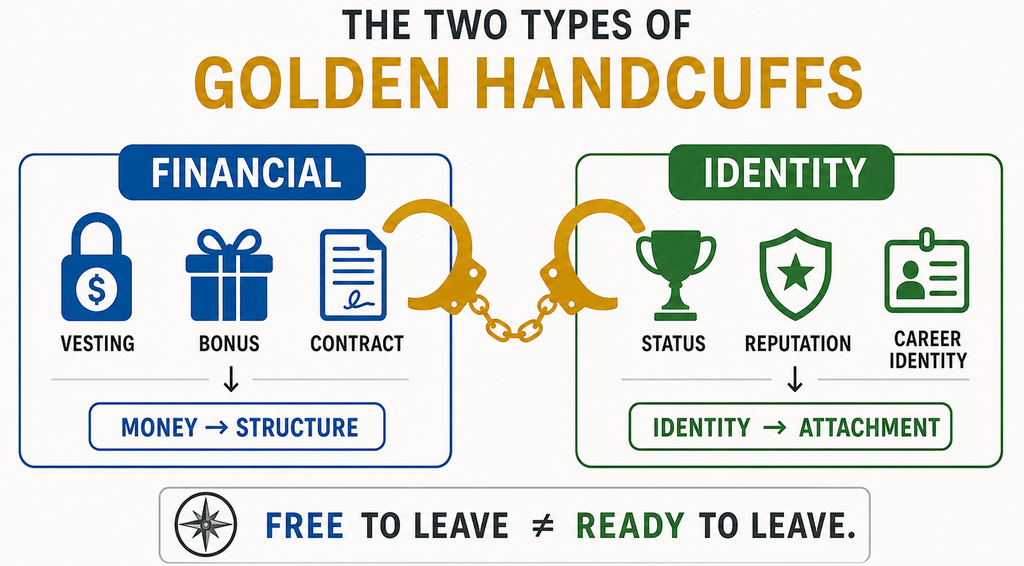
Golden handcuffs are incentives designed to make leaving expensive. In their classic form, they’re structural: vesting schedules, deferred bonuses, retention packages, and non-compete clauses that create a financial disincentive to walk away. Companies use them because replacing senior people costs a fortune. They work.
But the definition has widened. Financial planners now describe a newer, stickier version where the tie isn’t the compensation package at all but the person’s attachment to their own career identity. You can be financially free to leave and still feel unable to. The ability to make a change and the readiness to make it are two different things.
That’s the version this article is about. Because it’s the one that follows you.
Why Leaving Feels So Much Harder Than the Math Says It Should
You’ve probably run the numbers more than once. The numbers say you’d be fine. You’re still here.
That gap has a name. Career decisions are distorted by the sunk cost fallacy the pull to keep going because of what you’ve already invested- amplified by loss aversion: our tendency to feel losses more sharply than equivalent gains. The years, the credential, the reputation built in a specific room full of specific people none of it is recoverable. Rationally, it shouldn’t factor into the next decision. Emotionally, it’s most of the decision.
There’s a second distortion underneath. Research on golden handcuffs suggests people often stay not because they love the work but because they fear losing the respect and standing that come with the position. Worth sitting with honestly: are you staying for the work, or for what people call you at dinner parties?
Neither is shameful. But you can’t tell the difference between fear and intuition until you name which one is talking.
The Second Set of Handcuffs Nobody Warns You About
Here’s the part the escape-story articles leave out. They end at the resignation letter, roll credits, and never show you month eighteen.
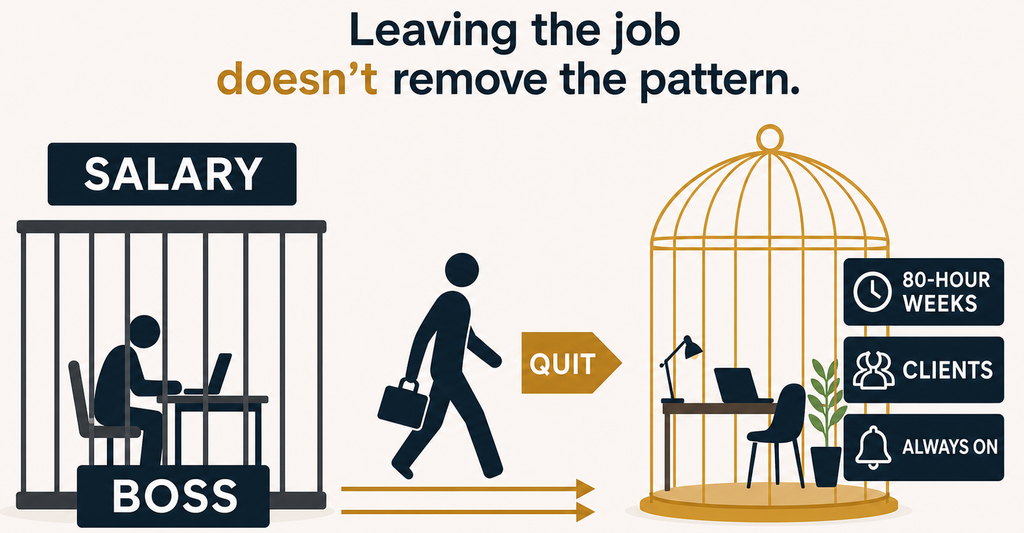
Month eighteen looks like this. You left. You built the practice. By every external measure, you’re free. And you haven’t taken a full weekend off since spring, you’re answering a client at 10:40 pm, and you’ve quietly started to resent the thing you gave up a salary to create.
This isn’t a theoretical risk. The labour data further down shows that self-employment routinely reproduces and often intensifies the exact hours people left to escape. It’s also the trap James walked into.
He spent 14 years in corporate IBM, Lenovo, and Novell. He left. He built businesses, eight of them over a decade. By the fifth, he was working 80-hour weeks, on anxiety medication, and calling that success. He’d broken out of one cage and spent ten years building a nicer one by hand. He describes it now as a prison with a very good view.
Then his niece asked him why he didn’t come and visit anymore.
That was the moment. Not the revenue chart, not the burnout, not the medication. A kid asking a reasonable question.
Marcus arrived with the same shape of problem from the other direction. Real business, real team, genuinely respected in his market and miserable in a way he couldn’t say out loud, because from the outside he had everything he’d said he wanted. Twenty clients down to nine premium ones. Sixty hours down to thirty. Revenue up. Same man, different mountain.
Why Most Career Pivots Rebuild the Same Cage
The uncomfortable answer: you weren’t the passenger in the first cage. You were, in part, the architect.
The patterns that made you valuable enough to be handcuffed in the first place the reliability, the over-delivery, the constitutional inability to let something go out at 90% don’t stay behind when you clean out your desk. They come with you. And in a business you own, with no manager to cap them, they run without a governor.
So it shows up as: taking the wrong-fit client because saying no feels rude. Undercharging because you can’t quite make yourself name the higher number. Rebuilding a deliverable at midnight that was already good. Staying visibly busy so you never have to make the one high-leverage decision that would change things.
None of that is a strategy problem. You know what to do. You’re not doing it, and knowing more won’t fix that.
That’s not a character flaw. It’s unexamined wiring doing exactly what it was built to do. It protected you for years. It’s simply the wrong tool now.
This is the causal claim at the centre of everything here: you’re not stuck despite working 60 hours. You’re stuck because you’re working 60 hours. The overwork isn’t the price of the plateau. It is the plateau.
What Actually Makes a Career Pivot Safe
Conventional advice says: decide what you want, save six months of expenses, then leap.
Half of that sequence is sound. Half of it is backwards.
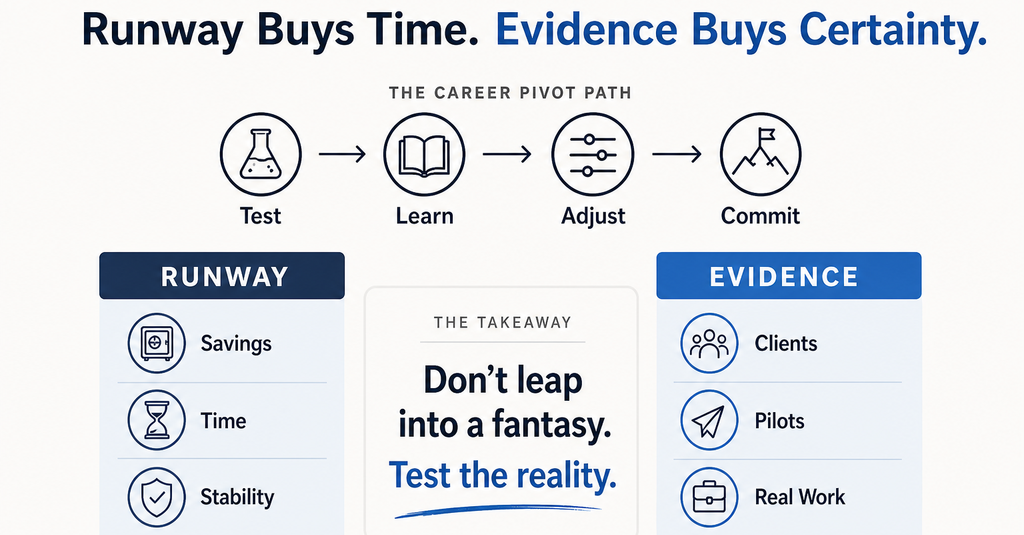
The financial half is fine; a runway genuinely protects you. It’s the decide-first, then act half that the research contradicts. In Working Identity, London Business School’s Herminia Ibarra found that successful career changers don’t figure it out and then move; they move and thereby figure it out. Knowing is the result of doing. Her guidance is to treat the next move as side projects and temporary assignments rather than binding decisions, pursue them seriously, and deliberately delay commitment while you compare experiences.
This reframes safety entirely. A runway buys you time. Evidence buys you certainty. Not the same purchase.
Practically: run small experiments while the salary is still landing. Two paying clients in the evenings. One workshop delivered. Sit with the actual work rather than the fantasy of it. Psychologists advising people in golden-handcuff roles say much the same: test-drive the next move before you quit.
It also means adjusting your timeline. Transitions unfold over years, not weeks disappointing if you wanted a clean answer by Friday, enormously relieving if you’ve been reading your slow progress as failure. Understand why real change takes the time it takes before you conclude something’s wrong with you.
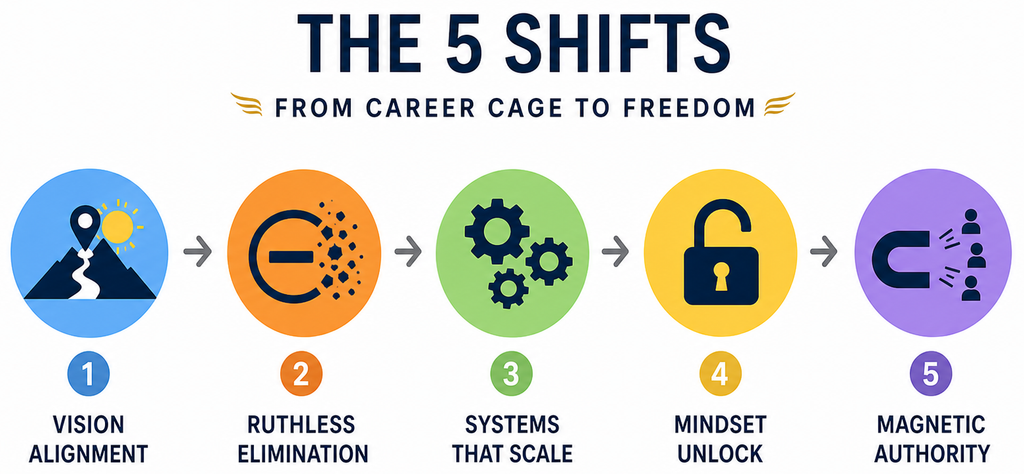
How to De-Risk the Pivot: The 5 Shifts to Freedom
The 5 Shifts to Freedom is the method James uses with coaches, consultants, and wellness practitioners the only method that rewires the unconscious programming keeping you overworked, then rebuilds your strategy and your business around your life.
It works because of three pillars operating together. Performance Psychology addresses why you can’t delegate, why you undercharge, why you over-deliver. Freedom-First Business Strategy cuts the 80% of activity that steals your time so the 20% can produce.
Freedom-First Business Structure redesigns operations, so you’re no longer the bottleneck. Strategy without psychology is another unfinished course. Psychology without strategy is feel-good fluff that doesn’t pay the bills. Structure without both is just a prettier prison.
Applied to a pivot:
Vision Alignment:
Define what you actually want, not the version you think you should want. Most pivots are aimed at escaping something rather than arriving somewhere, which is how people make decisions they can’t fully commit to.
Ruthless Elimination:
Before you add a business, subtract. If your current week has no slack in it, your pivot has nowhere to live.
Systems That Scale:
Build the new thing so it doesn’t require you in every seat. Do this early. Retrofitting is far more expensive.
Mindset Unlock:
Dismantle the programming that would rebuild the cage: the over-delivery, the discomfort with charging properly, and the self-doubt sitting underneath both.
Magnetic Authority:
Position yourself so the right clients recognise you immediately, which is what lets you charge premium rates for focused work instead of competing on volume.
David (name changed) is what Shift 3 looks like in practice. Brilliant at the work, completely trapped by it; everything ran through him. 30 days to get his expertise out of his head and into documentation. His assistant absorbed most of his inbox. He took his first real two-week holiday in five years, and the business grew while he was gone. That’s what happens when your expertise stops living in your head.
Three Ways to Exit: Compared
There’s no universally correct exit. There’s the one that matches your obligations, your evidence, and your tolerance for ambiguity. Most people should be running the third option and mistakenly believe they must choose the first.
| Approach | What it de-risks | What it doesn’t | Best for | Main failure mode |
|---|---|---|---|---|
| Clean break, resign, then build | Removes the divided attention; forces speed | Everything else. No market evidence, no client base, no tested identity | Those with a signed contract or a book of committed clients already in hand | Financial pressure forces you to accept every client who offers, rebuilding the cage in month three |
| Financial runway: save first, then leap | Cash pressure and the panic decisions it causes | Doesn’t tell you whether the work suits you. You can burn a full runway discovering you dislike the thing | Anyone with dependents, a mortgage, or genuinely irregular income | Runway becomes the goal. Number keeps moving. Five years pass |
| Overlap and test experiment while employed | Both the cash risk and the fit risk, at the same time | Slower, and demands real discipline about your calendar | Almost everyone, especially service-based pivots into coaching or consulting | Experiments stay hobby-sized forever because you never set an exit trigger |
If you take one thing from this table: pick a decision trigger before you start, not after. “I leave when three paying clients renew” is a plan. “I’ll know when it feels right” is a way of staying forever.
Data & Findings
Every figure below comes from published labour-force and survey data. These are five separate studies covering different countries and periods, not one dataset; the point is that the same pattern appears independently across all of them.
Canada, self-employed workers are over six times more likely to work long hours than employees. Statistics Canada’s Labour Force Survey (1976–2022 series) found that 24.4% of self-employed workers usually worked 50 or more hours per week, compared with 3.7% of employees. Only a third of the self-employed worked a conventional 35–45 hour week, against roughly seven in ten employees.
Europe, the pattern repeats. Eurostat’s 2025 release reports that 27.5% of self-employed people worked long hours, versus 3.4% of employees across the EU.
United States self-employment carries the highest concentration of 60-hour weeks of any sector. Gallup’s Work and Education surveys found 26% of self-employed Americans reported working at least 60 hours per week, a far larger share than any other sector measured.
Time off largely disappears. In Gallup’s survey of US microbusiness owners, one in five took no vacation days at all in the preceding year, with a further 21% taking a week or less. A separate US survey of small business owners found only 14% say they can completely disconnect while away, against 54% of American workers generally.
What this means: leaving the job removes the boss. It does not remove the hours. Anyone framing a pivot purely as an escape from overwork is planning against the evidence, which is why the psychological and structural work isn’t a nice-to-have bolted on afterwards. It’s the part that determines which side of these numbers you land on.
Who Should Make This Pivot
- You’ve proven you can deliver; some people would pay you directly today, and you know their names
- You’ve run at least one real experiment and the work itself held up outside the fantasy
- You can absorb an income dip without endangering housing or care for someone who depends on you
- Your reason is directional, not just escapist. You’re moving toward something specific
- You’re prepared to work on your own patterns, not only your business plan
Who Should Wait
- You’re in acute burnout right now. Decisions made in that state tend to be reactions. Stabilise first
- Your entire motivation is that you hate your manager. That’s a job change, and a much cheaper one
- You have zero market evidence: no paying client, no completed pilot, nothing outside your own head
- You’re inside a vesting cliff or non-compete window and haven’t taken proper advice on what it actually restricts
- You believe the pivot will fix the overwork by itself. Read the data section again. It won’t, unless you change how you build
There’s no prize for going early. A well-timed pivot with evidence behind it beats a brave one every time and a smarter relationship with risk is what separates the two.
Frequently Asked Questions
Should I leave before or after I’ve replaced my income?
Neither extreme serves most people well. Waiting for full replacement means most pivots never happen, because the target keeps moving. Leaving with nothing forces you to accept every client who offers, which recreates the trap. A more workable threshold is enough committed, recurring client work to cover essential costs, combined with evidence that you actually enjoy delivering it.
How long does a career pivot realistically take?
Longer than the internet suggests. Ibarra’s research on professionals in transition describes a non-linear process measured in years rather than months, with a genuinely uncomfortable middle period where the old identity has loosened but the new one hasn’t set. That messy middle is a normal stage, not a sign you’ve chosen wrong.
What if my non-compete or vesting schedule blocks me?
Get the document reviewed by an employment lawyer in your jurisdiction before you plan around it. Many restrictions are narrower in practice than they read, and some are unenforceable depending on where you are. That’s a legal question, not a coaching one. Meanwhile, nothing stops you from building skills, relationships and clarity inside the restricted window.
Is it normal to feel guilty about wanting to leave a good job?
Extremely. A well-compensated role that other people would want carries a strong social expectation of gratitude, and wanting out of it can feel like ingratitude. Guilt is information about your conditioning, not evidence about your decision. The two are worth separating deliberately.
Won’t self-employment give me more time with my family?
Only if you design for it. The data says the opposite happens by default: self-employed workers are several times more likely than employees to work 50-plus hour weeks, and a large share take almost no time off. Presence is an outcome of deliberate structure deciding what you won’t do, building systems that run without you not a natural consequence of leaving a job.
The Handcuffs Were Never Made of Gold
The lock was never really the compensation package. It was the belief that your value is the same thing as your output and that belief will happily follow you out of the building, set up shop, and get worse without a manager to contain it.
Which is genuinely good news. A pay structure isn’t something you can renegotiate on your own. Your programming is.
James is home for dinner now, with his phone in another room. Martial arts twice a week. He’ll take a 36-minute nap in the middle of a Tuesday without a flicker of guilt. That took rebuilding the psychology, the strategy and the structure together not just a braver decision.
If you’re weighing a pivot, or you’ve already made one and quietly rebuilt the cage, the useful question isn’t whether to go. It’s whether the real constraint is psychological, strategic, structural or the pattern connecting all three.
That’s what a Freedom Blueprint Call is for 30 minutes. We’ll find the one thing that’s actually keeping you stuck. No pitch unless you ask for one.