
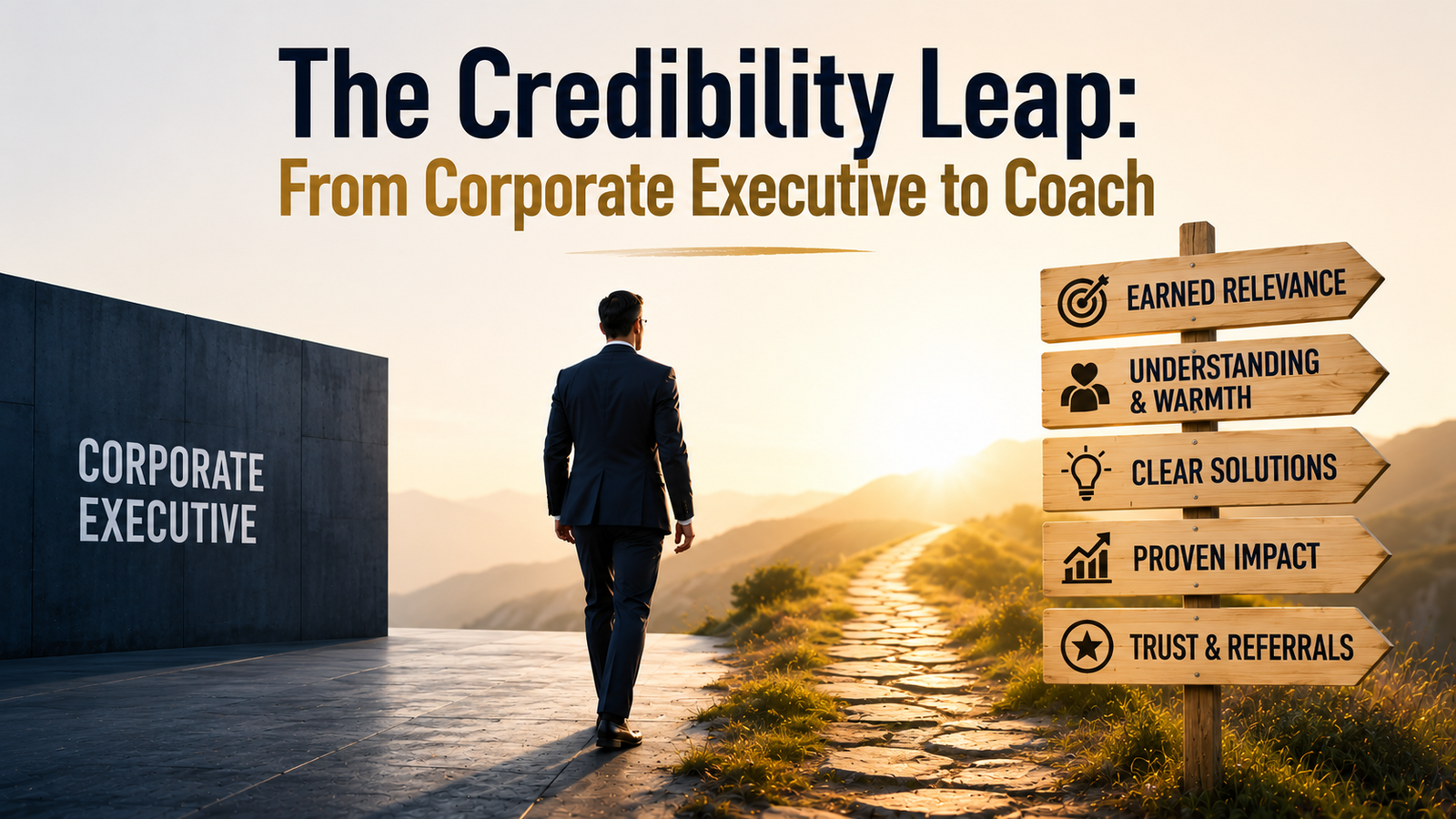
Corporate seniority and coaching credibility are two different currencies, and one does not automatically convert into the other. Inside a company, a title carried authority on your behalf; decisions were accepted partly because of the role you occupied. In a coaching practice, no title is doing that work for you.
Prospective clients assess two things: whether you understand their situation and mean well by them, and whether you are capable of helping. Research on social perception identifies these as the two foundational dimensions of human judgment, and finds the first carries more weight in what people do next. A résumé answers the second. Most former executives lead with it almost exclusively, which is why strong credentials often produce weak enquiry volume.
Buyer research in professional services ranks relevant reputation and the ability to make complex ideas understandable above professional certification as reasons a buyer selects an expert. The practical implication: the credibility gap is rarely a qualifications gap. It is a positioning and identity gap and it closes faster than the qualification route suggests.
Key Takeaway:
- Corporate executives transitioning into coaching must build credibility differently. Seniority and professional titles establish authority inside an organization, but coaching clients look for relevant expertise, a clear understanding of their problems, and evidence that you can help them achieve specific outcomes. [1]
- Why credentials alone fall short: Buyers evaluate trust, reputation, and the ability to explain complex ideas clearly, not just qualifications. Research cited in the article found that reputation among a buyer’s network ranked first at 56.5%, followed by the ability to make complex ideas understandable at 38.1%, while professional certifications ranked at 23.2%. [1]
- What to do: Define a specific coaching niche, identify the problems you solve, and translate your corporate experience into outcomes clients understand. Develop a repeatable coaching methodology, document client results, and communicate your expertise through targeted content, referrals, and visible professional insights. [1]
- Recognize the hidden credibility barrier: Over-preparation, undercharging, excessive work, and repeatedly pursuing additional certifications can reflect a belief that you must become more qualified before becoming visible. These behaviors may delay the positioning, outreach, and client conversations needed to build a sustainable coaching practice. [1]
- When to rethink the transition: Coaching is not simply an escape from a difficult corporate job or a route to semi-retirement. Before leaving, ensure you can clearly explain whom you serve, what problem you solve, and why your approach is relevant. Build a financial runway and be prepared to earn trust in a competitive market. [1]
Bottom Line: Your corporate experience is valuable, but it does not automatically establish coaching credibility. Translate your expertise into a specific client problem, a clear methodology, and demonstrable value. Build your positioning before collecting another credential.
What Is the Credibility Leap From Corporate Executive to Coach?
The credibility leap is the gap between the authority you held inside an organisation and the authority you have to earn in an open market.
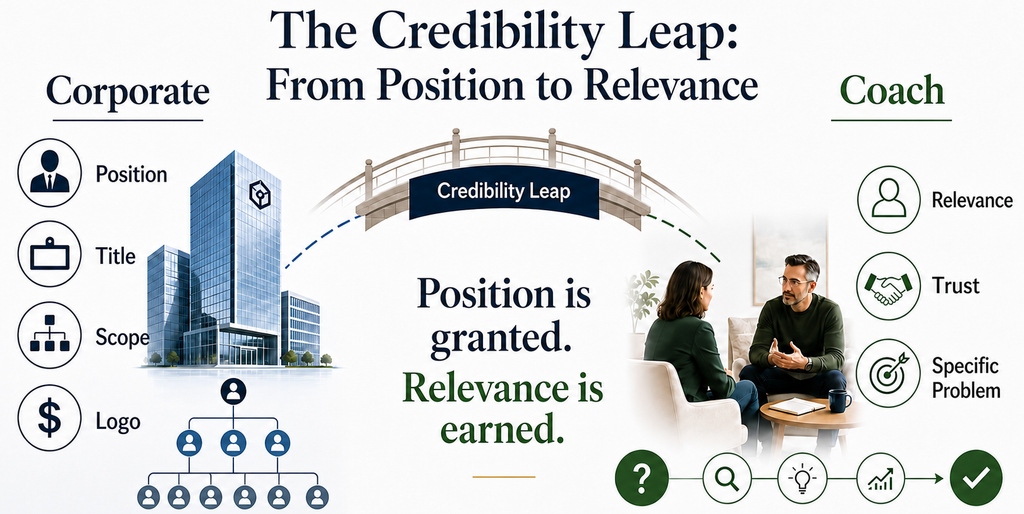
Two different currencies are at work. Positional authority was granted to you; it came with the role, the org chart, the budget, the logo on your email signature. Earned relevance is granted by the buyer, one at a time, based on whether you visibly understand their specific problem.
Positional authority doesn’t port. Earned relevance does but only if you translate the experience into the buyer’s language rather than presenting it in yours.
Here’s what makes the leap disorienting rather than merely difficult: it feels like starting over, and it isn’t. You have more raw material than almost anyone entering this market. You just have it stored in a format buyers can’t read yet.
Why Your Corporate Résumé Doesn’t Transfer Into Coaching Credibility
Your résumé transfers your competence. It does not transfer your relevance, and relevance is what gets you hired.
Inside the company, your title did the persuading before you opened your mouth. People accepted your judgement partly because of where you sat. That’s not a criticism; hierarchy is a shortcut for trust, and it worked in your favour for years.
Outside the company, your credentials aren’t doing that persuading anymore. They’re one input among several, and the thing buyers reach for first is whether you understand them.
That’s the reversal that catches senior people off guard. You spent two decades being evaluated on capability by people who already knew who you were. Now you’re evaluated on understanding by people who don’t. Scope of responsibility, headcount, regions covered all answering a question the buyer hasn’t asked yet.
And there’s a quieter problem underneath. Seniority can actually work against you at first contact. In the stereotype content model developed by Cuddy, Fiske and Glick, perceived high status reliably confers perceived competence but people read as competitors are judged as less warm. Lead with rank, and you can trigger the exact evaluation you don’t want.
What Do Buyers Actually Evaluate When They Choose a Coach?
Two things, on two separate dimensions and former executives underweight the one that carries more weight.
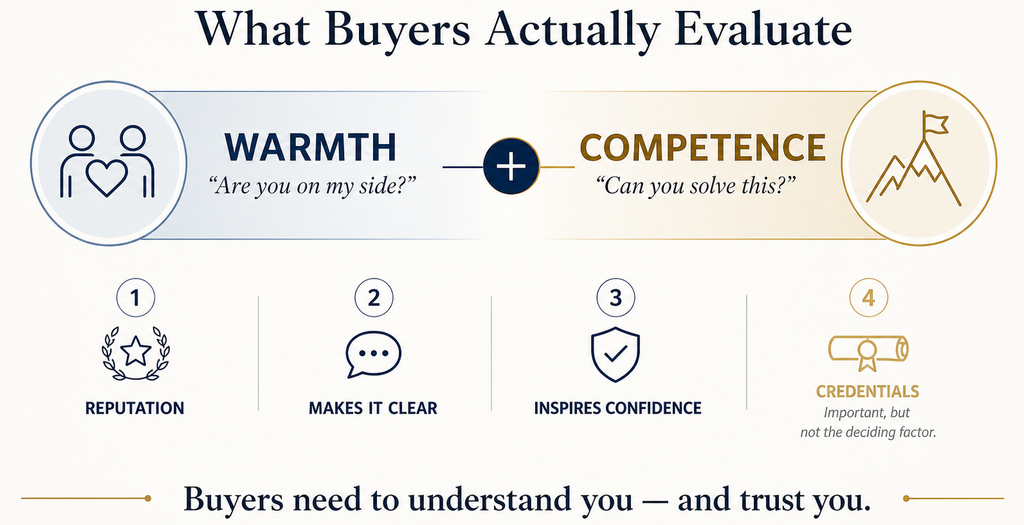
Start with the psychology. In their review of warmth and competence as universal dimensions of social cognition, Fiske, Cuddy and Glick describe warmth and competence as the two foundational dimensions of how people judge anyone, and report considerable evidence that warmth judgements are primarily formed early, weighing more heavily on what people do next. Warmth here isn’t likeability. It’s the read on your intentions: friend or foe, on my side or selling to me.
That’s a finding about human perception, not a study of coaching buyers. But it’s a fair lens on what happens when a prospect sees fourteen years at three recognisable companies: a competence answer arriving before the warmth question is settled.
In the Hinge Research Institute’s study of over a thousand professional services purchasers, Finding Experts, the most-cited factor in identifying an expert was reputation among the buyer’s own friends and colleagues, at 56.5%. Ability to make complex ideas understandable came next at 38.1%, then talent for inspiring confidence at 31.1%.
Professional certifications came in at 23.2%.
Read that ranking honestly. The two things outranking credentials are both about translation can you make my problem make sense to me, and do I feel steadier after talking to you. Neither appears on a résumé. Both are trainable.
Why More Credentials Won’t Close the Credibility Gap
Because the gap isn’t in your qualifications. It’s in your positioning and increasingly, in your willingness to be visible.
To be fair to the other side: credentials are not worthless. The 2022 ICF Global Consumer Awareness Study found a large majority of clients value working with a credentialed coach. If you’re weighing whether a certification is worth it at all, the honest answer is that it functions as a filter it gets you past the shortlist gate. It doesn’t win the decision. Different jobs, and confusing them is expensive.
Which is where the honest question comes in. At some point, another certification can become a delay tactic wearing a productivity costume, and only you know whether you’ve reached that point. It feels like building the business. It can also be the most respectable available way to postpone being seen.
The curse of expertise and why deep experience can make you harder to buy from
There’s a second, stranger cost to twenty years of experience. It can make you worse at explaining what you know.
Research on the curse of expertise found that people with more expertise were consistently worse at predicting how hard a task would be for a novice and resistant to debiasing techniques meant to correct it. Related work by Fisher and Keil on miscalibrated explanatory insight found experts overestimate their ability to explain their own domain more than an unfamiliar one.
Your knowledge has compressed into instinct. That compression makes you valuable, and unintelligible to a buyer still assembling the picture piece by piece.
Where the self-doubt is actually showing up
It rarely shows up as “I don’t feel qualified.” It shows up as behaviour.
It shows up as the fourth revision of a landing page nobody has seen. As over-delivering because disappointing someone feels unbearable. As undercharging, then resenting the client. As self-doubt surfacing as over-preparation rather than as an admitted feeling.
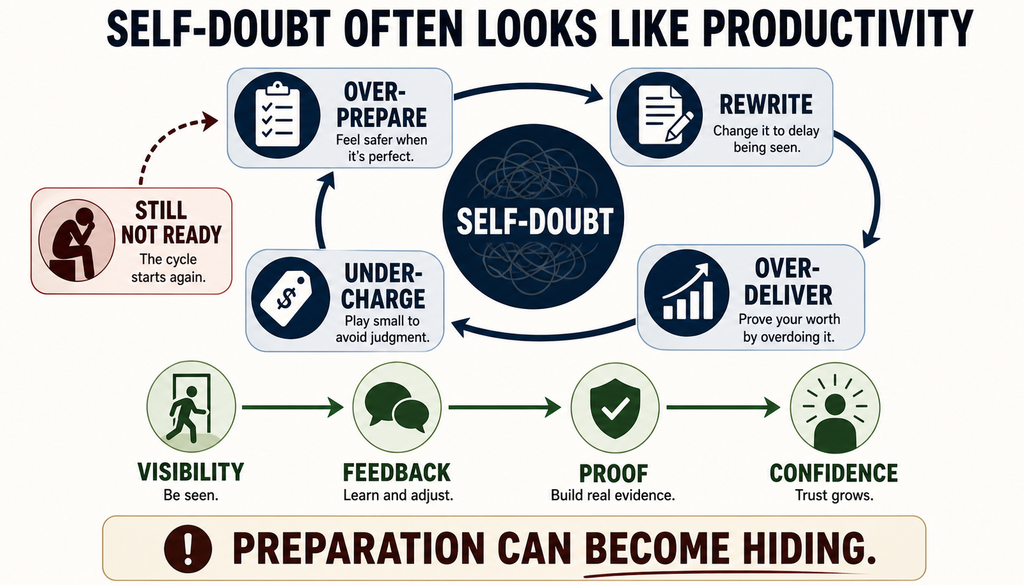
It’s common. A 2024 review in the Journal of Organizational Behavior cites the estimate that roughly 70% of people experience the impostor phenomenon at some point, though a systematic review in JGIM puts measured prevalence between 9% and 82% depending on the instrument, so treat the number with suspicion and the pattern as real.
Common isn’t harmless. It’s the mechanism quietly setting your ceiling.
Why the Corporate Identity Makes You Overwork Your New Practice
Often because you left the job and kept the operating system.
This one isn’t a research finding. It’s a pattern James sees repeatedly in the first two years of a new practice, worth checking yourself against rather than taking on his word. They wanted out of the 60-hour week. They built something that runs 70, and call it freedom because at least the hours are self-imposed.
Where it shows up, the rule driving it is usually some version of I have to earn the right to be seen. Not stated. Not conscious. Just quietly running, and producing exactly the behaviour it needs to justify itself. If credibility must be earned through volume, rest is theft and visibility is premature. Both conclusions keep you invisible.
You’re stuck because you’re working sixty hours. Not despite it. The overwork is the plateau, because the hours go into preparation nobody can see instead of positioning everybody can.
James knows the shape of this one from the inside. Fifth business, 80-hour weeks, on anxiety medication and calling it success and after 14 years inside IBM, Lenovo and Novell, he had every credential he thought he needed. What ended it wasn’t a strategy. It was his niece asking why he didn’t visit anymore.
These days he’s home for dinner with his phone in another room, and he takes a 36-minute nap without apologising to anyone for it.
Jennifer (name changed) arrived with an extraordinary background and real expertise, badly undercharging, fully aware she should raise her prices and completely unable to make herself do it. The work wasn’t a pricing workshop. It was deep reconditioning, not affirmations. Within 60 days, she had doubled her prices and more than doubled her revenue. Same expertise, same market, different self-concept.
Doubled her prices in 60 days. The strategy was never her problem. Her programming was.
How Coaching Credibility Actually Gets Built: The 5 Shifts to Freedom
The 5 Shifts to Freedom is the only method that rewires the unconscious programming keeping you overworked, then rebuilds your strategy and your business around your life. It works through The 3 Pillars: Performance Psychology, Freedom-First Business Strategy, and Freedom-First Business Structure. Because strategy without psychology is just another unfinished course, and mindset without systems is a prettier prison.
For the executive making this leap, the shifts run in this order for a reason.
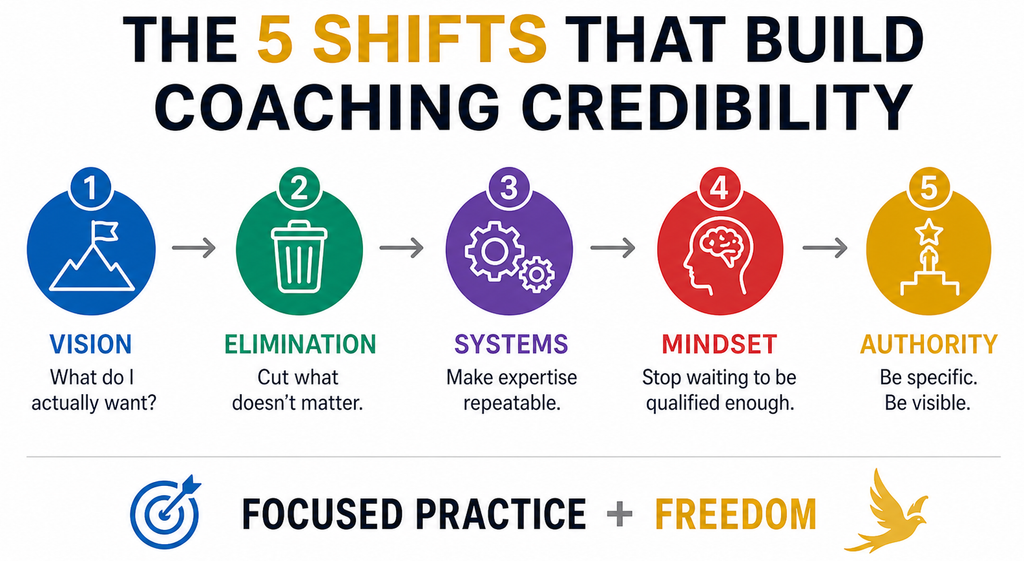
Vision Alignment:
Get specific about what you actually want, not what a successful practice is supposed to look like. Most people leaving corporate rebuild a smaller version of what they left, because it’s the only template they have.
Ruthless Elimination:
Cut the 80% of activity absorbing your time and producing nothing. For new practices, that’s usually audience width: three ideal clients, five service lines, nobody able to describe what you do in a sentence.
Systems That Scale:
Get your expertise out of your head and into something repeatable. This is also where the curse of expertise gets solved, because documenting a method forces you to articulate the steps you’d been skipping.
Mindset Unlock:
Dismantle the programming that says you must be more qualified before you’re allowed to be visible. The heaviest-lifting step for former executives, and the one they skip. It’s also where other people’s opinions, particularly former colleagues’, stop setting your ceiling.
Magnetic Authority:
Position yourself so the right clients recognise you immediately, and charge premium rates for focused work. Not louder. More specific. Specificity is what the strongest practitioners do differently.
Tom (name changed) had twenty years of hard-won experience and was virtually invisible in his market. He rebuilt his positioning around his own story and his own methodology, specific enough that the right clients immediately knew he was for them. He moved from undercharging for long programs to premium rates for focused engagements.
Twenty years of expertise, invisible. Then positioned properly, and the right clients came to him.
Corporate Credibility vs. Coaching Credibility
The verdict: these aren’t two levels of the same thing. They’re two systems with different granting authorities, accrual speeds, and failure modes. Treating one as a continuation of the other is the most common strategic error in this transition.
| Particulars | Corporate credibility | Coaching credibility |
|---|---|---|
| What confers it | Position, tenure, scope of responsibility | Demonstrated relevance to a specific problem |
| Who grants it | The organisation, once | Each buyer, repeatedly |
| How fast it accrues | Slowly, then permanently within that context | Quickly in a narrow niche, slowly across a broad one |
| What destroys it | Political missteps, restructuring | Vagueness and invisibility |
| Primary proof artefact | The résumé | A named method plus a specific client outcome |
| Failure mode | Plateauing inside the hierarchy | Being highly qualified and impossible to find |
What the Market Data Says
The market is more crowded than when you started considering this. The 2025 ICF Global Coaching Study estimates 122,974 coach practitioners worldwide, up 15% since 2023 and 54% since 2019, across more than 120 countries. Roughly nine in ten report active clients. Practitioner volume is rising faster than differentiation.
Visibility is getting harder, not easier. Hinge’s Inside the Buyer’s Brain research found buyers’ perception of firms as highly visible fell from 23.1% in 2020 to 14.6% in 2022 and that relevance and visibility move together, with firms rated highly on one tending to rate highly on the other. Being unfindable and being unspecific tend to reinforce the same underlying problem: weak differentiation.
The toll of running your own practice is measurable. In BDC’s 2025 survey of 1,510 Canadian small business owners, more than a third said mental health challenges interfered with their ability to work at least weekly 60% among owners under 40, against 19% of those 50 and over. Among those who sought professional support, 47% reported reduced anxiety. Canadian data, but the shape will be familiar wherever you operate: isolation is an occupational condition of solo practice.
Who Should Make This Leap?
- Operators with genuine depth in a specific domain, not general seniority
- People willing to be publicly visible, including in front of former peers
- Those with an existing network inside the domain they intend to serve
- Anyone with enough runway that the first client doesn’t have to be the right one
- People who want to do the work, not manage people doing the work
Who Should Not Make This Leap Yet?
- Anyone leaving mainly to escape a bad manager. That’s a job change, not a practice.
- Anyone who can’t name who they serve and what problem they solve, in one sentence, without hedging
- Anyone who needs this to replace their income immediately. Urgency and premium positioning are chemically incompatible.
- Anyone unwilling to be wrong in public. Visibility means being quotable, and quotable means occasionally quoted badly.
- Anyone treating coaching as semi-retirement. This market is more competitive than the one you’re leaving.
Frequently Asked Questions
Do I need a coaching certification to be credible?
It helps as a filter and it isn’t the deciding factor. Buyer research ranks reputation and clarity of explanation above certification. Get one if your market expects it; just don’t expect it to generate enquiries on its own.
How long does it take to build credibility as a new coach?
Faster in a narrow niche than a broad one, and that’s the variable most people get wrong. A specific position in a defined market compounds within months. General availability to everyone compounds slowly or not at all.
Should I lead with my corporate background or hide it?
Neither. Translate it. “Twenty years in enterprise software” is a competence claim. “I know exactly why your best engineer just quit, because I made that mistake at scale” is the same experience answering the question the buyer is actually asking.
Why am I working longer hours now than I did in corporate?
Usually because the rule that governed your career that you have to earn the right to be seen followed you out of the building. It now has no ceiling, because nobody sends you home at six.
What’s the first thing to fix?
Positioning, not credentials. Who you serve, what problem you solve, what you call your method. Everything downstream pricing, marketing, referrals gets easier or harder based on that one decision.
Conclusion
You are not underqualified. You’re mistranslated.
The experience is real, the capability is real, and the thing standing between you and a full practice may not be another credential at all; it may be the identity still quietly insisting you need one. That’s fixable, and faster than another certification cycle.
Which changes the question. If the problem is translation rather than qualification, it stops being what should I study next and becomes what has to change in how I position and operate. A harder question, and a much shorter road.
The Freedom Blueprint 30 Minutes Call. We’ll find the one thing that’s actually keeping you stuck. No pitch unless you ask for one.