

Boardroom charisma is not a performance skill. It is what remains when you stop needing something from the room. Most advice on commanding respect is additive: better posture, stronger stories, more preparation.
For consultants and advisors selling into corporate, that advice can make the problem worse. Before decision-makers can fully weigh your expertise, they are already forming impressions about confidence, competence and motive, and research on impression management shows that self-promotion can reduce trust in capable people rather than build it.
That is why visible need matters so much. Hedged language, over-explaining and answers that keep going past their natural end are commonly interpreted as uncertainty, regardless of how strong the underlying work is. Commanding respect without trying too hard means removing the behaviours that signal need, rather than adding behaviours meant to signal authority.
Those behaviours are rarely a skills gap. They are usually driven by the same unconscious programming that produces over-delivering and undercharging everywhere else in the business.
Key Takeaway:
- Boardroom charisma is not about performing confidence or dominating conversations. It comes from communicating genuine expertise with calm, clarity, and minimal need for approval. For consultants and advisors, removing behaviours that signal insecurity is often more effective than adding presentation techniques. [1]
- Why trying harder can backfire: Over-explaining, excessive self-promotion, unnecessary qualifiers, and pre-emptive discounts can undermine perceived credibility. These behaviours often reflect anxiety about disappointing others, causing capable professionals to appear less confident than their actual expertise warrants. [1]
- How to command respect: Ask thoughtful follow-up questions, seek relevant advice from decision-makers, and focus on diagnosing problems rather than delivering a lengthy pitch. When challenged, pause briefly and respond with one clear, direct sentence instead of filling the silence with qualifiers.
- Build lasting executive presence through three pillars: Performance Psychology addresses the beliefs driving over-explaining and undercharging; Freedom-First Business Strategy removes low-value activities; and Freedom-First Business Structure reduces operational dependence on you. Together, they create the capacity to communicate with greater composure and authority.
- When to rethink your approach: Charisma cannot replace genuine expertise, a differentiated offer, or relevant credentials. If your knowledge or positioning is weak, strengthen those foundations first. For established professionals, clearer positioning and reduced performance anxiety can help the right clients recognize their value without excessive persuasion.
Bottom Line: Boardroom charisma comes from removing the behaviours that undermine trust, not trying harder to impress decision-makers. Develop genuine expertise, ask better questions, communicate with precision, and build a business that gives you the capacity to lead with calm authority.
What Is Boardroom Charisma, Really?
Boardroom charisma is the quality of being taken seriously in a senior room without visibly working for it. It is not warmth, not volume, and not polish.
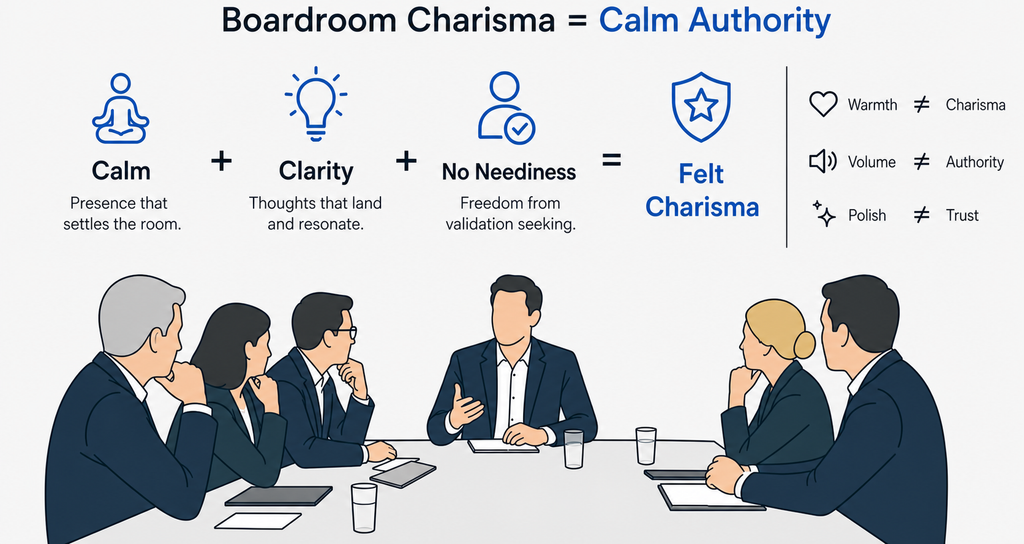
A useful distinction before we go further: charisma is the felt experience; authority is the underlying signal. People describe someone as charismatic when what they actually registered was calm, clarity and an absence of need. That is why most of this article is about trust, competence and positioning rather than delivery technique. Fix the signal and the felt experience follows.
The standard model of executive presence breaks it into three parts: gravitas, communication skills and appearance, with gravitas doing most of the work. That model was built for employees climbing an internal ladder. It assumes you already belong in the room.
You don’t. You’re an outsider being evaluated as a supplier, and the arithmetic is unforgiving. Gartner’s research finds that B2B buyers spend only about 17% of their total buying time meeting with potential suppliers, with six to ten stakeholders shaping a single decision. Split across competing vendors, your slice of that room’s attention is smaller than you think.
Which is precisely why trying harder is the wrong instinct. When you have forty minutes with eight people who have already done most of their thinking without you, the winning move is not to compress more of yourself into the space.
Why Does Trying Harder to Impress a Boardroom Backfire?
Trying harder backfires because effort is legible, and visible effort invites the question of what it might be covering.
This isn’t a matter of taste. In a large study published in PNAS, researchers found across online experiments and a field experiment that impression-management tactics such as self-promotion and intimidation can substantially backfire specifically for highly capable people. The proposed mechanism is uncomfortable: capable people are held to a higher standard on honesty and kindness, so self-promotion reduced perceived benevolence and integrity, and trust fell with them.
Ironically, then, the people with the most ability may have the most to lose from heavy-handed self-promotion.
Psychologists have a name for the underlying pattern: the self-promoter’s paradox. Overt claims about your own competence can lead the listener to assume you might be compensating for, or covering up, a lack of it.
So the forty-slide deck doesn’t necessarily read as thorough. The three case studies you worked into your opening don’t necessarily read as credible. There’s a real chance they read as a person who isn’t sure the room will conclude he’s good unless he tells them.
You’re not being under-valued in that boardroom because you under-prepared. You’re being under-valued because you’re over-performing.
What Do Executives Register First in a Meeting?
Executives register confidence signals early and tend to treat them as competence data sometimes before there is enough evidence to judge ability accurately.
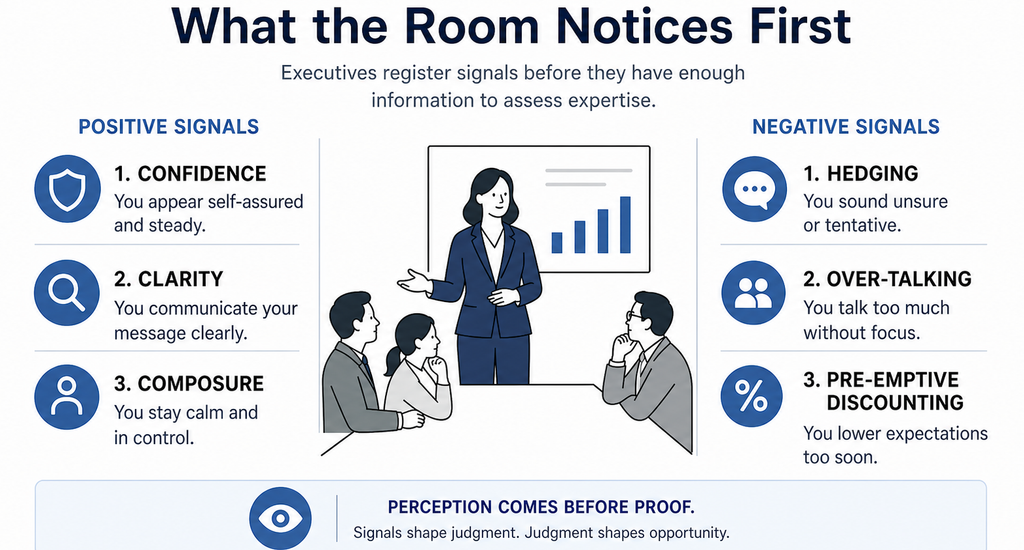
Berkeley researchers Cameron Anderson and Gavin Kilduff found that individuals high in trait dominance were rated as more competent by fellow group members, outside observers and research staff, even after controlling for their actual abilities.
That tells you something uncomfortable about senior rooms: perception can shape influence before anyone has enough information to assess you properly.
The trap is assuming the fix is to perform dominance. It isn’t; that’s the behaviour the PNAS work just told you carries a trust penalty. The fix is subtraction: remove the signals that broadcast uncertainty.
Here’s what those look like in practice, concretely:
- The answer that keeps going after it has finished, because silence feels like a verdict
- The pre-emptive discount, offered before anyone raised price
- “This might be off-base, but…” attached to your strongest point
- The slide you narrate line by line because you can’t tolerate them reading ahead of you
None of that is a communication deficit. Every item on that list is a person managing their own anxiety in public.
Why Do Consultants Over-Explain in Front of Executives?
Consultants over-explain in front of executives because over-explaining is over-delivering, wearing a suit.
It’s the same driver: disappointing someone feels unbearable, so you pre-empt it by giving more. More detail. More proof. More value than was asked for. In a delivery context, it looks like scope creep. In a boardroom it looks like a man answering a question that stopped being asked ninety seconds ago.
That’s not a presentation problem. That’s the programming running underneath the behaviour, and it doesn’t stay in one room.
Take Jennifer (name changed). Extraordinary background, real expertise and badly undercharging. She knew she should raise her prices. She could not make herself do it. The reconditioning work that followed was not affirmations; within sixty days she’d doubled her prices and more than doubled her revenue. Same expertise, same market, different self-concept.
Doubled her prices in 60 days. The strategy was never her problem. Her programming was.
The consultant who over-explains to a CFO and the consultant who discounts before being asked are the same person, running the same script, in two different rooms.
I know, because I ran it for years. In my fifth business, I was working eighty-hour weeks, on anxiety medication, calling it success and I walked into pitch rooms with forty slides because I could not sit with the possibility of being asked something I didn’t have covered. I thought that was diligence. It was fear, laminated.
Which is also why the tactical advice never sticks. You can memorise every technique for not worrying about what people think of you and still walk in carrying the weight of a quarter that depends on this contract. Buyers infer a great deal from that weight, and very little of it flatters you.
How Do You Command Respect Without Dominating the Room?
You command respect by taking up less airtime and more responsibility for the conversation’s direction.
Dominance is a poor bet anyway. It buys compliance rather than commitment, and in a buying committee, compliance evaporates the moment you leave the room. Two moves read as authority precisely because they don’t look like performing:
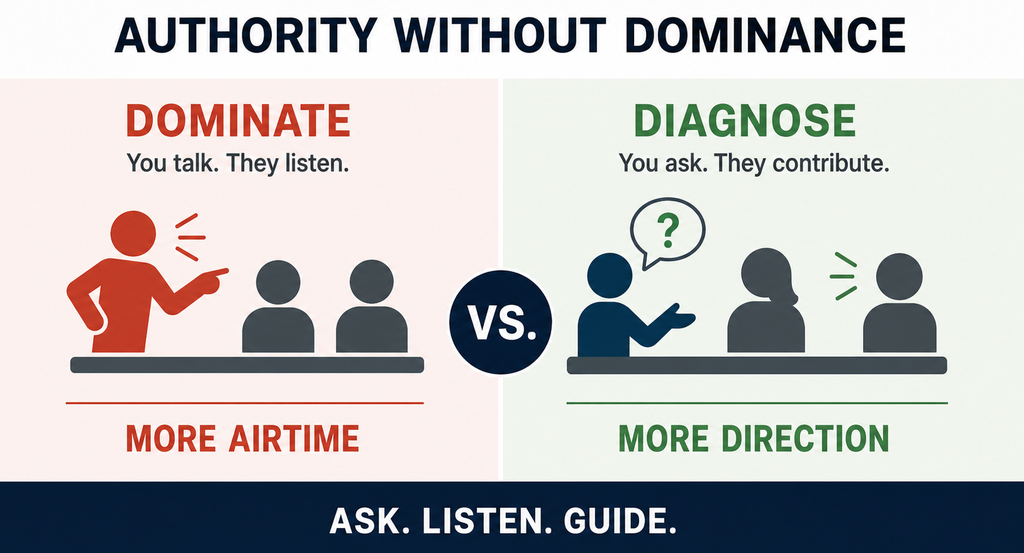
Ask and then ask again
Harvard researchers found across three studies of live conversations that people who ask more questions, particularly follow-up questions, are better liked by their conversation partners. And people consistently do not expect the number of questions they ask to influence how others see them. Your competitors are pitching. You’re diagnosing.
Seek advice inside the room
This one feels dangerous, which is why almost nobody does it. Researchers at Harvard and Wharton found that people are reluctant to seek advice for fear of appearing incompetent, but that this fear appears misplaced: advice-seekers were perceived as more competent than non-seekers, an effect strongest on difficult tasks and when advice was sought from the person directly.
Asking the COO how she’d sequence the rollout is not a retreat from authority. It is authentic influence rather than borrowed authority and it makes her a co-author of your recommendation.
What Do You Do When Someone Challenges You in the Room?
When you’re challenged, let one beat of silence land, then answer in a single clean sentence.
The instinct under challenge is to fill, soften, qualify, and add caveats. Resist it. Hedges are classified as powerless language, and along with hesitations and tag questions, they have been shown to decrease ratings of a speaker’s perceived confidence and competence. “I think maybe we could look at” costs you more than being wrong ever would.
This is where the 3-Second Rule from the 6 Psychological Hacks earns its keep. It isn’t a physiological intervention and I won’t dress it up as one; it’s a behavioural interrupt. Instead of letting pressure choose your first words, you choose them.
Try this: for your next three client meetings, ban four words from your own speech: just, actually, hopefully, sorry (when nothing has gone wrong). Write them on a sticky note inside your notebook. You’ll be startled how often you reach for them, and how much heavier your sentences land without them.
If the nerves themselves are the problem, that’s addressable too; the nerves tend to fade once the underlying mechanism changes, not once you’ve rehearsed harder. Same with the language patterns that hold up under pressure: they’re trainable, but only on top of a nervous system that isn’t bracing.
How Do You Build Boardroom Charisma Before You Walk In?
You build boardroom charisma by fixing your positioning, so the room has largely made up its mind about you before you speak.
This is Shift 5: Magnetic Authority, the final shift in The 5 Shifts to Freedom. And the reason it works where technique alone fails is the mechanism underneath it: the 3 Pillars.
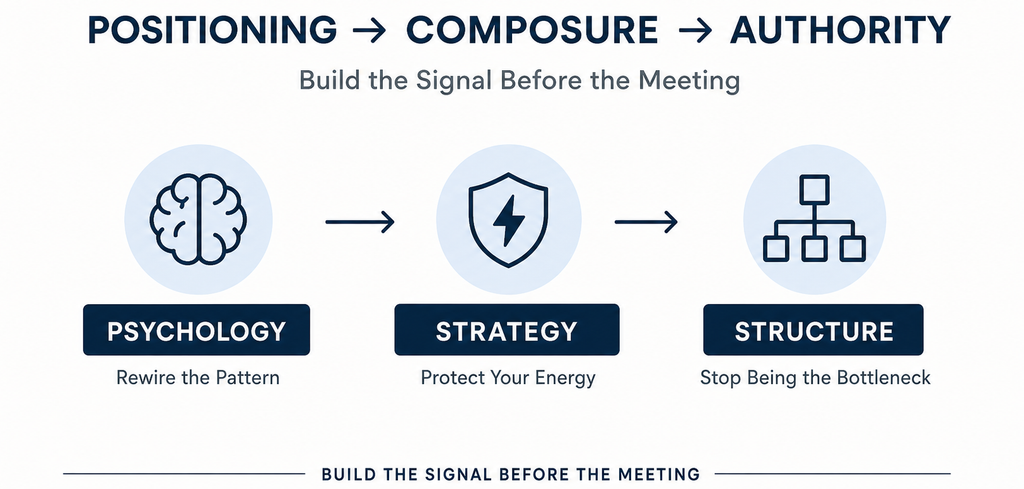
Performance Psychology:
Rewire the programming that produces over-explaining, discounting and over-delivering. You cannot present from a position of authority you don’t privately believe you hold.
Freedom-First Business Strategy:
Cut the 80% of activity stealing your time and energy. Nobody walks into a boardroom composed on four hours of sleep and a calendar they resent.
Freedom-First Business Structure:
Redesign operations so you’re not the bottleneck, which is what creates the capacity to be selective about which rooms you enter at all.
Strategy without psychology is another unfinished course. Psychology without strategy is feel-good fluff that doesn’t pay the bills. Structure without both is a prettier prison. You need all three working together.
Tom (name changed) had twenty years of hard-won experience and was effectively invisible in his market. He rebuilt his positioning around his own story and methodology specific enough that the right clients immediately recognised he was for them. He went from undercharging for long programmes to premium rates for focused engagements.
Twenty years of expertise, invisible. Then, positioned properly, the right clients came to him.
He didn’t get more charismatic. He got harder to confuse with anyone else.
And here’s the part that sounds like a lifestyle claim but is actually a competitive one: I train most mornings, do martial arts twice a week, and take a 36-minute nap without apologising to anyone for it. When I walk into a client meeting, I am not carrying a week. That composure is not a technique I deploy. It’s a by-product of a business that stopped consuming me.
Who Should Use This Approach?
- Consultants, advisors and coaches who are genuinely good at the work but keep losing rooms to less capable competitors
- Anyone who replays their own sentences on the drive home
- Practitioners whose proposals get respect but whose presence doesn’t
- People who over-prepare as an anxiety strategy and call it professionalism
Who Should Avoid This Approach?
- Anyone whose real gap is subject-matter depth. Presence cannot cover for not knowing your material, and shouldn’t.
- Anyone looking for a manipulation script. Everything here works by removing pretence, not adding it.
- Early-stage practitioners still building a body of work. Positioning amplifies substance; it doesn’t substitute for it.
- People who want a one-meeting fix. This is a change in what you’re carrying, not what you’re saying.
Performed Authority vs. Carried Authority
Both get you through the door. Only one holds up under an unscripted question.
One clarification worth stating plainly, because it’s the most common misreading: carried authority does not compensate for missing competence. It allows real competence to be perceived without excessive performance. If the expertise isn’t there, nothing in this article will manufacture it.
| Particulars | Performed Authority | Carried Authority |
|---|---|---|
| Core method | Add signals: polish, volume, proof, preparation | Remove signals of need |
| What it communicates | Effort which invites the question of what it’s covering | Composure, which tends to be read as competence |
| Where it holds | Scripted presentations, first impressions, short meetings | Interrogation, silence, unexpected objections, long sales cycles |
| Where it breaks | The unscripted question; the second meeting | Rooms that genuinely require credentials or depth you lack |
| Energy cost | High, depleting, requires sustained maintenance | Low; it’s a by-product, not an act |
| Ideal user | Nobody, long-term | The competent practitioner who is under-respected relative to their work |
Data & Findings
Six sourced findings on how respect is allocated in senior rooms.
1. Self-promotion can reduce trust in capable people. Across online laboratory studies and a large field experiment, researchers demonstrated that impression-management tactics can substantially backfire, at least for those with high ability, with the effect running through reduced perceptions of benevolence and integrity. PNAS, Reimann & Schilke, 2022
2. Perceived competence can outrun measured competence. People high in trait dominance were rated as more competent by peers, observers and staff even after controlling for their actual abilities. Journal of Personality and Social Psychology, Anderson & Kilduff, 2009
3. Asking for advice raised perceived competence. Advice-seekers were perceived as more competent than non-seekers, an effect strongest on difficult tasks and when advice was sought from the person directly. Management Science, Brooks, Gino & Schweitzer, 2015
4. Follow-up questions build liking, and nobody expects it. Across three studies of live conversations, people who asked more questions were better liked, yet people do not anticipate that question-asking influences how others perceive them. JPSP, Huang, Yeomans, Brooks, Minson & Gino, 2017
5. Hedging carries a credibility cost. Hedges, hesitations and tag questions have been shown to decrease ratings of a speaker’s perceived confidence and competence. Psychonomic Bulletin & Review, 2012
6. Your time in the room is scarcer than you assume. Gartner’s research finds B2B buyers spend only about 17% of their total buying time meeting with potential suppliers, with six to ten stakeholders shaping a single decision, meaning your share of any one committee’s attention is a fraction of that. Gartner B2B buying research
Frequently Asked Questions
Is charisma something you’re born with, or can it be learned?
The behaviours that read as charisma are learnable, but they’re learned by removal rather than addition. Most people trying to build charisma are adding things stories, gestures, energy on top of an underlying anxiety that tends to leak anyway. Address what’s generating the anxiety and the presence usually follows.
How is this different from standard executive presence training?
Executive presence training is largely written for employees seeking internal promotion, and it assumes you already belong in the room. As an external advisor, you’re being evaluated as a supplier and you need something from the meeting. That changes what people are watching for, and it makes “try harder” advice actively counterproductive.
Won’t asking questions make me look like I don’t know the answer?
That’s the fear the research complicates. In controlled studies, advice-seeking was read as a competence signal rather than a weakness signal, particularly on genuinely difficult problems and when you ask the decision-maker personally. The distinction that matters is asking to understand their situation versus asking because you haven’t done your homework. Senior buyers tell the difference quickly.
What if I’m the least senior or least credentialed person in the room?
Then don’t borrow authority you don’t have; that’s when performed authority collapses fastest. Anchor on the one thing you genuinely know better than anyone present, be specific about it, and be equally direct about what sits outside your lane. Clear boundaries read as confidence. Vague coverage of everything reads as bluffing.
How long does it take to change how I show up in senior rooms?
The surface behaviours dropping hedges, pausing under challenge shift within a few meetings of deliberate practice. What takes longer is the underlying pattern driving them, because that pattern is also producing your over-delivering and your reluctance to raise prices. That’s typically a matter of weeks of structured work, not a single mindset breakthrough.
Does this work in virtual meetings and video calls too?
Yes, and arguably more so. On video, there’s less to perform with no room to command, no materials to spread out, so the residual signals carry more weight. Pauses read longer, hedges are more audible, and over-explaining is more obvious when everyone can see the clock.
Bringing It Together
Boardroom charisma isn’t a set of moves you deploy at 9 am on Tuesday. It’s what’s left over when you’re not walking in carrying a week you resent and a quarter that depends on this one meeting.
That’s the uncomfortable part: you can’t perform your way out of needing the contract. Decision-makers pick up the need, no matter how good the deck is. What changes their read is changing what you’re actually carrying: the programming underneath the over-explaining, the strategy that’s eating your week, and the structure that makes you the bottleneck in your own business.
You already know you’re capable of more. The room just hasn’t seen it yet, because it’s been watching you try.
Book a Freedom Blueprint 30 minutes Call. We’ll find the one thing that’s actually keeping you stuck. No pitch unless you ask for one.