
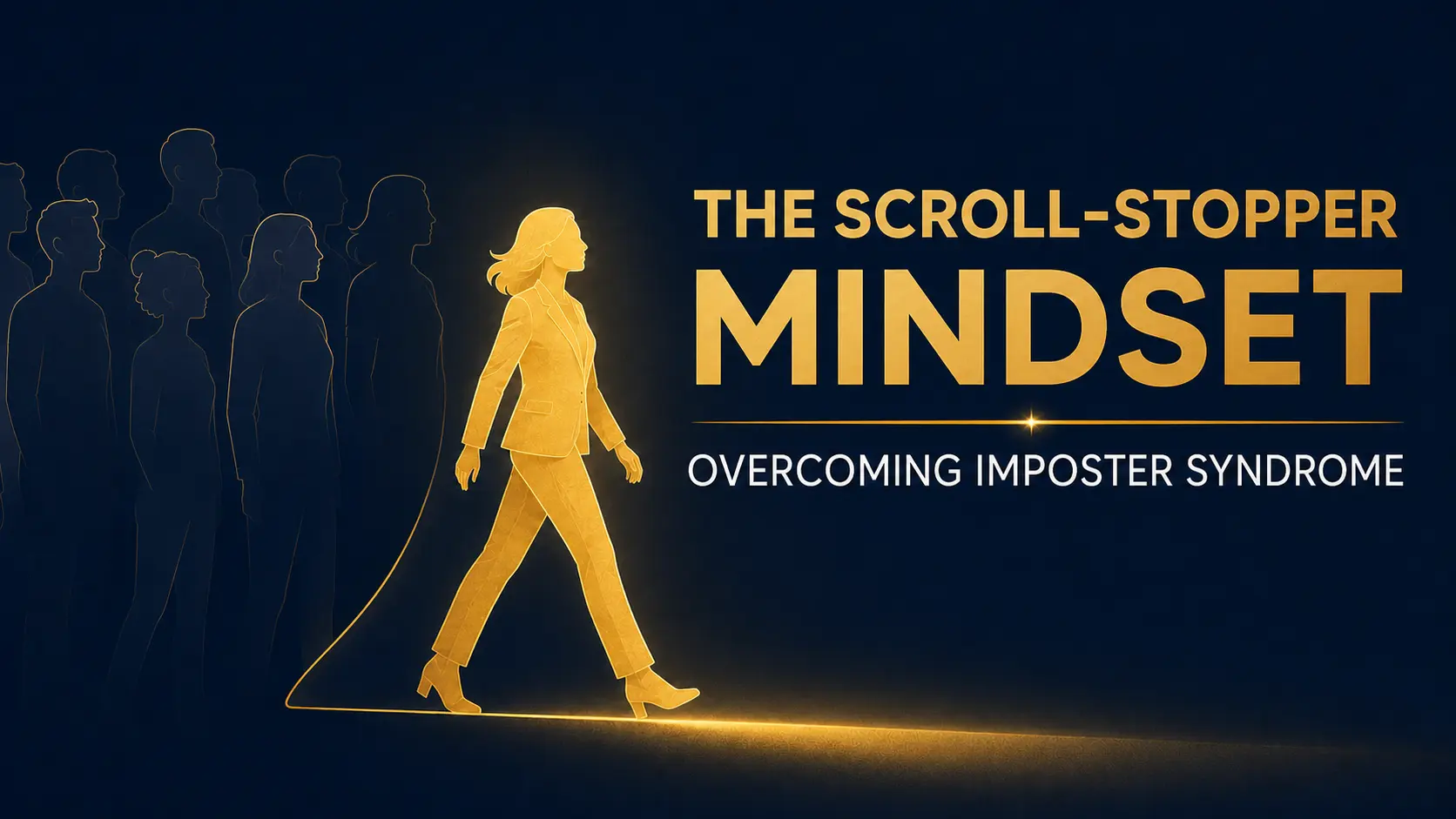
Imposter syndrome doesn’t just create self-doubt; it creates what we can call a visibility gap: the distance between what you actually know and how much of that knowledge the world ever gets to see. Capable professionals under-share their ideas, avoid speaking up in meetings, delay publishing content, and hesitate to pursue the opportunities they’re qualified for, all because visibility feels risky.
The fix isn’t waiting until you feel ready. It’s building a repeatable system for showing your expertise before your confidence fully catches up. James R. Elliot’s SEEN Framework gives professionals a practical, four-step path for closing that gap, so confidence grows through consistent action instead of staying stuck in preparation.
Key Takeaway:
- Imposter syndrome can create a visibility gap between what you know and what other people get to see. Even highly capable professionals may avoid sharing ideas, speaking up, publishing content, or pursuing opportunities because visibility feels risky. [1]
- Confidence often develops through action rather than appearing before action. Small, repeated visibility habits such as contributing in meetings, sharing professional insights, tracking accomplishments, and accepting opportunities can provide evidence that challenges self-doubt and builds confidence over time. [1]
- The SEEN Framework provides four practical steps for closing the visibility gap: Spot the Story, Examine the Evidence, Express Before You’re Ready, and Normalize Visibility. The goal is to replace avoidance and perfectionism with small, consistent actions that make being seen feel more natural. [2]
- Imposter syndrome and low self-esteem are not the same experience. If self-doubt is tied to deep, long-standing identity beliefs or extends across many areas of life, broader personal development or appropriate mental health support may be more suitable than a visibility-focused approach alone. [2]
Bottom Line: Overcoming imposter syndrome isn’t about eliminating every moment of self-doubt; it’s about refusing to let doubt control your visibility. By taking small, consistent actions and using evidence to challenge unhelpful stories, you can turn visibility into a skill and allow your expertise to create the opportunities you deserve.
- Source: Unleash Your Power – The Scroll-Stopper Mindset: Overcoming Imposter Syndrome
- Source: FAQs Section
What Is the Scroll-Stopper Mindset?
A scroll-stopper isn’t just someone who gets noticed online. It’s someone whose ideas consistently earn attention, in a meeting, on a call, at a networking event, or in a room full of people who could become clients, colleagues, or champions.
You already know things worth sharing. The question is whether anyone ever gets the chance to hear them.
That gap between what you know and what you let people see has a name: the Visibility Gap. It’s the space where your best insights, your hardest-won lessons, and your genuine expertise sit quietly, unseen, while less qualified voices take up the room.
Imposter syndrome is one of the biggest forces that widens this gap. It convinces you that staying quiet is safer than being seen, even when the evidence says otherwise.
What Is Imposter Syndrome and Why Does Success Make It Louder?

Imposter syndrome is the persistent feeling that your success isn’t fully earned, that you got lucky or that at some point people will realize you don’t belong. It was first named by psychologists in the late 1970s, and decades later it still shows up in nearly every high-performing field.
A systematic review published in BMC Psychology found the prevalence sits around 62 percent across the professions studied, with some fields reporting rates far higher. That’s not a fringe experience. That’s a majority experience among people doing serious, demanding work.
Here’s the part most people don’t expect: success can make it worse, not better. Asana’s research on imposter syndrome found that younger leaders, those between 24 and 44, report frequent impostor thoughts nearly twice as often as leaders in their late fifties and beyond.
That makes sense once you think it through. Every promotion raises the stakes. Every new title adds an audience watching to see if you can back it up. Visibility goes up, and so does the internal volume on the voice asking, “How long before they figure out I don’t actually have this handled?”
In my 20+ years working with professionals and entrepreneurs, I’ve seen this pattern again and again. It’s rarely about a lack of skill. It’s about a mismatch between what someone has built and what they’re willing to let others witness.
Imposter Syndrome vs. Low Self-Esteem: What’s the Difference?
People often use these terms interchangeably, but they describe different experiences with different fixes.
| Factor | Imposter Syndrome | Low Self-Esteem |
| Source | Discomfort with your own visible success | A general, ongoing sense of low personal worth |
| Confidence in other areas | Often high in areas outside the trigger context | Typically low across most areas of life |
| Competence | Objectively high, backed by real results | Can be high or low, unrelated to the core issue |
| Common trigger | New achievements, promotions, or visibility | Everyday situations, not tied to specific wins |
| Recovery pattern | Responds well to evidence and visible action | Usually needs deeper, longer-term work on self-worth |
| Workplace impact | Hiding despite proven ability | Hesitating due to genuine self-doubt about ability |
The distinction matters because it points you toward the right next step. Imposter syndrome tends to respond well to the kind of practical, action-based approach in the SEEN Framework. Low self-esteem usually needs a broader foundation of work before visibility feels safe at all.
Why Capable Professionals Stay Invisible

This is where the real damage happens, not in the feeling itself, but in the behavior it produces.
Picture what visibility avoidance actually looks like day to day. You draft the LinkedIn post and never hit publish. You have the sharpest point in the meeting and let someone else say it first. You turn down the speaking invitation because you tell yourself you’ll do it “once you’re more established.”
Perfectionism plays a starring role here too. You wait for the idea to be flawless, the pitch to be airtight, the moment to be perfect. Since none of those things ever fully arrive, waiting becomes its own kind of hiding.
Darren G. came to James because he felt stuck despite having a job that paid well. He described feeling hopeless and purposeless, blocked from the promotions, raises, and business ownership he genuinely wanted, even though nothing on paper explained why. Working through his limiting beliefs and what he called his own “goal blocks,” Darren uncovered how much he’d been holding himself back from being seen and heard in rooms where he had every right to speak up. Once he exposed those blocks, the shift showed up fast, in his career, his confidence, and even his relationships.
That’s the pattern. The invisibility isn’t caused by a lack of ability. It’s caused by a belief that ability alone should be enough, and that putting yourself forward is somehow arrogant or premature.
Try This: Next time you catch yourself deleting a post or staying quiet in a meeting, pause and ask, “Am I protecting quality, or am I protecting myself from being seen?” The honest answer usually tells you everything you need to know.
The Hidden Cost of Staying Invisible
Many professionals assume staying quiet protects their reputation. In reality, remaining invisible often carries a much higher cost than speaking up imperfectly. Every opportunity you decline, every idea you keep to yourself, and every conversation you avoid reduces the chances of others recognizing your expertise.
Visibility isn’t about chasing attention. It’s about allowing your knowledge to create opportunities. Whether you’re an entrepreneur, consultant, leader, or employee, people can’t value contributions they never see.
Over time, staying invisible can affect multiple areas of professional growth.
Hidden Costs of Low Visibility
- Missed promotions because decision-makers don’t fully recognize your capabilities.
- Lost business opportunities because potential clients never discover your expertise.
- Slower career progression despite consistently delivering high-quality work.
- Increased frustration when less experienced people receive recognition first.
- Growing self-doubt as silence reinforces the belief that your ideas aren’t valuable.
Instead of asking,
“Am I ready to be seen?”
consider asking,
“What opportunities disappear if I stay hidden?”
That small shift changes visibility from an act of self-promotion into an act of service.
Data & Findings
According to Personnel Today’s coverage of Executive Development Network’s workplace research, 72 percent of people who’ve experienced imposter syndrome say it has held them back at work, and 43 percent report feeling it at least once a week. This isn’t an occasional bad day. For a huge share of the workforce, it’s a recurring tax on performance.
The cost shows up in concrete, countable ways. Speakwise’s compiled workplace data, drawing on Training Industry research, points to roughly one in three workers leaving valuable work unfinished because they fear it will expose them as less capable than people assume. That’s missed deadlines and abandoned ideas, not from lack of skill, but from fear of the spotlight.
KevinMD’s clinical perspective on high-achieving professionals adds another layer. High-performing environments tend to reward the appearance of certainty. People mask their doubt behind a polished exterior, and over time the gap between how they look and how they feel widens, which only reinforces the fear of being “found out.”
On the personal branding side, research on visibility and imposter syndrome makes the point bluntly: the people with less experience and more confidence are often the ones taking the stage, writing the book, and launching the podcast, while more qualified people stay quiet in the audience.
Every moment of invisibility teaches your brain that hiding is safer than contributing. That lesson compounds. The longer you stay quiet, the more natural quiet starts to feel, and the harder it becomes to break the pattern later.
The 4-Step SEEN Framework for Closing the Visibility Gap
Here’s what this means for you. Overcoming imposter syndrome as a visibility problem doesn’t require years of internal work before you’re allowed to show up. It requires a repeatable sequence you can start using this week.

Spot the Story
Notice the narrative running in the background before you hesitate to share something. Ask yourself what you’re telling yourself in that moment, and what you’re assuming about how people will react. Most imposter thoughts are stories, not facts, and you can’t challenge a story you haven’t noticed yet.
Examine the Evidence
Once you’ve spotted the story, put it on trial. What real evidence supports it? What evidence contradicts it? Most people find that the case against them is thin, built on a handful of memorable failures, while the evidence in their favor- promotions, results, positive feedback- gets quietly ignored.
Express Before You’re Ready
This is the step that actually closes the gap. Publish the post before it feels perfect. Speak up in the meeting before you’ve rehearsed every word. Pitch yourself for the opportunity before you feel fully qualified on paper. Small, visible actions build real evidence faster than any amount of private preparation ever will.
Normalize Visibility
Confidence isn’t something you wait to feel before you act. It’s something that shows up after repeated action, once your brain has enough new evidence to update the old story. Build small visibility habits: one comment, one question, one share, and repeat them until being seen stops feeling like a risk and starts feeling like something you simply do.
Together, these four steps give you a structure for overcoming the mental blocks that stall your business without needing to resolve every internal doubt first. Action creates the evidence that reshapes belief, not the other way around.
Small Daily Practices That Reinforce the SEEN Framework
The SEEN Framework becomes more effective when it’s supported by consistent daily actions. Overcoming imposter syndrome isn’t usually about making one bold leap. It’s about collecting small moments that prove to yourself that you can contribute, be visible, and handle the uncertainty that comes with growth. Each action becomes evidence that challenges the old belief that staying hidden is safer.
Turn Visibility Into a Habit
Rather than waiting until you feel confident, build simple routines that make showing up a normal part of your day.
- Share one professional insight every week: Post a lesson you’ve learned, answer a common question, or offer a practical tip from your experience.
- Speak at least once in every meeting: Whether it’s asking a thoughtful question or adding a new perspective, regular participation strengthens your confidence over time.
- Keep a record of your wins: Save positive feedback, successful projects, client testimonials, and milestones so you have objective evidence when self-doubt appears.
- Focus on progress instead of perfection: Every completed action teaches your brain that imperfect visibility is more valuable than perfect invisibility.
- Ask for feedback instead of assuming criticism: Constructive feedback provides facts, while imposter syndrome often relies on assumptions.

Remember: Visibility Is a Skill
Like public speaking, leadership, or networking, visibility improves through practice. Every time you choose to contribute instead of staying silent, you strengthen the habit of showing up. Over time, these repeated actions make visibility feel less risky and more natural, allowing confidence to develop as a result rather than a prerequisite.
Decision Matrix: Is the SEEN Framework Enough?
| If this sounds like you… | Best next step |
| You avoid posting your ideas online | SEEN Framework |
| You get nervous speaking up in meetings | SEEN Framework |
| You fear presentations despite being prepared | SEEN Framework |
| You hesitate to pitch yourself for opportunities | SEEN Framework |
| The doubt feels tied to deep, long-standing identity beliefs | NLP Coaching |
| The pattern has followed you since childhood, across every area of life | NLP Coaching |
| The struggle involves trauma beyond workplace confidence | Appropriate mental health support |
If you land in that first group, the framework above is a strong place to start today. If you recognize yourself in the second or third group, that’s a sign the work runs deeper than a visibility habit, and it deserves the right kind of support.
Common Mistakes That Keep Imposter Syndrome Alive
- Waiting to feel confident before acting: Confidence is usually the result of action, not the requirement for it.
- Comparing your beginning to someone else’s middle: The person you’re measuring yourself against has years of visible reps you haven’t seen.
- Mistaking humility for invisibility: Real humility means being honest about your strengths, not hiding them.
- Believing your expertise should speak for itself: Expertise that nobody sees doesn’t get the chance to speak at all.
- Assuming successful people don’t struggle with this: Some of the most accomplished professionals in any field quietly carry the same doubt you do.
Signs You’re Developing a Scroll-Stopper Mindset

Overcoming imposter syndrome isn’t about eliminating every moment of doubt. It’s about changing how you respond when those thoughts appear. Progress often shows up in subtle behavioral changes before it feels like confidence.
You may be building a stronger Scroll-Stopper Mindset if you:
- Share your ideas even when they aren’t perfect.
- Accept compliments without immediately downplaying them.
- Volunteer for opportunities that once felt intimidating.
- Spend less time comparing yourself to others.
- Recover more quickly after criticism or rejection.
- View visibility as helping others instead of seeking attention.
- Trust your experience instead of waiting for another qualification.
These signs don’t mean self-doubt has disappeared. They simply show that your actions are becoming stronger than your fears, which is where lasting confidence is built.
Frequently Asked Questions
Can successful people have imposter syndrome?
Yes, and often more intensely. Success raises visibility and the stakes attached to it, which frequently makes the internal doubt louder rather than quieter, even among people with years of proven results.
Is imposter syndrome a mental illness?
No. It isn’t classified as a clinical disorder. It’s a pattern of thought and belief, which is good news, because patterns can be interrupted and changed with the right approach.
Does imposter syndrome ever go away completely?
For most people, it fades rather than vanishes. The goal isn’t to erase every doubt forever. It’s to stop letting that doubt control what you do and don’t share with the world.
How long does it take to overcome imposter syndrome?
It varies by person, but many people notice a real shift in how they experience visibility within a few weeks of consistently applying a structured approach like the SEEN Framework.
Can NLP help with imposter syndrome?
Yes. NLP techniques like reframing and evidence-based questioning are effective for identifying and interrupting the specific thought patterns that fuel imposter feelings.
Why do entrepreneurs experience imposter syndrome so often?
Entrepreneurship removes the external validation that comes with titles and performance reviews. Without that structure, self-doubt has more room to fill the silence, especially around visibility and self-promotion.
Does confidence really come before action, or after it?
After, in most cases. Waiting for confidence to arrive before acting usually means waiting indefinitely. Action generates the evidence that confidence is built from.
Conclusion
Your expertise only creates value once other people get to experience it. Closing the visibility gap isn’t about becoming a different person or manufacturing confidence you don’t feel yet. It’s about letting the knowledge, skill, and perspective you already have be seen consistently, one small, visible action at a time.
Start today. Share the post you’ve been sitting on. Speak up in the next meeting before you’ve rehearsed every word. If you’re ready for structured support in building this kind of presence, explore NLP training built for real-world visibility or see how leadership coaching can help you step into more presence.
Unleash Your Power: Stand Out, Take Action, and Create the Success You Want.