
A lot of professionals reach a crossroads. They’re good at what they do, maybe even great, but something is missing. They want to communicate with more precision, coach others through real change, or lead without white-knuckling it through every difficult conversation.
That’s when many of them discover Neuro-Linguistic Programming. And then comes the next frustration: trying to figure out how NLP certification actually works in Canada.
The landscape is genuinely confusing. Programs range from a single weekend to months of intensive study. Prices vary wildly. Some carry international accreditation, others are self-certified by whoever runs them. There’s no government licensing body, no national registry, and no single standard every provider is held to.
If you’re serious about getting NLP certified in Canada, you need a clear picture of what you’re choosing between, what each level involves, and how to avoid wasting money on a program that won’t serve you. That’s exactly what this guide covers, from your first decision all the way through to what life looks like after you graduate.
Key Takeaway:
- Getting NLP certified in Canada equips you with practical communication, mindset, and behavioral change techniques that can be applied in coaching, leadership, sales, education, healthcare, and personal development. The right certification emphasizes hands-on practice, not just theory. [1]
- When choosing an NLP certification program, compare accreditation, trainer experience, curriculum, live practice opportunities, mentorship, class format, and post-certification support. A reputable provider offers structured training that helps you confidently apply NLP in real-world situations. [1]
- Certification levels typically progress from Practitioner to Master Practitioner and Trainer. Your ideal pathway depends on whether you want to improve your own performance, become a professional coach, enhance workplace leadership, or teach NLP to others. [2]
- The value of NLP certification comes from consistently applying the skills after training. Continued practice, coaching experience, and ongoing professional development help transform certification into lasting personal growth, stronger client results, and greater career opportunities. [2]
Bottom Line: Earning an NLP certification in Canada is a worthwhile investment when you choose a high-quality training provider and actively apply what you learn. The right program can strengthen your communication, coaching, leadership, and personal development skills while opening new professional opportunities.
What Is NLP Certification and Why Does It Matter in Canada?
What You’ll Actually Learn
NLP stands for Neuro-Linguistic Programming, and at its core, it’s a framework for understanding how people think, communicate, and create behavioural patterns. When you get certified, you’re learning to recognise those patterns in yourself and in others, and to apply specific techniques to shift them toward better outcomes.
A quality NLP Practitioner program covers rapport building, language patterns, reframing limiting beliefs, anchoring emotional states, goal-setting strategies, and the fundamentals of effective coaching conversations. These aren’t abstract concepts. They’re tools you can use in a meeting, with a client, or inside your own head when you’re running a loop that isn’t working.

Understanding Canada’s Unregulated NLP Landscape
Here’s something that surprises most people: NLP certification is not legally regulated in Canada. No government body oversees program quality, and there’s no licensing exam required to practise.
That might sound like freedom. In some ways, it is. But it also means the burden of due diligence falls entirely on you.
According to the ICF’s 2025 Global Coaching Study, 73% of coaches report that clients and organisations now expect a formal credential before working with a practitioner. In a market where anyone can print a certificate, the quality of your training and the credibility of who delivered it matter more than the paper itself.
Choosing a program recognised by established professional bodies such as the ABNLP, INLPTA, or ITA doesn’t guarantee a great experience, but it gives you a measurable baseline and makes your credentials legible to prospective clients and employers.
Who Should Consider NLP Certification?
NLP certification makes sense for a wide range of professionals: coaches who want structured tools for facilitating change, business leaders who want to communicate with greater precision, HR professionals, educators, sales professionals, consultants, and entrepreneurs who interact with people at a high level every day. It’s also pursued by people who simply want to understand themselves better and break patterns that have held them back for years.
Clarify Your Goal Before You Enrol
This step gets skipped more often than any other, and it causes the most regret.
Are You Learning NLP for Personal Growth or Professional Development?
Someone who wants to work through limiting beliefs and communicate more confidently doesn’t need the same program as someone who wants to build a coaching practice. The training hours, practical requirements, and post-certification path look very different depending on where you’re headed.
Before you look at a single program, get honest about your actual goal. Are you looking to grow personally? Strengthen your leadership presence? Start or grow a coaching business? Apply NLP within an existing profession like therapy, HR, or sales? Your answer should shape every decision that follows.
What NLP Can and Can’t Do for Your Career
NLP certification opens real doors. With the right training and genuine skill development, you can build a meaningful coaching or consulting practice, increase your professional value across industries, and charge at a premium when you demonstrate results.
What it won’t do is hand you a ready-made career. The certification is a starting point, not a guarantee. Your results, and your clients’ results, depend on how much you practise, how consistently you apply what you learn, and whether you keep developing after the program ends.
Try this: Before enrolling in any program, write down your specific goal in one sentence. “I want to use NLP to help executives overcome communication blocks in leadership roles.” The more specific you are, the better you can evaluate whether a given program will actually get you there.
Understand the Three Levels of NLP Certification
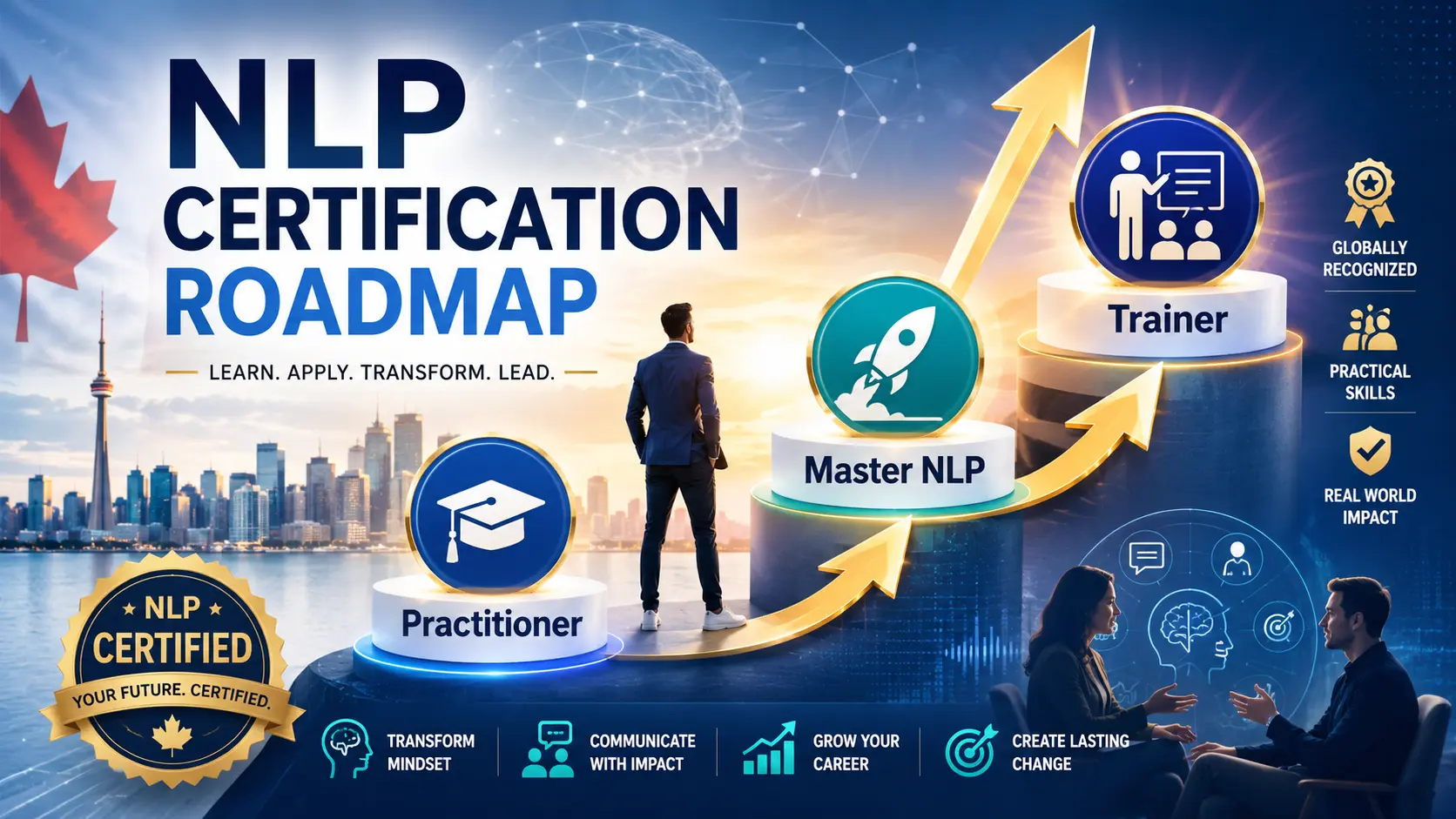
Most quality NLP programs in Canada follow a tiered progression. Here’s how the three levels break down:
| Level | Typical Duration | Focus | Best For |
| NLP Practitioner | 5 to 15 days | Core NLP skills and techniques | Beginners |
| NLP Master Practitioner | 6 to 10 additional days | Advanced methods and deeper coaching tools | Experienced practitioners |
| NLP Trainer Certification | Extended apprenticeship | Teaching NLP, program design, facilitation | Future trainers |
NLP Practitioner: Where Everyone Starts
The Practitioner level is your entry point. This is where you learn the foundational techniques: rapport, reframing, anchoring, language patterns, and how to structure change conversations. Programs at this level typically run anywhere from a few intensive days to several weeks part-time, depending on the provider.
NLP Master Practitioner: Deepening Your Skills
Once you’ve completed Practitioner training, the Master Practitioner level takes you further into advanced NLP methodologies. You’ll work with more complex behavioural change techniques, develop greater flexibility in your coaching conversations, and refine your ability to help clients shift deeply rooted patterns. Most reputable providers require proof of prior Practitioner certification before enrolling students at this level.
NLP Trainer Certification: Teaching and Certifying Others
The Trainer level is for those who want to design and deliver NLP programs themselves and, in some cases, certify their own students as Practitioners. It typically functions as an advanced apprenticeship and is often offered by invitation to those who’ve already completed Master Practitioner training.
In my 20+ years of working with clients and training professionals across Canada and internationally, I’ve seen the biggest breakthroughs come from people who move through the levels with intention rather than rushing to collect credentials. The skills compound when you give them time to integrate.
Choose an NLP Certification Program

This is where most people spend the least time and where the most consequential decisions get made.
What Accreditation Means
Professional NLP organisations like the ABNLP, INLPTA, and ITA set standards for curriculum content, trainer qualifications, and ethics. A program that carries its recognition has at least met a defined baseline. That’s worth something, especially when clients or employers are evaluating your credentials.
That said, accreditation is a floor, not a ceiling. The trainer’s experience, the quality of practical instruction, and the depth of the curriculum matter at least as much as the letters on the certificate. A good starting point is reviewing the top NLP certification programs in Canada to compare what different providers actually deliver.
What to Look for in a Quality Program
The best programs share a few things in common. They include significant live instruction with an experienced trainer, not just video modules or self-paced reading. They provide structured practical exercises where you actually use techniques with other participants and receive feedback. They’re transparent about the curriculum, the trainer’s background, and what’s included in the cost. And they offer support or community after the program ends, because that’s when the real learning deepens.
Small group sizes matter more than most people realise. When there are fewer students, you get more feedback, more practice time, and a more genuine learning environment.
Red Flags to Avoid
Be cautious of programs that promise NLP mastery in an unusually short time frame with little explanation of how. If a program has no practical component, no real trainer interaction, or a vague curriculum that doesn’t specify which techniques are covered, that warrants scrutiny. Any program leaning heavily on hype while avoiding concrete details about content and trainer credentials deserves a second look.
Online, In-Person or Hybrid?
If you learn best through direct human interaction and real-time feedback, in-person or live online programs tend to produce stronger outcomes. The rapport-building and communication skills at the heart of NLP develop more naturally when you’re practising with real people in real time. For a detailed breakdown, the guide on online versus in-person NLP training covers the key trade-offs.
What Does NLP Certification Actually Cost in Canada?
Costs vary significantly across providers, and the range can be disorienting.
| Program Type | Typical Investment | Often Includes |
| Entry-level programs | $500 to $1,500 | Basic instruction, limited live interaction |
| Mid-range programs | $1,500 to $3,000 | Live learning, structured practice sessions |
| Premium programs | $3,000 to $5,000+ | Comprehensive training, mentorship, and deep practical work |
What Influences the Cost?
The biggest factors are contact hours with an experienced trainer, class size, depth of curriculum, post-course support, and the quality of accreditation the program carries. For a closer breakdown of what Canadian programs typically charge at each level, the NLP certification cost guide offers useful comparisons.
What Cheaper Programs May Sacrifice
A lower price point usually reflects fewer live hours, larger group sizes, less individualised feedback, and limited support after the program ends. For someone who wants to use NLP seriously in coaching or leadership, these trade-offs can undermine the credential’s value. Price is a poor filter on its own. Compare what’s actually included and weigh it against what you need to achieve your specific goal.
Complete Your Training and Get the Most From It

Once you’re enrolled, the quality of your experience depends heavily on how you show up.
What Happens During Training?
Good NLP programs are active and experiential. You’ll watch demonstrations of techniques in action, practise exercises with other participants, receive structured feedback, and work through real scenarios. The best programs move back and forth between instruction and practice throughout each session, because repetition with feedback is how skills actually develop.
Heather Chetwynd came to James’s NLP Practitioner program having trained elsewhere before, but left feeling confused about how all the individual techniques connected into something she could actually use with clients. After working through James’s program, the framework clicked. She walked away with a clear understanding of how the tools work together, genuine confidence in applying them, and what she described as a full coaching toolbox she could draw on in her practice. That shift, from knowing techniques in isolation to using them as an integrated system, is what separates a quality program from a credential-only experience.
How to Get the Most Out of Your Certification
Practise outside of sessions. Every technique you learn can be applied in daily conversations, in how you frame challenges for yourself, and in how you respond to others. The students who get the most from NLP training treat the program as a starting point rather than a finish line. Stay curious, seek feedback even when it’s uncomfortable, and find at least one other student you can practise with between sessions.
Try this: Within 48 hours of each training session, apply one technique in a real conversation. A difficult discussion at work, a coaching moment with a friend, a pattern you notice in yourself. Integration happens faster when you practise in context.
Put Your NLP Certification to Work
Certification is where the journey begins, not where it ends.
Career Opportunities for Certified NLP Practitioners
A recognised NLP certification opens practical doors across a range of careers. Life and executive coaching are the most direct paths, and NLP tools are among the most effective available for helping clients create lasting change. Leadership development, HR, corporate training, sales, education, business consulting, and entrepreneurship are all fields where certified practitioners create real value.
Research from LinkedIn Learning’s 2025 Workplace Report confirms that leadership and communication remain the two most in-demand skills among Canadian employers, with coaching emerging as one of the fastest-growing competencies in leadership development. That’s a strong signal for anyone considering NLP as a career foundation.

Building a Practice or Applying NLP in Your Existing Career
If you plan to coach professionally, build experience immediately after certification. Offer sessions, gather feedback, and continue developing your skills. Many practitioners also combine NLP with other tools and credentials over time, deepening their value to clients. If you’re applying NLP within an existing career, start with rapport and reframing techniques. These tend to produce visible results quickly and help you build confidence in the broader toolkit. Learn more about structuring your next steps at the life coach training certification in Canada.
How Long Does NLP Certification Take in Canada?
The honest answer: it depends significantly on the format and provider.
Intensive Practitioner programs can be completed in as few as five to eight days of full-time training. Some spread the same content across weekends over two to three months. Online formats offer the most scheduling flexibility but vary considerably in quality. Master Practitioner training adds another six to ten days of live instruction. Trainer-level programs are longer still and are typically structured as apprenticeships rather than fixed-length courses.
Programs that promise the same outcomes in a fraction of the hours are cutting somewhere. And that somewhere is usually the hands-on practice that makes the difference between knowing the material and being able to use it under pressure with real people.
Data and Findings
The numbers behind NLP and coaching tell a consistent story. According to the ICF 2025 Global Coaching Study, 73% of coaches report that clients and organisations now expect a formal credential. That’s not a soft preference. It’s becoming a baseline requirement in a maturing market.
The global coaching industry generated $5.34 billion in revenue in 2025, with over 122,000 active practitioners worldwide. That’s a 54% increase in practitioner count since 2019 (ICF Global Coaching Study, 2025). The market is growing, and so is the competition. Credentials, proven skills, and the ability to demonstrate results are what separate practitioners who thrive from those who struggle to find clients.
From Unleash Your Power’s own 20+ years of client work, the pattern is consistent: professionals who invest in structured NLP training and apply it rigorously see measurable improvements in how they communicate, how they lead, and how they create change in others. The practitioners who grow the fastest are those who pair their certification with ongoing practice, a clear niche, and a genuine commitment to client results.
Meanwhile, 1 in 3 Canadian employers now integrates coaching into their leadership development frameworks (Conference Board of Canada, 2024). That means the demand for trained practitioners isn’t just coming from individuals seeking coaching. It’s coming from organisations looking to build coaching competency into their leadership culture.
The window for getting ahead of this curve is still open. But the market is professionalising quickly, and the gap between credentialed practitioners and those without formal training is widening every year.
Source reference URLs:
- ICF 2025 Global Coaching Study: https://coachingfederation.org/resources/research/global-coaching-study/
- Conference Board of Canada coaching data: https://icoachingeducation.com/how-canadian-organisations-value-coaching-credentials/
- NLP certification cost in Canada: https://unleashyourpower.com/blog/nlp-certification-cost-in-toronto/
- Top NLP certification programs Canada: https://unleashyourpower.com/blog/nlp-certification-programs/
How to Compare NLP Certification Programs: A Quick Checklist
Before you enrol, work through these questions for every program you’re considering:
- Is the training delivered live, with real interaction and feedback?
- How many hours of practical exercises are included?
- What are the trainer’s credentials and years of experience?
- Is the program recognised by an established professional body?
- What does the curriculum actually cover, specifically?
- What support is available after the program ends?
- Is there a learning community you can stay connected to?
- How will you apply these skills in your actual context after graduating?
If a program can’t answer these questions clearly and specifically, that’s the answer.
Frequently Asked Questions
Is NLP certification regulated in Canada?
No. NLP certification is not government-regulated in Canada, and there’s no national licensing body that oversees practitioners. This makes your choice of provider particularly important. Selecting a program aligned with recognised international organisations such as the ABNLP or INLPTA significantly improves the credibility of your credential with clients and employers.
How long does it take to become NLP certified in Canada?
It depends on the format and level. Intensive Practitioner programs can be completed in as few as five to eight days of full training. Spread over weekends or in a hybrid format, the same content might take two to three months. Master Practitioner training typically adds another six to ten days of live instruction. Most people underestimate how much ongoing practice matters after formal training ends.
Can I complete NLP certification online?
Yes. Many quality programs run live online via video conferencing, and the best of them preserve the interactive, practice-based elements that make in-person training effective. Avoid programs that are fully pre-recorded with no live interaction. The practical skills at the heart of NLP develop through real-time practice with real people.
What is the difference between an NLP Practitioner and a Master Practitioner?
Practitioner is the foundation level. You learn core techniques and develop basic competency in applying them. Master Practitioner builds on that foundation with more advanced methodologies, greater depth in behavioural change work, and more sophisticated coaching tools. Most credible providers require completed Practitioner training before admitting students to the Master’s level.
How much does NLP certification cost in Canada?
Entry-level programs start around $500, though quality at this price point varies significantly. Mid-range programs from established providers typically run between $1,500 and $3,000. Premium programs with mentorship, small group sizes, and comprehensive practical training can reach $5,000 or more. The right investment depends on your goal and how seriously you plan to use the skills.
Is NLP certification worth it?
For people who are serious about using the skills, yes. NLP provides practical tools for communication, coaching, leadership, and personal development with real applications across a wide range of professions. Whether it’s worth it for you specifically comes down to choosing a quality program and committing to applying what you learn.
Can NLP certification help me become a coach?
It’s one of the strongest foundations available for coaching work. NLP gives you concrete tools for helping clients identify and shift limiting beliefs, build new patterns, and take decisive action. Combined with genuine coaching experience and continued learning, it positions you well in a competitive and growing market.
How do I choose the best NLP certification program?
Start with your goal, then evaluate programs on trainer credentials, curriculum depth, live instruction hours, accreditation, practical components, and post-course support. Smaller group sizes, experienced trainers, and a track record of producing skilled graduates are strong positive indicators. Vague curriculum descriptions, unrealistically short timelines, and an absence of practical exercises are reasons to look elsewhere.
Conclusion
NLP certification in Canada is a genuine opportunity for anyone willing to approach it seriously. The skills you develop, communication, reframing, rapport building, coaching, and behaviour change, are applicable across coaching, leadership, business, and everyday life. But the credential is only as valuable as the training behind it.
Take the time to clarify your goal, understand the levels, evaluate providers honestly, and choose a program that gives you real, practical experience alongside the theory. The right training doesn’t just add a line to your resume. It changes how you think, communicate, and create results for others.
If you’re ready to explore NLP training in Canada grounded in 20+ years of proven results, I’d love to connect. Book a discovery conversation and we’ll talk through whether NLP certification is the right next step for your goals.
Unleash Your Power: Stand Out, Take Action, and Create the Success You Want.