
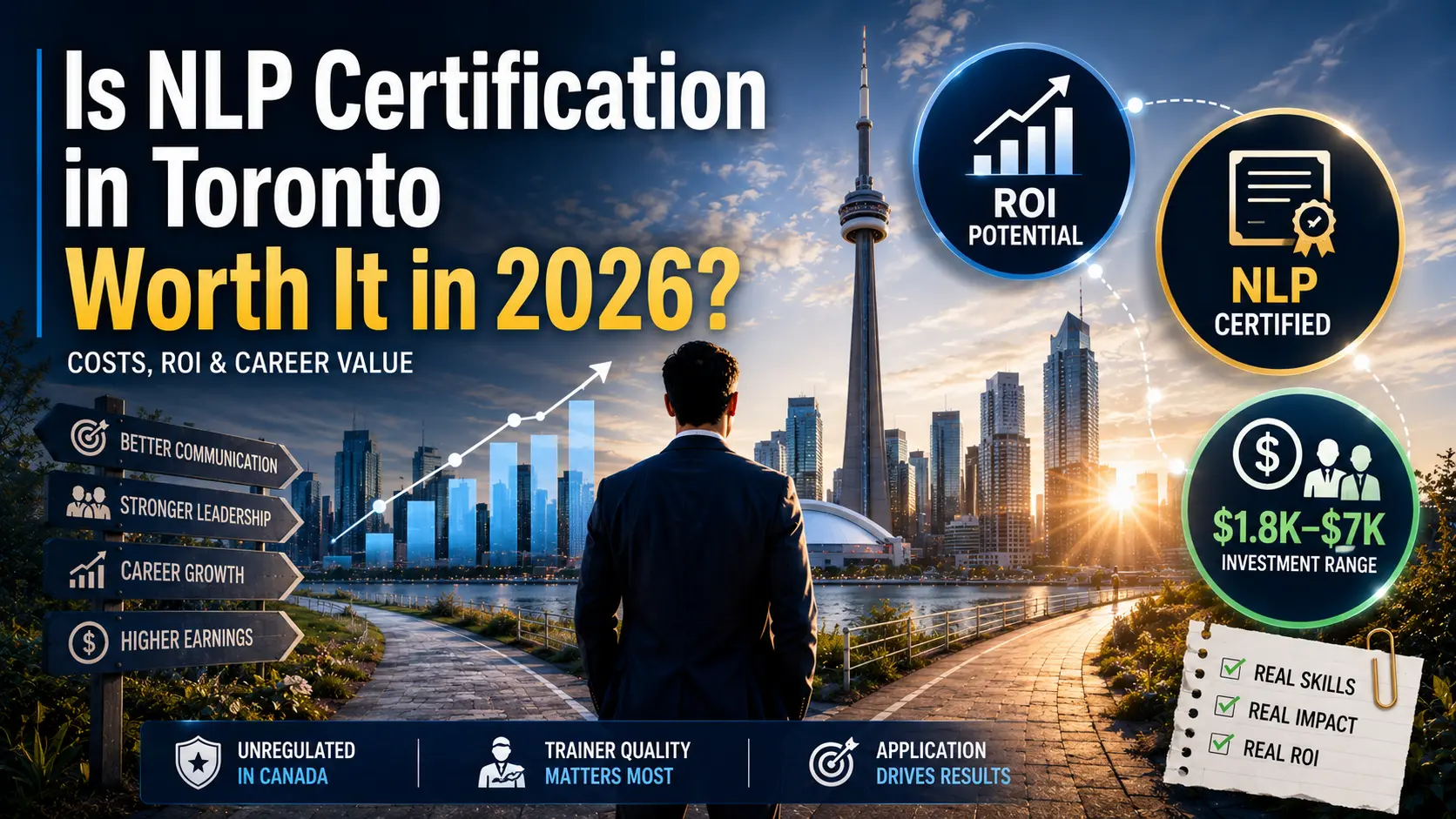
NLP certification in Toronto is worth it in 2026 for professionals who will actively use the skills in coaching, leadership, consulting, sales, or business development. Verified Practitioner programs typically cost between CAD $1,500 and $3,000, while advanced certifications can exceed CAD $7,000. The strongest return on investment comes from applying NLP techniques consistently rather than simply earning the credential.
Because NLP is not regulated in Canada, trainer quality, accreditation, and practical application matter far more than the certificate itself, this guide compares verified costs, recognition, ROI, career value, and alternatives to help you make an informed decision.
Key Takeaway:
- NLP certification in Toronto is worth the investment for professionals who plan to apply the skills in coaching, leadership, sales, HR, consulting, or personal development. Beyond earning a credential, participants gain practical communication, mindset, and behavior-change techniques they can use immediately. [1]
- The return on investment depends largely on the quality of the training. Choose a program with experienced trainers, hands-on practice, recognized accreditation, ongoing support, and real-world application rather than selecting solely based on price. [1]
- NLP certification delivers the greatest value when you consistently apply the techniques after training. Graduates often use NLP to improve client outcomes, strengthen leadership, increase confidence, enhance communication, and create more effective personal and professional relationships. [2]
- Before enrolling, compare course content, certification level, trainer credentials, class format, reviews, and post-certification mentoring. Investing in a reputable program can provide long-term benefits that extend far beyond the initial course fee. [2]
Bottom Line: NLP certification in Toronto is worthwhile when it aligns with your career goals and comes from a reputable training provider. The skills you develop in communication, coaching, leadership, and mindset can continue generating personal and professional value long after you complete the program.
NLP certification in Toronto is worth the investment for coaches, consultants, executives, sales professionals, and leadership-focused professionals who commit to applying the skills in their work. In 2026, verified program costs range from CAD $1,885 plus tax for a Practitioner certification at NLP Canada Training to $3,000 or more at other established providers, with Master Practitioner and Trainer programs reaching $7,000 when all costs are included.
The ICF Global Coaching Study reports that coaches in North America with 10 or more years of experience earn an average of $67,800 annually, with executive coaches commanding $200 to $500 per session. ROI is real, but it flows from application, not from holding the credential.
How Much Does NLP Certification in Toronto Cost in 2026?
Certification Level Cost Ranges
The price you’ll pay depends on the level you’re training for and which provider you choose. Here is how the market sits in 2026, based on verified pricing from established Toronto-area providers:
| Certification Level | Typical Cost Range (CAD) | Duration |
| NLP Practitioner | $1,500 to $3,000 | 7 to 10 training days |
| NLP Master Practitioner | $1,800 to $5,000 | 6 to 10 additional days |
| NLP Trainer Certification | $5,000 to $7,000+ | Several weeks to months |
Unleash Your Power’s NLP training in Canada covers the full pathway from Practitioner through to Trainer level. For a broader breakdown of what programs include and how they differ, see NLP certification programs in Toronto.
Hidden Costs Most People Overlook
The program fee is the headline number. The real all-in cost is usually higher. Before you budget, account for:
- Time away from work: An 8-day intensive is a full week plus of lost billable hours or salary
- Travel and accommodation for live-in-person programs outside your area
- Certification renewal or membership fees with accrediting bodies, which run from $100 to $300 annually
- Books and supplementary materials that some programs charge separately
- Practice groups and post-certification coaching, if you want to actually develop proficiency, not just pass the assessment
A realistic all-in budget for a solid NLP Practitioner certification in Toronto is $2,500 to $4,000 once these are included.
Why Prices Vary So Much
Two programs marketed at the same “NLP Practitioner” level can cost $1,200 and $3,500, respectively. The difference comes down to trainer credentials and experience, the accrediting body behind the certificate, the ratio of live supervised practice to lecture content, class size, post-certification support, and the strength of the alumni network. A lower price is not always the better deal.
Toronto NLP Provider Comparison: Verified 2026 Pricing
This table draws from publicly verified pricing available as of June 2026.
| Provider | Practitioner Cost (CAD) | Master Practitioner (CAD) | Format | Accreditation | Source |
| NLP Canada Training | $1,885 + tax (individual) | $1,800–$2,300 + tax | Live Zoom | Internal certification body | nlpcanada.com |
| Unleash Your Power | Program-based pricing | Program-based pricing | In-person + online | Board Designated Trainer | unleashyourpower.com |
| Market range (Toronto) | $1,500 to $3,000 | $3,000 to $5,000 | Varies | Varies by provider | unleashyourpower.com/blog |
What Skills and Credentials Does NLP Certification Give You?

Core Skills You’ll Develop
A properly structured NLP Practitioner program builds a specific set of communication and behavioural tools. These include:
- Rapport building: establishing a genuine connection quickly, even with difficult clients or stakeholders
- Communication flexibility: adjusting your delivery based on how other people process information
- Reframing: helping people shift perspective on challenges without dismissing real difficulty
- Anchoring: a technique for accessing resourceful emotional and mental states on demand
- State management: recognizing and influencing emotional states in yourself and others
- Goal-setting frameworks: are designed around how the unconscious mind actually responds to direction
- Coaching conversation structure: moving someone from stuck to clear without pressure or guesswork
These are practical tools. When applied in real conversations, they change how you lead, sell, coach, and negotiate.
What Certification Gives You on Paper
An NLP certification demonstrates that you completed structured training and supervised practice rather than self-study alone. For coaches, consultants, and leaders, it can strengthen credibility and provide a recognized communication framework when working with clients or teams.
What Certification Does Not Guarantee
NLP certification does not guarantee employment, promotions, clients, or income growth. Like most professional development programs, results depend on how effectively the skills are applied after training. The credential can create opportunities, but performance and implementation determine outcomes.
Is NLP Certification Recognized in Canada?
The Regulatory Reality
NLP is not regulated by any government body in Canada. There is no national licensing body, no protected title, and no regulatory college. Anyone can offer an NLP program. This makes accreditation research critically important before you enroll.
The recognition your certificate carries depends entirely on who issued it and which accrediting body stands behind it, not on any legal standing.
Industry-by-Industry Employer Recognition
Recognition varies significantly depending on where you work:
- Coaching and consulting: NLP credentials are actively valued. Many clients seek practitioners with formal NLP training
- Leadership development: NLP certification is relevant, particularly for coaches working with executive teams
- Sales and business development: Communication frameworks have a clear and measurable application
- Human Resources: Useful in culture, engagement, and change management roles
- Traditional corporate environments: Limited recognition; NLP rarely satisfies formal HR credential requirements
- Regulated professions (psychology, therapy, medicine): NLP certification carries no clinical standing and cannot substitute for licensed credentials
Accreditation Bodies Worth Knowing
When evaluating programs, look for recognition from the International Association of NLP (IANLP) or the American Board of NLP (ABNLP). For coaches pursuing broader recognition, look for programs that qualify toward International Coaching Federation (ICF) hours. Ask the provider directly which body accredits their certification and how that accreditation can be verified.
What Are the Criticisms of NLP Certification?

The Scientific Debate
NLP was developed in the 1970s and has a mixed research record. Some studies have found support for specific techniques, particularly in communication and behaviour change contexts. Others have challenged whether the theoretical underpinnings hold up under controlled research conditions, citing limited replicability in academic settings.
Parts of the psychology and therapy community have been critical, noting that NLP does not meet the standards of evidence-based clinical practice and should not be positioned as a substitute for regulated therapeutic modalities.
This is a legitimate critique. If you’re seeking a clinically validated or government-recognized therapeutic qualification, NLP is not that.
Why Professionals Continue to Use It
Despite ongoing academic debate, NLP remains widely used in coaching, leadership development, sales, and consulting because many professionals find its communication and behavioural frameworks practical and easy to apply. While NLP should not be presented as a substitute for evidence-based clinical treatment, its tools continue to be used successfully in business, coaching, and personal development contexts.
How Long Does It Take to Get NLP Certified in Toronto?
| Certification Level | Typical Training Duration | Format Options |
| NLP Practitioner | 7 to 10 training days | Full-time intensive or multi-weekend |
| NLP Master Practitioner | 6 to 10 additional training days | Multi-weekend over 4 to 8 weeks |
| NLP Trainer Certification | Several weeks to months | Supervised delivery + assessment |
Most Practitioner programs in Toronto are structured as two or three long weekends, or as a condensed 7 to 8-day intensive. Completion usually requires attending all scheduled days. Some providers also require a recorded session submission or a one-to-one tutorial for sign-off.
Trainer certification is substantially longer and involves supervised facilitation experience on top of the classroom hours.
What Is the Real ROI of NLP Certification?

ROI from NLP certification breaks into three categories, and each is worth assessing separately before you invest.
Direct ROI: Income from NLP-Based Services
According to the ICF Global Coaching Study 2023, life coaches in North America earn an average of $67,800 annually with 10 or more years of experience, at an average hourly rate of $244. Executive life coaches charge $200 to $500 per session, with top earners well above those figures. (Source: entrepreneurshq.com/life-coach-earnings/)
The direct ROI calculation is straightforward: if a single NLP coaching engagement brings in $2,000 to $4,000, a $1,885 Practitioner certification breaks even within one to two client engagements. The challenge is building the client base, which takes marketing, relationships, and demonstrated results, none of which the certificate delivers automatically.
Career ROI: Professional Performance
For professionals not building a coaching practice, the ROI shows differently. Leaders who apply NLP communication tools tend to see improvements in team performance, negotiation outcomes, sales results, and conflict resolution. In 20+ years of training professionals across industries, what James’s clients consistently report is that these techniques create compounding career advantages over time rather than immediate salary jumps. How to integrate NLP daily for leaders maps this out practically.
Personal ROI: Mindset and Relationships
Some of the clearest ROI shows up off the balance sheet. Clients who enter NLP training feeling stuck in limiting beliefs, struggling with confidence, or unable to communicate effectively in high-pressure situations describe the shift as significant and lasting. This is harder to quantify but no less real, and it’s often what makes everything else in the career ROI category possible.
Common Mistakes When Choosing NLP Certification
Many professionals reduce their ROI by making avoidable mistakes:
- Choosing the cheapest provider instead of the most qualified trainer.
- Ignoring accreditation and trainer credentials.
- Expecting certification alone to create income growth.
- Failing to practice after graduation.
- Enrolling without a specific professional application.
The most successful graduates enter training with a clear objective and implementation plan.
Data and Findings
Verified 2026 pricing (NLP Canada Training):
- NLP Practitioner: $1,885 + tax (individual); $1,285 + tax (groups/students)
- NLP Master Practitioner (own graduates): $1,800 + tax; (other institute graduates): $2,300 + tax
- Combined Practitioner + Master bundle: $3,100 + tax
- Source: nlpcanada.com
Verified market range (Toronto, 2026):
- Practitioner: CAD $1,500 to $3,000
- Master Practitioner: CAD $3,000 to $5,000
- Trainer: CAD $5,000 to $7,000+
- Source: unleashyourpower.com/blog/nlp-certification-cost-in-toronto/
ICF Global Coaching Study 2023 income data:
- North America average annual income (coaches): $67,800
- Global average hourly rate: $244
- Executive coaching rate: $200 to $500 per session
- Source: entrepreneurshq.com/life-coach-earnings/
Client outcome examples (Unleash Your Power):
Heather Chetwynd arrived at James’s NLP Practitioner program having trained elsewhere, but left feeling confused about how to apply the techniques in her actual work. After completing the program, she walked away with both the integration clarity she had been missing and unexpected business insights she hadn’t anticipated. Her experience reflects what happens when someone with genuine professional intent invests in quality training from an experienced trainer.
Darren G. came in with a well-paying job but was feeling completely blocked when it came to career advancement and income growth. Working through NLP techniques with James exposed the goal blocks holding him back and produced measurable shifts in his thinking, behaviour, and career trajectory. The application was specific. The results followed.
Online vs. In-Person NLP Certification: Which Delivers More Value?
| Factor | Online | In-Person |
| Cost | Lower | Higher |
| Schedule flexibility | High | Moderate |
| Networking | Limited | Strong |
| Supervised live practice | Good | Excellent |
| Travel required | No | Sometimes |
| Depth of immersion | Moderae | High |
| Post-course community | Varies | Often stronger |
Online programs are generally best for professionals seeking flexibility and lower costs. In-person programs often provide stronger networking opportunities and more intensive supervised practice. The better choice depends on your learning style, budget, and professional goals.
How to Choose an NLP Certification Program in Toronto
Evaluation Checklist
| Evaluation Factor | What to Look For |
|---|---|
| Trainer | Experience, credentials, training lineage |
| Accreditation | IANLP, ABNLP, or a recognized body |
| Reviews | Independent testimonials and outcomes |
| Practice Time | High supervised practice ratio |
| Support | Alumni community and mentorship |
| Class Size | Smaller groups for feedback |
The 3-Question ROI Test

Before you invest, answer these three questions without rationalizing:
Will you actively practice NLP after certification?
Not planning to. Not hope to. Actually use the techniques in real conversations with real people, consistently, starting within weeks of completing the program.
Do you have a specific professional or personal application in mind?
A coaching practice you’re building. A leadership role where communication quality drives team outcomes. A sales environment where rapport and influence have direct revenue implications. Something specific, not “personal development broadly.”
Are you investing primarily for capability, or for credentials?
Credentials are a useful side effect. Capability is the point. If your main driver is adding a line to a resume without changing how you communicate, the investment may not return what you’re expecting.
How to read your answers:
- Three yes answers: you’re a strong investment candidate and the conditions are right
- Two yes answers: certification is potentially worthwhile; clarify your application before committing
- One or zero yes answers: consider waiting until you have a clearer intent, or explore a shorter NLP introduction first
ROI by Audience: Is NLP Certification Worth It for You?
| Audience | Recommended? | Primary ROI Driver | Notes |
| Coach (building a practice) | Highly recommended | Direct income from NLP services | Strongest and most direct ROI when the client base is built |
| Consultant | Recommended | Client communication and influence | Enhances discovery, rapport, and change management work |
| Executive/senior leader | Often worthwhile | Leadership effectiveness and team performance | Apply daily in meetings, feedback, and negotiation |
| Sales professional | Usually worthwhile | Rapport, objection handling, influence | Clearest ROI when applied in client-facing conversations |
| HR professional | Situational | Culture, engagement, and change management | Depends on role scope and organizational support |
| Student (pre-career) | Depends on goals | Personal development and differentiation | Higher ROI if entering coaching, sales, or consulting |
| General self-development | Consider carefully | Personal mindset and relationships | Real value possible, but no direct career ROI |
Who Benefits Most From NLP Certification?
NLP certification tends to deliver the strongest ROI for:
- Coaches building a client practice
- Consultants improving communication and influence
- Executives and managers leading teams
- Sales professionals working in relationship-driven environments
- HR professionals focused on leadership and change management
- Entrepreneurs building expertise-based businesses
The more frequently communication impacts your results, the more likely NLP training will generate measurable value.
Who Should Wait (or Skip It Entirely)?
NLP certification may not be the best investment if you are seeking a government-recognized credential, a clinically validated therapeutic qualification, or a certification that automatically generates career opportunities. Professionals without a clear application plan often achieve lower ROI than those entering training with specific goals.
Alternatives to NLP Certification
| Goal | Better Alternative |
| Executive leadership development | ICF-accredited leadership coaching certification or MBA communication programs |
| Clinical therapy practice | Evidence-based psychotherapy training (CBT, ACT, DBT) |
| Sales performance | Structured sales methodology (SPIN Selling, Challenger, etc.) |
| Coaching career entry | Life coaching certification with ICF accreditation |
| Public communication | Toastmasters or professional public speaking training |
These alternatives are not universally better than NLP. They are better for specific goals, credential requirements, and industry contexts. The right choice depends on what you actually need the qualification to do.
Final Verdict
NLP Certification Is Worth It If:
You have a clear professional application and will use the skills in real conversations. You’ve chosen a trainer with verified credentials and a demonstrated client track record. You’re investing to build capability, not to collect a credential. You’re in coaching, leadership, consulting, sales, or a communication-intensive role where the techniques produce measurable outcomes.
It Is Probably Not Worth It If:
You’re expecting universal employer recognition or automatic income growth. You’re unlikely to practice the techniques consistently after training. You’re seeking a government-regulated or clinically recognized qualification. You have no specific goal that NLP certification would help you reach.
Best Practices for Maximizing ROI
To maximize the value of NLP certification:
- Define a clear goal before enrolling.
- Choose a trainer with verified experience.
- Apply techniques immediately after certification.
- Participate in practice groups.
- Track measurable outcomes such as client retention, leadership effectiveness, sales performance, or coaching results.
Consistent application is the strongest predictor of long-term ROI.
Frequently Asked Questions
Is NLP certification regulated in Canada?
No. NLP is not regulated by any government or licensing body in Canada. There is no protected title, no national certification standard, and no regulatory college. The value of your certification depends entirely on the trainer’s credentials and the accrediting organization, not on any legal standing. (Verified: unleashyourpower.com/blog/nlp-certification-cost-in-toronto/)
How much does NLP certification cost in Toronto in 2026?
NLP Practitioner certification in Toronto ranges from CAD $1,500 to $3,000. A verified example: NLP Canada Training charges $1,885 + tax for individuals. Master Practitioner ranges from $1,800 to $5,000, depending on the provider and your existing certification. Trainer-level programs exceed $7,000 when all costs are included.
How long does NLP certification take?
A Practitioner certification takes 7 to 10 training days, structured as a full-week intensive or across two to three weekends. Master Practitioner adds 6 to 10 training days. Trainer certification is considerably longer and requires supervised facilitation experience and assessment.
Can NLP certification help me become a coach?
Yes, it provides a strong foundation. NLP gives coaches communication frameworks, behaviour change techniques, and a structured approach to coaching conversations. Many professionals combine NLP Practitioner training with a broader life or business coaching certification for stronger credibility and wider client reach. See life coach training and certification in Canada.
Is online NLP certification worth it?
It can be, provided the program includes live supervised practice sessions and isn’t primarily pre-recorded video. Flexibility and lower cost are real advantages. For those building coaching or training practices, in-person programs deliver deeper skill development and networking that online formats typically can’t fully replicate.
What is the difference between an NLP Practitioner and a Master Practitioner?
Practitioner covers the core tools and frameworks. Master Practitioner goes deeper into the patterns driving long-term behaviour, advanced language models, and the ability to work effectively with more complex challenges. It also builds the facilitation skills needed to teach and train NLP.
Which NLP accreditation matters most in Canada?
Recognition from the IANLP or ABNLP carries the most weight in coaching and professional development contexts in Canada. For coaches building broader credentials, look for programs that count toward ICF certification hours.
Can employers verify NLP certification?
Employers can contact the issuing provider or accrediting body directly. There is no central Canadian registry. Verification is possible but it is not standardized in the way regulated professional credentials are.
Conclusion
NLP certification in Toronto is not a shortcut and it’s not a scam. It sits somewhere more nuanced than either label: it’s a genuine skill investment that returns in proportion to how seriously you take application after the training ends.
Run the 3-Question ROI Test honestly. If the conditions are right, this kind of training can reshape how you communicate, how you lead, and how you help others create real change. If the conditions aren’t right yet, waiting is the smarter move, and a better investment when you’re ready.
When you are ready, NLP training in Canada through Unleash Your Power brings 20+ years of Board Designated Trainer experience, a structured pathway from Practitioner through to Trainer level, and the real-world application focus that turns certification into results. For those also considering how NLP integrates into daily leadership practice, how to integrate NLP daily for leaders is a strong next read.
Unleash Your Power: Stand Out, Take Action, and Create the Success You Want.