
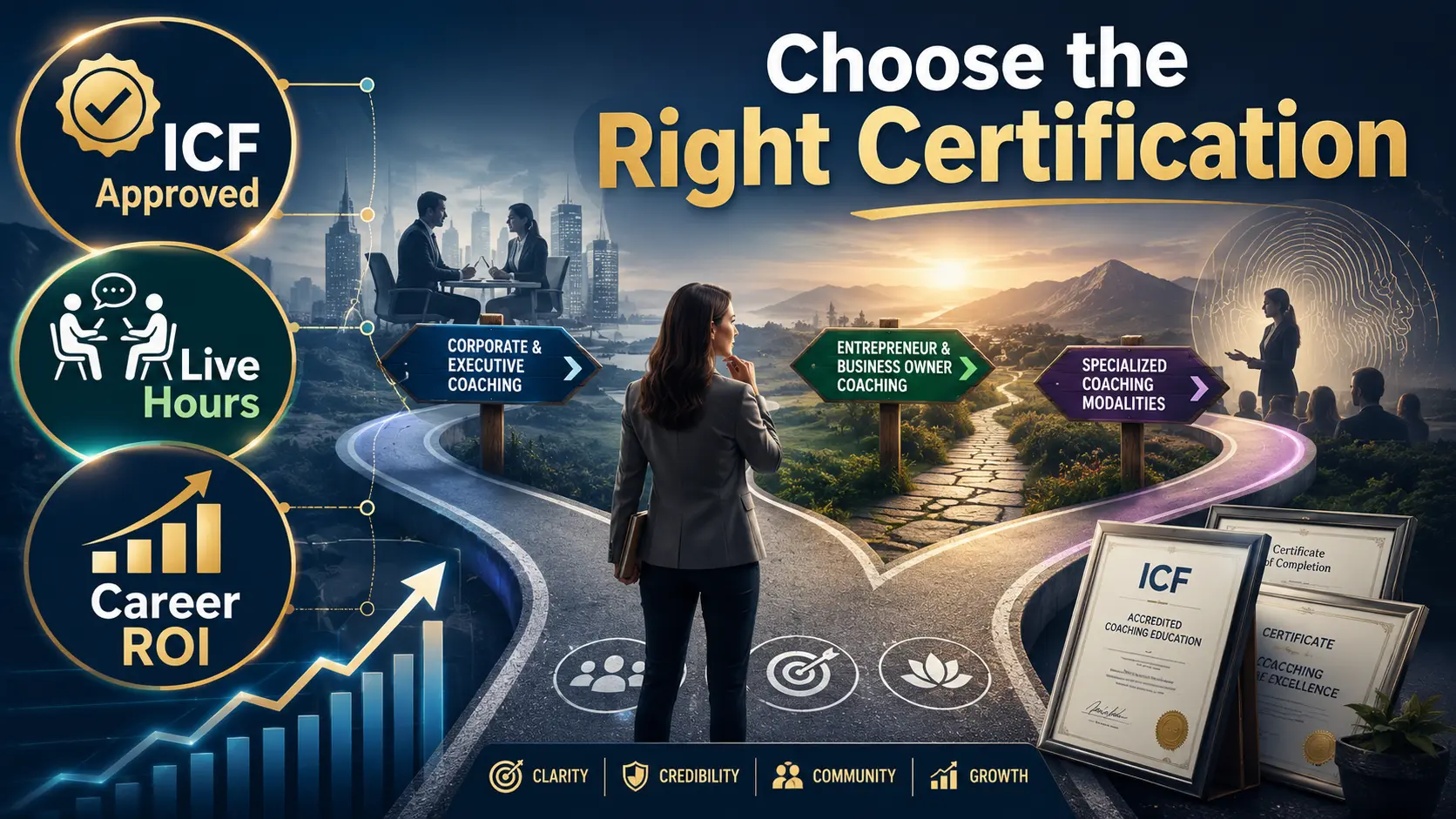
The right business coaching certification in Ontario depends on your goals, coaching style, and budget, not on which program has the loudest marketing. Certification isn’t legally required in Ontario, but a structured program gives you supervised practice hours, a mentor coach, and a community of working coaches who can vouch for your skills.
That structure separates coaches who build lasting practices from those who collect certificates and stall out. Expect to invest $600 to $10,000 and two to six months, depending on depth. The five-step framework below helps you clarify your niche, check accreditation, examine practice hours, confirm mentorship, and know your budget before you enroll.
Key Takeaway:
- A business coaching certification in Ontario builds the practical coaching skills, credibility, and confidence needed to help entrepreneurs and leaders achieve measurable results. While certification isn’t legally required in Canada, it can strengthen client trust and create more professional opportunities. [1]
- When comparing certification programs, look beyond price. Prioritize experienced trainers, recognized accreditation, hands-on coaching practice, mentorship, business development support, and a curriculum that teaches real-world coaching skills you can immediately apply with clients. [1]
- The best certification depends on your goals. Aspiring executive and leadership coaches often benefit from ICF-accredited programs, while entrepreneurs may prefer training that combines coaching techniques with client acquisition, communication, and business growth strategies. [2]
- Certification is only the beginning. Long-term coaching success comes from consistently practicing your skills, refining your niche, building authority, and delivering measurable client outcomes that generate referrals and sustainable business growth. [2]
Bottom Line: A business coaching certification in Ontario is a valuable investment when it provides practical coaching experience, recognized credentials, and ongoing support. Choosing the right program can accelerate your credibility, improve client results, and help you build a successful coaching business.
Business coaching certification is a structured training program that teaches coaching skills, communication techniques, ethics, client engagement, and coaching frameworks. Most programs include supervised practice, mentor feedback, and competency assessments.
In Ontario, certification is not legally required to become a business coach. However, certification can improve credibility, particularly when working with corporate clients, leadership teams, and larger organizations.
The most widely recognized credentialing body is the International Coaching Federation (ICF), which establishes standards for coach training and professional development.
Which Certification Path Is Best?
| Certification Path | Recognition | Cost Range | Best For | Main Advantage |
|---|---|---|---|---|
| ICF Accredited | High | $2,000–$10,000+ | Executive and corporate coaching | Global credibility |
| University Extension | Medium-High | $2,000–$8,000 | Career changers | Academic reputation |
| NLP-Based Training | Medium | $1,500–$7,500 | Entrepreneurs and transformational coaches | Practical communication tools |
| Specialized Modalities | Medium | $1,000–$5,000 | Niche coaching practices | Deep expertise |
| Non-Accredited Programs | Low to Variable | $500–$5,000 | Exploratory learning | Lower cost |
Is Business Coaching Certification Right for You?

Business coaching certification is most valuable for people who plan to build a coaching business, work with corporate clients, or transition into coaching professionally. It is less critical for those exploring coaching casually or using coaching skills internally within an existing role.
Certification makes sense for most people building a coaching practice from the ground up, but it isn’t the right next step for everyone right now.
It’s a good fit if:
- You’re building a coaching practice and want a credential clients recognize.
- You’re changing careers and need structured, supervised training, not just confidence.
- You want extra credibility with corporate or executive clients.
- You plan to work with business owners, leadership teams, or entrepreneurs and need frameworks built for that world.
You may want to wait if:
- You’re only exploring coaching casually and aren’t ready to invest yet.
- You’re really after consulting skills, where industry expertise matters more than a coaching credential.
- You already hold an ICF or equivalent credential and need a specialization rather than a foundational program. If you’re looking to hire a coach rather than become one, our guide to finding a business coach in Canada will get you there faster.
The CHECK Framework for Choosing a Certification
Five checks separate a certification that builds your career from one that just drains your bank account: clarity, accreditation, practice hours, mentorship, and budget.
Clarify Your Coaching Niche
Before you compare programs, get specific about who you actually want to coach. Business owners, executives, and entrepreneurs each respond to different frameworks, and the right certification trains you in the one that matches your goals.
Heed Accreditation
Accreditation from a recognized body like the ICF signals a baseline standard for training hours, ethics, and supervised practice. It matters most for corporate or international clients, and less if you’re staying niche and local.
Examine Practice Hours
Look at how much of the program is live coaching and real feedback, versus lectures and reading. Programs built around actual client interaction prepare you far faster than ones built on theory alone.

Confirm Mentorship and Community
Ask whether mentor coaching is included and whether the program connects you with other working coaches. That community often becomes your first referral source and your support system through the early stretch of building a practice.
Know Your Budget and ROI
Map the full investment, including hidden costs like supervision hours, against what you can realistically charge once certified. A pricier program that gets you paying clients faster often beats a cheaper one that leaves you to figure out marketing alone.
Common Mistakes When Choosing a Coaching Certification
Many new coaches evaluate programs based on marketing rather than training quality.
Common mistakes include:
Choosing Based on Price Alone
Low-cost certifications often provide limited coaching practice and mentorship.
Ignoring Practice Hours
Real coaching experience matters more than theory.
Assuming All Accreditation Is Equal
Verify which organization provides accreditation.
Focusing Only on Techniques
A strong coaching methodology is usually more valuable than learning dozens of disconnected tools.
Neglecting Business Development Training
Many new coaches struggle because they learn coaching skills but not client acquisition.
What to Look for Before You Enroll

Seven questions filter out weak programs before you spend a dollar.
- Who accredits the program, and is that accreditation named specifically rather than implied?
- How many live coaching hours are actually included in the curriculum?
- Is mentor coaching part of the program, or an expensive add-on?
- What credentials do the instructors themselves hold?
- Does the program teach you to build a coaching business, not just to coach?
- Is there an active graduate community you can join once the program ends?
- What’s the full cost once you add required extras, not just the headline tuition figure?
Best Practices for Evaluating Coaching Programs
Before enrolling, use these best practices:
- Define your target client.
- Compare curriculum depth.
- Verify accreditation directly.
- Prioritize live coaching practice.
- Speak with recent graduates.
- Review mentor support options.
- Calculate total investment.
- Assess alumni community strength.
Programs that score well in all eight areas generally produce stronger coaching outcomes.
Heather Chetwynd had already completed an NLP practitioner course before training with James R. Elliot, but came away from that earlier program confused about how the pieces fit together. Working through James’s program gave her the clarity to integrate the techniques into her own business, along with a toolbox she still uses with clients today. Her experience illustrates why a coherent curriculum matters more than a long list of techniques covered on a syllabus.
Real-World Example: Why Curriculum Design Matters
Heather’s experience highlights a common challenge in coach education. Many programs teach techniques individually without helping students understand when and how to apply them.
A structured curriculum connects coaching frameworks into a repeatable process. This reduces confusion, accelerates confidence, and improves client outcomes.
When evaluating programs, ask not only what techniques are taught, but how those techniques integrate into a complete coaching methodology.
Do You Need Certification to Coach in Ontario?

No. Ontario doesn’t legally require certification to call yourself a business coach.
Coaching remains an unregulated profession across Canada, so nothing stops you from working with clients without a credential. That said, certified coaches tend to charge more and close corporate clients faster, since a credential signals training that a prospective client otherwise can’t easily verify.
A few practical considerations matter regardless of certification status:
- No provincial licensing exam stands between you and your first paying client, since coaching itself isn’t regulated.
- If you coach under a business name other than your own, you’ll need to register it with the Ontario Business Registry, covered in our guide to the legal requirements for coaching businesses in Canada.
- Corporate clients increasingly expect recognized training behind your name, and liability insurance is worth pricing out either way, since insurers often factor training into your premium.
The International Coaching Federation, known as the ICF, is the largest professional body for coaches worldwide and the closest thing the industry has to an internationally recognized standard. ICF accreditation helps if you want to work with larger organizations or eventually pursue advanced credentials like the PCC or MCC. If your work stays local and niche, other accreditation models or specialized modality training can serve you just as well.
For context, the entry-level ACC credential currently requires 60 hours of coach-specific education, 100 hours of coaching experience with at least 75 paid, and 10 hours of mentor coaching, followed by a performance evaluation. When you’re evaluating an ICF-accredited program, check how those hours are actually delivered, since some programs front-load lectures and leave practice hours thin.
Why Certification Matters More in 2026
Several trends are increasing the value of professional coaching credentials:
- Corporate buyers increasingly verify coach qualifications.
- Coaching competition continues to grow.
- Credential standards are becoming more rigorous.
- Clients are more likely to research credentials before hiring.
According to coaching industry research, approximately 85% of coaching consumers value working with a credentialed coach.
While certification alone does not guarantee success, it can reduce credibility barriers during client acquisition.
How Much Does Business Coaching Certification Cost?
Expect to pay anywhere from a few hundred dollars to ten thousand dollars or more, depending on depth and accreditation level.
| Program type | Typical cost |
| Introductory | $600 to $1,500 |
| Mid-tier | $1,500 to $4,000 |
| Comprehensive | $4,000 to $10,000 |
| Premium / advanced pathway | $10,000+ |
Cost Comparison by Coaching Goal
| Goal | Recommended Investment |
|---|---|
| Explore coaching | $600–$1,500 |
| Start a coaching business | $1,500–$5,000 |
| Corporate coaching | $4,000–$10,000+ |
| Executive coaching pathway | $8,000–$15,000+ |
Pricing across leading programs generally falls within that range, though exact totals depend on how many supervised hours and mentor sessions are bundled in versus sold separately.
The timeline varies just as much as the price. Fast-track programs run a few intensive weeks, part-time programs spread the same material over three to six months, and comprehensive pathways toward the PCC can take a year or more once you include the required coaching hours.
Run the math before you commit: compare your tuition against what certified coaches in your niche typically charge, then calculate how many clients it takes to break even. A program with a clear plan for finding your first clients often pays for itself faster than a cheaper one that leaves marketing up to you.
Types of Business Coaching Certifications Compared
Four main pathways cover most of what’s available to Ontario-based coaches in 2026.
| Path | Best for | Typical investment | Main strength |
| ICF-accredited | Corporate and executive credibility | Higher | Global recognition |
| University extension | Academic prestige | Moderate to high | Institutional reputation |
| Specialized modalities (including NLP) | Practical, applied skills | Moderate | Frameworks you can use immediately |
| Unaccredited programs | Varies widely | Low to high | Requires careful evaluation |
ICF-accredited programs carry the most weight with corporate buyers and open the door to advanced credentials later. University extension programs trade some flexibility for institutional prestige. Specialized modality training, including NLP-based business coach training, teaches applied frameworks you can use in your very next session, which is why it tends to pair well with a base ICF credential rather than replace it. Unaccredited programs vary widely in quality, so run the CHECK framework above even more rigorously before enrolling in one. For specific Ontario programs mapped to these paths, our roundup of Ontario certification options is a useful next stop.
Which Certification Is Best?
There is no universally best certification. The ideal option depends on your target clients, preferred coaching style, and long-term business objectives.
For corporate and executive coaching, ICF-accredited programs typically offer the strongest market recognition. For entrepreneurs and transformational coaches, NLP-based and specialized methodology training may provide more immediately applicable tools.
Five Red Flags That Signal a Weak Program
These five signs recur in the certification horror stories coaches share online.
- No clear accreditation or governing standard, just a vague claim of being “accredited” without naming the body.
- Little to no supervised coaching practice, with most of the program delivered through pre-recorded lectures.
- Heavy marketing and testimonials stand in for real curriculum details you can actually review before paying.
- No accreditation is named at all, or no mentorship and alumni community, once the paid modules end.
- A fragmented curriculum that covers many techniques without tying them into one coherent coaching methodology.
Why the Coaching Industry Continues to Grow

The coaching industry has expanded consistently over the past decade due to increased demand for leadership development, entrepreneurship support, executive performance coaching, and workplace wellbeing initiatives.
Growing demand has also increased competition, making professional training and certification more important differentiators than they were in previous years.
Data & Findings
The numbers below frame just how much a certification decision actually weighs in today’s coaching market.
- Global coaching market size: $5.34 billion in 2025, projected to reach $5.8 billion in 2026, continuing nearly a decade of steady growth. Source: Luisa Zhou, Coaching Industry Market Size 2025-26
- Active coach practitioners worldwide: roughly 122,974 in 2025, up 15% since 2023 and 54% since 2019. Source: Tandem Coach, Coaching Industry Statistics 2026
- Client preference for credentials: about 85% of coaching clients say they specifically value working with a credentialed coach. Source: ICF Global Consumer Awareness Study, via Tandem Coach
- Executive and business coaching segment: valued at roughly $103.6 billion in 2025, projected to reach $161.1 billion by 2030, one of the fastest-growing niches in the industry. Source: Simply.Coach, ICF Coaching Statistics 2026
- Credential standards update: new ICF Minimum Skills Requirements took effect January 1, 2026, raising the bar for ACC and MCC performance evaluations. Source: ICF, Supporting Coaches With Greater Clarity
- Ontario context: the province’s business coaching segment runs an estimated $492 million within the broader global industry, per our analysis in How to Find a Business Coach in Canada.
For new coaches in Ontario, growing demand paired with rising credentialing standards makes a well-chosen certification more valuable now than it would have been five years ago, not less.
Frequently Asked Questions
Can I become a business coach without certification?
Yes. Ontario doesn’t require certification to coach, but most coaches who build lasting practices eventually get certified for the credibility it provides.
How long does certification take?
Anywhere from a few intensive weeks to a year or more for a full ICF Level 2 pathway, depending on how many coaching hours you still need.
Is online certification respected?
Yes, as long as the program carries real accreditation and includes live, supervised practice rather than only self-paced video lessons.
What’s the difference between business coach and life coach certification?
Business coach training focuses on leadership and growth strategy for organizations and entrepreneurs, while life coach training leans toward personal development and mindset work. Many programs, including James R. Elliot’s, blend both.
Can I coach while completing certification?
In most ICF pathways, yes, since required coaching hours typically come from real client sessions completed during training.
Which certification is best for career changers?
A program pairing ICF accreditation with strong business-building support tends to work best, since you’re learning to coach and to run a business at the same time.
Is ICF accreditation required?
No. Certification and ICF accreditation are optional. However, many organizations prefer coaches with recognized credentials.
Can entrepreneurs benefit from coaching certification?
Yes. Many entrepreneurs pursue coaching certification to improve communication, leadership, team development, and client relationships.
What is the biggest mistake when choosing a certification?
Focusing on marketing claims rather than coaching practice hours, mentorship quality, and curriculum design.
Can coaching certification increase earning potential?
Certification alone does not guarantee income, but it can improve credibility and help coaches access higher-value client opportunities.
Conclusion
Choosing a business coaching certification in Ontario requires balancing credibility, practical training, mentorship, and cost. The strongest programs provide more than coursework; they offer supervised coaching practice, mentor feedback, and a clear pathway to developing real-world coaching skills.
When evaluating programs, use the CHECK framework to compare accreditation, coaching hours, mentorship, community, and return on investment. This approach helps separate high-quality certifications from programs that rely primarily on marketing claims.
For most aspiring coaches, the best certification is not necessarily the most expensive or most popular. It is the one that aligns with your coaching goals, target clients, and long-term professional development plans.