
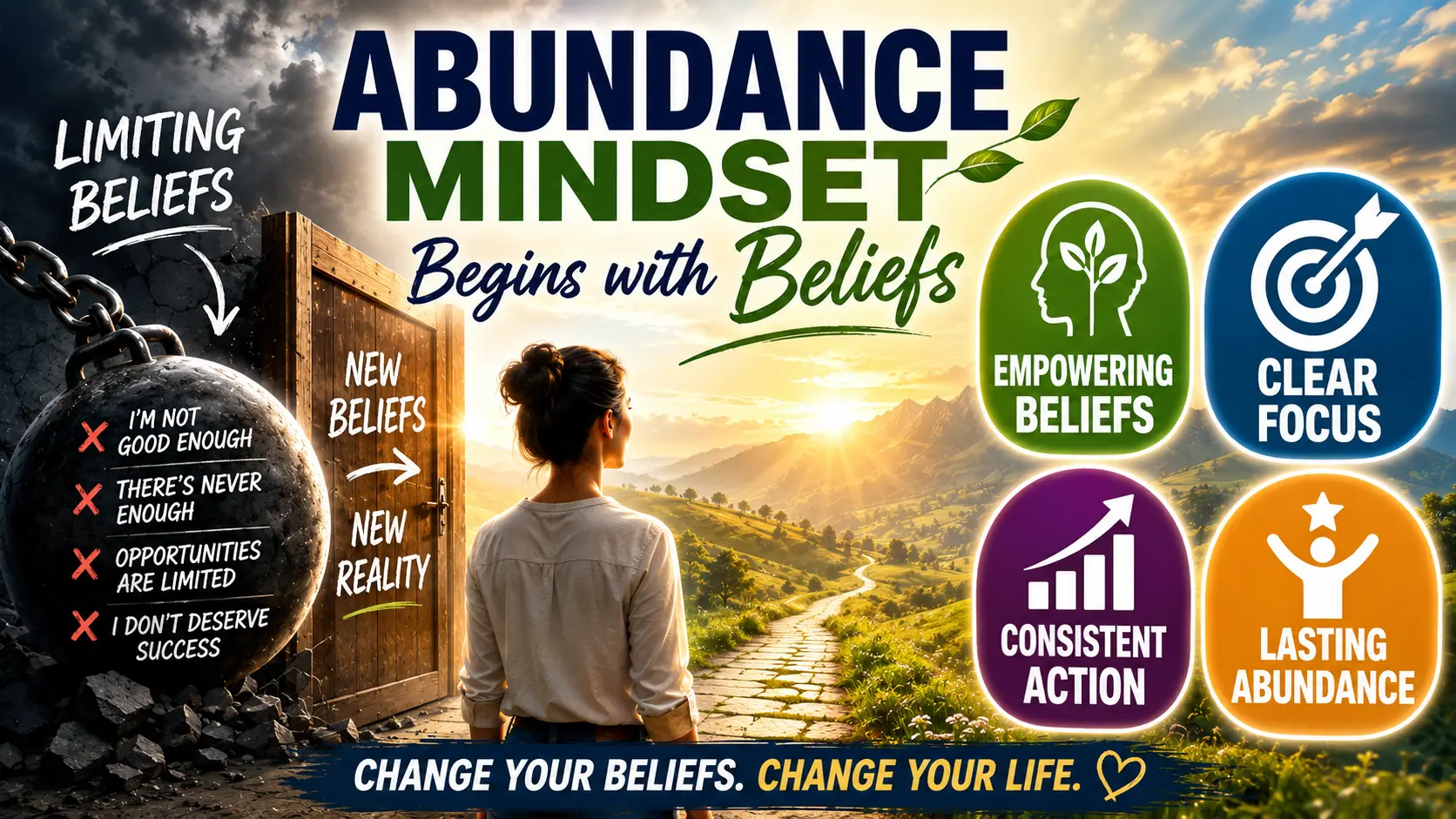
An abundance mindset alone often doesn’t create lasting change because it works at the level of thought, while the beliefs driving your decisions usually sit underneath that thought, shaped by experience, conditioning, and interpretation. Repeating a positive statement doesn’t automatically resolve a belief that contradicts it, which is why affirmations can feel hollow or even backfire for some people.
NLP-based coaching takes a different approach. Instead of layering optimism on top of an old belief, it works to identify where that belief came from, question whether it still holds up, and reframe it into something the person can actually act on. The goal isn’t positive thinking. It’s a new interpretation that leads to different behavior.
Key Takeaway:
- An abundance mindset is the belief that opportunities, success, and growth are available, while limiting beliefs create subconscious mental barriers that can lead to self-doubt, fear, and hesitation. Recognizing these patterns is the first step toward creating lasting personal and professional change. [1]
- Limiting beliefs often develop through past experiences, upbringing, or repeated negative messages. NLP techniques such as reframing, visualization, and language pattern awareness can help individuals challenge these beliefs and adopt more empowering perspectives. [1]
- Developing an abundance mindset requires consistent practice. Daily habits such as gratitude, intentional self-talk, goal setting, and taking small, aligned actions help reinforce confidence and shift attention from perceived scarcity to possibility and growth. [2]
- Mindset work is most effective when paired with practical action. Replacing limiting beliefs alone does not guarantee success, but combining empowering beliefs with skill development, persistence, and strategic decision-making can support meaningful long-term results. [2]
Bottom Line: Building an abundance mindset begins by identifying and replacing limiting beliefs that no longer serve you. When empowering thought patterns are reinforced through consistent action and personal growth, you become better equipped to pursue opportunities, overcome obstacles, and create lasting success.
What Is an Abundance Mindset?

Where the Idea Comes From
An abundance mindset is the belief that opportunities, resources, and success aren’t limited, and that your outlook shapes what you’re able to notice and pursue. It grew out of positive psychology and later became closely associated with the law of attraction, the idea that focused thought and feeling can draw specific outcomes toward you.
There’s real overlap between an abundance mindset and a growth mindset, the well-researched idea that abilities can be developed through effort. Both encourage people to see possibility instead of limitation. Where they diverge is in mechanism. A growth mindset is about how you respond to setbacks and feedback. An abundance mindset, especially in its law of attraction form, leans more heavily on the idea that thought and feeling alone can shift outcomes.
Used realistically, an abundance mindset has value. It can widen your view of what’s possible and interrupt scarcity thinking that keeps you playing small. The trouble starts when it’s treated as a complete solution on its own.
Why It Sometimes Isn’t Enough
Surface-level thinking rarely changes a deeply rooted belief. If you’ve spent years operating from the assumption that money is scarce, that you’re not the kind of person who gets promoted, or that opportunities go to other people, a new thought pattern layered on top of that assumption doesn’t erase it. The old belief is still running underneath, still shaping your decisions in small, often unconscious ways.
That’s the gap this article is really about. For deeper work on spotting these patterns in your own life, identifying your limiting beliefs is a useful starting point before you try to change anything.
Why Affirmations and Positive Thinking Alone Don’t Always Work

The Gap Between What You Say and What You Believe
Psychologists describe this as self-discrepancy, the tension that shows up when a statement you’re repeating doesn’t match what you actually believe about yourself. Say “I am successful” while a quieter, more established belief insists otherwise, and your mind doesn’t simply accept the new statement. It notices the gap.
This is where cognitive dissonance comes in. Holding two conflicting ideas at once is uncomfortable, and the mind tends to resolve that discomfort by siding with the belief that’s more established, which is usually the older, more negative one. The affirmation gets dismissed, and the original belief can end up feeling even more confirmed than before.
That’s why “I am successful” repeated by someone who deeply doubts their own competence often produces frustration instead of confidence. The words and the belief are pulling in opposite directions, and the belief tends to win.
What Research Says About Affirmations
The Wood et al. (2009) Study
One of the most cited studies on this topic comes from psychologist Joanne Wood and her colleagues. Participants were asked to repeat the statement “I am a lovable person” over several minutes while researchers tracked their mood and self-esteem afterward.
The results were split along one clear line. People who already had relatively high self-esteem experienced a mild mood boost, while people with low self-esteem who repeated the statement felt worse afterward than participants who hadn’t repeated it at all. The affirmation didn’t just fail to help this group. It appeared to work against them.
The likely explanation ties back to self-discrepancy. When a statement sits too far outside what someone currently believes about themselves, repeating it doesn’t shrink the distance between belief and statement. It highlights it.

What This Doesn’t Mean
This research doesn’t mean affirmations are useless across the board. It means they’re not a universal fix, and their effect depends heavily on whether the person can actually believe what they’re saying.
Affirmations tend to work better when they’re specific, believable, and paired with real action, rather than broad, sweeping statements repeated without any behavioral change behind them. On their own, though, they’re unlikely to shift a belief that’s been reinforced by years of experience.
NLP vs. Traditional Abundance Mindset: What’s Different?
Traditional abundance mindset work mostly operates at the level of thought. NLP, short for Neuro-Linguistic Programming, works a layer deeper, at the level of the beliefs and mental representations that produce those thoughts in the first place.
| Question | Traditional Abundance Mindset | NLP-Based Belief Work |
| Primary focus | Positive thoughts | Underlying beliefs and interpretations |
| Typical tools | Affirmations, gratitude, visualization | Reframing, language patterns, guided exercises |
| Goal | Encourage optimistic thinking | Help support new perspectives and behaviors |
| Action required | Often self-directed | Usually guided coaching or structured practice |
The core NLP concept at play here is reframing: taking the same set of facts and finding a genuinely different, more useful interpretation of them, rather than papering over the original interpretation with something positive-sounding. A belief like “I always mess things up” doesn’t get replaced with “I am amazing.” It gets examined, tested against evidence, and rebuilt into something more accurate, like “I’m still learning this, and I improve with practice.”
That distinction matters. Reframing works with the belief instead of trying to outshout it, which is part of why it tends to hold up better over time. If you want to go deeper on this specific technique, overcoming limiting beliefs with NLP breaks down several of the tools coaches use.
The ANCHOR Method: A Coaching Framework Inspired by NLP

The ANCHOR Method is James’s six-step coaching framework, built on core NLP principles, for examining and reframing the beliefs that keep people stuck.
Acknowledge
Name the pattern out loud. Most people can sense when they’re repeating a familiar cycle, whether it’s hesitating before a big ask, undercharging for their work, or talking themselves out of opportunities. Acknowledging it clearly is the first step, before any attempt to change it.
Name the Origin
Trace the belief back to where it started. A parent’s comment about money, a school experience that taught you to play it safe, a failed business attempt that got generalized into “I’m not cut out for this.” The belief usually has a source, and naming it takes away some of its automatic authority.
Challenge the Pattern
Question whether the belief still holds up. Is it actually true, or was it true once, in a specific situation, and never updated since? This step looks for evidence on both sides instead of accepting the belief at face value.
Have a New Meaning
Build an interpretation that’s grounded in evidence rather than wishful thinking. This is where reframing happens directly: not “everything is abundant now” but something closer to “I have more control over this outcome than I’ve been giving myself credit for.”
Own the State
Reinforce the new interpretation using a consistent physical or mental cue, often called anchoring in NLP. A specific breath, a gesture, a phrase said internally before a hard conversation. The goal is to make the new belief accessible in the moment it’s actually needed, not just in a quiet reflection session.
Repeat Into Action
Turn the new belief into observable behavior through repeated practice and feedback. A belief that never gets tested against real decisions stays theoretical. This step is where the work becomes visible in someone’s actual choices.
A Real Example
Darren came to coaching feeling stuck despite outward success. He had a job that paid well, but felt hopeless and purposeless, unable to get the promotions, raises, or business he actually wanted. Working through what James calls goal blocks, specific limiting beliefs that quietly cap what someone will pursue, exposed the pattern underneath his stagnation. Once those beliefs were identified and reframed, Darren described real shifts in his thinking, his behavior, and his relationships, along with renewed momentum toward the goals that had felt out of reach.
His experience illustrates the point of this whole approach. The change didn’t come from deciding to think more positively. It came from locating the specific belief that was quietly running the show and rebuilding it into something more accurate.
Who Can Benefit From NLP-Based Belief Work?
This kind of coaching tends to help:
- Entrepreneurs and business owners who keep hitting the same ceiling despite working harder
- Professionals who know exactly what they should be doing but struggle to actually do it
- Leaders whose confidence doesn’t match their competence
- Anyone who’s tried affirmations or vision boards and found the results didn’t stick
If you recognize yourself repeating the same pattern across different jobs, relationships, or ventures, that repetition is usually a sign the belief driving it hasn’t actually changed yet, even if your circumstances have.
Consider Another Approach First If…
NLP coaching is not a substitute for licensed mental health treatment. If you’re navigating severe anxiety, trauma, depression, or another condition that would benefit from clinical support, working with a licensed therapist or medical professional should come first, or alongside coaching, not instead of it. NLP-based belief work is designed to complement that kind of care where appropriate, not replace it.
Data & Findings
The case for looking underneath positive thinking isn’t just anecdotal. A few data points, drawn from peer-reviewed research and current business survival data, help explain why belief work matters more than mood work.
On affirmations and self-esteem:
In the frequently cited Wood et al. study, researchers found that participants with low self-esteem who repeated the statement “I am a lovable person” felt worse afterward than a comparison group who didn’t repeat any statement, while participants with high self-esteem saw a mild mood improvement. The full study is available via PubMed. The takeaway for coaching: a person’s starting belief determines whether positive self-talk helps or backfires, which is exactly why belief-level work matters more than repetition alone.
On mindset and business persistence:
Entrepreneurs with a strong growth mindset are roughly three times more likely to persist after a business setback than those without one, according to research summarized by Nexford University. Persistence is not a minor factor. Business survival data from Crestmont Capital’s 2026 small business report shows that only about half of new employer businesses in the U.S. survive past the five-year mark, with the steepest drop-off occurring in year one.
On limiting beliefs specifically in entrepreneurship:
Business research from Escalon and Cosmico identifies recurring belief patterns, such as perfectionism before launch, the belief that asking for help is a weakness, and fear of failure, as consistent factors behind stalled growth, independent of skill or market conditions.
Timeframe:
Across the coaching literature and NLP-based practice, belief-level shifts are typically reported within a small number of focused sessions, while translating that shift into consistent new behavior, the kind that shows up in business results, tends to take sustained practice over several weeks to a few months.
Taken together, these findings point in the same direction: the beliefs someone holds about their own capability are a measurable factor in whether they persist, adapt, and follow through, not just how they feel on a given day.
What Results Can You Realistically Expect?

The realistic outcomes of this kind of work tend to show up gradually rather than overnight. People who go through structured belief work often report greater self-awareness around the moments they’re most likely to self-sabotage, along with more consistent follow-through on decisions they’ve already made.
This lines up with broader research on mindset and resilience. Entrepreneurs with a strong growth mindset are roughly three times more likely to persist after a setback than those without one, and that persistence is closely tied to long-term outcomes, since only about half of new employer businesses in the U.S. survive past the five-year mark.
Belief work won’t change those odds by itself, but it addresses one of the more overlooked reasons people quit early: not a lack of ability, but an old belief about what they’re capable of that never got questioned.
For more on how this connects to business performance specifically, see mastering mindsets for business and the entrepreneurial mindset through NLP.
Frequently Asked Questions
Can an abundance mindset become toxic positivity?
Yes, when it’s used to avoid acknowledging real problems instead of addressing them. A useful abundance mindset makes space for honest assessment alongside optimism. It doesn’t replace one with the other.
Are affirmations useless?
No, but they’re not a complete strategy on their own. They tend to work best when they’re specific, believable to the person saying them, and backed by real action, rather than used as a stand-in for that action.
Is NLP scientifically proven?
The evidence on NLP is mixed, and it should not be presented as a clinically validated therapy. It’s widely used in coaching contexts as a practical framework for examining beliefs and behavior, and many people find the tools useful, but it doesn’t carry the same research backing as approaches like cognitive behavioral therapy.
How long does belief change take?
It varies. Some patterns shift after a focused session or two, while others, especially long-held ones, take sustained practice over weeks or months to fully change how someone responds in real situations.
Can NLP replace therapy?
No. NLP coaching addresses beliefs, patterns, and goal-directed behavior. It isn’t a substitute for treating clinical mental health conditions, and a good coach will tell you when that kind of support is what’s actually needed.
Conclusion
An abundance mindset can be a valuable perspective, but perspective alone doesn’t always change behavior. If you keep running into the same limits despite trying to think more positively, the issue usually isn’t your effort. It’s that the belief underneath the thought hasn’t been addressed yet.
A structured coaching approach that examines and reframes those beliefs can help bridge the gap between insight and action. If you’re ready to look at what’s actually running underneath your patterns, NLP training for business is a practical next step for professionals and entrepreneurs who want sustainable change, not just a better mood for a few weeks.