
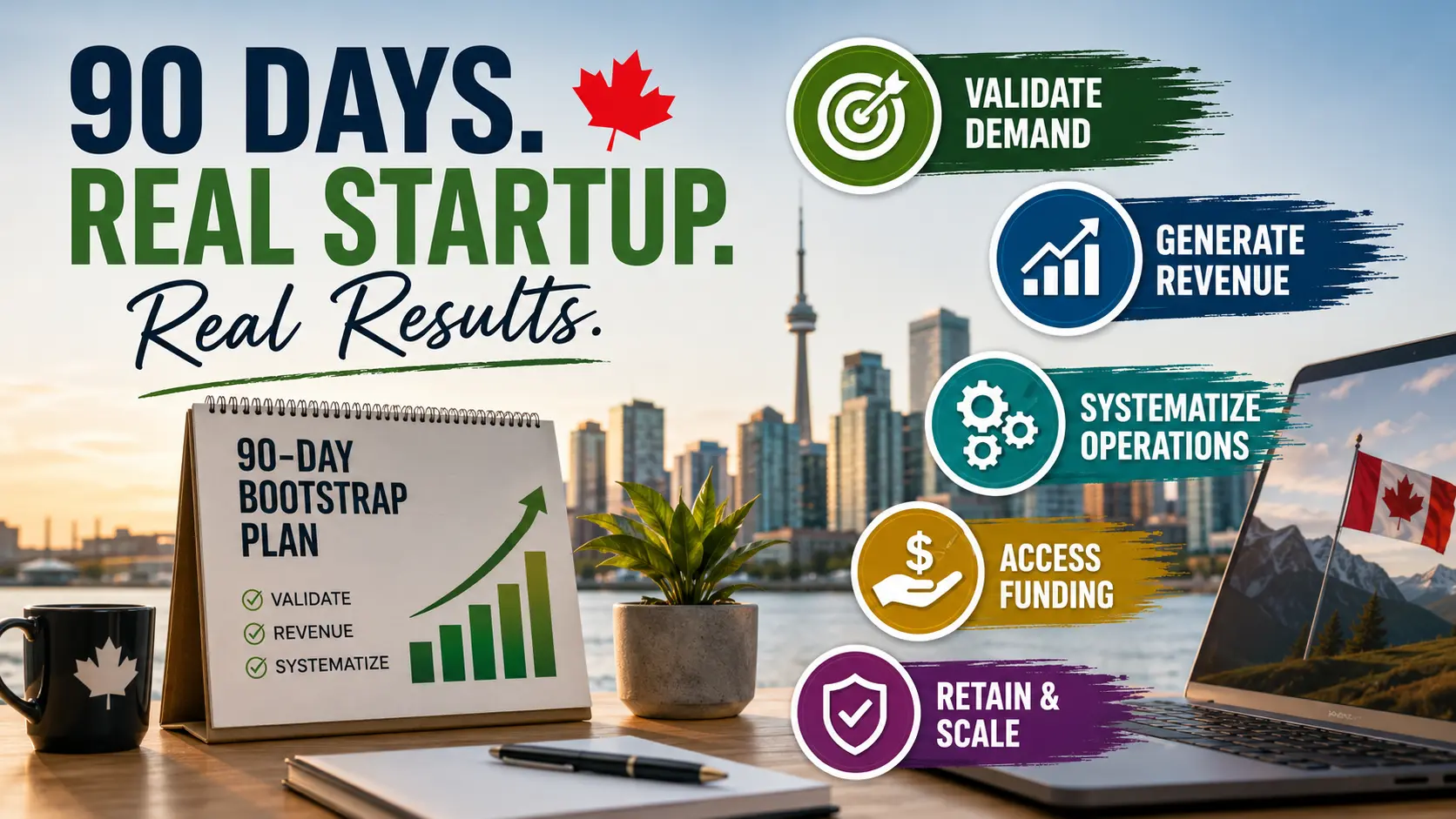
Bootstrapping a Canadian startup means building with personal savings and early customer revenue instead of outside investment. A practical 90-day plan follows three phases: validate demand and secure paying customers (Days 1-30), launch a minimum viable product and generate revenue (Days 31-60), and systematize operations while leveraging non-dilutive funding like SR&ED and IRAP (Days 61-90).
Canada offers a major advantage most founders overlook: close to $5 billion in annual government funding that requires no equity. The 90-day window is not about perfecting your business. It is about proving it can survive on its own terms.
Key Takeaway:
- Bootstrapping a Canadian startup means building the business using personal savings, customer revenue, and reinvested profits instead of relying heavily on outside investors or venture capital. [1]
- Bootstrapped startups often maintain greater ownership, decision-making control, and long-term flexibility because founders avoid early equity dilution and investor pressure. [2]
- Successful Canadian bootstrapped businesses typically focus on lean operations, early profitability, recurring revenue, and solving specific market problems before scaling aggressively. [3]
- Many founders reduce startup costs by using remote teams, automation tools, low-overhead digital business models, grants, and organic marketing strategies instead of expensive expansion tactics. [4]
- While bootstrapping can slow growth initially, it often creates stronger financial discipline, healthier unit economics, and more sustainable long-term business operations.
Bottom Line: Bootstrapping a Canadian startup prioritizes ownership, financial discipline, and sustainable growth over rapid expansion. Founders who focus on lean operations and early revenue generation can build profitable businesses without sacrificing equity or control.
- Source: Shopify Canada – How to Bootstrap a Business
- Source: Investopedia – Bootstrapping Definition and Benefits
- Source: Ownr – Starting a Business in Canada
- Source: Reddit – Bootstrapping Startups in 2026 Discussion
What Is Bootstrapping a Canadian Startup
Bootstrapping means building a business on your own terms, funded by your own resources and early customer revenue rather than outside investors. No pitch decks. No equity given away. No board telling you what to do with your company.
More Canadian founders are choosing this path than you might think. Research has found that over 30% of new Canadian tech startups launch before raising a single dollar of outside capital. They build in stealth, find customers, and prove their idea works before anyone else gets a seat at the table.
Some of Canada’s most recognized companies took this route early. Shopify validated a niche e-commerce problem before scaling the product broadly. Hootsuite focused on product-market fit with real users before chasing growth. FreshBooks was built around a revenue-first mindset, which gave the company financial discipline that carried through its growth years. None of them needed outside capital to prove the concept worked.
That said, it is worth being honest about what you are signing up for. Startup failure rates are cited between 70 and 90% globally, and Canada is not exempt from that reality. Bootstrapping does not automatically protect you from that number. What it does is put the decisions in your hands.
For a broader look at what trips up early-stage businesses, our guide on why small businesses fail to grow breaks down the patterns worth knowing before you launch.
What It Actually Costs to Bootstrap in Canada

One of the first things founders get wrong is underestimating what the first 90 days will actually cost them. Here are honest starting numbers.
Incorporation: Federal incorporation through Corporations Canada runs about $200 online. Provincial incorporation varies between $300 and $1,500, depending on your structure and any legal help you bring in.
Tools and software: Expect $50 to $300 per month in subscriptions, depending on what your business model requires (CRM, invoicing, email marketing, project management).
Living runway: This is the cost most founders forget to calculate. You need 3 to 6 months of personal expenses covered before you can operate with a clear head. Financial stress short-circuits good decisions at the worst possible time.
Time to first revenue: Between 30 and 90 days is a realistic window for most service-based or early SaaS businesses. For product businesses, it often runs longer. Treat that gap as a real line item, not an afterthought.
Before you set up anything else, get your banking sorted properly. The right business account makes a real difference in how you track cash flow and how you look to clients. Our breakdown of business bank accounts for Canadian startups covers the options that make sense at this stage.
The Hard Truth About Bootstrapping in Canada
This section exists because most guides skip it, and that is a disservice to you.
Bootstrapping is slower. A venture-backed competitor with $2 million in the bank can outspend you on ads, hire faster, and buy market share you have to earn one customer at a time. You are not competing dollar for dollar. You are competing on focus, relationships, and precision.
It is also financially personal. When the business is slow, that pressure lands directly on you. It affects your sleep, your decisions, and sometimes your relationships. That is real, and it is worth acknowledging before you start, not after you are six weeks in.
And it can be lonely. Many of James’s clients have arrived at exactly this point, when the business idea was solid but the mental weight of going it alone was quietly undermining their confidence and clarity. Darren G. came to James feeling completely blocked in his career and income, unable to move forward on his own business despite having a good-paying job. He had the idea and the drive. What he was missing was the internal clarity to act. After working through goal blocks and limiting beliefs with James, the shifts he experienced were decisive and his business trajectory changed.
The point is not to scare you off bootstrapping. The point is that your inner game matters as much as your business plan. If you want to go deeper on this, the article on entrepreneurial mindset through NLP is worth reading before you hit your first wall.

Days 1-30: Validate Before You Build Anything
The most common mistake early-stage founders make is building before they have confirmed anyone will pay. You can spend 60 days building a product and then discover that nobody wants it at the price you need.
Validation is not asking friends if your idea is good. It is asking potential customers whether they will pay for it. The difference matters enormously.
Start with the problem, not the solution. What specific painful problem are you solving, and for whom? The narrower your answer, the better your odds. Broad markets feel safer, but they are harder to crack without capital.
Then get in front of people who actually have that problem. Offer a free strategy session, a pilot, or a pre-sale. If they will not commit even at a discounted early price, that is information you need now, not 90 days from now.
Days 1-30 Checklist
- Define the specific painful problem you solve
- Identify 10 potential customers you can reach this month
- Get at least 3 paying commitments (not interest, not leads, commitments)
- Avoid building anything until you have those commitments
- Set up your business banking and basic legal structure
Days 31-60: Build Your MVP and Land First Revenue
An MVP is not a half-finished product. It is the simplest version of your offer that delivers real value and generates real revenue.
For service businesses, your MVP might be a four-session coaching package or a defined consulting deliverable. For software, it might be a manual process you deliver before automating it. For product businesses, it is the one version that solves the core problem. Nothing more.
The goal here is to move from a cash commitment. Those three people who said yes in Month 1 are now paying customers. You learn faster from one paying customer than from 100 people who thought the idea was interesting.
Mike L. came to James struggling with self-doubt and mental noise that was showing up directly in his professional performance. Through NLP coaching, he cleared the internal clutter and started showing up with genuine confidence in his work. That pattern shows up constantly in early-stage founders: the mechanics of building an MVP are rarely what stop people. The hesitation to put yourself out there is.
Days 31-60 Checklist
- Deliver your MVP to your first paying customers
- Document what worked and what surprised you
- Track revenue weekly, even when the numbers are small
- Ask customers what they would pay to keep getting this result
- Start building a simple referral process
Days 61-90: Systematize, Retain, and Set Up for Scale
By Day 61, you have paying customers and a working offer. The work now is to make it repeatable. A business that requires you to personally reinvent the wheel every cycle is not a business yet. It is a freelance arrangement with extra steps.
Systematizing means documenting how you acquire customers, how you deliver your product or service, and how you retain people. It does not need to be sophisticated. A simple checklist or a short video walkthrough of your process counts.
Retention matters more than acquisition at this stage. It costs far more to replace a customer than to keep one. Follow up, ask for feedback, and look for a logical next offer that deepens the relationship.
This is also the phase where you start looking at non-dilutive funding options. Not because you need rescuing, but because you are starting to build real leverage. Our guide on smart reinvestment strategies covers how to think about putting early revenue back to work strategically.
Days 61-90 Checklist
- Document your core acquisition and delivery process
- Build a simple retention follow-up system
- Identify one R&D or innovation activity that could qualify for government funding
- Review monthly costs against revenue and check your runway status
- Decide: stay bootstrapped, seek non-dilutive funding, or raise capital from a position of strength
Canadian Government Funding Bootstrappers Routinely Miss
Canada is genuinely one of the better countries in the world to build a bootstrapped startup, and not enough founders know why.

Between SR&ED, Mitacs, and NRC IRAP, there is close to $5 billion allocated annually to Canadian companies through non-dilutive programs. No equity. No debt. That figure changes the bootstrapping math significantly
SR&ED (Scientific Research and Experimental Development)
Canada’s largest non-dilutive funding program rewards companies for doing technically uncertain work where outcomes are not guaranteed. It functions as a retroactive tax credit covering up to 69% of eligible labour and overhead costs. If you are building software, testing a new process, or solving a technical problem, it is worth finding out whether your work qualifies.
IRAP (Industrial Research Assistance Program)
IRAP provides direct grant funding rather than tax credits, covering up to 80% of technical salaries and 50% of contractor costs for approved R&D projects. Small projects can access up to $50,000 through an accelerated review, while larger scale-up projects can reach significantly more. You work with an Industrial Technology Advisor throughout, who brings advisory support in addition to funding. Successful IRAP participation is also viewed by private investors as third-party validation of technical merit.
Mitacs
Less talked about than SR&ED and IRAP, but worth knowing. Mitacs connects Canadian businesses with post-secondary researchers through funded internships. Businesses contribute $7,500 per four-month placement and Mitacs matches that to create a $15,000 research project. For a bootstrapped startup that needs technical talent but cannot afford full-time hires, this is a practical and underused option.
One key timing note: IRAP applications need to happen before you start the project. SR&ED is retroactive. Understanding this distinction changes how you plan your product and development roadmap from the start.
Bootstrapping vs. VC Funding in Canada
| Factor | Bootstrapping | VC Funding |
| Equity retained | 100% | 15-35% given up per round (typically) |
| Decision-making | Full founder control | Board and investor input required |
| Timeline to launch | Faster (weeks to months) | Slower (fundraising comes first) |
| Growth speed | Organic, revenue-funded | Faster burn, faster scale potential |
| Failure risk profile | Lower immediate financial pressure | Higher pressure to hit milestones |
| Ideal business type | Services, SaaS, niche products | High-growth, large TAM, tech platform |
| Government funding | Full access, often prioritized | Accessible but often deprioritized |
Bootstrapping is not the inferior option. It is the right option for founders who want to prove their idea before giving away ownership, and for business models where product-market fit can be found without massive upfront capital. VC funding makes sense when your model requires scale to work at all, or when market timing demands speed you cannot achieve organically
The VRS Method: A 90-Day Bootstrap Framework
After working with hundreds of Canadian entrepreneurs over 20 years, a clear pattern emerged in who actually makes it through the first 90 days and who stalls. The founders who succeed follow three phases in order. Skipping ahead collapses the whole structure.

Step 1: Validate
Confirm that real people with a real problem will pay real money before you build anything. Get three paying commitments. Not leads. Not interested. Commitments.
Step 2: Revenue
Build the minimum viable version of your offer and deliver it. Turn commitments into cash. Learn what customers actually value versus what you assumed they valued.
Step 3: Systematize
Document what works. Build repeatable processes. Set up the systems that let the business run without you having to rebuild it from scratch every cycle.
The VRS Method works because it forces founders to move in the right sequence. Most startup failures happen when founders skip Step 1, build through Step 2, and never reach Step 3 because they run out of cash or confidence first. The 90-day window keeps you honest.
Data and Findings
The following patterns emerge from Unleash Your Power’s work with Canadian entrepreneurs and the broader bootstrapping research literature:
In Canada, early-stage startups typically depend on internal financing sources such as personal savings, retained earnings, and support from close networks. Many startups rely on personal savings and internal funding in the early stages. Access to external capital is often limited at the idea or validation stage, which makes bootstrapping a practical and necessary approach. This funding structure encourages founders to focus on revenue generation, customer validation, and cost control from the very beginning, rather than relying on outside investment to sustain operations.
Business survival data consistently shows that approximately half of all new businesses do not make it past the five-year mark. About 50% of businesses fail within their first five years. The highest risk period occurs after the initial launch phase, when early capital is depleted and founders must rely on consistent revenue to survive. This reinforces the importance of validating demand early, maintaining financial discipline, and building a sustainable business model rather than pursuing growth without a stable foundation.
Investors place significantly more value on startups that can demonstrate real traction through revenue, even if the numbers are modest. Early revenue signals product-market fit, reduces perceived risk, and strengthens a founder’s negotiating position during fundraising. Demonstrating revenue improves fundraising outcomes. Startups that bootstrap to initial revenue often achieve better valuations and retain more equity compared to those raising capital based solely on projections or ideas.
Canada offers a strong ecosystem of government-backed funding programs designed to support innovation without requiring founders to give up equity. Canada provides billions in non-dilutive funding through SR&ED, IRAP, and Mitacs. Programs like SR&ED provide tax credits for research and development activities, IRAP offers direct funding for technology and innovation projects, and Mitacs supports collaboration with academic researchers. Together, these programs help reduce financial pressure, extend runway, and enable startups to invest in growth while maintaining ownership and control.
There is no fixed cost to launching a startup in Canada, as expenses vary significantly based on the type of business. Startup costs in Canada vary widely depending on the business model and sector. Service-based businesses can often start with minimal upfront investment, while product-based or technology startups may require higher initial capital for development, inventory, or infrastructure. Key cost components typically include incorporation fees, software tools, operational expenses, and personal living runway. Understanding these variables is essential for realistic financial planning and long-term sustainability.
Who Should Bootstrap Their Canadian Startup?
Bootstrapping makes the most sense when:
- Your business model can generate revenue within 30 to 90 days of launch.
- You are building a service, consulting practice, SaaS product, or niche e-commerce brand that does not require massive upfront infrastructure.
- You want to retain full ownership and decision-making authority through the early stages.
- You have 3 to 6 months of personal living costs covered and can operate without a salary in the short term.
- You are comfortable with slower initial growth in exchange for building a business that is genuinely yours.
Who Should Avoid Bootstrapping?
Bootstrapping is the wrong move when:
- Your model requires significant upfront infrastructure, inventory, or technology before you can generate any revenue at all.
- You are in a market where speed is the only moat, and a well-funded competitor will outpace you before you build real traction.
- You do not have a financial buffer and will be making decisions from a place of scarcity within weeks.
- You need specialized talent on day one that you cannot access through Mitacs or similar programs.
Frequently Asked Questions
What does bootstrapping a Canadian startup mean?
Bootstrapping a Canadian startup means building a business using personal savings and early customer revenue instead of external funding. Founders retain full ownership and control while focusing on validating demand, generating revenue quickly, and scaling sustainably without dilution.
How much does it cost to start a business in Canada?
Startup costs in Canada vary widely depending on the business model. Basic incorporation ranges from about $200 to $1,500, while monthly tools may cost $50 to $300. Service-based businesses can start with minimal capital, while product or tech startups require significantly more investment.
What government funding is available for Canadian startups?
Canadian startups can access non-dilutive funding through programs like SR&ED (tax credits for R&D), IRAP (grants for innovation projects), and Mitacs (funded research internships). These programs collectively provide billions in annual support without requiring equity.
How long does it take to generate revenue when bootstrapping a startup?
Most service-based or early-stage SaaS startups can generate initial revenue within 30 to 90 days if they focus on validating demand and securing paying customers early. Product-based businesses may take longer due to development and production timelines.
Is bootstrapping better than venture capital for Canadian startups?
Bootstrapping is better for founders who want full control, lower financial risk, and early validation through revenue. Venture capital is more suitable for startups that require rapid scaling, large upfront investment, or operate in highly competitive markets where speed is critical.
Ready to Start Bootstrapping Your Canadian Startup?
Bootstrapping a Canadian startup in 90 days is not a guarantee of success. Nothing is. But it is a clear, honest path to finding out whether your idea has legs before you give away equity, take on debt, or spend years chasing funding rounds that may never close.
The VRS Method gives you a framework. The government programs give you real financial leverage. And the work of clearing the internal blocks that slow founders down at the decision stage is where the right coaching support makes the difference between stalling and breakthrough.
If you are ready to map your 90-day plan or want coaching support for the entrepreneurial journey ahead, connect with James at Unleash Your Power. Your business is waiting. The only question is when you decide to start.
Unleash Your Power: Stand Out, Take Action, and Create the Success You Want.