
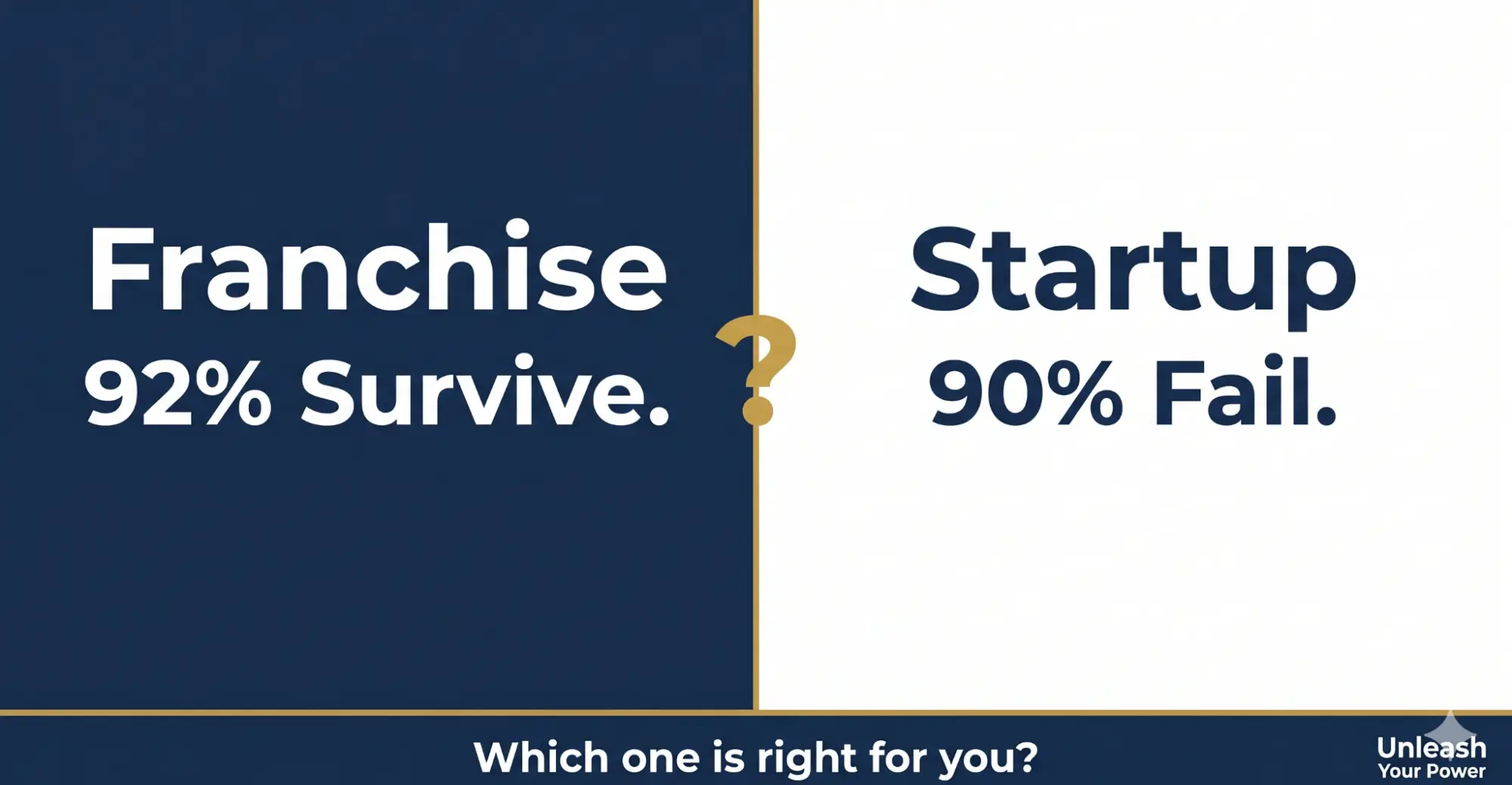
When comparing franchising vs startups, franchising is more profitable in the short term. Startups that survive are more profitable in the long term. In 2026, the data is unambiguous: franchises offer faster break-even timelines, dramatically lower failure rates, and predictable annual income, with the average franchise owner earning around $103,000 per year and roughly 92% of franchises surviving their first two years.
Startups carry far higher risk, with around 90% eventually failing, but they offer uncapped upside and full ownership of everything you build. Which model wins depends less on the numbers and more on who you are, your risk tolerance, your psychology, and whether you’re built for structure or for creating something from nothing.
Key Takeaway:
- Franchises and startups offer very different paths to profitability franchises provide proven systems, brand recognition, and lower operational uncertainty, while startups offer greater flexibility, ownership, and long-term upside potential. [1]
- Franchises often generate revenue faster because they operate with established branding, operational playbooks, and customer trust, but they usually involve franchise fees, royalties, and stricter operational rules. [2]
- Startups generally carry higher risk and slower early profitability, but successful founders retain full control, avoid royalty payments, and can scale far beyond the limits of traditional franchise models. [3]
- The most profitable option depends on the entrepreneur’s goals, risk tolerance, capital access, and skill set operators often prefer franchises, while innovators and builders may benefit more from startups. [4]
- In Canada’s 2026 business environment, startups with scalable digital or service-based models can achieve higher long-term margins, while franchises may provide more predictable cash flow and stability earlier on.
Bottom Line: Franchises typically offer faster stability and lower operational risk, while startups provide greater flexibility and higher long-term growth potential. The better choice depends on whether the entrepreneur values predictability or scalability more heavily.
- Source: NerdWallet – Franchise vs Startup Comparison
- Source: International Franchise Association – Franchise Pros and Cons
- Source: Shopify Canada – Startup Business Guide
- Source: Reddit – Franchise vs Startup Profitability Discussion
Profit Comparison: Franchise vs Startup by the Numbers
Franchising wins on speed. Most franchise owners reach operational break-even within six to eighteen months, according to 2026 profitability data from In Business Magazine. Startups typically need one to five years before they see consistent profitability, and many never get there at all.
The average franchise owner earns around $103,000 annually, based on industry data compiled by Capital Counselor. That number is stable, predictable, and built on a system already proven to work. Startup income is a wide bell curve by contrast. Some founders make nothing for years. A small number build generational wealth. Most land somewhere in between, or exit before they ever find out which category they fall into.
Where startups win is the ceiling. A franchise agreement typically caps your territory, limits your pricing, and locks you into a royalty structure. A startup has no ceiling. If the business scales, so does your equity. The trade-off is real: you’re accepting far more variance in exchange for far more upside.
Multi-unit franchise ownership is where the income math shifts meaningfully. Owners who successfully operate several locations build significant net worth over time. It’s less glamorous than a startup exit story, but far more reliable. Applying smart reinvestment strategies from day one accelerates this considerably.
Survival Rates: Why Franchises Outlive Most Startups
This is where the gap is most striking. Research tracking franchise performance consistently shows success rates of 80 to 90% in the early years, with only around 4% of franchises failing within their first five years. Compare that to startups, where data from Failory’s 2026 analysis shows roughly 90% eventually fail, with more than 20% closing in the first year alone.
The reasons for franchise resilience are structural. You’re not figuring out operations from scratch. You’re inheriting a tested system. Brand recognition brings customers through the door before you’ve earned a single review. Supplier relationships are established. Training is built in. These are not small advantages.

Startups fail for a different set of reasons. A 2026 Wilbur Labs survey of 200 founders found that the most common cause of failure was misunderstanding product-market fit, with nearly half of respondents citing competition and shifting market dynamics as key contributors. Funding gaps, hiring missteps, and technology issues rounded out the list. The underlying pattern: startups require you to solve every problem simultaneously, with no playbook and a ticking clock.
Understanding why small businesses fail to grow is just as important as choosing the right model. The failure patterns repeat regardless of which vehicle you’re in.
Upfront Investment: What You’re Actually Buying
Franchise costs are high and predictable. Depending on the brand and industry, you’re typically looking at a franchise fee between $10,000 and $100,000 or more, plus build-out, equipment, working capital, and initial marketing. Total investment for established brands commonly runs from $50,000 to well over $350,000.
Startup costs are theoretically lower but practically unpredictable. You might launch a service business for a few thousand dollars. You might spend $500,000 and three years building something that never finds its market. The range is genuinely unlimited in both directions.
The key question isn’t which is cheaper. It’s what you’re buying with each dollar. With a franchise, you’re buying a system, a brand, and a support structure. With a startup, you’re buying time, autonomy, and the chance to own something entirely yours. Neither is wrong. They’re just different assets.

One important shift for 2026: In Business Magazine’s analysis highlights that franchises integrating AI tools are achieving meaningful reductions in overhead, compressing break-even timelines further. The cost-to-profit equation for well-run franchises in technology-enabled categories has improved considerably this year.
What Eats Into Franchise Profits
Franchising profits look cleaner on paper than they are in practice. The royalty structure is the biggest factor that most new franchisees underestimate. The Franchise King’s breakdown puts average royalties at around 5% of revenue, with marketing fees adding another 1 to 2%. These fees come out of revenue, not profit, meaning they hit you even in months where margins are thin.
Beyond royalties, you’re often locked into approved suppliers, which limits your ability to negotiate better costs. Territory restrictions can prevent you from expanding even when local demand is clearly there. Brand dependency is real: if the parent company faces a scandal or shifts strategy, your business feels it immediately.
This doesn’t make franchising a bad deal. It makes it a specific deal with specific trade-offs. The smarter question isn’t whether the fees are fair. It’s whether the revenue the brand generates justifies them. For well-positioned franchise owners, the answer is usually yes. The problem is buyers who focus on gross income figures in a Franchise Disclosure Document without carefully modeling the actual take-home after every fee.
What’s Changed in 2026 and Why It Matters
The 2026 business landscape has shifted in ways that affect both models, but not equally.
For startups, AI has meaningfully lowered the cost of building. Solo founders can now ship products, automate operations, and reach customers at a fraction of what it cost three years ago. The Wilbur Labs 2026 founder survey found that running out of money dropped to 25% as a cited cause of failure, down from 38% in 2023, likely because technology reduced the funding barrier. It did not reduce the product-market fit challenge.
For franchises, AI integration is becoming a clear differentiator between average and excellent operators. Business Magazine’s 2026 analysis found that franchises deploying AI management systems are seeing roughly 15% reductions in operational waste compared to those on legacy systems. Franchisors are increasingly offering these tools as part of their support packages, which is one reason the model continues to outperform the broader economy. IFA data shows the US franchise sector growing at 4.4% in 2026, against a broader economic projection of 1.9%.
Uncertainty is also pushing more entrepreneurs toward predictable models. Tighter capital markets and higher operating costs are making moonshot startups harder to justify for first-time founders without deep networks or prior exits.
The Most Profitable Franchise Categories in 2026

Not all franchises are equal. The most profitable categories in 2026 share common traits: low overhead, essential services, recurring revenue, and resilience to economic cycles.
Health and wellness franchises are leading the sector, driven by an ageing population and growing demand for preventive care. Home services are close behind, repairs, cleaning, senior care, and specialised trades that cannot be automated or offshored. These businesses benefit from strong local demand and relatively simple operations.
Peak Franchise Capital’s 2026 analysis highlights that mobile or home-based franchise models are delivering above-average margins because of lower fixed costs. You don’t need a retail footprint to operate, which completely changes the unit economics.
The common thread in high-performing franchises: they meet a need people have regardless of economic conditions, they don’t require massive physical infrastructure, and they scale through systems rather than individual heroics.
Who Should Choose Franchising in 2026
Franchising is the stronger choice if you want a faster, more structured path to business ownership and you’re genuinely comfortable operating within a proven system.
You’re a strong candidate if you’re a first-time entrepreneur who wants real training and support without starting from zero. If you’re coming from a corporate background and you’re more comfortable executing than experimenting. If you want income stability within a defined timeframe and would rather optimise a proven model than invent a new one from scratch.
The psychological profile matters as much as the financial one. Franchise owners who thrive are execution-focused. They follow the playbook, build local relationships, and stay disciplined about operations. They don’t need creative control. They want a reliable business that rewards consistent work.
If you’re risk-averse, capital-limited, or want to own a business without betting everything on an untested idea, franchising in 2026 is a genuinely strong path.
Who Should Choose the Startup Path in 2026
A startup is the right choice if you have a specific, validated idea and you’re genuinely willing to absorb years of uncertainty in exchange for owning something entirely yours.
Data from Growthlist shows that serial entrepreneurs have roughly a 30% success rate compared to 18% for first-time founders. Experience matters enormously. So does honest self-assessment. If you’re entering the startup world for the first time and your idea hasn’t been tested with real customers, your risk is substantially higher than most people admit before they start.
The startup path rewards people who are comfortable making decisions without a map, who can tolerate the loneliness of building something new, and who have a high enough pain threshold to keep going through stretches where nothing is working. The 2026 Wilbur Labs survey found that 87% of founders said building a company was lonelier than anticipated. That’s not a warning to scare you off. It’s the information you need before you decide.
One of the most common internal barriers to startup success isn’t the business model at all. Darren G. came to James struggling with a paradox many founders face: he wanted to build something of his own but kept finding himself stuck, blocked by deeply ingrained beliefs about what he was capable of achieving. After working through NLP techniques to identify and dismantle those goal blocks, his thinking, decision-making, and behaviour shifted in ways that changed his career trajectory and business results entirely. The blocker usually isn’t the plan. It’s the internal story running underneath it. If that resonates, exploring coaching for entrepreneurs before you invest is time well spent.
The 3-Question Clarity Test: James R. Elliot’s Framework for Choosing the Right Model
This framework helps you cut through the noise and make a decisive, psychologically honest choice before you commit a dollar or a year of your life. In my 20+ years as a Board Designated NLP Trainer working with entrepreneurs, this is the fastest way I’ve found to identify a real mismatch between a person and the path they’re considering.

Question 1: Do you want certainty or control?
Franchising gives you certainty within a defined structure. You know roughly what the business will look like, what support you’ll get, and what the income range is. A startup gives you control, but certainty is something you build over years, not something you’re handed on entry. Neither preference is better. But you need to know which one you actually want, not which one sounds more impressive.
Question 2: Are you optimising for income or equity?
Franchise ownership is an income-generating asset. It pays well, it can be sold, but it rarely makes you rich in the way a successful startup exit can. A startup is an equity game. You’re building something to own a large share of something valuable. If your ten-year target is a $2 million sale, franchise ownership is a plausible path. If it’s a $20 million exit, you’re looking at the startup world.
Question 3: Are you running toward a vision or away from discomfort?
This is the question most people avoid answering honestly. Many people choose startups because they’re fleeing a job they hate, not because they have a specific problem they’re uniquely positioned to solve. Many choose franchising because it feels safe, not because they’ve genuinely assessed whether it fits their skills and lifestyle. The entrepreneurial mindset work that surfaces this distinction early is almost always the most valuable part of the process. Running toward something is sustainable. Running away from something is rarely.
Exit Potential: Where Real Wealth Is Built
Most people make their business decisions based on annual income. The smarter entrepreneurs think about exit from day one.
Franchise exits are predictable. The valuation is income-based, typically a multiple of EBITDA, and buyers know exactly what they’re getting. A well-run franchise in a strong territory can sell for two to four times annual earnings. Not spectacular, but real and bankable.
Startup exits are asymmetric. The failure rate is high, but the upside for those who succeed is dramatically higher than anything a franchise can offer. In an acquisition, IPO, or strategic sale, the multiples are in an entirely different league. The challenge is that you won’t know which category you’re in until years deep into the journey.
For most people, the biggest wealth event of their entrepreneurial life happens at exit, not during daily operation. That means the choice between franchise and startup isn’t just about monthly income. It’s about what you want the end of the story to look like, and how much uncertainty you’re able to hold in the meantime.
Franchise vs Startup: Full Side-by-Side Comparison
| Factor | Franchising | Startup |
| Risk level | Low to medium | High |
| Speed to profit | 6 to 18 months | 1 to 5 or more years |
| Profit ceiling | Moderate | Very high |
| Average annual income | Approx. $103,000 | Highly variable |
| 5-year survival rate | 80 to 90 percent or higher | Roughly 50 percent |
| Creative control | Limited by agreement | Full |
| Scalability | Structured multi-unit growth | Unlimited |
| Exit potential | Predictable income multiple | Asymmetric equity-based |
| Upfront investment | $50K to $350K or more | Highly variable |
| Ideal for | Stability-focused entrepreneurs | Vision-driven builders |
Startup Failure Causes vs Franchise Failure Causes in 2026
Understanding why each model fails helps you protect yourself regardless of which path you choose.
| Failure Cause | Startup (share of failures) | Franchise (equivalent risk) |
| No product-market fit | 42 percent | Not applicable |
| Running out of cash | 25 percent | Undercapitalisation at launch |
| Founder or team issues | 30 percent | Owner not following the system |
| Competition and market shifts | 45 percent | Brand or territory saturation |
| Technology and product issues | 44 percent | Outdated franchisor systems |
| Poor marketing | 14 percent | Over-reliance on brand name alone |
| Mistimed market entry | 10 percent | Entering an already saturated market |
The Real Reason Most People Choose the Wrong Path

Most people don’t choose poorly because they lack information. They choose poorly because fear, ego, or social pressure is driving the decision.
Some people choose startups because owning a franchise sounds boring, even though the structure is exactly what they need. Others choose franchising because they’re terrified of uncertainty, even though the idea they’re shelving is genuinely worth pursuing. The mismatch between personality and model is one of the most expensive mistakes an entrepreneur can make.
The wrong model amplifies your weaknesses. The right model compounds your strengths. If you’re execution-focused but you choose a startup, you’ll spend years frustrated that there’s no playbook. If you’re vision-driven but you choose a franchise, you’ll spend years feeling constrained by rules you can’t change.
Make this decision from self-knowledge, not from which outcome sounds most impressive to other people.
Data and Findings
Key data points from 2026 research informing this comparison:
- The US franchise industry generates nearly $936 billion in annual economic output, with 4.4% projected growth in 2026 outpacing the broader economy at 1.9%, IFA via Capital Counselor
- 92% of franchises survive their first two years, compared to roughly 50% of independent businesses at the same milestone
- The average franchise owner earns approximately $103,000 annually
- Roughly 90% of startups fail over time, with product-market fit misalignment driving around 42% of closures, according to Failory 2026
- First-time founders succeed at an 18% rate; serial entrepreneurs improve to around 30%, Growthlist 2026
- Franchises using AI-integrated management systems are reducing operational waste by roughly 15% InBusiness Magazine 2026
- 87% of 2026 startup founders reported the experience was lonelier than they anticipated, Wilbur Labs 2026
- Top-performing franchise categories in 2026: health and wellness, home services, senior care, and mobile or home-based service models. Peak Franchise Capital
FAQs: Franchising vs Startups
Is franchising or starting a business more profitable in 2026?
Franchising is generally more profitable in the short term because it offers faster break-even timelines, proven systems, and lower failure rates. Startups have much higher long-term earning potential through equity and scalability, but most take years to become profitable and carry significantly greater financial risk.
What are the biggest risks of buying a franchise vs starting a startup?
Franchise risks include royalty fees, limited creative control, supplier restrictions, and dependence on the parent brand. Startup risks are much higher and include product-market fit failure, cash flow problems, and unpredictable revenue. Choosing the wrong model for your personality and risk tolerance is one of the biggest hidden dangers.
How much money do you need to start a franchise or startup in 2026?
Most franchises require an upfront investment between $50,000 and $350,000, depending on the industry and brand. Startups can begin with only a few thousand dollars or scale into six-figure investments. AI tools in 2026 have reduced startup launch costs, especially for online and service-based businesses.
Are franchises safer investments than startups?
Yes, franchises are statistically safer because they use proven business systems, established branding, and operational support. Many franchises achieve survival rates above 80% in the first five years, while roughly 90% of startups eventually fail due to competition, poor market fit, or financial instability.
How do I decide between franchising and launching a startup?
Choose franchising if you prefer structure, predictable income, and lower risk. Choose a startup if you value creative freedom, scalability, and long-term equity potential. Your decision should align with your personality, financial situation, and tolerance for uncertainty rather than trends or social pressure.
Which Path Will You Choose?
Franchising vs startups is not a question the numbers can answer on their own. The data gives you context. Your honest self-assessment gives you direction.
If you want a structured path to business ownership with proven systems, faster income, and dramatically lower failure risk, franchising is the stronger choice in 2026. If you have a validated idea, genuine resilience, and you’re building toward equity rather than a salary, the startup path is worth taking with clear eyes.
The most expensive mistake either way is not choosing the wrong model. It’s choosing without clarity. Every entrepreneur I’ve worked with over more than two decades who struggled the most was not undercapitalised or undertalented. They were misaligned. They picked a path based on what sounded right rather than what was right for them specifically.
If you’re at that decision point right now, working with a business coach in Toronto before you commit your capital and the next chapter of your life is one of the highest-leverage decisions you can make. Clarity before commitment, every time.
Unleash Your Power: Stand Out, Take Action, and Create the Success You Want.