
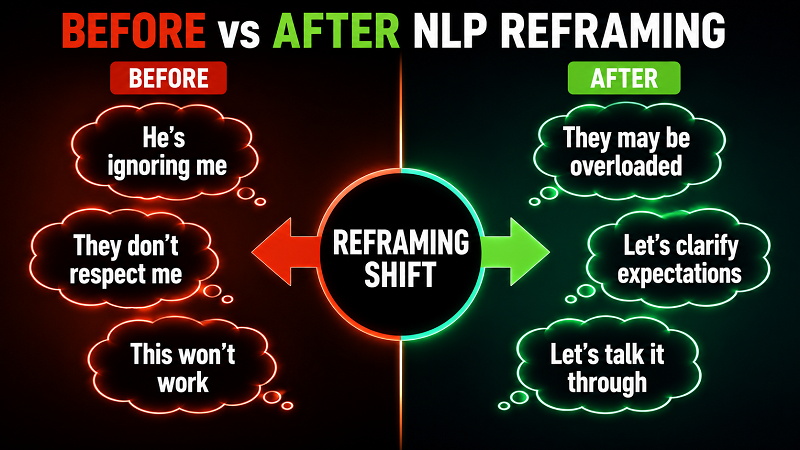
NLP (Neuro-Linguistic Programming) resolves team conflict by changing how individuals perceive, interpret, and communicate disagreements. By using techniques like reframing, mirroring, and perceptual positioning, teams can de-escalate tension, improve understanding, and reach faster, more collaborative solutions.
Most workplace conflict doesn’t start with shouting it starts with silence, tension, or a message that didn’t land the way someone hoped. Maybe a teammate felt dismissed in a meeting. Maybe feedback hit harder than intended. These moments stack up and over time, they affect trust, morale, and collaboration.
That’s where Nlp techniques for conflict resolution in teams becomes a practical tool not just for improving communication, but for resolving real conflict within teams.
NLP helps people pause, reflect, and respond with more clarity when it matters most. It’s not about avoiding hard conversations it’s about having them better. With the right language, awareness, and techniques, NLP helps teams shift from blame to understanding and from tension to action.
So let’s walk through the NLP techniques that actually work and how you can start using them right away to handle real team conflict with more calm, clarity, and confidence.
Key Takeaway:
- NLP helps teams resolve conflict by improving communication, uncovering misunderstandings, and shifting conversations from blame to collaboration. Techniques focus on how messages are interpreted—not just how they are delivered. [1]
- Key NLP methods include matching and mirroring to build rapport, reframing to change perspectives, Meta-Model questioning to clarify vague statements, and perceptual positions to understand multiple viewpoints before reacting. [1]
- For lasting results, integrate NLP into daily team habits by modeling effective communication, practicing one technique at a time, encouraging reflection, and using future pacing and anchoring to reinforce calm, solution-focused behaviors. [1]
- Be mindful that NLP works best as a communication and collaboration framework rather than a replacement for structured conflict management. Serious interpersonal or organizational issues may require formal mediation, leadership intervention, or HR support. [2]
Bottom Line: NLP techniques help teams transform conflict into productive dialogue by building trust, improving clarity, and encouraging empathy. Consistent use of these communication habits strengthens collaboration and creates a healthier, more resilient team culture.
- Source: Unleash Your Power – NLP Techniques for Conflict Resolution in Teams
- Source: The Importance of Conflict Resolution Techniques in Autonomous Agile Teams
Why Traditional Conflict Resolution Fails in Teams
Most workplace conflicts persist because they operate at the behavior level, not the perception level. Teams try to fix what people say instead of how they interpret situations.
According to a 2026 workplace dynamics study, 67% of unresolved team conflicts stem from misinterpretation, not actual disagreement.
NLP targets the root:
- Internal language (self-talk)
- Meaning-making patterns
- Emotional triggers tied to communication
Core NLP Techniques for Conflict Resolution in Teams
Some team conflicts are loud and obvious. Others are subtle tension in a meeting, silence in a group chat, or that awkward pause no one talks about. But in both cases, the fix usually starts with better communication.
NLP offers a set of practical tools teams can use in real-time. These aren’t scripts or forced positivity they’re strategies for making conversations clearer, calmer, and more effective. Below are the core techniques that can help shift the way teams handle conflict from reaction to resolution.

Build Instant Connection with Matching and Mirroring
Conflict often starts when someone feels disconnected, dismissed, or unheard. When people feel seen and understood, they’re more likely to listen and less likely to argue. Mirroring helps rebuild that connection without even saying a word. It’s the subtle act of aligning your body language, tone, and pacing with the other person. You’re not copying them you’re showing up in a way that feels familiar, safe, and aligned.
For example, if a teammate is speaking quickly and with energy, match their pace for a moment before slowing the conversation down. If someone seems reserved and slow to speak, lower your tone, and mirror their posture. That quiet rapport often opens the door to better listening and resolution.
Shift Blame to Possibility with Reframing
Reframing helps shift how someone sees a situation. You’re not ignoring the issue you’re just helping them view it from a more useful angle.
When someone says, “This isn’t fair,” respond with: “You’re right it feels frustrating. What do you think would make it feel more balanced?” That turns an emotional block into a constructive step forward.
Instead of, “He’s being difficult,” try: “He’s concerned we’re missing something.” If someone feels attacked, reframe the feedback as a shared goal: “I think what they’re trying to say is we both want this project to work.”
Meta-Model Questions: Getting Clarity When Words Get Vague
Team arguments often stem from vague statements and assumptions. The Meta-Model helps cut through confusion with better questions ones that reveal what’s actually being said.
When someone says, “Nobody listens to my ideas,” ask, “Who specifically?” Or, “We’re behind” “Behind what schedule?” Or, “They’re always micromanaging us” “Who exactly? What did they do that felt like micromanaging?”
These questions bring clarity and take emotion out of the equation.
Step into Their Shoes with Perceptual Positions
Tension often exists because everyone’s stuck in their own view. This technique encourages people to mentally step into the other person’s experience, and then a third, neutral viewpoint. It’s not just about empathy it’s about widening perspective.
After a conflict-heavy meeting, ask your team, “How do you think the other person experienced that exchange?” Then ask, “If someone objective had watched us, what would they have noticed?” This reflection alone can shift the entire energy of a team.
Break the Pattern Before It Escalates
Some conflicts are just patterns on repeat. Same reactions. Same eye rolls. Same shutdown. NLP’s pattern interrupt technique is about doing something unexpected to shift that loop.
If a conversation is heating up and going nowhere, pause and ask a totally different question: “Okay, how would we explain this issue to a new hire joining next week?” It breaks the loop and invites people to think differently.

Regain Control with Anchoring in High-Stakes Moments
When people get emotionally triggered in conflict, they often lose their ability to think clearly. NLP anchoring helps you mentally “bookmark” a confident or calm emotional state and bring it back when you need it.
Before a difficult conversation, recall a time you handled something well. Pair that memory with a small physical action like pressing your thumb and finger together. Practice this until the feeling becomes automatic. Use it in moments where you’d normally feel reactive or stressed.
Clarify the Real Problem by Chunking
Sometimes conflict feels overwhelming because it’s too vague (“This whole system is broken”) or too granular (“Line 143 in the code is wrong”). NLP helps you chunk up or down zooming out to the bigger picture or zooming in to the root cause.
Try this: When a teammate says, “Everything’s a mess,” ask: “Which part specifically?” Or if someone’s stuck on details, ask: “What’s the bigger goal we’re aiming for here?” These simple shifts help people focus and move forward faster.
Help Teams Move Forward with Future Pacing
After a conflict is resolved, people sometimes stay mentally stuck in the past. NLP future pacing helps the brain look ahead and lock in a better outcome.
Say, “Imagine this process goes smoothly next month what would that look like for you?” This mental rehearsal creates clarity, motivation, and follow-through.
Spot Unspoken Tension Early with Sensory Awareness
Not all conflict is loud. Sometimes it’s subtle crossed arms, silence in a normally chatty person, or a shift in eye contact. NLP helps you sharpen your awareness so you can catch these cues early and address issues before they explode.
In your next meeting, notice who’s engaged and who seems checked out. Follow up privately with anyone showing signs of frustration. A simple, “You seemed quiet anything on your mind?” can prevent weeks of silent resentment.
Keep Things Collaborative with the Agreement Frame
Conflict doesn’t mean people don’t care it often means they care deeply. But when you shut down someone’s idea with “No,” you lose that energy. The agreement frame helps you keep the conversation open while still redirecting.
Instead of, “That won’t work,” try: “Yes, I see why that’s important, and I think there’s a way to get there without pushing back our deadline.” It softens tension and invites better problem-solving.
What Are NLP Techniques in Conflict Resolution?
NLP techniques are structured psychological and communication tools designed to reprogram how individuals process conflict situations.
NLP (Neuro-Linguistic Programming) in conflict resolution is a cognitive-behavioral framework that modifies internal representations (thought patterns), linguistic structures (communication), and neurological responses (emotions) to reduce interpersonal friction and improve collaborative outcomes. It focuses on aligning perception, language, and behavior within team interactions.
How Does NLP Help Resolve Team Conflicts Faster?
NLP accelerates conflict resolution by interrupting automatic emotional responses and replacing them with conscious communication strategies. Techniques such as perceptual positioning, reframing, and rapport-building enable individuals to reinterpret intent, reduce defensiveness, and establish mutual understanding, which leads to faster and more sustainable resolution outcomes.
NLP vs Traditional Conflict Resolution (Comparison Matrix)
| Factor | NLP Approach | Traditional Approach |
|---|---|---|
| Focus | Perception & internal state | Behavior & actions |
| Speed | Faster resolution | Often prolonged |
| Emotional control | High (anchoring, reframing) | Low |
| Communication clarity | Structured | Often reactive |
| Repeat conflicts | Reduced | Common |
| Team trust | Improves significantly | Variable |
When Should Teams Use NLP for Conflict Resolution?
- Repeated communication breakdowns
- Emotional escalation in meetings
- Misalignment between departments
- Leadership vs employee friction
How to Integrate NLP into Your Team to Resolve Conflict
Learning NLP techniques individually is insufficient; successful conflict resolution requires embedding NLP into team habits and culture. Key steps include:
- Model NLP techniques in your own communication people mirror what they see.
- Introducing NLP basics in team sessions with practical, jargon-free explanations.
- Focusing on one technique at a time for regular practice.
- Incorporating NLP into regular meetings and feedback processes to normalize its use.
- Developing a shared NLP language for easy real-time application.
- Reflecting on NLP’s impact periodically to refine usage.
- Using NLP actively in conflict recovery to rebuild trust quickly.
The goal isn’t to turn everyone into an NLP expert. It’s to create shared habits that make communication clearer, calmer, and more productive.
Common Mistakes When Using NLP in Teams
- Using techniques manipulatively
- Skipping emotional regulation
- Over-intellectualizing conflict
- Not practicing consistently

Tools to Integrate NLP into Your Team Culture
- Conflict resolution SOPs
- NLP-based communication training
- Weekly reflection sessions
- Leadership coaching
FAQs
What is the most effective NLP technique for conflict resolution?
Reframing is widely considered the most effective NLP technique because it directly changes how a situation is perceived. When individuals reinterpret a conflict (e.g., from “attack” to “misunderstanding”), emotional intensity drops immediately. This creates a safer environment for constructive dialogue and problem-solving. In team settings, reframing often acts as the first intervention before applying other NLP tools.
How does NLP reduce emotional escalation in workplace conflicts?
NLP reduces emotional escalation by interrupting automatic reactions and replacing them with controlled responses. Techniques like anchoring help individuals access calm emotional states, while mirroring builds subconscious trust between parties. Together, these methods regulate emotional responses, making conversations less reactive and more solution-focused.
Can NLP completely eliminate workplace conflict?
No, NLP cannot eliminate conflict entirely because disagreement is a natural part of team dynamics. However, it significantly reduces the frequency, intensity, and duration of conflicts. More importantly, it transforms conflict into a productive process that leads to better decisions, stronger relationships, and improved collaboration.
How long does it take for NLP techniques to work in teams?
Basic NLP techniques can show results almost immediately in one-on-one interactions. However, for team-level transformation, it typically takes 2–6 weeks of consistent practice. Organizations that integrate NLP into communication systems (meetings, feedback loops, leadership training) tend to see faster and more sustainable improvements.
Is NLP scientifically proven for conflict resolution?
NLP as a field has mixed academic support, but many of its techniques align with well-established psychological principles such as cognitive reframing, behavioral conditioning, and communication theory. These underlying principles are widely used in coaching, therapy, and organizational development, making NLP practically effective even where formal validation is debated.
Final Thought: NLP Doesn’t Just Solve Conflict It Changes Team Culture
You don’t need every team member to become a communication expert. You just need a shared language that creates clarity, not confusion. That’s what NLP provides. It turns frustrating moments into learning opportunities and helps teams rebuild trust, one conversation at a time.
So if your team is stuck in silent tension, constant reactivity, or one too many Slack misunderstandings, NLP might be what shifts the energy.
Start with one technique. Try reframing your response. Mirror someone’s tone. Ask a better question. You’ll be surprised how quickly small shifts in language can lead to big changes in how people work together.
Conflict is not a communication problem, it’s a perception problem. NLP gives teams the tools to rewrite perception, which automatically transforms communication, behavior, and outcomes.