
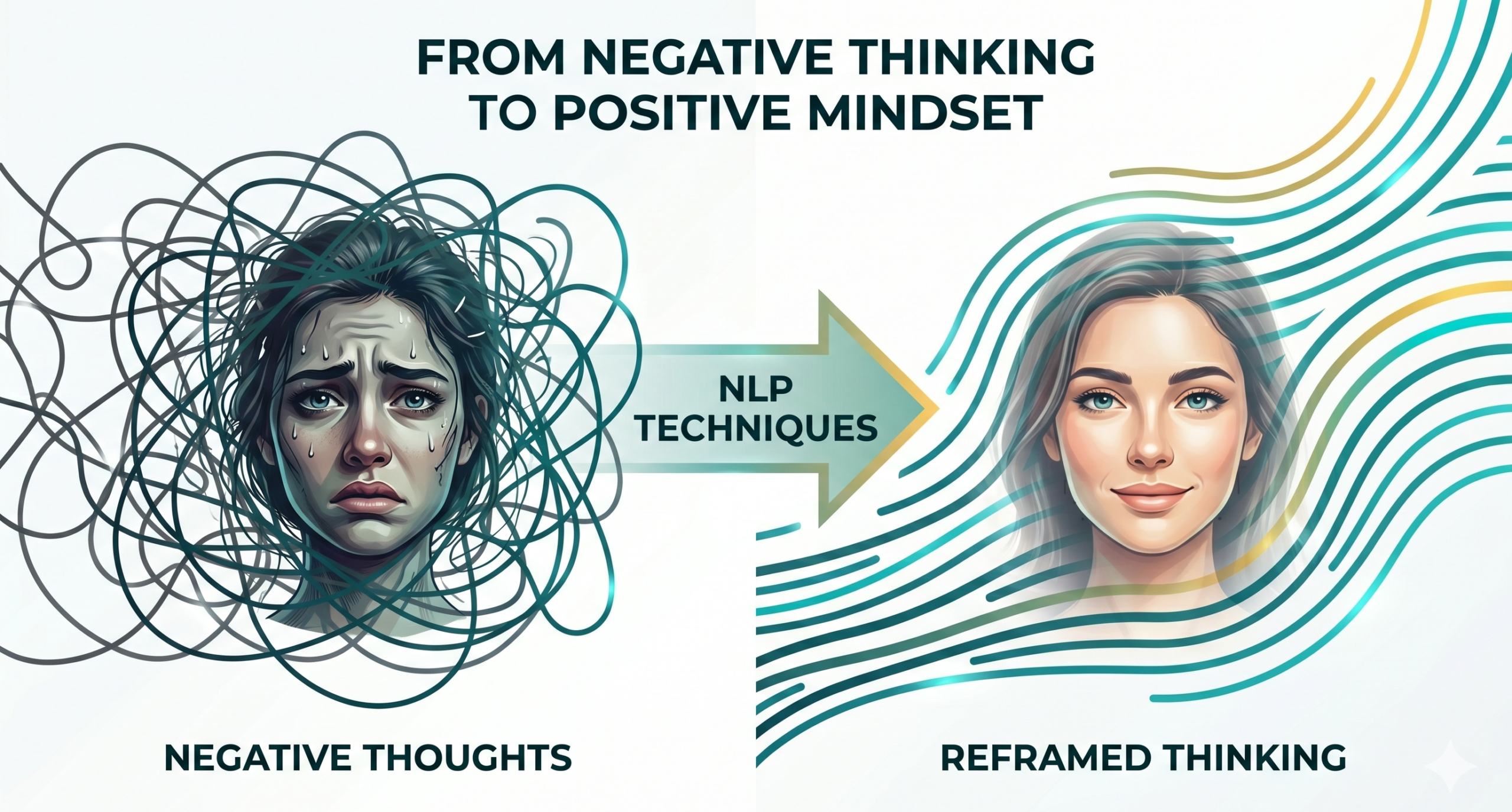
Neuro-Linguistic Programming (NLP) overcomes negative thoughts by identifying the mental “submodalities” (size, brightness, location) of the thought and systematically “reframing” or “swishing” them into positive triggers. Key techniques include the Swish Pattern, Anchoring, and the Meta-Model, which interrupt the brain’s automatic neural pathways to foster emotional resilience.
You don’t need more motivation.
You need a way to interrupt the negative thoughts running on autopilot.
Because most people don’t realize this:
Negative thinking is not random, it’s patterned.
And once you understand the pattern, you can change it.
In this guide, you’ll learn how NLP techniques help you break negative loops and rewire your thinking step by step.
Key Takeaway:
- Yes, NLP (Neuro-Linguistic Programming) can help overcome negative thoughts by identifying and reframing limiting beliefs, changing internal dialogue, and shifting emotional responses. It works by reprogramming how the brain interprets experiences and triggers reactions. [1]
- Mechanisms: NLP techniques such as reframing, anchoring, and pattern interruption help break negative thinking loops, reduce emotional intensity, and replace disempowering thoughts with constructive mental patterns. This allows individuals to regain control over their mindset. [1]
- What to do: Start by becoming aware of recurring negative thoughts, then consciously reframe them into more empowering interpretations. Use visualization, positive language patterns, and repetition to reinforce new mental habits. Consistency is key for lasting change. [2]
- When to be cautious: Deep-rooted emotional patterns or trauma may require additional support beyond NLP techniques. If negative thoughts are persistent or overwhelming, combining NLP with professional guidance can lead to more effective results. [2]
Bottom Line: NLP helps rewire negative thinking by changing how you interpret and respond to experiences. With consistent practice, it can transform limiting beliefs into empowering mental patterns.
- Source: Unleash Your Power – NLP for Overcoming Negative Thoughts
- Source: Unleash Your Power – NLP & Personal Development Insights
Can NLP Really Help Overcome Negative Thoughts?
Yes, NLP is widely used to identify and reprogram negative thinking patterns by changing how you interpret experiences.
- Pattern awareness: Helps you recognize automatic negative thoughts
- Reframing: Changes the meaning you assign to situations
- Emotional control: Anchoring techniques help shift your state instantly
- Behavior change: Interrupts recurring mental loops
7 NLP Techniques to Overcome Negative Thoughts

- Reframing: Change the meaning of a situation to reduce emotional impact
- Pattern Interruption: Break automatic negative thinking loops
- Anchoring: Associate positive emotional states with triggers
- Swish Pattern: Replace unwanted thoughts with desired mental images
- Visualization: Mentally rehearse positive outcomes
- Language Shifts: Replace limiting words with empowering ones
- Future Pacing: Imagine success to influence present behavior
What Are Negative Thought Patterns?
To understand how this works, we must look at Neuroplasticity. NLP leverages the brain’s ability to rewire itself by utilizing Cognitive Reframing. By adjusting the Submodalities, the internal “coding” of a thought like its brightness or size, we trigger a Pattern Interruption. This prevents an Amygdala Hijack, where a negative thought spiral takes over your emotional state, allowing for a logical and calm response instead.
Negative thought patterns are automatic, unhelpful ways of thinking that trap you in cycles of self-criticism, fear, or doubt. They often become ingrained, shaping how we see ourselves and the world. Think of them like a mental rut, one that’s tough to break free from.

For example, self-doubt makes you second-guess your abilities, even when there’s no reason to. Your mind asks, “What if I’m not good enough?” Catastrophizing leads you to jump to worst-case scenarios. Spill coffee on your shirt?
Suddenly, your entire day is “ruined.” Imposter syndrome convinces you that you’re just pretending to be competent, and sooner or later, everyone will figure it out.
These patterns don’t just weigh on your mood. They can hold you back in life, making it hard to take risks, limiting your growth, and damaging relationships. Over time, they may even affect your mental health, leading to stress, anxiety, or depression.
But here’s the silver lining: negative thought patterns can be rewired. With NLP techniques, you can spot these thoughts and replace them with more helpful ones.
Why Do Negative Thoughts Keep Repeating?
Negative thoughts are often the result of learned mental patterns, past experiences, and subconscious associations. The brain tends to repeat familiar emotional responses, even if they are not helpful.
- Past conditioning and beliefs
- Fear-based thinking patterns
- Habitual internal dialogue
- Focus on problems instead of solutions
NLP vs Traditional Approaches to Negative Thinking
| Approach | Focus | Speed |
|---|---|---|
| NLP | Pattern change | Fast |
| Therapy | Root cause | Moderate |
| Positive thinking | Surface mindset | Slow |
How NLP Rewires the Brain
NLP works by reprogramming your brain, much like resetting a GPS route. Imagine your brain as a network of pathways. Negative thinking wears these pathways down, forming deep mental grooves, much like well-trodden dirt roads. The more you use them, the more stuck they become.
NLP steps in by building new, healthier mental roads. The brain’s ability to reshape itself, known as neuroplasticity, is key here. Just as repetitive exercise strengthens muscles, practicing positive thinking rewires the brain, forming fresh patterns.
Take John, for instance. He felt crippled by anxiety before public speaking. Through NLP’s anchoring technique, he learned to link feelings of calm and confidence to a simple gesture, squeezing his thumb and finger together. Over time, this small action became his trigger for calmness, helping him speak in public without nerves.
NLP doesn’t offer a quick fix; it provides lasting change by teaching your brain to react differently to challenges.
Why NLP Drives Personal Growth

Imagine having a switch that lets you control how you react to life’s challenges. NLP gives you that power. Whether you’re breaking limiting beliefs, boosting communication skills, or building better habits, NLP is a catalyst for personal and professional growth.
Shifting Limiting Beliefs
Those sneaky thoughts, “I’m not good enough” or “I’ll never succeed”, can quietly sabotage progress. NLP helps you flip the mental script, turning “I can’t” into “I’m learning.” This small shift unlocks new opportunities, helping you break free from chains of self-doubt.
Gaining Emotional Control
Ever felt anxiety take over? NLP helps you regain the wheel. Techniques like anchoring enable you to trigger positive emotions when needed. Think of a sports player visualizing past victories before a game, NLP equips you with similar tools to stay calm and focused under pressure.
Strengthening Communication
Our growth often hinges on how we connect with others. NLP sharpens your ability to respond, listen, and build trust, paving the way for deeper personal and professional relationships.
Breaking Bad Habits
NLP offers practical solutions for kicking habits that no longer serve you. Techniques like the Swish Pattern allow you to replace old routines with healthier, more productive behaviors.

How to Apply NLP Techniques in Daily Life
- Pause and identify the negative thought pattern
- Interrupt the pattern using a physical or mental trigger
- Reframe the situation with a more empowering meaning
- Replace the thought with a constructive alternative
Getting Started with NLP
Neuro-Linguistic Programming isn’t just theory, it’s a toolbox. Here’s how to start using NLP to improve your thinking, behavior, and growth:
- Set Clear Goals: Don’t just aim to “improve.” Be specific. “I will read 10 pages a night” sets a clear path and keeps you motivated.
- Change Your Inner Dialogue: Your self-talk matters. Replace “I’ll never get this right” with “I’m improving every time I try.” This simple shift builds confidence.
- Anchor Positive Emotions: Find a small action, like tapping your fingers, that you can link to a confident memory. The next time you need that feeling, use the action to trigger it.
- Break Bad Habits: NLP’s Swish Technique helps replace negative habits with positive ones. Picture the bad habit, then visualize the new, desired behavior. Practice this mental switch until it becomes second nature.
- Reframe Challenges: Instead of thinking, “I failed,” ask, “What did I learn?” This flips problems into opportunities for growth.
- Visualize Success: Spend a few minutes each day picturing your goals achieved. Visualization helps keep your brain focused and motivated.
Practice these techniques daily, and you’ll notice real shifts in how you think and feel.
NLP for Overcoming Negative Thoughts Pattern
Negative thoughts can keep you stuck, but NLP (Neuro-Linguistic Programming) gives you simple tools to turn them around. Here’s how you can start using NLP techniques to take control of your thoughts and stop negativity from holding you back.
- Reframe: When a negative thought appears, ask, “How can I see this differently?” Shifting your perspective reduces the thought’s power over you.
- Swish Technique: Replace negative thoughts with positive ones by mentally switching from the negative image to a positive one. Repetition will train your brain to favor the better option.
- Anchor Emotions: Link positive feelings to a small physical action. When negativity strikes, use the action to quickly bring back the positive emotion.
- Interrupt Patterns: When negative thoughts start, do something unexpected, like standing up or clapping. This interrupts the thought cycle and snaps you out of the loop.
- Change Your Inner Dialogue: Speak kindly to yourself. Replace harsh self-talk with encouraging words that push you forward.
- Dissociate from Emotions: Visualize yourself as an outsider watching your emotions. This distance helps you see the situation clearly, without getting overwhelmed.
- Challenge Beliefs: Ask yourself, “Is this really true?” Challenge the negative beliefs and replace them with more empowering ones.
FAQs
How does NLP differ from traditional therapy techniques?
Unlike traditional therapy, which often focuses on understanding the root of emotional issues, NLP is action-oriented. It provides practical tools to quickly reframe thoughts and change behaviors. NLP is about focusing on solutions rather than dwelling on problems.
Can NLP techniques be used in daily life outside of overcoming negative thoughts?
Absolutely! NLP techniques can be applied to various aspects of daily life, such as improving communication, setting clear goals, managing stress, and building better relationships. The flexibility of NLP allows you to adapt its principles to almost any personal or professional scenario.
Is NLP effective for managing stress and anxiety?
Yes, NLP can be highly effective for managing stress and anxiety. Techniques like dissociation help create emotional distance from stressful situations, while reframing helps shift your perspective on anxiety-inducing events, allowing you to approach them with more clarity and calm.
Can NLP improve my confidence and self-esteem?
NLP is a great tool for boosting confidence and self-esteem. By replacing negative self-talk and limiting beliefs with empowering thoughts, NLP helps you build a more positive self-image and trust in your abilities. Anchoring positive emotions to specific actions also reinforces feelings of confidence.
How quickly can I see results from using NLP techniques?
Results from NLP can vary depending on the individual and the techniques used. Some people may notice changes immediately, especially with techniques like anchoring or reframing, while others may need consistent practice over time to rewire deeper thought patterns. Regular use of NLP tools often leads to faster, more lasting results.
Conclusion: Making NLP a Lifelong Tool
NLP isn’t just about stopping negative thoughts, it’s a lifelong tool for growth. The more you practice, the stronger your mental muscles become. Each day offers new opportunities to break limiting patterns and build healthier ones.
The best part? NLP grows with you. Whether you’re managing everyday stress or aiming for big goals, NLP keeps you in control of your mindset and actions.
Ready to master your mindset? The Unleash Your Power NLP Protocol is designed to take you beyond traditional therapy by giving you the literal “remote control” to your brain. If you’re a service-based entrepreneur or professional looking to scale, start your journey with our NLP Certification for Business Leaders today.