
You’ve done the research. You’ve watched the videos. You know that NLP training could genuinely change the way you communicate, lead, and show up in your work.
As you watch for NLP certification red flags, you start looking at programs. Almost immediately, the noise begins.
Weekend intensives. “Internationally recognized” certificates. Courses priced at $97 promising the same result as programs that cost $4,000. It’s hard to know what’s real and what’s just clever marketing.
Here’s something most providers won’t tell you: because NLP is not government-regulated anywhere in the world, almost anyone can create a program, invent a credential, and start selling certification. That’s not a reason to walk away from NLP training. It is a reason to choose carefully.
In my 20+ years as a Board Designated Trainer, I’ve seen what happens when people invest in the wrong program. They finish with a certificate they can’t use, skills that don’t hold up in real coaching sessions, and genuine confusion about what they actually learned. I don’t want that for you.
This article gives you a clear framework for evaluating any NLP certification before you commit. By the end, you’ll know exactly what to look for, what to walk away from, and the right questions to ask.
Key Takeaway:
- Not all NLP certification programs deliver practical skills. Major red flags include “weekend certifications,” theory-only courses, unclear trainer credentials, no supervised practice, unrealistic promises, and certificates awarded based solely on attendance rather than demonstrated competence. [1]
- A reputable NLP certification emphasizes live training, real-world practice, personalized feedback, competency assessments, and experienced trainers who actively apply NLP professionally. These elements help bridge the gap between learning techniques and confidently using them with real clients. [1]
- Before enrolling, verify accreditation, trainer experience, curriculum depth, supervised coaching opportunities, post-certification support, and graduate testimonials. Asking detailed questions upfront can save both time and money while helping you choose a program that develops genuine competence rather than simply issuing a certificate. [2]
- The true value of NLP certification comes from consistent practice and ethical application. A quality program provides the foundation, but long-term success depends on continually refining your skills, gaining real client experience, and applying NLP responsibly in professional settings. [2]
Bottom Line: The best NLP certification programs focus on developing real-world skills—not just awarding credentials. By avoiding common red flags and choosing comprehensive, practice-based training, you’ll gain the confidence and competence needed to create meaningful results for yourself and your future clients.
The 3 Biggest NLP Certification Red Flags
Avoid programs that:
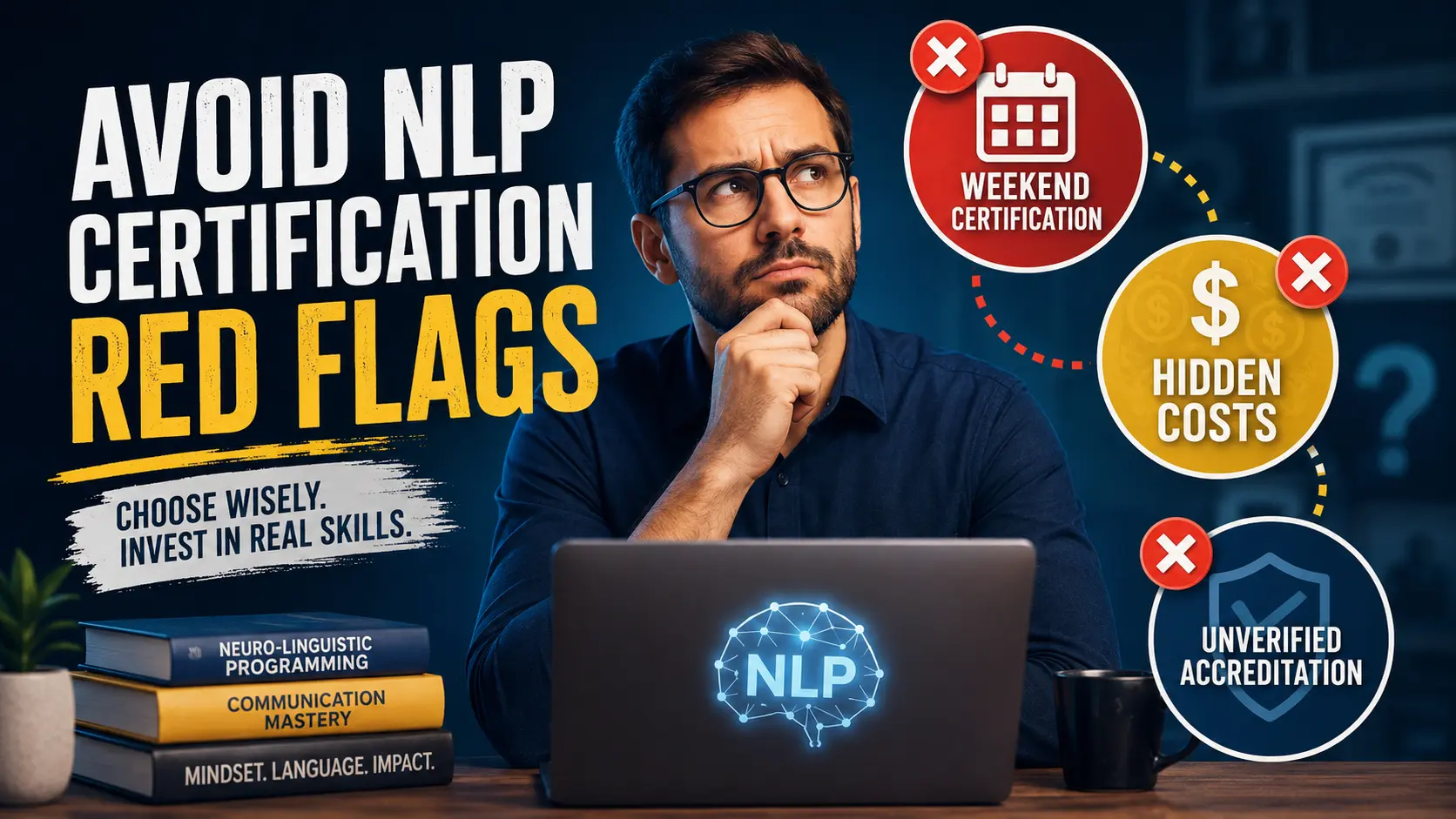
- Promise a full Practitioner certification after a weekend
- Rely on hidden costs and escalating upsells
- Use accreditation claims that can’t be independently verified
Look for programs that offer:
- Transparent training hours and a structured curriculum
- Practical assessments and demonstrated competency requirements
- Experienced trainers with verifiable coaching backgrounds
- Recognized professional affiliations
- Clear, all-in pricing with no surprises
Data & Findings
Before we get into the red flags, it helps to understand the landscape you’re navigating.
According to market analysis published by Fortune Business Insights, the global NLP market was valued at USD 36.8 billion in 2025 and is projected to reach USD 193.4 billion by 2034. That explosive growth has created enormous demand for trained practitioners and coaches and it has also attracted a flood of low-quality certification programs looking to profit from that demand.
On the coaching side, NLP Practitioner certification costs range from under $300 for self-paced online programs to over $8,000 for comprehensive, internationally accredited programs. Research from EntrepreneursHQ’s 2026 review of NLP certification programs places the typical legitimate Practitioner certification in the $1,800 to $4,595 range, depending on depth, format, and accrediting body. Programs significantly below that range, promising equivalent certification, should be investigated carefully before you invest.
Training hour requirements vary just as dramatically. IANLP, one of the most rigorous NLP standards bodies, requires a minimum of 18 days and 130 hours of face-to-face training. The American Board of NLP (ABNLP) sets a minimum of 120 hours of curriculum. By contrast, dozens of online programs promise full Practitioner certification after as few as 10 to 20 hours of video content, a gap that should immediately raise questions about what those certificates are actually worth.
The table below summarizes key benchmarks to help you compare any program you’re considering:
| Factor | Low-Quality / Risk Programs | Legitimate Programs |
| Training Hours | 10 to 30 hours | 120+ hours (ABNLP minimum) |
| Training Format | Pre-recorded video only | Live sessions + supervised practice |
| Assessment | Automatic on completion | Demonstrated competency required |
| Accreditation | Self-created or unverifiable | ANLP, ABNLP, IANLP, INLPTA, or ICF |
| Pricing Transparency | Entry price only; upsells hidden | Full path to certification costs upfront |
| Trainer Background | Vague or unverifiable | 10+ years NLP practice; verifiable credentials |
| Post-Certification Support | None after graduation | Mentoring, practice groups, and alumni access |
Keep this table in mind as you read through the red flags below; it gives you an instant benchmark for any program you evaluate.
Why the NLP Certification Market Can Be Confusing

NLP is unregulated but that doesn’t Mean It’s Unprofessional
NLP doesn’t have a government licensing body the way medicine or law does. The Association for Neuro Linguistic Programming (ANLP) describes NLP as “currently not regulated by law in the same way as some professions” and exists specifically to help consumers identify legitimate training through an independent standards framework.
That gap creates a lot of confusion. It also creates a lot of room for low-quality programs to present themselves as legitimate.
The good news is that industry self-regulation does exist. Professional bodies like ANLP, ABNLP, IANLP, and INLPTA have established clear standards around training hours, curriculum content, and assessment. Programs that voluntarily align with these standards are a significantly safer investment than those that don’t.
How Quality Gaps Create Consumer Risk
The rise of online education has lowered the barrier to entry dramatically. Anyone with a Zoom account, a course platform, and a certificate generator can put together an NLP Practitioner program over a weekend and start selling it on Monday.
That’s not a criticism of online learning; quality online training absolutely exists. The issue is that there’s no built-in filter. A professional-looking sales page is not evidence of a credible program. You have to evaluate deliberately, using the right criteria. The three red flags below are the ones I see most often.
Red Flag #1: The “Certified in a Weekend” Illusion

Why Training Hours Matter More Than Marketing Claims
NLP is a skill-based discipline. Reading about rapport, anchoring, or reframing is useful. Actually developing the ability to apply those techniques in a live session with a real person, that takes time, practice, and feedback.
ANLP’s official certification structure guidance states clearly that good Practitioner training should include live practice, interaction, feedback, and assessment, and that “one course, however long or short, will not automatically make someone a skilled practitioner.” Becoming genuinely proficient with NLP requires practice and ongoing development over time.
A weekend program can introduce you to NLP concepts. It can be a strong starting point. What it cannot do is certify you as a Practitioner. Any program claiming otherwise is either redefining what “Practitioner” means or cutting corners you’ll feel later.
What Legitimate Practitioner Programs Typically Include
A program worth your investment has a structured curriculum that covers core NLP patterns in depth, dedicated practice sessions where you apply techniques with real people, a clear assessment process, and a demonstrated competency requirement before certification is awarded.
You want to finish knowing exactly what you can do, not just what you’ve been taught. Those are two very different things.
Try this: Before enrolling, ask directly: How many total training hours are included? How are students assessed? What does a student have to demonstrate to receive certification? If the answers are vague or the program gets defensive, that tells you something important.
What One Student Discovered
Heather Chetwynd had already completed NLP training before she came to work with me. She described leaving her previous program feeling confused about how the techniques fit together and uncertain about how to actually integrate them into her work.
After completing the Practitioner course here, her experience was completely different. She gained clarity on how all the pieces connect, had real opportunities to practice the techniques with other participants, and came away with a practical toolbox she could immediately apply in her business and life. She also mentioned something she hadn’t expected, unexpected clarity about her own business direction that emerged through the depth of the training itself.
The difference wasn’t the content on paper. It was the depth of the training and the experience of a trainer who could show her not just what the techniques were, but how they work together in practice.
Red Flag #2: The Endless Upsell Funnel

How the Low-Cost Entry Offer Works
You’ve probably seen this before, even if you didn’t recognize it at the time. A program opens with a free webinar, a $97 introductory workshop, or a “discovery session.” The content is interesting. You feel like you’re learning. And then the offer comes.
To get the full benefit of what you just experienced, you need to take the next step. Then the step after that. Research into online course scams published by Scambusters.org identifies urgency and scarcity tactics, limited-time offers, countdown timers, and “only a few spots left” as among the most common tools used to push people into purchasing before they’ve had the chance to properly evaluate a program.
This isn’t exclusive to NLP. It’s a business model used across online education. But in the NLP space, the content is emotionally engaging and genuinely interesting enough that it’s particularly effective at keeping people in the funnel.
Signs You’re Entering an Upsell-Based Business Model
Watch for vague pricing that never tells you what the full path to certification actually costs. Watch for programs that promote “levels” without clear timelines or outcomes at each stage. Watch for high-pressure time-limited offers, especially ones wrapped in emotional language around your potential and transformation.
And watch for a curriculum that always seems just a little incomplete, always pointing you toward the next purchase to fill the gap. Legitimate programs are transparent about the full investment upfront. They don’t need artificial urgency to earn your enrollment.
Understand Total Investment, Not Just Entry Cost
According to a 2026 review of NLP certification programs by EntrepreneursHQ, serious Practitioner certifications typically range from around $1,800 on the lower end to over $8,000 for comprehensive, internationally accredited programs. That’s a wide range, and price alone doesn’t determine quality. But it gives you a benchmark.
If a program starts well below that range and seems to require multiple additional purchases to complete the path to certification, calculate the full cost before you commit.
Try this: Search the program name alongside words like “total cost,” “upsell,” or “reviews” before you enroll. Look for experiences from former students outside of the program’s own testimonials page. What you find, or don’t find, tells you a lot.
Red Flag #3: Misleading Accreditation Claims

How Questionable Accreditation Is Created
This one is genuinely tricky, because the language of accreditation sounds authoritative even when it isn’t. Some programs display logos from organizations they created themselves, or that exist primarily to add credibility to that specific training school. Others list affiliations with bodies that have little to no recognized standing in the professional NLP field.
It’s not illegal. But it is misleading. And because most people researching NLP certification don’t know the difference between a well-regarded professional body and a name a trainer invented last year, it works. NLP World’s guide to certification bodies notes that some platforms have received accreditation logos from well-known bodies, only to use them in ways that undermine the integrity those bodies were meant to signal.
Professional Associations Worth Investigating
A few organizations have genuine standing in the NLP field and are worth understanding:
- ANLP (Association for Neuro Linguistic Programming) is an independent UK-based international body that offers a peer-reviewed accreditation process for trainers and programs. Because it’s not affiliated with any specific training school, its accreditation carries real weight.
- ABNLP (American Board of NLP) is one of the most recognized certification bodies in North America, with standards around training hours, content, and trainer qualifications.
- IANLP (International Association for NLP) sets some of the most rigorous standards in the field, including the 130-hour minimum requirement.
- INLPTA (International NLP Trainers Association) focuses specifically on trainer standards and is recognized across multiple countries.
According to Paperbell’s 2026 review of top NLP certifications, programs aligned with ANLP, ICF, or AIP represent the most recognized credentials for NLP coaches in the current market.
One important clarification: no single organization governs NLP globally. Accreditation from any of these bodies is meaningful, but it should be considered alongside the trainer’s experience, the depth of the curriculum, and the practical application built into the program. Accreditation is a signal, not a guarantee.
Try this: When a program mentions accreditation, search for the accrediting organization directly. Look for their history, their standards documentation, and whether they’re referenced by sources outside the program itself. A reputable body will have a clear, independent presence.
Bonus Red Flag: Guaranteed Outcomes

When Marketing Crosses the Line
Ethical NLP training develops skills, tools, and frameworks. What it doesn’t do is guarantee specific results. Be cautious of programs promising guaranteed business growth, instant confidence, guaranteed coaching success, or that you’ll attract a full client roster within weeks of graduating.
These claims aren’t just misleading. They set you up to feel like you failed if the guarantee doesn’t materialize, when the real problem was the promise, not you.
What Ethical NLP Trainers Actually Promise
A trainer with integrity will promise a solid curriculum, real practice, experienced guidance, and honest feedback. They’ll tell you what skills you’ll develop and what you’ll be able to demonstrate by the end. They won’t tell you your income or life will look a specific way six months from now.
Transformation through NLP is real, I’ve seen it firsthand across more than two decades of this work. But it comes through practice, application, and commitment over time. Not through a certificate alone.
What a Legitimate NLP Certification Actually Looks Like
Experienced Trainers With Real-World Expertise
The most important factor in any training program is the person delivering it. Look for trainers who have years of hands-on NLP practice, not just years of teaching it. The best trainers bring real coaching and consulting experience into the room; they connect the techniques to situations you’ll actually face.
Check their background. Look for verifiable credentials, student outcomes you can investigate independently, and a professional history that exists outside their own platform.
Transparent Curriculum and Assessment
A quality program clearly outlines its learning objectives, training hours, assessment criteria, and certification requirements before you enroll. You should know exactly what you’re getting into before you pay a deposit.
If a program’s curriculum is vague, its assessment process is unclear, or you can’t get straight answers about what certification actually requires, those are signals worth taking seriously. You can also explore how to evaluate NLP certification programs to get a clearer picture of what a solid program should include.
Student Support Beyond Certification
Real transformation through NLP is a process, not an event. Look for programs that offer mentoring or practice opportunities after graduation, communities where you can continue developing your skills, and continuing education paths that support your growth over time.
A program that hands you a certificate and disappears has given you a starting point, not a finish line.
7 Questions to Ask Before You Enroll
Getting clear answers to these questions will tell you almost everything you need to know about any program:
- How many total training hours are included?
- What practical assessments are required for certification?
- Who accredits the certification, and what are their standards?
- How long has the trainer been actively practicing and teaching NLP?
- What support is available after graduation?
- Are there any required purchases beyond the initial cost?
- Can I connect with former students to hear about their experiences?
A legitimate program will welcome every one of those questions. If asking them creates friction or evasion, that’s your answer.
Why Choosing the Right Trainer Is the Real Decision
When people come to me after completing NLP training elsewhere, the story I hear most often sounds like Heather’s. They left feeling like they had pieces, not a whole picture. They understood some techniques individually, but couldn’t see how everything connected. They had a certificate that they weren’t sure how to use.
In my experience delivering NLP training in Canada for over 20 years, the biggest factor in how much someone gets from their certification isn’t the brand name of the program. It’s the quality of the guidance. A skilled trainer doesn’t just deliver information; they show you how to integrate it, practice it, and apply it in real situations.
That’s what changes things. Not the badge. The depth of learning and the experience of the person who takes you through it.
If you want to understand how NLP compares across online and in-person training formats, that’s worth exploring before you decide. And if you’re thinking about what a legitimate NLP certification realistically costs, that context will help you evaluate everything you find.
Frequently Asked Questions
Is NLP certification worth it?
Yes, if you choose the right program. A legitimate NLP certification gives you practical tools for improving communication, shifting limiting beliefs, and supporting others through meaningful change. The value depends almost entirely on the quality of the training behind it. A credential from a well-structured, credentialed program has real professional value. One from an unverified weekend course does not.
How long should an NLP Practitioner certification take?
Legitimate Practitioner programs typically range from 7 to 25 days of structured training, depending on format and intensity. The most rigorous standards bodies require a minimum of 120 to 130 hours before certification is awarded. Programs promising certification after two or three days are not meeting recognized industry standards.
Can you get a legitimate NLP certification online?
Yes. Many reputable programs are delivered fully online, including live interactive sessions and peer practice. The format matters less than the depth of curriculum, the trainer’s experience, and whether the program meets recognized accreditation standards. A quality online program will have live sessions, not just pre-recorded videos.
Why do NLP certification costs vary so much?
Because NLP is unregulated, pricing varies dramatically, from a few hundred dollars for short online programs to $8,000 or more for comprehensive, accredited programs. Price alone doesn’t determine quality, but it’s a useful signal. If a program is priced far below the legitimate market range and makes equivalent claims, investigate why.
Are NLP certifications internationally recognized?
Some are. Certifications from programs accredited by ANLP, ABNLP, IANLP, or INLPTA are generally recognized across multiple countries. Certifications from self-created or unverified accreditation bodies may not be recognized beyond the organization that issued them.
What accreditation should I look for in an NLP certification?
Look for programs affiliated with established bodies like ANLP, ABNLP, IANLP, or INLPTA. ICF alignment is also a strong signal, particularly for those pursuing coaching credentials alongside NLP training. Always verify the accrediting body independently rather than taking the program’s word for it.
How can I verify whether an NLP trainer is legitimate?
Search for the trainer’s professional background outside their own platform. Look for their work history, independent reviews from former students, professional body memberships you can verify directly, and whether their credentials are referenced by sources other than their own website. A legitimate trainer with 20+ years of experience and verifiable credentials will have a clear public track record.
What is the difference between NLP training and NLP certification?
NLP training refers broadly to any program that teaches NLP concepts and techniques. NLP certification specifically means a student has completed a structured curriculum, demonstrated practical competency, and met the requirements of a recognized standard. Look for programs where certification is earned through demonstrated skill, not just attendance.
Conclusion
The best NLP certification isn’t the one with the most impressive-sounding name or the lowest entry price. It’s the one that gives you enough training hours to actually develop skill, practical experience applying what you’ve learned, transparent pricing with no hidden path, credible professional affiliations that hold up under scrutiny, and a trainer who’s genuinely committed to your development.
Use the framework in this article every time you evaluate a program. Ask the seven questions. Look up the accrediting body independently. Search the full cost before you take any intro offer.
If you’re still exploring why NLP continues to be one of the most powerful tools available to coaches, leaders, and professionals, the evidence is real. But the results come from quality training, not from shortcuts.
When you’re ready to take a serious look at what a comprehensive, credentialed NLP Practitioner program looks like, explore what’s available through Unleash Your Power. Review the curriculum. Check the credentials. Ask questions. That’s exactly the level of diligence a legitimate trainer will respect.
Unleash Your Power: Stand Out, Take Action, and Create the Success You Want.