
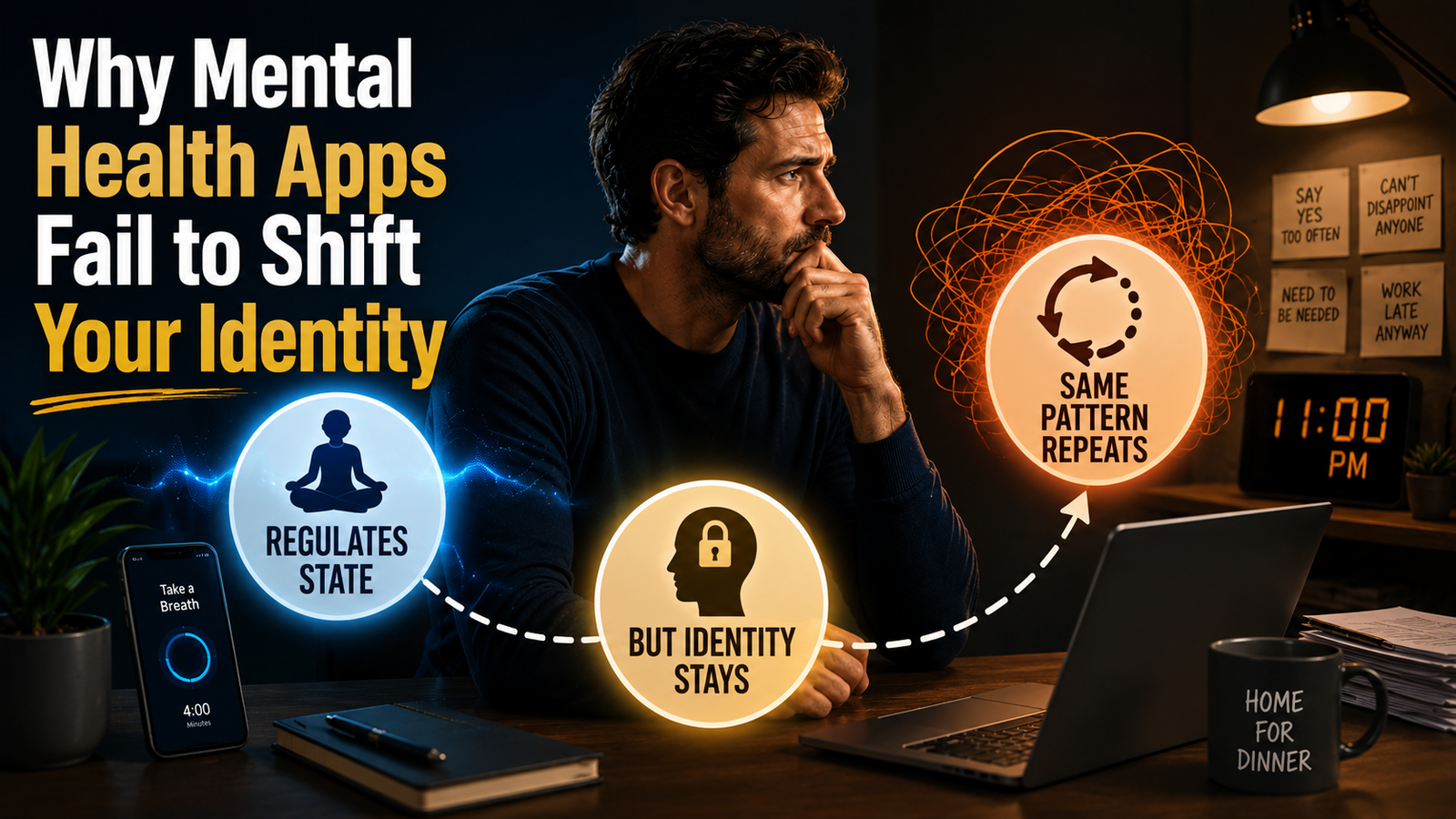
Mental health apps rarely shift your identity because they’re built to change your state, not your self-concept. State is how you feel right now: wired, calm, flat. Identity is who you believe you are, and it quietly decides whether you delegate, whether you say no, whether you close the laptop at six. A guided breath settles your nervous system in four minutes. It has no direct route to the belief that disappointing a client is unsurvivable.
This isn’t a claim that apps don’t work. The clinical evidence shows real, measurable improvement in symptoms like anxiety and low mood, and for many people they’re the most accessible support available. But most are self-guided and automated, built around tracking and skills practice rather than the repeated, relational work self-concept change usually asks for.
So the app does its job. The pattern stays. And you quietly conclude you’re the problem.
Key Takeaway:
- Mental health apps can genuinely improve symptoms such as anxiety and low mood, but they primarily regulate your current state rather than change the deeper beliefs that drive recurring behaviour. The limitation is often a scope mismatch, not that the apps are ineffective. [1]
- Mechanism: State regulation can help you feel calmer in the moment, while identity influences what you do when the same situation returns. If beliefs such as “I must always be available” or “being needed makes me valuable” remain unchanged, the old behaviour can quickly return. [1]
- Use the “11 pm Test”: instead of asking only whether an app made you feel better, ask whether you behaved differently when the old pattern appeared later that day. If you still overwork, over-deliver, or struggle to say no, the underlying behavioural pattern needs attention. [1]
- What changes identity: repeated pattern interruption, human support, and new evidence that challenges the old self-concept. Catch the behaviour at the trigger, make a different choice, and repeat it until the new behaviour becomes familiar and credible to you. [1]
- When to rethink your approach: if you keep adding meditation, tracking, or wellness tools while the business still depends entirely on you, the next tool may be avoidance rather than the solution. Keep useful regulation tools, but address the structural issue through psychology, strategy, and business systems. [1]
Bottom Line: Mental health apps can help regulate how you feel, but lasting behavioural change requires more than symptom management. Keep the tools that help you regulate, then work on the identity patterns, decisions, and business structures that keep the same problems repeating.
Why Do Mental Health Apps Fail to Shift Your Identity?
Mental health apps target the symptom layer, and identity sits underneath it. That’s the whole answer; everything below is the elaboration.

Here’s what that looks like. You meditate before the day starts and genuinely feel better. Then at 2 pm a client asks for “one small favour,” and you say yes before your brain has finished processing the question. Nothing in that four-minute session touched the part of you that believes being needed is the same as being valuable.
The apps aren’t underperforming. They’re being asked to solve a problem they were never designed for and the behaviour eating your week isn’t a mood. It’s a pattern with your name on it.
A note before we go further: this is about business patterns, not clinical treatment. If you’re struggling with your mental health, a qualified professional is the right starting point not a blog post, and not a coaching programme.
Do Mental Health Apps Actually Work?
Yes, and the evidence is stronger than the internet’s cynicism suggests. Let’s establish that before critiquing anything.
A meta-analysis of 176 randomised controlled trials found smartphone apps produced significant improvements in depression and anxiety symptoms versus control conditions. A review of 92 trials with more than 16,000 participants reported a moderate pooled effect on clinical outcomes. That’s a genuinely useful intervention available to anyone with a phone.
There are also tools that help you manage the pressure of running a business, and using them is good judgment, not weakness.
So the honest framing isn’t “apps don’t work.” It’s: apps aren’t failing because they’re useless. They fail you when you ask them to solve a problem they weren’t built to solve.
What’s the Difference Between Regulating Your State and Changing Your Identity?

Regulating your state changes how you feel in the next ten minutes. Changing your identity changes what you do when the old situation shows up again.
State regulation is real and valuable it lowers activation and makes hard conversations possible. But it’s temporary by design, and it resets.
Identity is the layer beneath: the beliefs about who you are that generate behaviour without consulting you first. I’m the one who handles things. If I’m not busy, I’m not contributing. Research on habit and identity suggests the two reinforce one another; the more a behaviour is bound up with how you see yourself, the more durable it tends to be.
So changing a behaviour isn’t always as simple as knowing what to do. When it’s tied to how you see yourself, the old pattern feels strangely right, which is exactly why you can know the answer and still not do it.
Why Does the Calm From Your Morning Session Disappear by 11 pm?
Because calm was never what held the pattern in place. Here’s the clearest diagnostic I know.
The 11 pm Test
Don’t ask “Did the app make me feel better?” Ask: “When the old pattern showed up later that day, did I behave any differently?”
Run a real day through it:
- 7:00 AM: You meditate. You feel calm. It works.
- 9:30 AM: Good meeting. Sharp, present, useful.
- 2:00 PM: A client asks one small favour. You say yes.
- 6:00 PM: You should stop. You say twenty more minutes.
- 11:00 PM: Still answering emails.
The app may have done everything it promised. The pattern simply remained.
That’s not a discipline failure. It’s a scope mismatch and once you see it, you stop blaming yourself for the wrong thing.
Why Doesn’t Tracking Your Mood Change Your Behaviour?

Because measurement isn’t a mechanism; a tracker is a mirror, and mirrors don’t move you.
Mood logging builds real awareness. Thursdays are brutal; the dip lands after invoicing, you’re wired at midnight three nights a week. Useful. But noticing a pattern and changing it are two different jobs.
The usage data hints at it. Across 93 popular mental health apps, median 15-day retention was about 3.9% and 30-day retention around 3.3%.
Read that generously. When a tool produces insight but no change in what actually happens on Thursday, people stop opening it. That’s not weak character it’s a reasonable response to the gap between knowing and doing.
Is Your Self-Help Stack Quietly Becoming a Substitute?
Sometimes, yes and this is the uncomfortable paragraph, so let’s be precise rather than judgmental. The pursuit of the next tool can become a safer substitute for confronting the behaviour the tools were meant to change. Look at the stack honestly:
- Meditation app → calmer
- Mood tracker → more aware
- Breathwork app → regulated
- Sleep tracker → better informed
- Business still runs entirely through you → unchanged
Four wins and one immovable object. There’s a reason it doesn’t move: shifting it means firing a client, raising your prices, or handing something important to someone who’ll do it 80% as well as you. Downloading another app is free. That isn’t.
So the question isn’t “which app should I try next?” It’s: what if the next tool isn’t the answer because the thing you’re avoiding isn’t a regulation problem?
If that landed a bit hard, good. It means you already knew. That’s not a flaw in you; it’s the most common pattern I see in capable people, and it’s changeable.
What Actually Changes Identity?
Repetition, contact with another human, and new evidence about yourself. Not affirmations, and not more information.
Interruption at the trigger: Not calming down afterwards, but catching the pattern in the two seconds before you type “of course, no problem at all!”
A human in the loop: A review of 31 meta-analyses found supported digital interventions beat unsupported ones in roughly half the effect sizes examined. Meanwhile, most consumer apps are fully automated and bypass the human element that’s the trade for scale and price.
New evidence, repeatedly: You raise your price once and survive. You delegate something real and the sky stays up. Do it enough times and the self-concept updates, because it has data it can’t argue with. That’s the reconditioning work that actually holds: slow, unglamorous, permanent.
Start by learning to spot the programming running underneath. You’ve spent years quietly programming the version of yourself you keep getting, usually without noticing.
Why do I know this? In my fifth business, I was working 80-hour weeks, on anxiety medication, calling it success. I had the discipline and the strategies. What finally moved me wasn’t a technique it was my niece asking why I don’t visit anymore. (That’s my story, not a promise about yours. Health outcomes aren’t something any business programme can offer.)
How The 5 Shifts to Freedom Handles This
The 5 Shifts to Freedom is the journey; the 3 Pillars are the mechanism underneath it: Performance Psychology, Freedom-First Business Strategy, and Freedom-First Business Structure. Strategy without psychology is another unfinished course. Psychology without strategy is fluff that doesn’t pay the bills. Structure without both is a prettier prison.

Vision Alignment: Get clear on what you actually want, not what you think you should want.
Ruthless Elimination: Cut the 80% of activity stealing your time so the 20% can produce.
Systems That Scale: Get your expertise out of your head and into something repeatable.
Mindset Unlock: The hinge for this article. Dismantle the unconscious programming that sabotages every strategy the reason you can’t delegate, undercharge, and over-deliver even when you know better.
Magnetic Authority: Position yourself so the right clients recognise you immediately, and charge accordingly.
Jennifer (name changed) arrived with an extraordinary background and prices that didn’t reflect a fraction of it. She’d known she should raise them for two years. What changed was deep reconditioning work, not a pricing strategy and not affirmations. Within 60 days she’d doubled her prices and more than doubled her revenue. Doubled her prices in 60 days. The strategy was never her problem. Her programming was.
Marcus (name changed) had the impressive business, the real team, the respect and he was miserable. He went from 20 clients to 9 premium ones, and 60 hours a week to 30. Revenue went up. Twenty clients down to nine. Sixty hours down to thirty. Revenue up. Same man, different mountain.
These days I’m home for dinner with my phone in another room, I journal before the day starts, and I take a 36-minute nap without a shred of guilt. Not as a reward for scaling. Because working less was the mechanism.
Who Should Use This Approach?
This is for you if you’re a coach, consultant or wellness practitioner who’s already proven you can build something, and the business now runs your life. You’re working 50–60+ hours. You know what you should do and can’t make yourself do it. The tools worked and nothing changed.
Who Should Avoid This?
Skip this if you’re in significant distress or dealing with a diagnosed condition that calls for a qualified clinician, not a business programme, and there’s no shame in making that your first call. Coaching doesn’t replace therapy, psychiatric care, or medical treatment.
Skip it too if you want tactics only, or you’re unwilling to change how the business runs. If the answer turns out to be “let go of that client” and that’s off the table, no amount of psychology will help.
Mental Health Apps vs. Clinical Care vs. Identity-Focused Coaching
Not competitors. Different layers and most people who get unstuck use more than one.
| Approach | Primary target | Mechanism | Best suited for | Key limitation |
|---|---|---|---|---|
| Mental health apps | Self-guided symptom management, skills, tracking | Practice, psychoeducation, self-monitoring | Anyone wanting accessible, low-cost tools for day-to-day wellbeing | Mostly automated; light regulation; retention is typically low |
| Professional clinical care | Mental health conditions, significant distress, clinical symptoms | Assessment, evidence-based treatment, therapeutic relationship | Anyone needing diagnosis, treatment, or support through a hard period | Cost and access; not designed around business strategy or structure |
| Identity-focused coaching | Behavioural patterns, self-concept, leadership and business decisions | Pattern interruption, reconditioning, accountability, structural redesign | People functioning adequately but stuck in the same loop for years | Not treatment; ineffective if the underlying need is clinical |
Data & Findings
Five findings, all from the linked sources.
1. Canadian business owners carry this into the working day. In BDC’s 2025 survey of 1,510 small business owners, more than a third said mental health challenges interfered with their ability to work at least weekly, 60% among owners under 40. Around 35% had sought professional help that year.
2. Apps produce genuine clinical benefit. Across 176 randomised controlled trials, apps significantly outperformed control conditions on depression and anxiety symptoms, with a weighted dropout rate near 23.6%.
3. Better design isn’t the missing variable. In 92 trials with over 16,000 participants, the number of persuasive design features showed no significant association with efficacy or engagement.
4. Real-world retention is low. Among 93 popular apps, median 15-day retention was 3.9% and 30-day retention 3.3%, with a median daily open rate of 4.0%.
5. Human support moves the needle. A meta-review of 31 meta-analyses found human-supported digital interventions outperformed unsupported ones in nearly half of reported effect sizes, most strongly for people with more severe symptoms.
Frequently Asked Questions
Do mental health apps help with burnout?
They can help with the symptoms of burnout: the activation, the poor sleep, the inability to switch off. What they can’t do is change the working conditions producing it. If you’re burned out because the business runs entirely through you, a calmer version of you will still be doing 60 hours next week. Treat the app as relief, and treat the structure as the actual project.
Can an app change unconscious programming?
Only partially, and rarely on its own. Apps are good at delivering skills, psychoeducation, and practice all of which matter. But the patterns driving undercharging or an inability to delegate tend to shift through repeated interruption at the moment they fire, plus evidence that the feared outcome didn’t happen. Most consumer apps aren’t built for that, and the research consistently shows supported interventions outperforming unsupported ones.
Should I stop using my meditation app?
No. Keep it. State regulation is genuinely useful, and a regulated nervous system makes the harder identity work more possible, not less. The mistake isn’t using the app it’s expecting the app to do a job it never claimed to do, then concluding you’re the failure when nothing structural changes.
How long does identity-level change take?
Longer than a technique and shorter than you fear. In practice it moves when a specific pattern gets interrupted repeatedly and the new behaviour survives contact with reality a few times. What accelerates it is targeting one pattern rather than attempting a total personality overhaul. Start with whichever one costs you the most hours each week.
Is coaching a replacement for therapy?
No, and treating it as one is a mistake. Therapy and psychiatric care address mental health conditions and significant distress; they’re the right call if that’s what you’re dealing with. Coaching addresses behavioural and business patterns in someone who’s functioning but stuck in the same loop. Plenty of people use both, and there’s no contradiction in that.
Why do I know exactly what to do and still not do it?
Because knowing lives in one system and doing lives in another. When a behaviour is tied to how you see yourself the reliable one, the one who never disappoints anyone the alternative doesn’t feel wrong intellectually, it feels unsafe. That’s not a willpower deficit. It’s the programming doing its job, badly, on your behalf.
The Real Question
Mental health apps didn’t fail you. You asked a state tool to do identity work, and it politely declined exactly what a well-built state tool should do.
Keep the app. Keep the therapist if you have one. Then go after the layer underneath: the programming that makes saying no feel like a risk to your livelihood. That’s where the 60-hour week lives and you’re stuck because of those hours, not despite them.
Ready to find the real bottleneck? Book a Freedom Blueprint Call. We’ll find the one thing that’s actually keeping you stuck. No pitch unless you ask for one.