
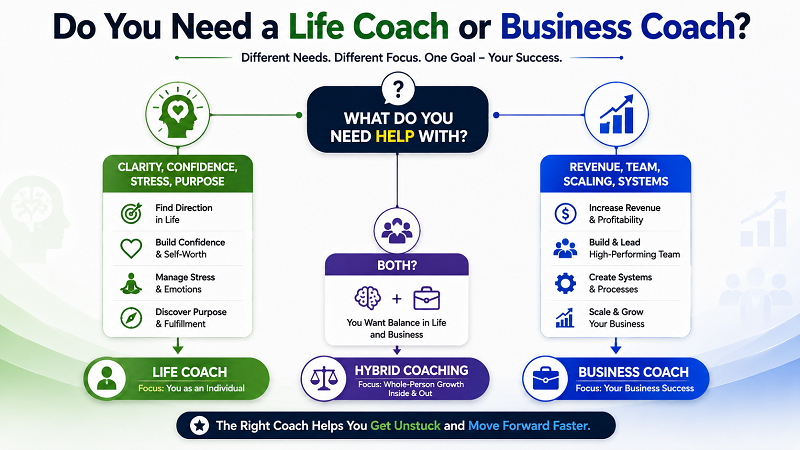
Business coaching focuses on improving professional performance, revenue, and strategic decision-making, while life coaching helps individuals achieve personal clarity, emotional balance, and life goals. If your primary struggle is career growth or business scaling, choose business coaching; if you feel stuck, overwhelmed, or unclear about life direction, life coaching is the better fit.
So, which one should you choose? This article will break down the key differences between business coaching and life coaching, and help you figure out which one might be right for you. Whether you’re looking to grow your business or gain more clarity in your personal life, the right coaching can make all the difference. Let’s dive in!
Key Takeaway:
- Business coaching focuses on improving external outcomes like revenue, systems, and leadership performance, while life coaching targets internal growth such as mindset, clarity, and emotional well-being. The difference lies in what is being optimized—results vs personal alignment. [1]
- Mechanism: Business coaching uses structured frameworks like strategy, KPIs, and execution systems to drive measurable growth, whereas life coaching works through mindset shifts, goal clarity, and behavioral change to remove internal limitations that block progress. [1]
- What to do: Identify your primary constraint—if your challenge is scaling, decision-making, or execution, choose business coaching; if you feel stuck, overwhelmed, or lack direction, choose life coaching. High performers often combine both for maximum impact. [2]
- When to rethink: Business coaching may fail if the real issue is burnout or mindset, while life coaching alone may not work if you lack systems or strategy. Choosing the wrong type delays results and creates frustration. [2]
- Best approach: Sustainable success comes from addressing both internal and external constraints—aligning mindset with execution systems to improve decision quality, consistency, and long-term performance. [2]
Bottom Line: Choose business coaching for external growth and life coaching for internal clarity—but for real, sustainable success, combine both to remove constraints and accelerate results.
- Source: Unleash Your Power – Business Coaching vs Life Coaching
- Source: International Coaching Federation – Global Coaching Study
What is Business Coaching?
Business coaching is a performance optimization process focused on improving measurable business outcomes such as revenue, efficiency, and leadership effectiveness. Life coaching is a personal development methodology aimed at increasing self-awareness, emotional intelligence, and life satisfaction. The key distinction lies in measurement: business coaching uses external metrics (KPIs, ROI), while life coaching uses internal metrics (clarity, confidence, well-being).
A business coach works on:
- Revenue growth strategies
- Marketing and sales systems
- Leadership and team performance
- Operational efficiency
According to the International Coaching Federation (ICF), coaching delivers measurable ROI and performance improvement in organizations.

Key Areas Covered in Business Coaching
Leadership and management:
Business coaches work with leaders to enhance their decision-making, team management, and communication skills. By improving leadership abilities, teams can work more effectively toward shared goals.
Strategic planning:
Coaches help business owners and leaders create long-term plans that align with their vision and objectives. Through goal setting and actionable steps, business owners can stay on track to achieve measurable success.
Productivity and efficiency:
Coaches focus on improving workflows, streamlining processes, and helping teams manage their time better. The aim is to boost productivity and drive business growth.
Sales and marketing:
Business coaches provide guidance on refining sales strategies, building better customer relationships, and strengthening the brand. This is essential for growth and staying competitive in the market.
Benefits of Business Coaching
Clearer Business Vision and Goals
A business coach helps you clarify your business goals and vision, so you know exactly where you’re headed. With a clear direction, you can make smarter decisions and avoid wasting time on unnecessary tasks.
Better Leadership and Decision-Making
Business coaching sharpens leadership skills, helping you manage your team more effectively. With improved decision-making abilities, you can guide your business through challenges and seize new opportunities with confidence.
Increased Efficiency and Productivity
Coaches help streamline operations and improve time management. This means you and your team can focus on what matters most, driving productivity and making business operations run more smoothly.
Stronger Business Strategy
Business coaches assist in creating actionable, measurable strategies for growth. By focusing on the long term and developing sustainable strategies, your business can avoid common pitfalls and stay ahead of the competition.
Improved Profitability
By fine-tuning various aspects of your business leadership, sales, marketing, and productivity business coaching directly impacts your bottom line. With a sharper focus and optimized operations, you can drive profitability and secure long-term success.
What is Life Coaching?
Life coaching focuses on personal development, emotional clarity, and aligning actions with values.
A life coach helps with:
- Goal clarity and life direction
- Confidence and self-belief
- Stress management
- Work-life balance
Research published by the National Library of Medicine shows coaching improves goal attainment and psychological well-being.
Additionally, the American Psychological Association supports goal-setting and behavioral coaching as effective tools for personal growth.
Key Areas Covered in Life Coaching
Goal setting and motivation:
Life coaches help clients define meaningful goals and develop strategies to stay motivated and focused on achieving them. It’s about taking small steps that lead to big changes.
Stress management and work-life balance:
Coaches provide tools and techniques to manage stress, helping clients maintain a healthy balance between their personal and professional lives. This includes practical advice on setting boundaries and prioritizing self-care.
Relationships and communication:
Life coaching can improve personal relationships by enhancing communication skills and offering strategies to navigate conflicts. A coach helps clients build stronger, more supportive connections with others.
Mindset and self-esteem:
Life coaches work with clients to boost confidence, clarity, and mental well-being. By helping individuals shift their mindset and overcome limiting beliefs, coaches enable them to reach their full potential.
Benefits of Life Coaching
Greater Self-Awareness
Life coaching helps you understand your values, desires, and life goals, giving you clearer direction. This clarity makes it easier to make decisions aligned with what truly matters to you.
Stronger Relationships
Life coaching improves communication and conflict-resolution skills, helping you form deeper and more meaningful connections with others.
Stress Reduction and Better Balance
With stress management tools and advice on maintaining work-life balance, life coaching helps you reduce stress, leading to more relaxation and a sense of peace in daily life.
Boosted Confidence
Life coaching enhances self-esteem by focusing on your strengths and progress. This increased confidence empowers you to tackle challenges and pursue personal goals with conviction.
Achieving Personal Goals
With personalized strategies and accountability, life coaching helps you stay on track with personal aspirations, breaking through obstacles and turning dreams into reality.
Key Differences Between Business Coaching and Life Coaching
Though both business coaching and life coaching are designed to help individuals grow, they focus on different areas of life. Here are five key differences to help you choose the right coaching for your needs.

Focus: Professional vs. Personal
- Business Coaching: Primarily focuses on improving business performance, leadership skills, and achieving professional goals. It’s about growing your business, developing strategies, and making decisions that benefit your career or company.
- Life Coaching: Centers around personal growth, helping you become more self-aware, improve relationships, and find balance in life. Life coaching is about finding clarity on your personal values, goals, and overcoming personal obstacles.
Target Audience: Leaders vs. Individuals
- Business Coaching: Typically aimed at entrepreneurs, business owners, executives, or anyone looking to improve their professional life. Business coaching focuses on individuals or teams who want to boost productivity and grow their companies.
- Life Coaching: Aimed at anyone looking to enhance their personal life. Life coaching is for people who want to work on self-confidence, manage stress, or navigate personal challenges, regardless of their career.
Methods and Tools
- Business Coaching: Uses practical tools like strategic planning, business assessments, and performance reviews. The approach is more structured, focusing on measurable results, growth strategies, and leadership development.
- Life Coaching: Focuses on reflection, mindset shifts, and personal development. Techniques may include journaling, visualization, and setting personal goals. Life coaching is more about guiding someone through personal change and self-improvement.
Outcomes: Business Growth vs. Personal Fulfillment
- Business Coaching: Aims for tangible outcomes such as higher revenue, improved leadership, and business growth. The focus is on measurable achievements and professional success.
- Life Coaching: Focuses on intangible outcomes like emotional well-being, confidence, and achieving life balance. Success is often defined by increased happiness, reduced stress, and personal satisfaction.
Approach: Structured vs. Flexible
- Business Coaching: Tends to be more structured with clear goals, deadlines, and actionable steps to achieve professional milestones. It’s about developing a plan and executing it to see results.
- Life Coaching: More flexible and client-driven. Life coaching often allows for a slower, more reflective approach, focusing on understanding oneself and working through challenges at a comfortable pace.
These differences make it clear that business coaching is ideal for professional growth, while life coaching is better suited for those looking to improve their personal lives. The right choice depends on what area of your life you want to focus on.
Business Coaching vs Life Coaching: Key Differences
| Aspect | Business Coaching | Life Coaching |
|---|---|---|
| Primary Focus | Revenue, performance, growth | Personal clarity, fulfillment |
| Metrics | KPIs, profit, ROI | Happiness, alignment, confidence |
| Approach | Strategic, analytical | Reflective, mindset-based |
| Audience | Entrepreneurs, executives | Individuals at any stage |
| Outcome | Scalable systems | Emotional clarity |
How to Choose Between Business Coaching vs. Life Coaching
When deciding between business coaching and life coaching, it’s important to align your choice with your current focus. Here’s how you can make the best decision for yourself.
Identify Your Primary Focus
- If you’re looking to grow your career, build a business, or improve leadership skills, business coaching is the way to go. It’s for people who need support in advancing professionally or driving business success.
- If you’re feeling disconnected from your personal goals, dealing with stress, or looking to enhance your emotional well-being, life coaching could be the better choice. Life coaching focuses on personal fulfillment, overcoming obstacles, and achieving inner balance.
Evaluate What You Want to Achieve
- Business coaching focuses on practical goals like increasing revenue, improving efficiency, and refining leadership. If your focus is on measurable business outcomes, this is where a coach can help you make significant progress.
- Life coaching, however, works with more personal, internal goals like building confidence, overcoming fears, or learning how to balance your life better. If you’re looking to improve how you feel or how you relate to others, life coaching provides the tools for personal transformation.
Understand Your Current Life Stage
- If you’re navigating a career transition, scaling a business, or aiming for more career success, business coaching provides a clear structure to help you set and achieve professional goals.
- Life coaching can be more useful when you’re at a personal crossroads, trying to achieve a better work-life balance, or need help navigating life changes like a new relationship or lifestyle shift.
Consider the Type of Guidance You Need
- Business coaching is often more goal-oriented, with a focus on strategy, accountability, and achieving professional milestones.
- Life coaching, on the other hand, often involves deeper reflection and mindset shifts. If you want support in tackling personal barriers or unlocking potential in your everyday life, life coaching helps you find clarity and direction.
Can You Benefit from Both?
If your career and personal life both require attention, consider using both types of coaching at different times. While business coaching can help you grow professionally, life coaching can help you manage stress and boost your personal development, creating a more balanced approach to success.
The Role of a Coach in Both Types of Coaching
Responsibilities of a Business Coach
A business coach helps you navigate the challenges of running a company. They guide you in identifying key issues and opportunities that can drive growth. Whether it’s improving team performance or developing strategies to expand your business, a business coach gives you the tools to make informed decisions and achieve your goals. They work with you to implement practical steps that lead to increased efficiency and measurable success.
Responsibilities of a Life Coach
A life coach is there to support your personal growth journey. They help you stay motivated and focused on becoming the best version of yourself. Whether you’re setting personal goals, overcoming obstacles, or building confidence, a life coach offers encouragement and direction. They listen closely, provide helpful perspectives, and guide you through the process of self-improvement, helping you build a clearer vision for your life.
How to Work Effectively with Your Coach
To get the most out of your coaching experience, trust and communication are key. Whether you’re working with a business or life coach, it’s essential to build a relationship based on openness and respect. Share your challenges and goals honestly, and be open to feedback. Setting clear expectations and goals for the coaching relationship ensures you stay focused and make measurable progress. When you and your coach are aligned, you’re more likely to reach your desired outcomes.

Can You Benefit from Both Business and Life Coaching?
When Both Types of Coaching Can Complement Each Other
Sometimes, personal and professional growth go hand in hand. Imagine you’re a business owner who’s struggling with both your business performance and your work-life balance. You might find that working with both a business coach and a life coach helps you reach your full potential. A business coach will help you scale your business, make strategic decisions, and boost productivity. Meanwhile, a life coach can support you with managing stress, improving relationships, and finding more fulfillment in your personal life.
Real-life examples show that many successful individuals use both types of coaching. For instance, a CEO may work with a business coach to develop leadership skills and grow the company while also engaging with a life coach to navigate personal challenges like balancing family life and work. This holistic approach ensures that success is achieved not just in business but in personal life as well.
Balancing Professional and Personal Development
Balancing business and life coaching allows you to focus on both areas simultaneously, ensuring that neither your career nor your personal life is neglected. When you invest in both, you’re not just working towards career success, but also creating a life that supports your well-being. This balance leads to more sustainable growth in both your professional life and your personal satisfaction.
For example, improving leadership and decision-making in business can help you feel more confident in your career, while addressing personal challenges with a life coach can bring better clarity and peace of mind. By tackling both at the same time, you create a cycle of growth that feeds into each other, resulting in a more fulfilling and successful life overall.
Can You Have Both a Business Coach and a Life Coach?
Yes, and this is increasingly common.
The International Coaching Federation (ICF Research Portal) reports growing demand for integrated coaching approaches.
McKinsey & Company, People and Organizational Performance Insights highlights that emotional well-being directly impacts executive performance and decision-making.
When Business Coaching Fails (And Why
Business coaching fails when:
- The real issue is mindset, not strategy
- The client is burned out
- There is lack of clarity or emotional stability
When Life Coaching Isn’t Enough
Life coaching may not work if:
- You lack execution systems
- You need structured business strategies
- The problem is technical (sales, marketing, operations)

Frequently Asked Questions About Business Coaching vs Life Coaching
What is the main difference between business coaching and life coaching?
Business coaching focuses on improving external results like revenue, performance, and strategy, while life coaching focuses on internal growth such as mindset, clarity, and emotional well-being. The key difference is that business coaching is measured through KPIs and outcomes, whereas life coaching is measured through personal alignment and satisfaction.
Is business coaching better than life coaching?
Neither is better, it depends on your situation. Business coaching is ideal if you need help with growth, systems, or leadership. Life coaching is more effective if you feel stuck, overwhelmed, or lack direction. The right choice depends on whether your challenge is external or internal.
Can life coaching improve business performance?
Yes, life coaching can improve business performance by strengthening mindset, clarity, and emotional control. When leaders think clearly and manage stress effectively, they make better decisions, communicate better, and lead more effectively, which directly impacts business results.
Who should hire a business coach?
Entrepreneurs, executives, and professionals who want to grow revenue, improve strategy, or solve business challenges should hire a business coach. It is especially useful for those who need structured guidance, accountability, and faster execution.
Do successful people use both business coaching and life coaching?
Yes, many high performers use both. Business coaching helps them achieve results, while life coaching helps them maintain clarity, balance, and long-term sustainability. Combining both often leads to better overall performance and well-being.
Conclusion
Choosing between business coaching and life coaching depends on where you are in your personal and professional journey. Business coaching is ideal for those focused on improving leadership, productivity, and business strategies, while life coaching helps individuals grow personally, build confidence, and find balance.
The good news is that these two coaching paths don’t have to be mutually exclusive. Many successful individuals use both types of coaching to enhance different areas of their lives, ensuring a holistic approach to success.
By understanding the key differences and benefits of each, you can make an informed decision about which coaching style will help you achieve your goals.
Whether you’re looking to scale your business or improve your personal well-being, the right coaching can provide the support and direction needed to unlock your full potential. Embrace the growth opportunities that coaching offers, and you’ll see lasting changes in both your career and your life.