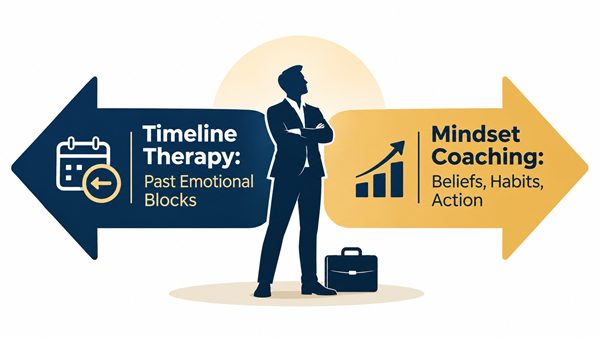
Neither approach automatically grows a business, and the evidence behind them differs. Timeline Therapy is a trademarked NLP technique created by Tad James that works with how a person holds memories of past events, and it has very little published research behind it. Mindset coaching is a broader, forward-looking approach to beliefs, habits and action. In a randomized trial of 1,500 entrepreneurs in Togo, psychology-based mindset training raised profits 30%, versus 11% for traditional business training, though that program wasn’t Timeline
Therapy and the setting was a single city. Mindset coaching has the stronger business evidence. Timeline Therapy may suit someone stuck on a specific past-emotion block. Persistent anxiety, trauma symptoms or low mood call for a licensed professional, not either approach.
Key Takeaway:
- Timeline Therapy and mindset coaching address different challenges. Timeline Therapy is an NLP-based technique that targets negative emotions associated with past experiences, while mindset coaching focuses on present beliefs, habits, decisions, and forward-looking business goals. [1]
- Evidence and effectiveness: Mindset coaching has stronger research support for business-related outcomes. A randomized trial involving 1,500 entrepreneurs in Togo found that psychology-based personal initiative training increased profits by 30%, compared with 11% for traditional business training. However, this was not a Timeline Therapy study, and results should not be generalized to every coaching program. [2]
- How to choose: Consider Timeline Therapy when a specific past experience repeatedly triggers emotional blocks or prevents decisions. Choose mindset coaching when you need better pricing decisions, consistent follow-ups, stronger accountability, delegation, or improved business execution. [1]
- What to do: Apply the 3-Gate Fit Test. First, identify whether your challenge comes from a past emotional experience or a forward-looking habit gap. Second, rule out clinical concerns. Third, establish one measurable 90-day business goal, such as booked calls, proposal conversion rates, or revenue growth, before starting either approach. [1]
- When to be cautious: Research specifically supporting Timeline Therapy remains limited, and no identified study establishes its impact on business revenue or profits. Neither approach guarantees instant results or replaces professional mental health treatment. Persistent anxiety, trauma symptoms, or low mood require support from a licensed professional. [1]
Bottom Line: Mindset coaching has the stronger evidence for business growth because it develops actionable beliefs, habits, and decisions. Timeline Therapy may be worth considering for specific past emotional blocks, but choose based on your actual challenge, prioritize measurable outcomes, and seek licensed professional support for clinical concerns.
- Source: Unleash Your Power – Timeline Therapy vs Mindset Coaching: Which Grows Business?
- Source: World Bank – Entrepreneurship Training and Business Growth in Togo
Before the Rounds: Why This Choice Feels Hard
You’ve worked hard, and something still holds your business back. One person tells you to clear the past. Another tells you to build the right mindset. Both sound convincing, both promise change, and neither offers a straight comparison.
A quick disclosure first. James R. Elliot teaches NLP-based methods, and this article is published on his site. To keep the verdicts honest, they rest on outside research, and we say plainly where that research is thin.
Here are six head-to-head rounds. Each one ends with a verdict, so you can see where each approach earns its place.
The Head-to-Head: Six Rounds
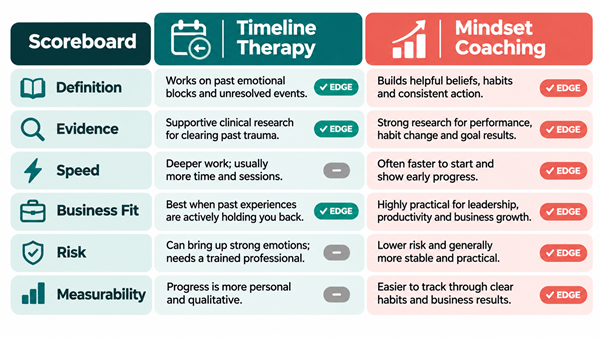
Round 1: What Each Approach Actually Is
Timeline Therapy. Created by Tad James in 1985, it’s a technique that works with how the unconscious mind arranges memories along a personal timeline. Practitioners aim to release negative emotions tied to past events, then rehearse a positive future. The name is trademarked, and you’ll see it written as Time Line Therapy®.
Mindset coaching. A broader practice that works on the beliefs, habits and decisions shaping your actions now. It usually involves goals, accountability and practice. Our guide to mindset training goes deeper.
Verdict. Different tools for different jobs. One looks back to release a block. The other looks forward to build action.
Round 2: The Evidence
Timeline Therapy. A directory page on the technique acknowledges limited clinical evidence compared with hypnotherapy or NLP, and mentions only a couple of small studies. Its stronger claims, such as superiority over traditional psychotherapy, aren’t clearly backed by its own sources.
Mindset coaching. A meta-analysis of workplace coaching found positive effects on performance, well-being, coping, work attitudes and goal-directed self-regulation, with effect sizes from 0.43 to 0.74. That covers coaching broadly, not a single mindset method, and the abstract doesn’t report the study count.
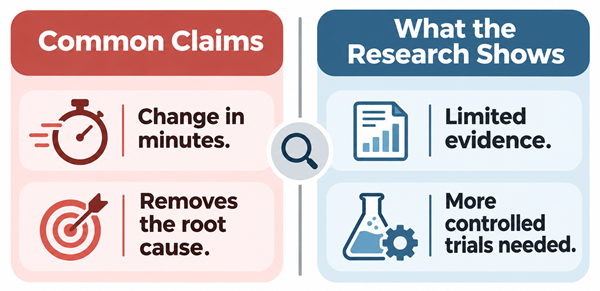
The wider NLP picture is cautious. A 2012 systematic review found 10 relevant studies and little evidence of health benefits, though its author said she wasn’t claiming NLP doesn’t work, only that more controlled trials are needed. See another summary of NLP’s evidence base for context.
Verdict. Coaching has the stronger evidence. Timeline Therapy has the thinner one.
Round 3: Speed and Claims
Timeline Therapy. Promotional materials often say change can happen in minutes rather than months. One directory page repeats that claim without citing research for it.
Mindset coaching. It tends to build through practice. Results usually grow over three to six months of consistent work, and good coaches avoid promising a date.
Verdict. Treat speed claims from either side with care. Fast shifts can happen, but you should plan for practice.
Round 4: Fit for Business Problems
Timeline Therapy. It may help when a specific past experience drives a present block, such as a fear tied to one kind of client or a bad deal you can’t stop replaying. We found no study linking it to revenue or profit.
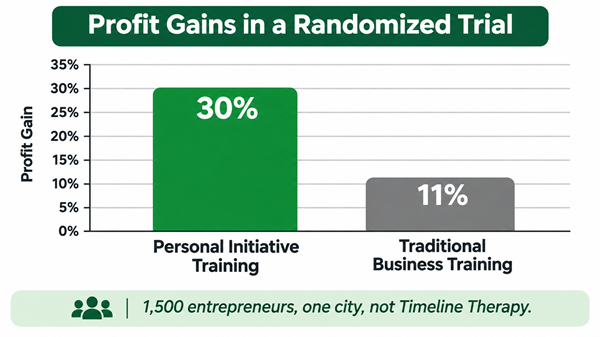
Mindset coaching. It fits forward gaps: follow-up habits, pricing decisions, delegating, taking action. In a randomized trial in Togo, 1,500 microentrepreneurs received either personal initiative training or traditional business training. Profits rose 30% with the mindset-focused program and 11% with traditional training. That program targeted self-starting behavior, goal-setting and overcoming obstacles. It wasn’t Timeline Therapy, it ran in one city, and costs were subsidized.
Jeff A. worked with James on mindset and said the shift spread into his relationships and his business, including bringing in new customers. That’s one person’s account, not a measured result. For more on blocks that stall business owners, read how to overcome mindset blocks and overcoming limiting beliefs with NLP.
Verdict. For most business growth problems, mindset coaching has the stronger case. For a clear past-emotion block, Timeline Therapy may be worth a careful try.
Round 5: Risk and Scope
Timeline Therapy. Promotional material often lists conditions like PTSD and depression, yet rarely discusses risks or practitioner licensing. One directory page notes the approach may not suit people with certain severe mental health conditions and doesn’t say whether practitioners hold a mental health license.
Mindset coaching. Lower risk for ordinary business goals, but it isn’t therapy either. A coach isn’t a substitute for treatment. For a closer look at the boundary, see NLP vs traditional therapy.
Verdict. Neither replaces a licensed professional for clinical concerns. Ask any practitioner about training, scope and when they refer out.
Round 6: Measurability
Timeline Therapy. Outcomes are mostly described as a felt shift, which is hard to measure against a business result. If you try it, set one measurable target first.
Mindset coaching. Easier to tie to behaviors you can count: calls made, proposals sent, price changes. Our post on measuring ROI from business coaching covers how.
Verdict. Mindset coaching is easier to measure. Whichever you choose, choose your metric before you begin.
Scorecard: Timeline Therapy vs Mindset Coaching
| Round | Timeline Therapy | Mindset coaching | Edge |
| What it is | Memory-based technique for past emotional blocks | Forward work on beliefs, habits and action | Different jobs |
| Evidence | Limited, mostly small studies | Broader coaching evidence, one strong mindset trial | Mindset coaching |
| Speed claims | Often marketed as very fast, unproven | Builds with practice over months | Treat both carefully |
| Business fit | No revenue evidence found | Trial showed profit gains | Mindset coaching |
| Risk and scope | Unclear licensing, clinical claims | Lower risk, not therapy | Mindset coaching |
| Measurability | Hard to measure | Tied to countable behaviors | Mindset coaching |
| NOT SURE WHICH FITS YOUR SITUATION?Bring your biggest business block to a short call and talk through the options. Book a 30-minute connection call. |
The 3-Gate Fit Test
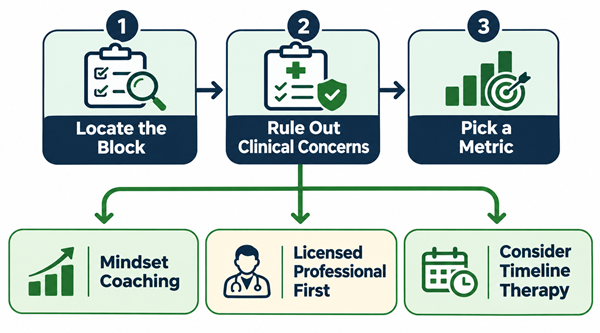
The 3-Gate Fit Test is a quick way to match your problem to an approach. Answer the gates in order.
Gate 1: Locate the Block
Is the problem tied to a specific past event, or to a forward habit you haven’t built? A past event points toward Timeline Therapy. A forward habit points toward mindset coaching.
Gate 2: Rule Out Clinical Concerns
Do you have persistent anxiety, trauma symptoms or low mood? If yes, start with a licensed professional. Coaching can sit alongside that care later, with their agreement.
Gate 3: Pick a Metric
Name one number you want to move in the next 90 days, such as booked calls or proposal win rate. If you can’t name one, you aren’t ready to judge any approach yet.
Who Should Use Which
- Choose mindset coaching if you have a clear forward goal, such as higher prices, more consistent follow-up or delegating.
- Consider Timeline Therapy if one specific past experience keeps resurfacing and blocking a decision, and you’ve found a qualified practitioner who explains their scope.
- Use both in sequence only if Gate 1 shows a past block and Gate 3 gives you a way to measure the result.
Who Should Avoid Both for Now
- Anyone with persistent anxiety, trauma symptoms or low mood. A licensed professional is the right first step.
- Anyone looking for a guaranteed or instant result. Neither approach offers one.
- Anyone whose problem is a skill or market gap, such as a weak offer. Fix that with training or strategy first.
Data & Findings
Here is what the sources support and where they fall short. We found no study measuring Timeline Therapy on business outcomes.
- Togo randomized trial (World Bank, 2017): 1,500 microentrepreneurs in Lomé, a control group and four follow-up survey rounds. Profits rose 30% with personal initiative training versus 11% with traditional training. The release reports a 40% versus 5% gap for female-owned firms without giving subgroup sizes. Costs were about $756 per participant, subsidized by the study. It’s a press-release summary of one city’s results.
- Workplace coaching meta-analysis: Five outcome areas showed positive effects, from g = 0.43 for coping to g = 0.74 for goal-directed self-regulation. The abstract doesn’t report the number of studies or limitations.
- NLP systematic review (2012): Ten studies, four of which referred only to general NLP techniques. It found little evidence of health benefits and did not conclude that NLP fails. It concerns health outcomes, not business.
- Timeline Therapy: A directory page describes it as created in 1985 and acknowledges limited clinical evidence. Its promotional claims go beyond the research it cites.
FAQs
Is Timeline Therapy the same as mindset coaching?
No. Timeline Therapy is a specific, trademarked technique that works with memories of past events. Mindset coaching is a broader practice focused on beliefs, habits and action going forward.
Which one grows a business faster?
Neither guarantees growth. The best business-outcome evidence we found comes from mindset-focused training in a Togo trial, while we found no business-outcome study for Timeline Therapy.
Is Timeline Therapy evidence-based?
Its evidence base is limited. Research on NLP overall is also thin, so ask any practitioner what they rely on and avoid anyone promising guaranteed results.
Can I use both together?
Some people do. Use the 3-Gate Fit Test first, and only add a second approach when the first has a clear measurable result or a clear gap left.
How do I choose a qualified practitioner?
Ask about training, scope and when they refer clients to licensed professionals. Be wary of practitioners who promise instant change or treat serious clinical conditions without a license.
Conclusion
Both approaches have a place, but they solve different problems. Mindset coaching has the stronger business case, and Timeline Therapy may help with a specific past block. Take decisive action this week: name your block, pick one metric and choose the approach that fits. For the bigger picture, read our guide to NLP coaching and business coaching, or book a 30-minute connection call.
Unleash Your Power: Stand Out, Take Action, and Create the Success You Want.