

Every year, Canadian founders leave tens of thousands of dollars in non-repayable government funding on the table. Not because the programs don’t exist. Not because they don’t qualify. Because they talked themselves out of applying before they even started.
If you’ve ever opened a government grants page, scrolled for ten minutes, and quietly closed the tab, this article is for you.
Canada has over 126 startup funding programs available right now. The CRA alone processed $4.5 billion in SR&ED tax credits in the 2024-2025 fiscal year across 22,738 claims. The money is real, the eligibility is broader than most founders assume, and a significant portion of it goes unclaimed every single year. What stands between most high-margin startups and that funding isn’t the paperwork. It’s the belief that the paperwork is pointless.
Key Takeaway:
- Many high-margin Canadian businesses miss out on grants simply because funding programs are fragmented across federal, provincial, and industry-specific portals that most entrepreneurs never fully explore. [1]
- The most valuable “hidden” funding opportunities are often tied to innovation, automation, exporting, hiring, digital transformation, and R&D activities rather than generic small business grants. [2]
- Programs like SR&ED tax credits, NRC IRAP, CanExport, and provincial innovation grants can provide substantial non-dilutive funding for SaaS, technology, consulting, manufacturing, and other high-margin business models. [3]
- Businesses improve approval odds significantly when they position applications around economic impact, innovation, job creation, productivity gains, or export growth rather than simply “needing funding.” [4]
- Most successful grant strategies involve stacking multiple programs together over time, combining grants, tax credits, wage subsidies, and low-interest financing to maximize growth without giving up equity.
Bottom Line: Canada offers billions in underused business funding, but the highest-margin companies benefit most when they strategically target innovation, automation, export, and R&D-focused grants instead of relying on generic small business funding searches.
- Source: GrantCompass – Canadian Business Grants Database (2026)
- Source: GrantHub – Grants for Businesses in Canada (2026)
- Source: GrantPilot – Canadian Startup Grant Database
- Source: Reddit – Canadian Government Funding Insights
Here’s what you’ll walk away with: a clear breakdown of the programs most founders overlook, how to stack them legally to cover 60 to 75% of project costs, the data behind what’s actually available, and the mindset shift that turns hesitation into a submitted application.
Why “I Won’t Qualify” Is the Most Expensive Belief a Founder Can Hold
The Exact Moment Most Founders Drop Off
It usually happens in the first five minutes. You find a program that sounds promising, click through to the eligibility criteria, and hit a wall of government language. Words like “eligible expenditure,” “systematic investigation,” and “technological uncertainty” start stacking up. You think: this probably isn’t for me. Tab closed.
That moment, not the application itself, is where most grants are lost.
In over 20 years of working with founders, the pattern is consistent: the gap between “people who qualify” and “people who apply” isn’t talent or eligibility. It’s the willingness to take a first, imperfect step before feeling completely ready.
The Scarcity Loop vs. the Action Loop
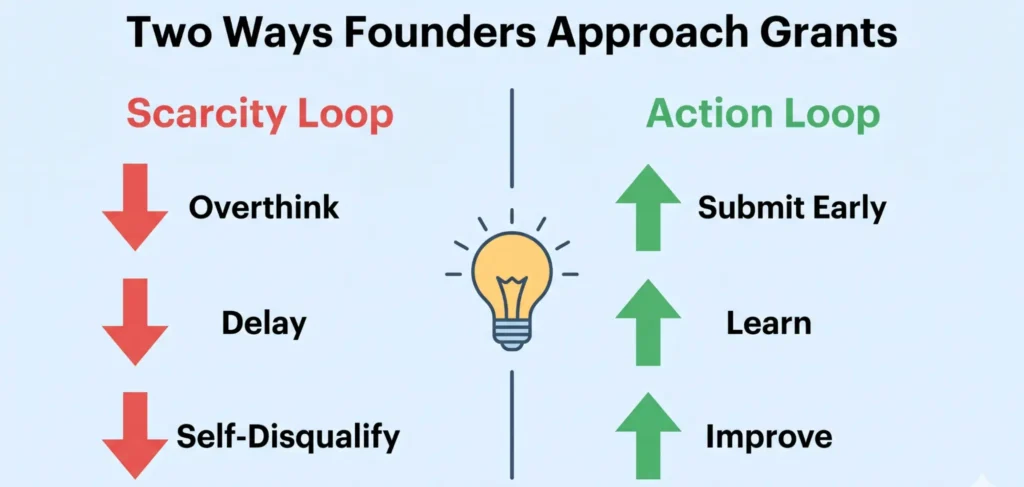
When founders operate from a scarcity mindset around funding, they tend to overthink, delay, and self-disqualify. The internal monologue sounds like: I’ll look into this properly when I have more time. I don’t want to waste a submission on something I might not get. That’s the scarcity loop. It feels responsible. It’s actually just avoidance dressed up as strategy.
The action loop looks different. Founders in it submit imperfect applications early, learn from the process, and improve over time. They treat grant applications the way good salespeople treat prospecting: volume and iteration beat perfection every time.
One of my clients, Darren, came to me stuck in exactly this pattern. He had a profitable business, the skills, the drive, but kept finding reasons why the next level wasn’t accessible to him. The block wasn’t capable. It was permission. Once we worked through that ceiling, he started taking action he’d been circling for years. The same pattern shows up with founders and grants: the funding is there, the eligibility is often there, but the mental permission to go after it isn’t. Exploring how NLP reshapes the entrepreneurial mindset is a practical next step if you recognize that pattern in yourself.
NLP Reframe: Turning Hesitation Into a Submitted Application
When you catch yourself in a scarcity thought around funding, try this reframe. This is the foundation of NLP’s Meta-Model approach: challenge the vague, limiting statement with a specific, answerable question. The obstacle shrinks from “this whole application” to “this one section, today.”
Try this: Write down the thought stopping you from applying. Then ask out loud: “What specifically is stopping me from submitting this today?” Write the answer. Nine times out of ten, the real answer isn’t “I don’t qualify.” It’s the fear of being told no. That’s a solvable problem.
| Scarcity Thought | NLP Reframe (Action-Oriented) |
| “This is too complex.” | “What is the one 15-minute step I can take right now?” |
| “I won’t qualify.” | “Which criteria do I already meet?” |
| “I’ll do it later.” | “What is the real cost of not applying at all?” |
| “Someone else deserves this more.” | “What evidence do I actually have for that belief?” |
| “The application will take too long.” | “What is the minimum viable first draft I could submit?” |
What Secret Government Grants Actually Mean
Not Secret, Just Misunderstood
These aren’t programs hidden in a government vault. They’re publicly listed. The “secret” is that most founders never find them because they rely on the same three or four programs that show up on every generic blog post.
It also helps to understand what you’re actually looking at. Not all programs are true grants (non-repayable). The landscape breaks into three categories: grants you don’t pay back, loans with soft terms that are still repayable, and tax credits you claim after spending. For cash-flow-conscious startups, this distinction matters enormously. A tax credit like SR&ED doesn’t show up as a line item in your bank account until you file, while a grant like IRAP can fund salary costs in real time.
The Unspent Budget Factor
Government programs operate on fiscal year cycles. As March approaches, program administrators are incentivized to deploy remaining capital. Applications submitted in Q1 of the fiscal year often face more competition. Applications submitted in late Q3 or Q4 can sometimes move faster because reviewers are working against a deadline to spend allocated funds. Timing your submissions strategically is a legitimate edge most founders ignore entirely.
The Niche Naming Problem
Many high-value programs don’t use the word “grant” at all. They show up as innovation vouchers, wage subsidies, pilot program funding, or market validation support. If you’re only searching for “grants for Canadian startups,” you’re missing a significant portion of what’s available. Broaden your search terms and you’ll find a materially different landscape.
Data and Findings: What the Numbers Actually Show
Most founders have no idea how large Canada’s innovation funding ecosystem actually is. The data tells a clear story.
According to CRA’s Annual Program Statistics for 2024-2025, the SR&ED program processed 22,738 claims and allowed $4.5 billion in credits in a single fiscal year. Software development alone accounted for 40.8% of those credits, amounting to $1.84 billion claimed by tech and digital businesses. This isn’t a program for lab researchers only.
Budget 2025 doubled the SR&ED expenditure limit for CCPCs from $3 million to $6 million. Qualifying startups can now earn up to $2.1 million in refundable credits annually. KPMG describes this as one of the largest expansions of the refundable SR&ED benefit since the program’s inception.
GrantCompass’s analysis of 194 funding programs confirms 126 are accessible to startups, with IRAP alone funding roughly 3,100 firms annually at an average non-repayable contribution of approximately $500,000.
According to Budget 2025 analysis from SREdReady, the additional $440 million in ongoing SR&ED support is projected to yield $1.2 billion in annual economic output, with a three-fold return on investment and a projected 3.5% uplift in real GDP by 2030.
The data points to one conclusion: the funding ecosystem is generous. The bottleneck is founder awareness and follow-through, not program availability.
The High-Value Programs Most Canadian Startups Overlook
Scientific Research and Experimental Development (SR&ED)
SR&ED is Canada’s largest R&D tax incentive, and it’s genuinely one of the most underclaimed opportunities for high-margin startups. The common misconception is that SR&ED is only for companies doing lab-level breakthrough research. It isn’t. The program supports work involving technological uncertainty, which includes iterative software development, product optimization, and process improvement.
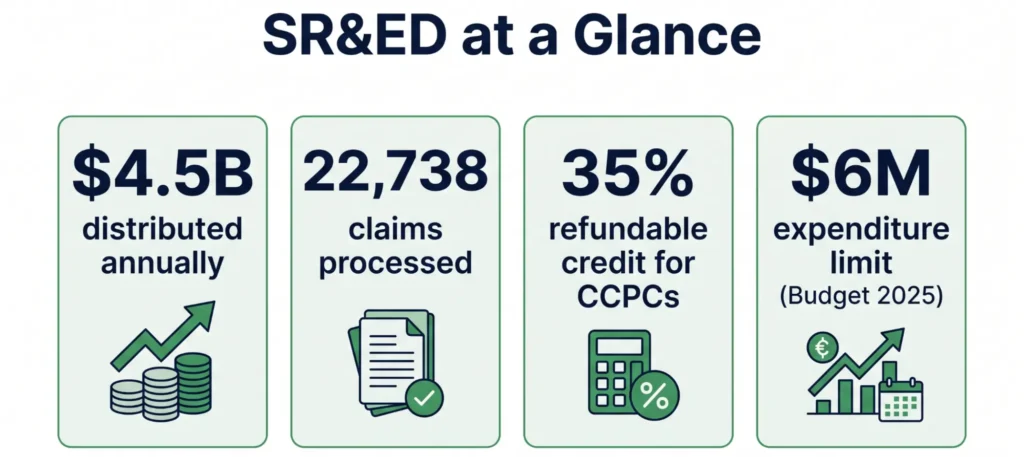
For CCPCs, the program offers a 35% fully refundable tax credit on qualifying R&D expenditures on the first $6 million of spend. A startup spending $200,000 on qualifying work could receive approximately $70,000 back in cash, even with no tax owing. Provincial credits stack on top, with rates ranging from 4.5% to 30% depending on your province, bringing total combined rates as high as 43 to 60% in some cases.
NRC Industrial Research Assistance Program (IRAP)
IRAP is the flagship non-repayable innovation program from the National Research Council. It funds roughly 3,100 companies annually with an average contribution of $500,000. The program is well-suited to startups hiring technical talent, building new products, or validating technology with commercial potential.
What makes IRAP different is the human element: you work with an Industrial Technology Advisor (ITA) who evaluates fit before you submit a formal application. That conversation is worth having even if you’re unsure about eligibility. An ITA’s guidance often clarifies whether you qualify faster than reading program documentation ever will. And it costs nothing to have.
Strategic Innovation Fund (SIF)
SIF is designed for companies ready to scale. It covers R&D, industrial development, and technology demonstration, with eligible cost coverage reaching 50% in some cases. If you’re past early traction and looking at significant investment in growth infrastructure, SIF deserves serious investigation.
Can Export SMEs
CanExport covers up to 75% of eligible international business development costs, capped at $50,000 per application. If you’re a high-margin service business considering expansion into new international markets, this program is underused relative to how accessible it actually is. Eligible costs include market research, product certifications, and professional development tied to international growth.
Regional Programs: The Goldmine Most Founders Never Dig Into
FedDev Ontario, Western Economic Diversification Canada, and the Regional Economic Growth through Innovation (REGI) initiative collectively represent significant non-repayable and repayable funding for region-specific businesses. These programs are less competitive than national ones simply because fewer founders know they exist. If you’re in Ontario, BC, or Quebec, especially, these deserve a spot on your applications list. See coaching for tech startups in Ontario for more context on the regional resources available to Ontario-based founders.
The Hidden Layer: Programs Most Founders Never Find
Beyond the major programs, there’s a second tier worth knowing. Mitacs Accelerate connects companies with university researchers and graduate students at subsidized cost, useful for startups that need research capacity without adding permanent headcount. The Women Entrepreneurship Strategy (WES) provides targeted support for women-led businesses across a range of eligible activities. And provincial wage subsidy programs, which never use the word “grant,” can dramatically reduce burn rate during hiring phases while strengthening future applications by demonstrating growth momentum.
These aren’t consolation prizes. They’re often faster to access than flagship programs and serve as credibility signals that improve your odds on the next, larger application.
Who Actually Qualifies? (You Might Be Surprised)
Pre-Revenue Startups
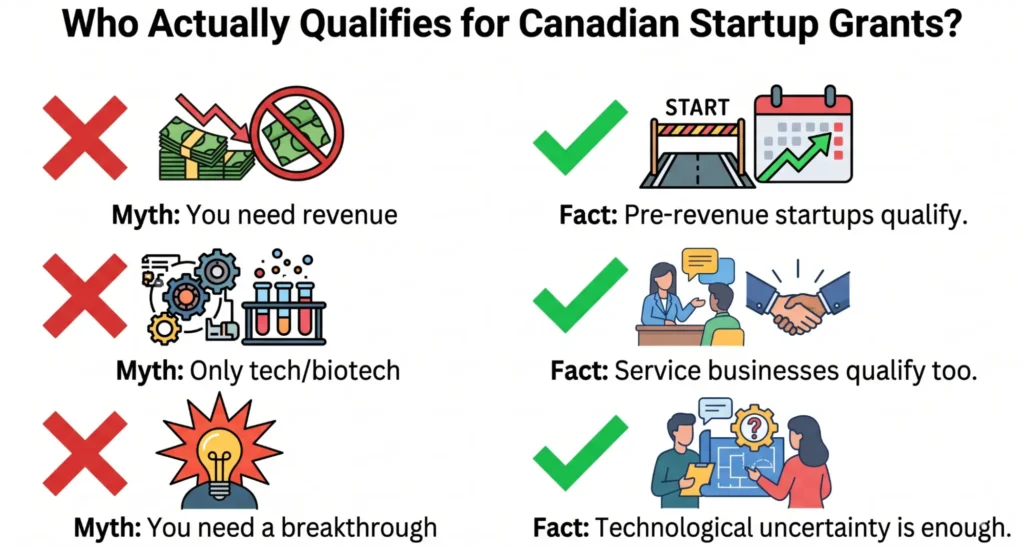
Yes, you can qualify without revenue. Programs like IRAP, Mitacs, and several provincial grants are explicitly designed for early-stage companies. What reviewers care about is a credible team, a defined project with clear milestones, and a realistic commercialization path. Revenue is a signal of traction, not a prerequisite for funding.
High-Margin Service Businesses
The assumption that grants are only for tech hardware or biotech is wrong. Digital transformation projects, training initiatives, process optimization backed by technology, and export development all have dedicated programs. If your business improves how something works using a systematic approach, you likely have more eligible activity than you realize.
You Don’t Need a Breakthrough
SR&ED’s qualifying standard is technological uncertainty, meaning you’re attempting something where the outcome isn’t known in advance and standard practice doesn’t provide a clear answer. That describes a significant amount of product and process development work that founders are already doing without claiming anything for it.
| Common Myth | The Reality |
| “You need to be a tech or biotech company.” | Service, manufacturing, and digital businesses all qualify across multiple programs. |
| “You need revenue to apply.” | Pre-revenue startups are explicitly eligible for IRAP, Mitacs, and others. |
| “SR&ED is for lab researchers only.” | Iterative software and process work qualifies under technological uncertainty. |
| “Grant applications take months to prepare.” | IRAP starts with a free ITA conversation. Many first applications take days, not months. |
| “Small businesses don’t get the big programs.” | Small businesses make up 64% of SR&ED claimants and receive $1.5B annually. |
How Smart Founders Stack Grants to Cover 60 to 75% of Costs
The real leverage in Canada’s funding landscape isn’t finding one program. It’s understanding how programs are designed to work together.
Stack 1: Simple (Ontario Tech Startup)
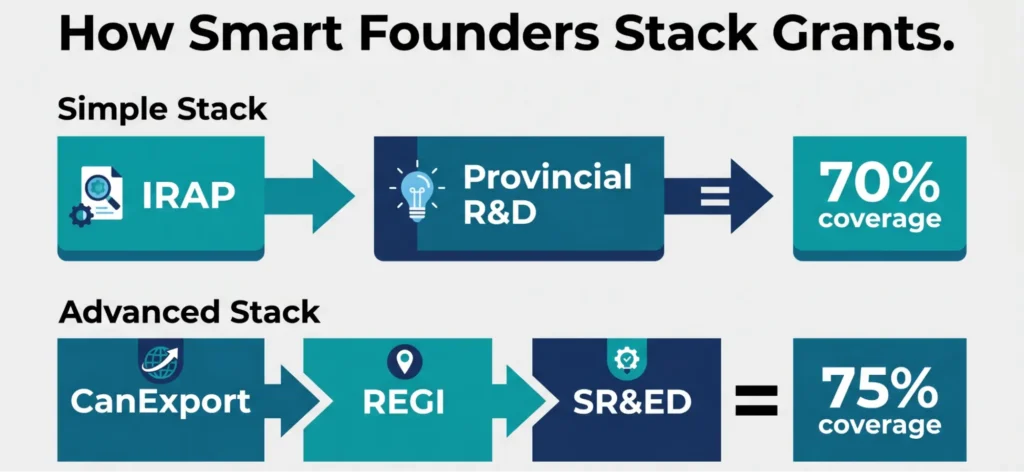
IRAP covers roughly 60% of technical salary costs. Add a provincial R&D tax credit at 10 to 15%. Result: approximately 70% of your R&D costs covered, no equity exchanged.
Stack 2: Advanced (Growth-Stage Expansion Play)
CanExport funds international expansion costs at up to 75%. A REGI contribution supports scale-up infrastructure. SR&ED captures qualifying development work running in parallel. Three programs, three project streams, one company. Legally stackable, with a combined government funding cap of 75% across federal and provincial sources.
The point isn’t to game the system. It’s to build a capital strategy the way serious operators build anything else: with intention, layering, and a clear understanding of the rules. For context on what to do with grant funding once you have it, smart reinvestment strategies is worth reading before you apply.
Try this: Pull up Canada’s Business Benefits Finder and answer the intake questions honestly. The output is a tailored list of programs your business qualifies for. Most founders are genuinely surprised by what comes back.
Why Most Grant Applications Fail
Three patterns show up repeatedly. First, founders write about their business instead of aligning with program goals. Grant reviewers are evaluating fit against specific criteria. Every sentence of your application should speak to those criteria directly, not to how good your business generally is.
Second, innovation claims are too vague. “We’re building something new” isn’t enough. Describe the specific technical uncertainty, what you tried, what didn’t work, and what you learned. Specificity signals credibility. Vagueness signals you haven’t done the work.
Third, founders quit before submission. Perfectionism dressed as thoroughness. An imperfect application submitted beats a perfect one that stays in drafts indefinitely. This connects to a pattern I see consistently in business coaching: the internal barrier that stops high-capable people from acting is rarely a skills gap. It’s a permission gap. If that resonates, understanding why small businesses fail to grow is worth an honest read.
How to Build a Grant-Winning Application Mindset
The apply-before-ready rule is simple: you learn more from one submitted application than from ten hours of researching whether you should apply. Reviewing feedback, understanding reviewer priorities, and refining your framing across iterations is how experienced grant applicants win. First-timers who wait until everything feels perfect rarely submit at all.
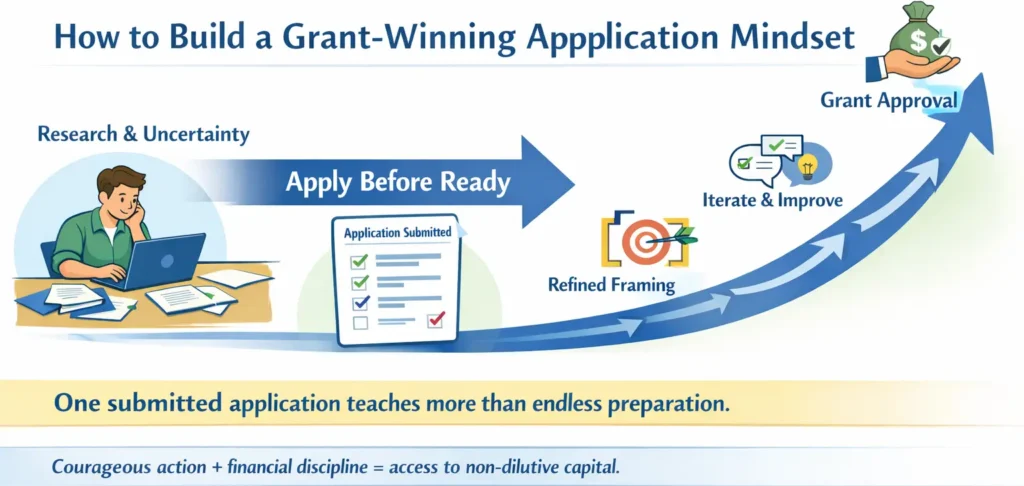
This connects to Pillar 3 of my work with clients: Courageous Action. The willingness to move on incomplete information, to submit before you’re certain, to take a first step without a guarantee, that’s the competency that separates founders who access non-dilutive capital from those who watch it go unclaimed. It’s also what separates businesses that scale from those that stall. How much profit a small business should retain ties directly to this: financial discipline and bold funding decisions work together, not in opposition.
Grant Quick-Reference Cheat Sheet
| Program | Type | Funding Potential | Best For |
| SR&ED | Refundable Tax Credit | 35% of R&D spend, up to $2.1M/year | R&D, software, process development |
| IRAP | Non-repayable Grant | Average approx. $500K | Hiring technical talent, innovation projects |
| CanExport SMEs | Non-repayable Grant | Up to 75% of costs, max $50K | International market expansion |
| SIF | Non-repayable Contribution | Up to 50% of project costs | Scale-ready businesses |
| FedDev / REGI | Repayable + Non-repayable | Varies by project | Regional growth in Ontario, BC and Quebec |
| Mitacs Accelerate | Subsidized Partnership | Varies | University research talent, early R&D |
| WES | Grant plus Advisory | Varies | Women-led businesses |
| Provincial Wage Subsidies | Wage Offset | Varies by province | Hiring support, burn rate reduction |
Frequently Asked Questions: Secret Canadian Grants
Can I apply for government grants if my Canadian startup has no revenue yet?
Yes. Several major programs, including IRAP, Mitacs, and select provincial grants, are designed for pre-revenue companies. Reviewers focus on your project plan, team credibility, and commercialization pathway, not your current revenue figure.
What is grant stacking and is it legal?
Grant stacking means combining multiple government funding programs for the same business, covering different project streams or cost categories. It’s entirely legal. The key rule is that combined government funding from federal and provincial sources generally cannot exceed 75% of eligible project costs.
How long does it take to receive government grant funding in Canada?
It varies by program. According to CRA data, 95.2% of SR&ED claims selected for review are processed within 60 days. IRAP contributions involve an advisor relationship and project approval that can take several months. Apply early, follow up consistently, and don’t rely on grant timelines for cash you need immediately.
Does SR&ED only apply to tech or biotech companies?
No. In 2024-2025, software development accounted for 40.8% of all SR&ED credits claimed, totaling $1.84 billion. Service businesses, manufacturers, and digital companies all qualify if their work involves technological uncertainty and a systematic investigation to resolve it.
What is the single best first step for a Canadian startup new to grants?
Start with Canada’s Business Benefits Finder at innovation.ised-isde.canada.ca. Answer the questions about your business type and goals and review the tailored output. Then book a free conversation with an NRC-IRAP Industrial Technology Advisor. Both steps cost nothing and give you more useful direction than hours of independent research.
Conclusion
The funding exists. The eligibility is broader than most founders believe. And the biggest barrier between you and tens of thousands in non-dilutive capital is almost certainly the narrative running in the background telling you it’s not worth applying.
Grants aren’t luck. They’re positioning and action. The SR&ED program distributed $4.5 billion last year. IRAP funded over 3,100 companies. CanExport, SIF, REGI, and dozens of provincial programs are actively looking to deploy capital to qualifying businesses right now. Canada’s funding ecosystem is genuinely generous for startups willing to learn how it works and build the discipline to apply consistently.
The mindset work and the funding strategy aren’t separate paths. They’re on the same path. Breaking through the belief that you don’t qualify, that the application is too complex, that someone else deserves it more, that’s the work. It’s also exactly the work that turns a promising business into a well-capitalized one.
Your next step is simple: identify one program from this list, spend 15 minutes on the eligibility criteria, and make a decision based on what you actually find rather than what you’ve assumed. That’s where it starts.
Unleash Your Power: Stand Out, Take Action, and Create the Success You Want.