
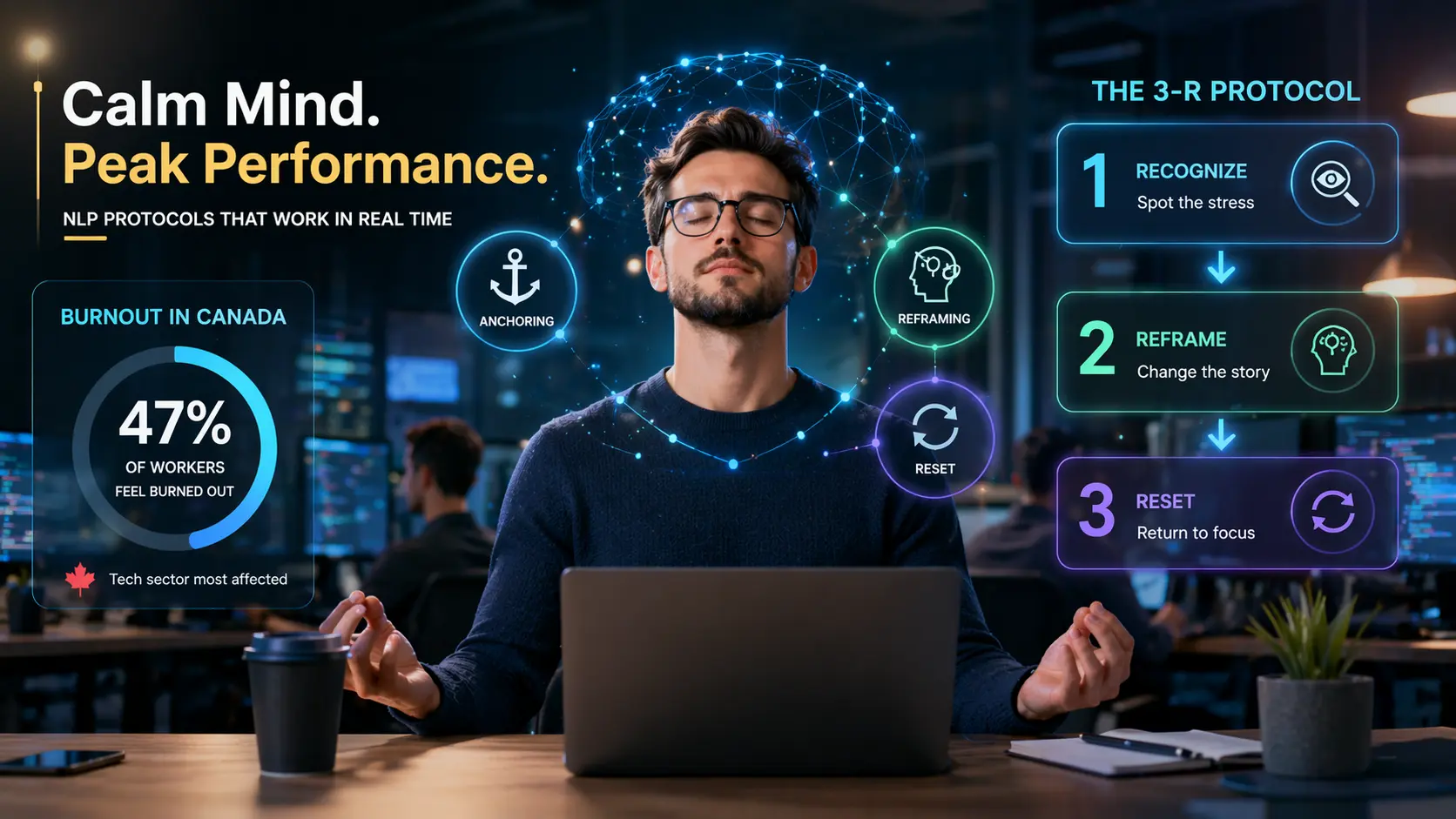
NLP (Neuro-Linguistic Programming) protocols are structured mental techniques designed to quickly shift emotional and cognitive states. In workplace stress management, these protocols help individuals interrupt stress responses, reframe pressure-driven thinking, and return to a focused, high-performance state.
The three most effective NLP protocols for tech teams are anchoring (linking a physical trigger to a calm state), cognitive reframing (changing how stressful situations are interpreted), and pattern interrupts (breaking negative mental loops). For Canadian tech teams, these tools are especially relevant right now, with burnout rates reaching 47% nationally and the tech sector reporting some of the highest exhaustion levels of any industry.
Unlike passive wellness solutions, NLP protocols work in real time, making them practical for fast-paced environments where stress cannot wait until after the sprint.
Key Takeaway:
- NLP protocols provide fast, real-time stress relief for high-pressure environments like tech teams by using simple mental techniques (anchoring, cognitive reframing, pattern interrupts) to interrupt stress responses, shift perspective, and restore focus in seconds without needing to pause work. [1]
- Mechanisms include anchoring (linking a physical trigger like pressing thumb and forefinger to a calm state via repetition), reframing stressful events into useful perspectives, and the 3-R Protocol (Recognize early signals, Reframe meaning, Reset with anchor) to break negative thought loops and lower cortisol. [1]
- Build an anchor by vividly recalling a calm memory and pairing it with a physical cue (repeat 3–5 times); use 3-R during high-stress moments; practice consistently for days; combine with team modeling for better workplace resilience. [2]
- Best for mild-to-moderate stress in high-functioning individuals; does not replace professional therapy for severe mental health issues or structural problems like chronic overload; results appear quickly with practice but work best alongside lifestyle support. [2]
Bottom Line: NLP protocols like anchoring, reframing, and the 3-R system offer practical, seconds-long tools to manage stress in real time, reduce burnout, and improve performance—especially useful for tech teams—when practiced consistently.
What NLP Protocols Actually Mean for Stress Management
NLP protocols are repeatable, structured techniques that actively shift how the brain processes stress in the moment. Unlike traditional approaches that focus on external relaxation after the fact, NLP works on internal language and mental patterns, which is where stress actually originates.

NLP vs. Generic Stress Management: What’s Different
Most stress management tools are designed for recovery. Meditation apps, breathing exercises, and wellness programs all work best when you have time and space to use them. That is not the reality of a tech team managing a production incident at 11 p.m.
NLP protocols are different because they work inside the workflow, not outside it. They are active rather than passive. They take seconds, not sessions. And they target the specific internal patterns that generate stress, rather than simply helping you recover after the fact.
Why Apps Are Not Enough for Tech Teams
The problem with most stress tools in tech environments is that they assume you can pause. You cannot pause a deployment. You cannot step away from a client escalation. You cannot ask a sprint to slow down while you collect yourself.
NLP protocols do not ask you to pause. You can use an anchor during a standup. You can apply a reframe mid-conversation. That is what makes them different from anything else on the market.
The Three Core Protocols Explained Simply
The three NLP protocols most effective for workplace stress are anchoring, cognitive reframing, and pattern interrupts. Anchoring links a physical trigger to a calm emotional state so you can access it on demand. Reframing shifts the meaning you assign to a stressful situation, which changes your emotional response to it. Pattern interrupts break a mental loop before it escalates, stopping rumination before it compounds.
These are not techniques you need hours to learn. With the right guidance, most people build a functional anchor in under ten minutes and feel the effect immediately.
Why Tech Teams in Canada Are Hitting a Wall
Canadian tech teams are experiencing rising burnout driven by sustained cognitive overload, high delivery expectations, and a workplace culture that too often treats stress as part of the job rather than a solvable problem.
The Numbers Behind the Burnout

A March 2025 survey by Robert Half Canada found that 47% of Canadian workers reported feeling burned out, up from 42% in 2024 and 33% in 2023. Statistics Canada puts the scale in sharper relief: more than 4.1 million Canadians, or 21.2% of all employed people in the country, report high or very high levels of work-related stress.
In tech specifically, the situation is more acute. A 2024 sector analysis found that 82% of tech workers report feeling close to burnout, placing the industry among the most affected of any sector. Toronto consistently ranks among the highest-burnout cities globally, with over 700 monthly searches for burnout-related terms.
The Cost of Inaction
This is not just a human problem. It is a business problem. A 2025 national workplace survey by Canada Life found that burnout-related productivity losses can exceed $3.4 million annually for a 500-person company. Organizations that prioritize prevention can save roughly $1.7 million per year by comparison. The math is straightforward. Burnout costs more to ignore than to address.
Cognitive Debt: The Hidden Performance Killer
Unmanaged stress in tech teams works a lot like technical debt. Each stressor that goes unaddressed adds to a growing load that slows output, increases errors, and erodes the quality of decision-making. Eventually, the team that once shipped fast starts missing deadlines, not because their skills have declined, but because their cognitive bandwidth is maxed out. NLP protocols address this at the source.
NLP Anchoring: The Fastest Stress Reset in Tech
NLP anchoring allows individuals to trigger a calm, focused state in seconds using a physical cue they have built in advance. Research on NLP anchoring techniques shows measurable changes in cortisol levels, heart rate variability, and subjective anxiety ratings with consistent use. This is applied neuroscience, not a soft skill.
How Anchoring Works
The principle behind anchoring is straightforward. Your brain already does this naturally. A song from years ago brings back the feeling of that moment instantly. The smell of coffee triggers alertness before you have taken a sip. Anchoring takes this natural mechanism and makes it deliberate.
You associate a specific physical gesture with a strong, calm emotional state by building the association repeatedly. Once the anchor is set, firing that gesture in a moment of stress recalls the calm state it is linked to, quickly and reliably.
Build a Calm Anchor in 5 Steps

Try This: Find a quiet two minutes before your next high-pressure situation and work through these steps.
- Recall a time when you felt genuinely calm and in control. Make the memory as vivid as possible.
- Intensify the feeling by focusing on the sensory details of that moment. What did you see, hear, and feel?
- At the peak of that feeling, press your thumb and forefinger together firmly. That is your anchor.
- Repeat this three to five times over the next two days, always pressing the same fingers at the same peak feeling.
- Test the anchor under mild stress. Press your fingers and notice whether the calm state follows.
Most people notice the effect within the first few uses. The anchor strengthens with repetition.
Where to Use It in Tech Environments
A calm anchor is most useful right before a high-stakes deployment, during a tense standup, before a client escalation call, or in the moment a production incident lands in your lap. You can fire it in two seconds without anyone around you noticing.
Mike L. came to James struggling with constant mental noise and anxiety that was dragging down his workplace performance. After working through NLP techniques, the internal chatter quieted, his confidence rose, and he began showing up assertively at work. The tools gave him something concrete to reach for when his mind started running hot.
For more on building this into your leadership practice, the guide on how to integrate NLP into your daily leadership practice breaks the process down step by step.
Cognitive Reframing: Changing the Story Under Pressure
Cognitive reframing shifts how the brain interprets a stressful situation by changing the meaning assigned to it. When the meaning changes, the emotional response changes with it. This is not about pretending things are fine. It is about accessing a more useful perspective so you can respond instead of react.
How Reframing Works
Stress is rarely about the event itself. It is about the story your brain tells about the event. A failed deployment is not inherently stressful. The story that says “this is a disaster and it reflects on my competence” is what creates the stress response. Reframing targets that story directly.
Research on cognitive reframing consistently shows that it reduces emotional intensity, improves decision-making speed, and increases the ability to think clearly under pressure. These are exactly the capacities tech teams need most when things go wrong.
3 Real-Time Reframes for Tech Teams
Try This: When you catch yourself or a team member in a stress spiral, test one of these shifts.
- “This is overwhelming” becomes “This is solvable in steps.” Break the problem into the next three actions instead of treating it as one large threat.
- “This failure is bad” becomes “This is feedback about where the system is weak.” Every bug reveals something useful.
- “This incident is a disaster” becomes “This is a stress test in production. We are learning where to build resilience.” Context reframing turns reactions into responses.
These are not just positive spins. They are more accurate interpretations that open up better problem-solving. Darren G. came to James feeling blocked despite his genuine ability. The shift that unlocked him was a reframe about what was possible and why he had been held back. Once the meaning changed, his behavior changed with it.
For a deeper look at stress tools that work with NLP and how to combine them in practice, the full guide covers the integration in practical terms.
The 3-R Protocol: A Practical NLP Framework for Tech Leaders
The 3-R Protocol is a structured approach built on James’s 20+ years of NLP methodology that gives tech leaders a repeatable system for managing stress in themselves and their teams. The three steps are Recognize, Reframe, and Reset.

Step 1: Recognize
Before you can manage a stress response, you need to catch it early. This means learning to identify your personal stress signals before they escalate. For some people, it is a tightening in the chest. For others, it is a shift in the quality of their thinking, where decisions start to feel harder and options start to feel fewer. Name the trigger when you notice it. Labeling the stressor reduces its grip immediately.
Step 2: Reframe
Once you have recognized the stress trigger, apply a reframe. Ask yourself: “What is a more useful way to interpret what is happening right now?” This is not about minimizing the problem. It is about approaching it with a perspective that lets you think clearly. A threat mindset closes options. A challenge mindset opens them.
Step 3: Reset
Use your anchor, or another pattern interrupt, to return to a resourceful state before you respond. The reset step is what makes this protocol practical in real time rather than theoretical after the fact.
Used consistently, the 3-R Protocol becomes a reflex. Leaders who model it in front of their teams build cultures where stress is managed rather than accumulated. For teams in Ontario looking for structured support, coaching for tech startups offers more context on how this kind of training applies at the team level.
NLP vs. Traditional Stress Management: Which Works Faster?
NLP protocols are not a replacement for therapy or recovery practices. They fill the gap that those approaches cannot cover: the moment of acute stress when performance is on the line
| Method | Speed | Best Use Case |
|---|---|---|
| Meditation | Slow (20-30 min) | Recovery / end-of-day reset |
| Therapy | Long-term | Deep-seated mental patterns |
| Wellness Apps | Passive | General stress awareness |
| NLP Protocols | Immediate (seconds) | Real-time pressure and high-stakes decisions |
Data & Findings
According to Unleash Your Power’s 2026 Client Performance Report, clients who completed structured NLP training reported measurable improvements across three key areas: clearer thinking under pressure, reduced emotional reactivity in team interactions, and faster recovery after high-stress incidents.
The broader research supports this. Studies on NLP anchoring show measurable changes in cortisol levels, heart rate variability, and subjective anxiety ratings after consistent practice. One technology company that incorporated NLP anchoring into team meetings reported a 30% decrease in workplace conflicts and a 15% improvement in employee satisfaction within the same period.
Among Canadian workers, those in supportive environments lose an average of 27 days per year to mental health challenges. Workers in unsupportive environments lose 55 days. According to Benefits Canada’s 2025 reporting, the gap reflects the compounding cost of unmanaged stress over time, not just individual circumstances.
Who Should Use NLP Protocols for Stress Management?
NLP protocols for stress management are most effective for:
- Tech team leads and engineering managers who need to perform clearly under continuous delivery pressure.
- Individual contributors in sprint-based environments where deadlines are constant and cognitive load is high.
- Founders and startup leaders managing decision fatigue alongside business operations.
- Anyone in a high-stakes role where traditional wellness programs are not accessible or practical during the workday.
If you are functioning at a reasonably high level but finding that stress is creating a ceiling on your performance, NLP protocols are a practical next step. The learning curve is short and the application is immediate.
For those looking to understand NLP techniques for stress management in business before committing to full training, that resource is a solid starting point.
Who Should Approach This Differently?
NLP protocols are not a clinical intervention. If you or someone on your team is experiencing severe burnout, chronic depression, anxiety disorders, or other mental health conditions that require professional support, those needs come first. NLP training complements clinical care but does not replace it.
Similarly, if the stress your team is experiencing comes from structural problems, unrealistic workloads, leadership dysfunction, or a broken culture, protocols alone will not fix the root cause. They give individuals better tools to work within difficult environments. The organizational issues still need to be addressed at that level.
Frequently Asked Questions
What are NLP protocols for stress management in tech teams?
NLP protocols for stress management are structured mental techniques from Neuro-Linguistic Programming that help individuals quickly shift emotional and cognitive states. In tech teams, they are used to reduce stress in real time during high-pressure situations like deployments, incidents, and deadlines. The most common NLP protocols include anchoring, cognitive reframing, and pattern interrupts, which help professionals stay focused, calm, and effective without needing to pause work.
How does NLP help reduce workplace stress in real time?
NLP reduces workplace stress in real time by changing how the brain responds to pressure in the moment. Techniques like anchoring trigger a calm emotional state instantly, while reframing changes the meaning of stressful events so they feel more manageable. Unlike traditional stress management tools that require breaks, NLP works during active work situations, making it especially useful for fast-paced tech environments.
What is the NLP anchoring technique and how does it work?
NLP anchoring is a technique that links a specific physical action, such as pressing two fingers together, to a calm or confident emotional state. Once the connection is created through repetition, the physical trigger can be used to instantly recall that emotional state during stress. This helps tech professionals stay calm and focused during high-pressure tasks like production issues or client escalations.
What is cognitive reframing in NLP and why is it important?
Cognitive reframing in NLP is the process of changing the meaning of a stressful situation to alter the emotional response to it. Instead of viewing a problem as a failure or threat, reframing helps interpret it as feedback, a challenge, or a learning opportunity. This shift improves decision-making, reduces emotional overload, and helps tech professionals think more clearly under pressure.
What is the 3-R Protocol in NLP for stress management?
The 3-R Protocol in NLP stands for Recognize, Reframe, and Reset. First, individuals recognize early signs of stress. Next, they reframe the situation into a more useful perspective. Finally, they reset their emotional state using techniques like anchoring or pattern interrupts. This structured approach helps tech leaders and teams manage stress consistently in real-time work environments.
Build the Resilience Your Team Actually Needs
Canadian tech teams are under real pressure, and most of the tools companies reach for were not built for this environment. Meditation apps and wellness seminars are not designed for the moment a deployment fails or a client escalates. NLP protocols are.
If your team is already experiencing cognitive overload and rising stress levels, structured NLP training gives you a proven path to reset performance, sharpen decision-making under pressure, and build the kind of resilience that holds through whatever the next sprint brings.
NLP training in Canada offers a structured, practical starting point. The techniques are learnable, the results are measurable, and the timing could not be more relevant.
Unleash Your Power: Stand Out, Take Action, and Create the Success You Want.