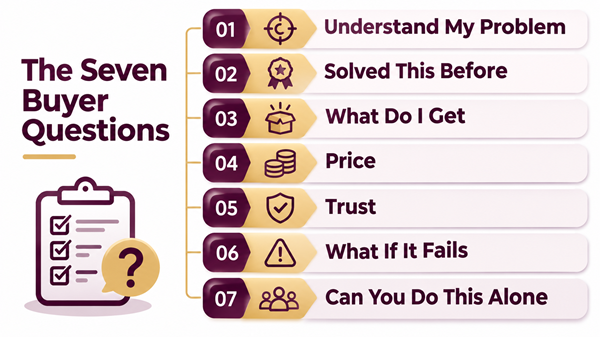
To convert corporate tech experience into a solo consulting firm, translate what you did into answers to the questions buyers ask: do you understand my problem, have you solved it, what exactly do I get, what does it cost, why should I trust you, and what if it fails. Package one narrow offer around a client outcome, price it from your real billable hours, and reach buyers through people who already know your work.
A 2017 UK survey of about 700 executives found that asking colleagues for recommendations and speaking directly with consultants ranked highest. Before you leave, review your employment agreements for non-compete, confidentiality and invention-ownership terms, and consider an employment lawyer’s advice. This is an operating plan, not a guarantee of income, and results build with practice over months.
Key Takeaway:
- Turning corporate tech experience into a solo consulting firm requires translating professional expertise into client-focused solutions. Buyers want to understand the problems you solve, the outcomes you deliver, and why they should trust your approach. Focus on measurable business results rather than job titles or technical credentials.
- The 7-question buyer framework helps position your consulting business: Do you understand my problem? Have you solved it before? What exactly will I get? How much will it cost? Why should I trust you? What if it fails? Can you really do this alone? Answer each question with clear evidence, relevant experience, and practical solutions.
- What to do: Package your expertise into one narrow, outcome-driven consulting offer with a defined scope, timeline, and deliverables. Build anonymized case studies using previous project results, establish pricing based on actual billable hours and client value, and reduce buyer risk through clear milestones and written agreements.
- Finding your first consulting clients depends heavily on relationships and credibility. A 2017 survey of nearly 700 UK executives found that 73% relied on colleague recommendations, 65% reviewed consultants’ websites, and 63% watched conference presentations. Start by reconnecting with former colleagues, managers, vendors, and professional contacts rather than relying only on social media marketing.
- When to be cautious: Review employment agreements before leaving your corporate role, especially non-compete, non-solicitation, confidentiality, and intellectual property clauses. Never reuse company files, customer information, or proprietary work. Also, build a financial runway before transitioning, as early client acquisition and consistent consulting income can take months.
Bottom Line: Your corporate tech experience can become a profitable solo consulting business when you translate expertise into a specific client outcome, demonstrate credibility, and communicate a clear offer. Start with one focused service, validate demand through your existing professional network, and protect your transition with proper legal and financial preparation.
- Source: Unleash Your Power – Convert Corporate Tech Experience into a Solo Consulting Firm
- Source: Consultancy.uk – How Clients Find and Select Consulting Firms
From Employee to Owner: The Gap Nobody Mentions
You’ve shipped systems, led teams and fixed the outage nobody else could. Then you sit down to write a services page, and you freeze. Ten years of experience and you can’t say what you sell.
You’re in a large crowd. MBO Partners’ 2026 report says 74.9 million Americans earn income independently, and almost 6 million earn over $100K a year. That vendor report doesn’t state its method on the page, and “independent” includes occasional gig work, so read it as a sign of scale, not a promise of income.
The fix isn’t more credentials. It’s translation. For a broader view of the business side, read our guide to starting a management consulting business. This article covers how to turn what you did in corporate tech into something a client will pay for.
Pre-Flight: Check Your Agreements First
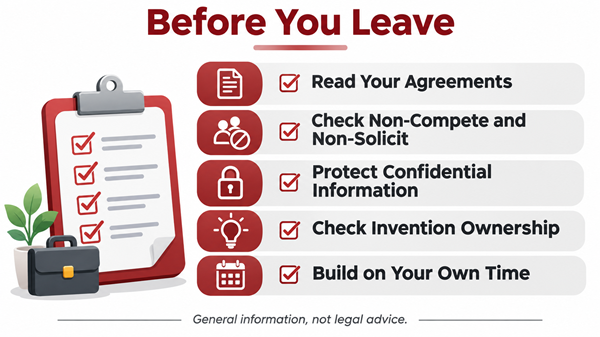
Before you announce anything, read what you signed. This is general information, not legal advice. Rules differ by country, province and state, so talk to an employment or IP lawyer where you live. A US law-firm overview from JD Supra highlights these checkpoints.
- Read your documents. Offer letter, confidentiality agreement, invention assignment, equity plans and handbook. Restrictive terms can hide in bonus and equity paperwork.
- Non-competes and non-solicits. Enforceability varies. Some US states enforce reasonable limits, while California generally voids employee non-competes. Non-solicits can cover employees and contractors.
- Confidential information. Pricing, customer lists, source code and product plans cause most disputes. Don’t copy files, forward emails or keep credentials.
- Invention ownership. Many agreements assign work done within your role to the company. Check what counts.
- Build cleanly. Use your own equipment and time, and keep a dated log of what you built and which public sources you used.
The 7-Question Buyer Framework
Buyers rarely say these questions out loud, but they decide on them. Work through each one and write your answer in plain language. By the end, you’ll have the bones of a website, a pitch and a first offer.
Question 1: Do You Understand My Problem
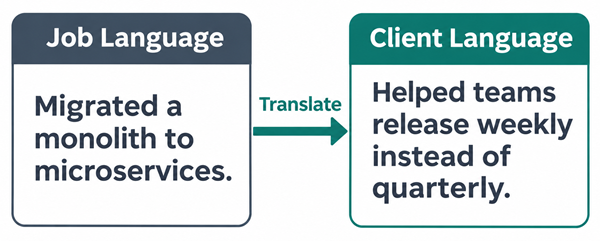
Clients don’t buy architecture. They buy fewer delays, lower costs and fewer surprises. Take three lines from your resume and rewrite each as a client problem followed by an outcome. “Migrated a monolith to microservices” becomes “helped product teams release weekly instead of quarterly.” Use the client’s words, not your team’s jargon.
Question 2: Have You Solved This Before
You need proof, but you can’t breach confidentiality to show it. Describe the pattern, not the company: the size of team, the kind of problem, the approach and the result, with names and internal figures removed. Add public proof where you can, such as talks, writing, open-source work or certifications. Keep a proof file with the situation, your action and the result for each project.
Question 3: What Exactly Will I Get
Choose one narrow offer. Three common shapes are a fixed-scope assessment, a time-boxed sprint and a monthly advisory. Write it as one sentence: “I help [who] achieve [outcome] in [time] through [method].” For example, “I help mid-size software teams cut cloud costs in six weeks with an audit and a prioritized fix plan.” That example is illustrative, not a recommended niche.
Question 4: How Much, and Why
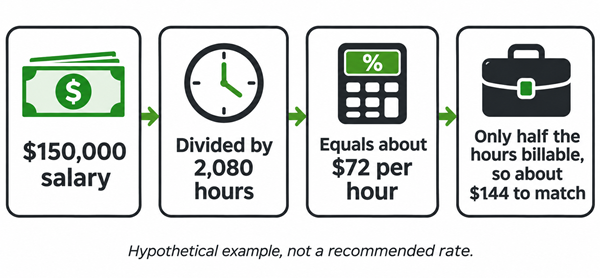
Start with honest math. Take a hypothetical $150,000 salary over 2,080 working hours: about $72 an hour. As a consultant, you won’t bill every hour, since sales, admin and gaps take time. If half your hours are billable, you’d need about $144 an hour just to match that salary, before benefits, taxes and business costs. That figure is an illustration, not a rate to copy.
Then price on the value of the outcome, not just your time. A fixed fee tied to a clear result is easier for a buyer to approve. For a general view of rules of thumb such as savings and bid buffers, Dice’s contractor guide offers some, though it cites little data. Talk to an accountant about taxes and structure in your location.
Question 5: Why Should I Trust You
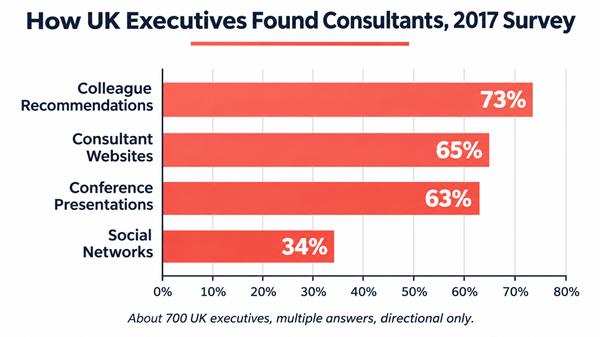
Look at how buyers find consultants. A 2017 survey of almost 700 UK executives involved in hiring consulting firms found that 73% asked colleagues for recommendations, 65% read consultants’ websites, 63% watched conference presentations and 34% used social networks like LinkedIn and Facebook. Nearly three-quarters spoke with consultants directly. The sample was UK-only, the fieldwork date wasn’t stated, and respondents could choose several answers, so treat these as directional.
The practical takeaway: people and proof come before posting. Tell your former colleagues, managers and vendors exactly what you now do. Our guides to mastering referral marketing and building your business network show how.
Question 6: What If It Fails
Buyers worry about risk. Reduce it with a clear scope, defined milestones, written acceptance criteria and a simple way to change the plan. Avoid promising results you don’t control. Have a lawyer review your contract template before your first signature.
Question 7: Can You Really Do This Alone
This one is internal. Many people lose confidence when the company title disappears. NLP trainers like James R. Elliot suggest chunking up: what did that title give me, and what else could give me that now? The answer is often credibility, structure or belonging, and you can rebuild each on purpose.
Mike L. came to James struggling with self-doubt and second-guessing, and later said his confidence and career direction had changed. He isn’t a consultant, but the pattern is common, and Confident Communication is one of the five pillars James teaches. See our posts on NLP for entrepreneurs and the entrepreneurial mindset through NLP for exercises. Results build with practice, usually over three to six months.
| WANT HELP SHAPING YOUR FIRST OFFER?Bring your seven answers to a short call and sharpen your offer together. Book a 30-minute connection call. |
Corporate Asset to Client Proof
Use this table to turn what you did into proof a client can use, and to check the confidentiality risk of each. It’s a starting point, not legal advice.
| Corporate asset | Client-facing proof | Confidentiality check |
| Led a platform migration | A repeatable approach to reducing downtime during moves | Don’t name internal systems or customers |
| Chose vendors | A reusable comparison framework | Remove internal pricing and contract terms |
| Led a team | A handoff and onboarding method | Don’t mention individuals |
| Ran incident response | A runbook structure anyone can adapt | Use a generic version, not internal procedures |
| Cut costs | A method for finding waste | Don’t use internal figures without permission |
Who Should Use This
- Senior tech professionals who can name a specific problem they solve well.
- People with a few colleagues or clients who would vouch for their work.
- Anyone with savings to cover a slow first few months and a reviewed set of employment agreements.
Who Should Avoid This
- Anyone who hasn’t reviewed their non-compete, confidentiality and invention terms.
- People who need steady income right away with no savings cushion.
- Anyone expecting clients to arrive without outreach. Most early work comes from people who already know you.
Data & Findings
Here is what the sources show and where they fall short. We found no study testing this framework, so treat it as a practical approach.
- Buyer survey (2017): Almost 700 UK corporate executives who hire consulting firms. 73% asked colleagues for recommendations, 65% read consultants’ websites, 63% watched conference presentations, 34% used social networks. There was no stated margin of error, the date of fieldwork wasn’t given, and the publisher is itself a source buyers use.
- MBO Partners (2026): 74.9 million Americans earn income independently, and almost 6 million earn over $100K. It’s a vendor report with no method stated on the page.
- Legal overview: A US law-firm summary advises reviewing agreements first, notes that non-compete rules vary by state, and warns against copying files or building on company time. It’s general commentary, not legal advice.
- Practical guide: Dice’s contractor guide offers rules of thumb with almost no cited data, from a recruiting-driven site.
FAQs
Can I consult for my former employer’s competitors?
It depends on your agreements and where you live. Non-competes, non-solicits and confidentiality terms all matter, so have an employment lawyer review them before you start.
How much should I charge as a solo consultant?
There’s no universal rate. Start with the math on your real billable hours, then price on the value of the outcome, and test your pricing with your first few clients.
How do I get my first client?
Start with people who have seen your work. In the buyer survey we cite, recommendations from colleagues were among the most common ways buyers found consultants, though it’s an older UK sample.
Do I need a niche?
A narrow offer is easier to explain and to refer, but we found no study proving it works better. Treat it as a practical choice and adjust after your first projects.
How long does it take to build a consulting firm?
It varies widely. Plan a savings runway for a slow start, and expect confidence and pipeline to build over months of consistent practice.
Conclusion
Your corporate tech experience isn’t wasted. It needs translating into answers a buyer can trust. Check your agreements, write your seven answers and take decisive action on one small step this week. For help with the mindset side, see our page on working with a career life coach, or book a 30-minute connection call.
Unleash Your Power: Stand Out, Take Action, and Create the Success You Want.