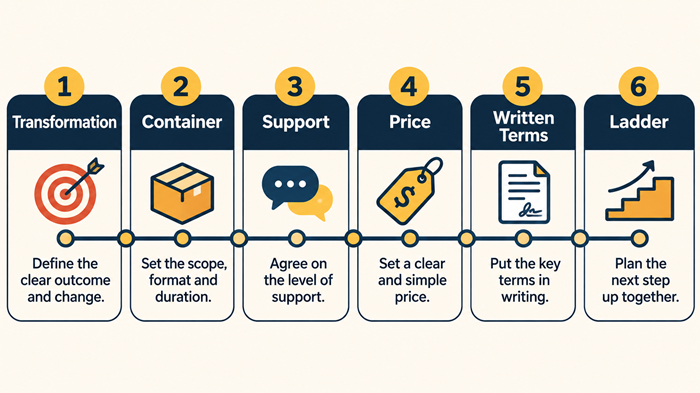
A high-ticket coaching package is a multi-month program built around one clear transformation and priced as a whole, not by the hour. Canadian life coaches can build one in six steps: choose the transformation, define the container, add real support, set the price in Canadian dollars, put the terms in writing, and map an entry and upgrade path. The ICF’s 2023 study put the average coaching hour at about $272 in North America, so the per-session math is a starting point, not a ceiling.
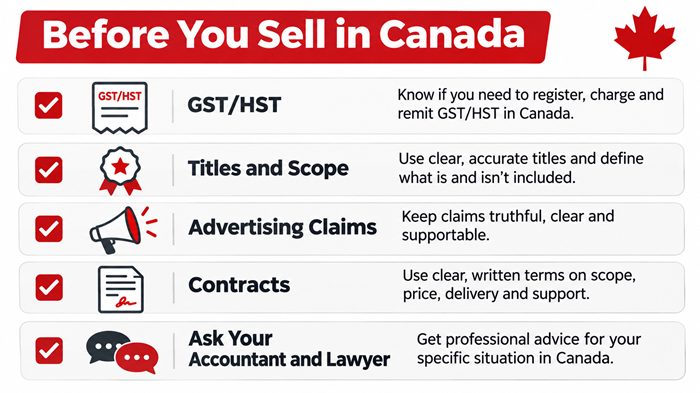
Before you sell, check the Canadian rules: GST/HST registration once taxable sales pass $30,000 over four calendar quarters, Ontario’s protected title and controlled act of psychotherapy, and Competition Act limits on performance claims. This is general information, not tax or legal advice, so confirm details with an accountant and a lawyer.
Key Takeaway:
- A high-ticket coaching package is a multi-month, outcome-focused program built around one clear client transformation and priced as a complete service rather than individual sessions. The value comes from the result, structured delivery, and ongoing support, not simply the number of coaching hours. [1]
- The six-step blueprint: Define one specific transformation, establish the program duration and session structure, add consistent between-session support, calculate a sustainable price in Canadian dollars, document payment and cancellation terms, and create entry, core, and premium offers. [1]
- Pricing strategy: Calculate your delivery capacity, operating costs, preparation time, and desired income before setting the package fee. A worked example in the article uses a 16-week program priced at $4,800 CAD, with entry and premium options at $350 and $7,200 CAD. These are illustrative figures, not industry benchmarks. [1]
- Canadian compliance matters: Monitor the CRA’s $30,000 taxable-sales threshold over four consecutive calendar quarters for GST/HST registration. Ontario coaches should understand protected professional titles and psychotherapy scope restrictions. Keep advertising claims truthful, avoid guaranteed outcomes, and have a lawyer review contracts and cancellation policies. [1]
- When to package or wait: Build a high-ticket offer when you can identify your ideal client, describe a proven transformation, and consistently deliver the promised support. If your offer is still untested or your target audience is unclear, start with a smaller paid session to validate demand before creating a premium program. [1]
Bottom Line: A successful high-ticket coaching package turns individual sessions into a structured, transformation-focused service with clear pricing, defined support, and written terms. Canadian life coaches should validate their offer, build a sustainable delivery model, and check tax, legal, and advertising requirements before selling.
What “High-Ticket” Actually Means
If you’ve been selling sessions one at a time, you’ve probably felt the ceiling. An hour of your time only stretches so far, and clients who buy one session at a time can also leave one session at a time. If you’re still setting up the business itself, start with our guide to starting a coaching business in Canada.
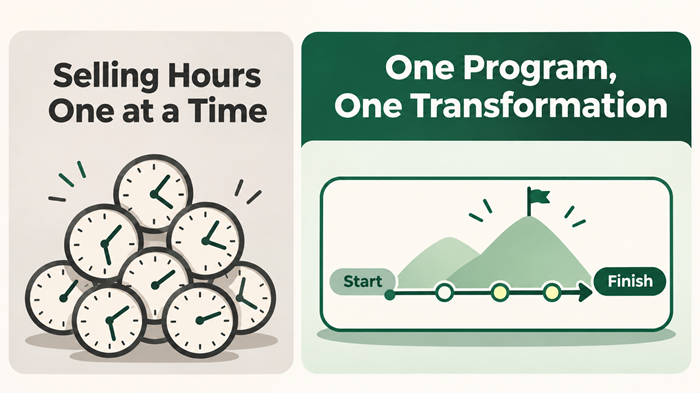
No official line separates a regular package from a high-ticket one. Here, high-ticket means a multi-month, outcome-focused program priced as a whole, where the client buys a result and the support to reach it, not a stack of hours. For a wider look at what coaches earn, see our guide to life coaching income and earnings.
The ICF’s 2023 Global Coaching Study reports an average fee of $272 per coaching hour in North America and an average coaching income of $67,800 there. Both are averages across every kind of coach, reported in US dollars, from data gathered in late 2022. As plain arithmetic, 12 weekly sessions at $272 comes to $3,264. Treat that as a reference point, not a recommended price. Your own capacity and the result you deliver matter more than any average.
Meet Maya: Our Worked Example
To keep this concrete, we’ll build one program for Maya, a made-up career-transition coach in Calgary. She isn’t a real client, and her numbers are illustrations, not benchmarks or recommended prices. She sells single sessions today and wants to move to a program.
Watch for the shaded box after each step. It shows how that step shapes her offer.
The Blueprint: Six Build Steps
Step 1: Choose One Transformation
A package sells when the client can say what changes. Pick one transformation for one kind of client, and state it the way they would. NLP trainers like James R. Elliot use the well-formed outcome for this: state it positively, make it observable, and keep it within the client’s control. If a prospect can’t repeat it to a friend in one sentence, it’s too fuzzy.
| MAYA’S BUILD: TRANSFORMATION Help mid-career professionals in Calgary move from a role they’ve outgrown toward work they chose on purpose, using a plan, practice and accountability over four months. No promise of a particular job. |
Step 2: Define the Container
The container is the shape of the program: how long it runs, how often you meet, and what marks the start and finish. A clear end helps clients commit and helps you plan your capacity. Results don’t arrive on a fixed schedule, so set expectations honestly. Our post on why success timelines matter in coaching explains why.
| MAYA’S BUILD: CONTAINER 16 weeks. Twelve weekly 60-minute sessions, with the first as a kickoff, then two check-ins in weeks 14 and 16. Fourteen sessions in total. |
Step 3: Add the Support Layer
Between sessions is where many clients stall. Decide what support you can deliver every time: a message channel with a stated reply time, a worksheet after each session, a short recording of a key exercise. Add only what you can keep up for every client at once. Daniel Nagel, who works with James through mentorship, values how available and approachable he is when challenges arise. That kind of access is part of what a client is buying.
| MAYA’S BUILD: SUPPORT A message channel with a reply within one business day, plus a one-page worksheet after every session. |
Step 4: Set the Price in Canadian Dollars
Start with capacity. Say you want to coach eight program clients at a time, and each one takes about 14 sessions plus preparation and messaging. Work out your hours, then your costs, then the income you need, and see what price makes that possible. Then test the price against the result, not only the hours. If the change you help create is worth far more to the client than the fee, the price is easier to stand behind.
State the fee in Canadian dollars and say whether tax is included. If you’re registered for GST/HST, you add it to taxable services on top of your fee, so quote “plus applicable GST/HST” to avoid surprises.
| MAYA’S BUILD: PRICE The core program is $4,800 CAD plus applicable GST/HST, a figure chosen for this example. Across 14 sessions that’s about $343 CAD per session. The ICF average is in US dollars, so the two aren’t a direct comparison. |
Step 5: Put the Terms in Writing
A clear agreement protects both of you. Cover what’s included and excluded, the payment schedule, how cancellations and missed sessions work, and what happens if either side ends early. Provincial consumer-protection and contract rules differ, so have a lawyer review your agreement before you use it.
Write your offer page with the Competition Bureau’s guidance in mind. It says performance claims need adequate and proper testing before they’re made, and that the general impression of an ad counts, not only the fine print. For a coach, a sensible habit is to describe your process and what clients can expect, and to avoid guaranteeing results.
| MAYA’S BUILD: TERMS Payment in full or four monthly instalments. One reschedule per session with 24 hours’ notice. A plain statement that coaching isn’t therapy and that no job outcome is guaranteed. |
Step 6: Build the Ladder
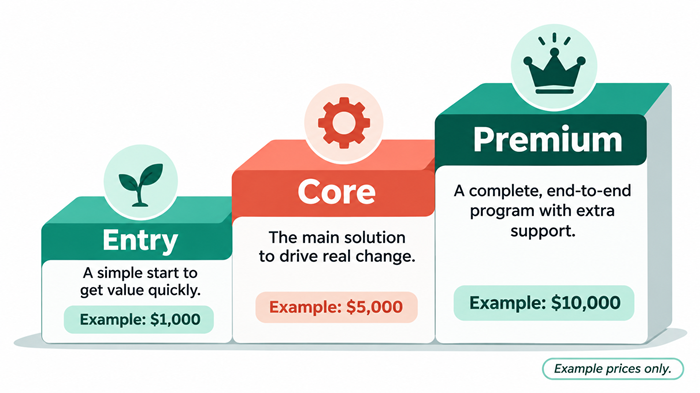
One offer leaves some clients with nowhere to start and others with nowhere to go. A ladder fixes both: a small paid first step, the core program, and a premium option for clients who want more access. Geoff G. took introductory NLP sessions with James and came away with concrete skills, including how to read body language and choose wording. A first step like that lets a prospect experience your method before they commit. For ways to bring people to that first step, see our guide on promoting your life coaching business.
| Tier | What’s included | Example price (CAD, plus applicable GST/HST) | Role |
| Entry: Career Clarity Session | One 90-minute session and a written action plan | $350 | Lets prospects try the method |
| Core: Career Pivot Program | 16 weeks, 14 sessions, message support and worksheets | $4,800 | Main offer |
| Premium: Pivot Plus | Core program plus four extra sessions and priority replies | $7,200 | For clients who want more access |
These are example prices for Maya, not benchmarks.
| NEED A SECOND SET OF EYES ON YOUR OFFER? Bring your draft to a 30-minute connection call and we’ll look at it together. |
The Canadian Layer: Check These Before You Sell
This section is general information, not tax or legal advice. Rules change and your situation is specific, so confirm each point with an accountant or lawyer.
- GST/HST registration. The CRA says you’re required to register when your gross taxable sales exceed $30,000 over the last four consecutive calendar quarters. You can also register voluntarily, which lets you claim input tax credits on business purchases. A handful of program sales can approach that line, so plan before you launch.
- The psychotherapy and counselling exemption. Since June 20, 2024, the CRA reports, certain licensed psychotherapists and counselling therapists no longer collect GST/HST on services within their scope of practice. The page doesn’t mention life coaching, so don’t assume it applies to you. Ask your accountant. Quebec providers are directed to Revenu Québec.
- Titles and scope in Ontario. CRPO says only members of certain regulated professions may use the title “psychotherapist” in Ontario, and that psychotherapy is a controlled act. Some tools and techniques are in the public domain, and CRPO offers a self-assessment tool. Keep your titles and offer wording clearly about coaching, and review your practice against that tool.
- Advertising claims. The Competition Bureau says claims need testing first, the overall impression counts, testimonials follow the same rules, and material connections such as payment or free services need clear disclosure. Don’t promise results, and disclose any connection.
- Contracts and consumer rules. Provincial rules vary, so ask a lawyer to check your cancellation and refund terms. If you’re weighing credentials alongside pricing, see our guide to life coaching certification in Canada.
A Weak Offer and a Strong One, Side by Side
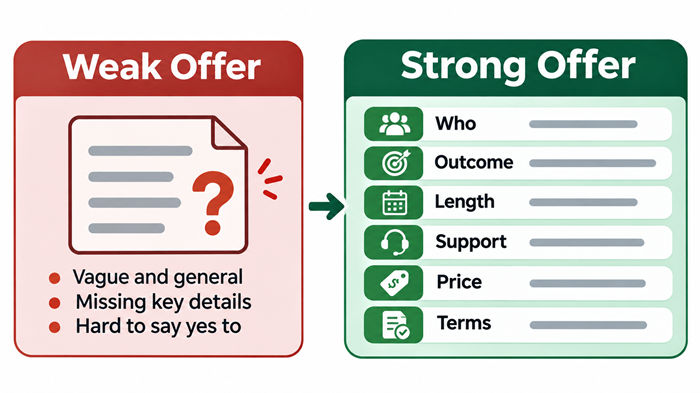
Same coach, same program, two ways to write it.
| WEAK OFFER Life Transformation Package. Unlimited support, amazing results and guaranteed breakthroughs. Message me for pricing. |
It names no client, states no outcome, has no container or price, and makes a guarantee nobody can honestly give.
| STRONG OFFER Career Pivot Program. For mid-career professionals in Calgary who have outgrown their role. Sixteen weeks, 14 one-on-one sessions, a one-business-day reply channel and a worksheet after each session. You leave with a clear target role, a tested story and an action plan. $4,800 CAD plus applicable GST/HST, or four monthly installments. Coaching isn’t therapy, and no job outcome is guaranteed. |
Who Should Package Now, and Who Should Wait
Package now if you can name one result you’ve helped clients reach, you can serve the number of clients you plan for, and you can describe your process in plain language.
Wait if you’re still testing what you offer, you can’t yet say who your best client is, or cash pressure would push you to discount on the first call. Run the entry session first and learn what clients ask for.
Frequently Asked Questions
What counts as a high-ticket coaching package?
There’s no official definition. In this guide it means a multi-month program built on one transformation and priced as a whole, not a set of hourly sessions.
How much should a Canadian life coach charge for a package?
There’s no single right number. The ICF’s 2023 study reports North American averages in US dollars across every type of coach. Work from your capacity, your costs and the result you deliver, then test the price with real prospects.
Do I charge GST/HST on coaching?
You’re required to register once taxable sales exceed $30,000 over four consecutive calendar quarters, and you would then charge it on taxable services. Whether your services are taxable or exempt depends on your situation. The CRA’s psychotherapy exemption covers certain licensed practitioners, and its page doesn’t mention life coaching, so confirm with an accountant.
Can I offer payment plans?
Many coaches do. Put the schedule and what happens after a missed payment in your written agreement. If you add interest or fees, ask a lawyer first.
How long should a coaching package run?
Let the transformation set the length, not the price. Sketch the milestones your client needs to reach, estimate the time each takes, and add a margin for real life. Results build with practice, so avoid promising a fixed outcome by a fixed date.
Package Build Sheet
| COPY THIS INTO YOUR OWN DOCUMENTTransformation (one sentence, in the client’s words): ______________________Client: ______________________Container: ____ weeks, ____ sessions Support: ______________________Price: $______ CAD plus applicable GST/HST Payment options: ______________________Agreement reviewed by a lawyer: yes / no GST/HST status confirmed with an accountant: yes / no Offer wording checked for guarantees: yes / no |
Conclusion
A package turns a pile of hours into one clear offer. Choose a transformation, build the container, set a price you can stand behind, and check the Canadian rules before you sell. Take decisive action on one offer this month. When you’d like help shaping yours, book a 30-minute connection call.