

Decouple your identity before selling and you separate who you are from what you own, years before a buyer ever sees your numbers. It matters for two reasons most owners discover too late.
First, identity fusion doesn’t stay psychological. It shows up inside the business as owner dependence: relationships held in your name, decisions only you make, expertise stored in your head and nowhere else. Buyers and appraisers price that as risk, and they discount it.
Second, the fusion you never dismantled is waiting for you the Monday after closing, when the calendar is empty and the identity that used to fill it has been sold. The work itself is structural, not sentimental.
You cut what only exists because you’re the one doing it, move authority from your name to the business’s name, and rewire the programming that keeps pulling the work back. That takes years, not the ninety days before a deal. Start early and you sell from choice instead of exhaustion.
Key Takeaway:
- Decoupling your identity before selling means separating who you are from the business you own. When your client relationships, expertise, and decisions depend entirely on you, buyers see owner dependency as a risk that can reduce business valuation and limit potential buyers. [1]
- Why founder identity fusion matters: Years of building a business can make it central to your identity, making it difficult to delegate, relinquish control, or prepare for life after an exit. This attachment can persist after closing, even when the financial outcome is successful. [1]
- How to reduce owner dependency: Document your expertise, build repeatable operating systems, delegate client delivery, and transfer relationships and decision-making authority to your team. Test your business by taking two consecutive weeks off without calls or emails to identify where operations still depend on you. [1]
- Prepare your personal identity alongside your business: Define what you want life to look like after a potential sale, develop interests and relationships beyond work, and address the habits that pull you back into every decision. A successful exit requires personal preparation as well as financial and operational readiness. [1]
- Start three to five years before a potential sale whenever possible. Building transferable systems and reducing founder dependence takes time; trying to reverse entrenched dependencies during the final 90 days is unlikely to deliver the same results. Solo practitioners should first document and productize their methods and build delivery support. [1]
Bottom Line: Your business becomes more transferable when its value lives in systems, people, and processes rather than in your constant presence. Start decoupling your identity early to reduce owner dependency, strengthen exit readiness, and build a business you can sell, keep, or step away from without losing your sense of purpose.
What does it mean to de-couple your identity before selling?
It means the business stops being the answer to “who are you?” and goes back to being something you own.

Right now, for most coaches, consultants and practitioners, those two things are the same thing. Your name is on the proposals. The best clients only take calls from you. Your team is loyal to you personally rather than to the company. That isn’t ego. It’s what happens when one person builds something from nothing over a decade.
Researchers call this entrepreneurial identity, and the work on it is clear: the venture stops being a role you perform and becomes part of how you define yourself. When that identity is threatened or altered, it triggers stress and grief that has nothing to do with the financial logic of the deal.
Decoupling is the deliberate reversal. You keep the expertise. You keep the standards. You stop being the load-bearing wall. And you find out who you are when the business isn’t in the room, while you still have time to like the answer.
Why is founder attachment a neurological problem, not a sentimental one?
Because it’s measurable in the brain, not just in the feelings.
A study published in the Journal of Business Venturing scanned 42 people: 21 founders shown images of their own venture, and 21 parents shown images of their own child. The finding: venture bonding is real, and it can be traced in specific brain regions. Founders responded to their own company differently from how they responded to a company they merely knew about.
Sit with that for a second. Your nervous system has categorised this business as yours in the deep sense of the word. That’s not a character flaw to apologise for. It’s the same attachment that made you answer the phone at 11 pm for nine years straight when a reasonable person would have let it ring.
But an attachment your brain built on purpose does not dissolve because a lawyer scheduled a closing date. That’s why “I’ll deal with the emotional side later” fails. You’re not managing a mood. You’re unwinding wiring.
How does identity fusion lower your exit price?
Directly, and in a line item buyers can name.
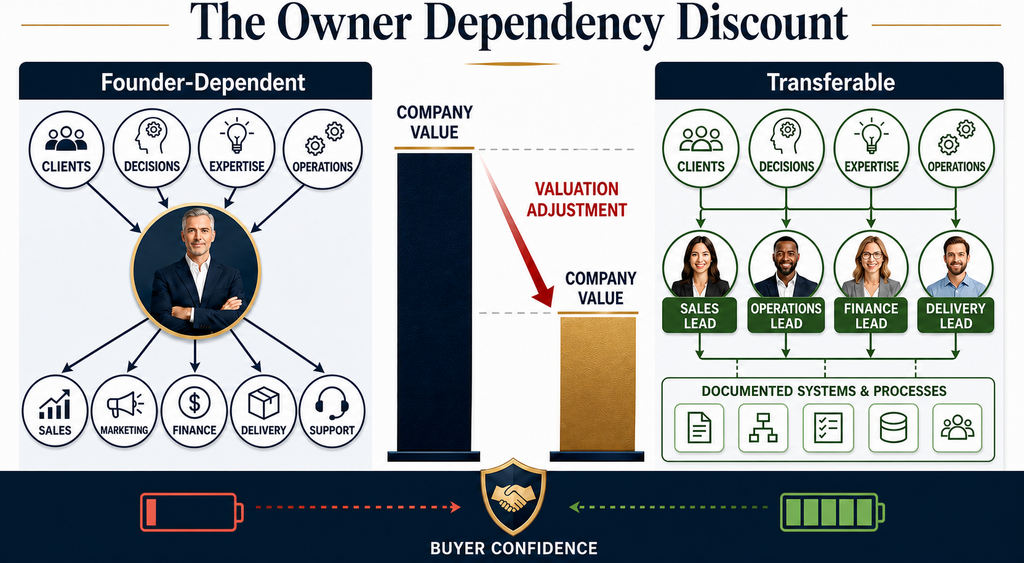
When the revenue, the relationships and the decisions all run through one person, appraisers apply an owner dependency adjustment. Practitioners put the typical range at 10% to 40% of enterprise value, climbing higher when it stacks with other risks like customer concentration. The related key person discount has long been framed at roughly 10% to 25%, and heavy dependence also shrinks the pool of buyers willing to look at it all.
Here’s the part nobody says out loud. Buyers aren’t discounting your business. They’re discounting you specifically, the part of the value that walks out the door when you do.
Take David (name changed). Brilliant at the work and completely trapped by it. Everything ran through him. He spent thirty days getting his expertise out of his head and onto paper; his assistant took over most of his inbox, and he took his first real two-week holiday in five years. Revenue went up while he was gone.
First two-week holiday in five years, and the business grew while he was gone. That’s what happens when your expertise stops living in your head.
That’s not a lifestyle win. That’s a diligence answer. And it usually starts with the warning signs that your systems are failing long before a buyer ever asks.
Why do most owners regret selling within a year?
Because they prepared the business and forgot to prepare the person.
Roughly 75% of owners report profound regret within a year of selling, according to widely cited Exit Planning Institute and PwC research. The same reporting notes that only 44% of owners felt they had planned enough and the gap was emotional, not financial.
One founder-CEO described it plainly after selling his software company: he hit the number, the wire cleared, and the following Monday he had no picture of what he wanted his life to look like. The business was ready. He wasn’t.
Notice what’s missing from that story. Price. The regret didn’t come from a bad deal. It came from a good deal landing on someone who had no idea who they’d be on the other side of it.
What are the signs your identity is still fused with your business?
The signs are behavioural, not emotional. You won’t feel fused. You’ll feel busy.
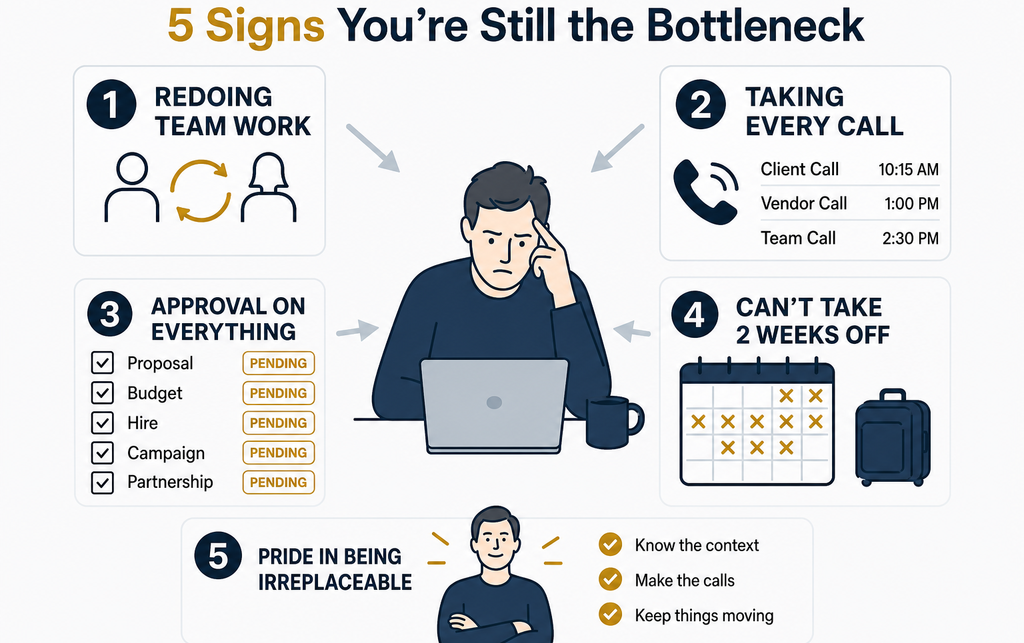
- You hand off a client, then take the next call yourself “just this once.”
- You redo your team’s work at 11 pm and file it under standards.
- Something tightens when a team member closes a deal you weren’t in.
- Nobody makes a real decision without checking, and you’ve stopped noticing.
- You can’t take two consecutive weeks off without a plan for the emergency you’re certain will happen.
Now the uncomfortable one. Some part of you is proud of being the person who can’t be replaced. That pride is the discount.
I say that with total affection, because I was worse. My fifth business had me at 80-hour weeks and on anxiety medication while I told everyone I was crushing my goals. I had built something nobody could have bought, because the only real asset was me. Then my niece asked why I don’t visit anymore. That was the moment, and it had nothing to do with a spreadsheet.
If any of that landed, it’s worth learning to spot the programming actually running the decision rather than negotiating with the symptom.
Can’t you handle the emotional side after the sale?
You can. It just costs you twice.
The standard order is: get the business in shape, then sort yourself out afterwards. That order is backwards, and it’s expensive in two directions. By the time you’re in diligence, the dependence is already priced into the offer; you can’t systemise your way out of it in ninety days while also running a deal process.
And grief has no leverage. Doing this work after closing means processing a loss you can no longer act on. Doing it three years earlier means each step makes the business more valuable and makes you less dependent on it. Same work, wildly different position.
A deal process also runs nine to twelve months of relentless decisions, which is a brutal time to learn how to decide faster without second-guessing yourself.
How do you de-couple without losing the drive that built it?
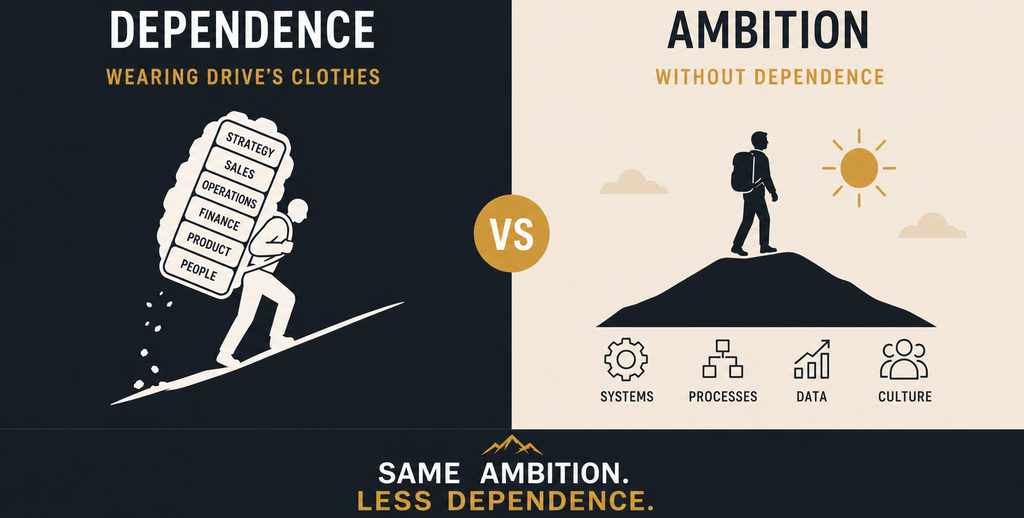
By understanding that fusion isn’t drive. It’s dependence wearing drive’s clothes.
The fear is reasonable: if I stop being the guy, do I stop being hungry? The research points the other way. A comparative study of entrepreneurs approaching exit, with an average business tenure of eleven years, found that identity diversification and social support were what eased the transition, and that financial success alone didn’t guarantee wellbeing afterwards. Having more than one answer to “who am I” is a stabiliser, not a sedative.
Marcus (name changed) had an impressive business, a real team, genuine respect in his market. And he was miserable. He went from twenty clients to nine premium ones, and his hours dropped from sixty a week to thirty. Revenue went up.
Twenty clients down to nine. Sixty hours down to thirty. Revenue up. Same man, different mountain.
He didn’t lose his edge. He stopped spending it on work that only existed because he was willing to do it. These days I’m home for dinner with my phone in another room, and I take a 36-minute nap without negotiating with myself about it. The ambition didn’t go anywhere. It just stopped eating the week.
How long does de-coupling actually take?
Longer than a deal, which is exactly why it has to start before one.
Practitioners generally put a well-executed transition at three to five years of coordinated work, and the same reporting on Exit Planning Institute research notes that around 80% of the average owner’s net worth sits inside the business itself.
The odds explain the urgency. Exit Planning Institute research finds that only 20% to 30% of businesses that go to market actually sell, while 51% of the US business market is Boomer-owned and transitioning within a decade. A wave of sellers, a limited pool of buyers, and a discount waiting for anyone who is still the business.
If you’re three years out, you have time to fix this properly. If you’re three months out, you have time to fix your expectations.
Who Should Use This?
- Coaches, consultants and wellness practitioners with a team, a client base and roots people who built something real and are now the ceiling on it.
- Owners three to five years from a possible sale who want the option to sell, not an obligation to.
- Anyone who has quietly realised the business runs on their presence rather than their systems, and would like that to stop being true.
- Owners who don’t want to sell at all, but want the business to be sellable, because sellable and enjoyable turn out to be the same build.
Who Should Avoid This?
- Anyone mid-diligence hoping to reverse a dependency discount in a few weeks. The work is real; the timeline isn’t negotiable.
- Solo practitioners whose business is entirely them delivering the work. There’s no transferable asset yet; decoupling is how you create one, so start there instead of with a valuation.
- Owners who want the identity work as therapy without the structural change. Insight without systems just makes the same prison more self-aware.
- Anyone looking for deal structuring, tax strategy or a broker. That’s a different professional, and you should hire one.
Comparison: The Fused Owner vs. The De-Coupled Owner
Same revenue, same market, radically different outcome. The difference isn’t effort. It’s where the value lives.
| Particulars | Fused Owner | Decoupled Owner |
|---|---|---|
| Where authority lives | In your name and your inbox | In the company’s name, systems and team |
| Two weeks fully off | Something breaks, or nothing moves | Business runs; some weeks it grows |
| How buyers price it | Dependency and key person risk adjustments | Fewer risk adjustments, stronger multiple |
| Deal terms | Longer earnouts, holdbacks, extended handover | Cleaner terms, more negotiating leverage |
| The Monday after closing | Empty calendar, borrowed identity gone | A life that already existed before the sale |
| Typical week | 50–60+ hours, always on | 25–35 hours, phone in another room |
Data & Findings
Founder attachment is physically measurable. An fMRI study of 42 subjects 21 entrepreneurs and 21 parents published in the Journal of Business Venturing found that venture bonding is a real phenomenon traceable in brain regions, not merely a metaphor.
Regret is the base rate, not the exception. Around 75% of owners report profound regret within twelve months of selling, with only 44% feeling they had planned adequately, a gap driven by emotional rather than financial preparation.
Dependence carries a priced discount. Owner dependency adjustments commonly run 10% to 40% of enterprise value, with key person discounts historically framed around 10% to 25%.
Most businesses never actually sell. Exit Planning Institute research puts completion at 20% to 30% of businesses that go to market, against 51% of the US market transitioning within ten years.
Diversified identity predicts better transitions. A study of entrepreneurs nearing retirement, averaging eleven years in business, found identity diversification and social support eased the shift, and that financial success alone didn’t secure wellbeing afterwards.
The De-Coupling Sequence: The 5 Shifts to Freedom, Applied to an Exit
This is the same method we use to get owners out of 60-hour weeks, pointed at a transaction. It works because of its mechanism: The 3 Pillars: Performance Psychology to rewire the unconscious programming that keeps pulling the work back,
Freedom-First Business Strategy to cut the 80% that only exists because you’ll do it, and Freedom-First Business Structure to rebuild operations so you’re not the bottleneck. Strategy without psychology is another unfinished course. Mindset without systems is a prettier prison.
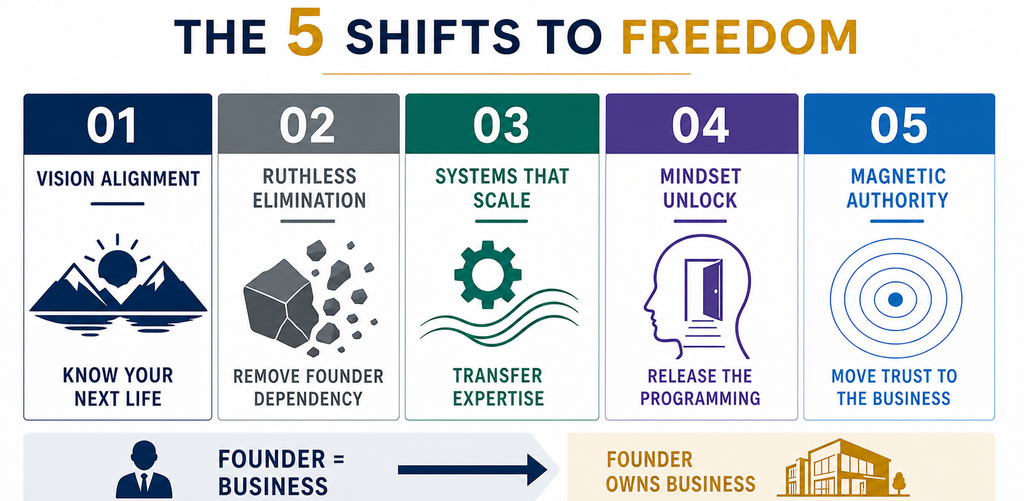
Vision Alignment
Decide who you are after, before you decide what it’s worth. Write the ordinary Tuesday you want two years post-sale, in detail: who’s in it, what you do at 10 am. If you can’t fill the page, the business isn’t your asset. It’s your scaffolding.
Ruthless Elimination
List every activity in your week and mark the ones that exist only because you’re willing to do them. Those aren’t your standards. They’re your dependency, and they’re not in the valuation.
Systems That Scale
Get your expertise out of your head and into documents someone else can execute from. This is where structure and systems convert your judgement into a transferable asset. If it isn’t written down, a buyer can’t buy it.
Mindset Unlock
Dismantle the programming underneath the pattern. You can’t delegate what your unconscious won’t release, which is precisely why the last assistant didn’t fix it and the one before that didn’t either.
Magnetic Authority
Move authority from your name to the business’s name. Let the team present. Publish under the company. Introduce a second face to your best clients while you’re still in the room to make it safe.
Frequently Asked Questions
Does de-coupling my identity mean I have to sell my business?
No. It means you get the option. A business that runs without you is worth more to a buyer and worth more to you if you keep it, because the version that survives your absence is also the version that gives you your evenings back. Most owners who do this work find the pressure to sell drops sharply once the business stops consuming them.
Can I de-couple my identity while still being the face of the brand?
Yes, with one caveat: your face can stay on the marketing, but your hands have to come off the delivery. Personal brands sell when the methodology, the systems and the client relationships transfer to a team. Buyers aren’t afraid of a known founder. They’re afraid of a founder who is the only one who can do the work.
How do I know if my business is owner-dependent?
Take two consecutive weeks completely off, with no calls and no email, and see what happens. Whatever breaks is your dependency map, and it’s the most honest diligence report you’ll ever get. If the idea of testing that feels impossible, you already have your answer.
What if I’m a solo coach or practitioner with no team?
Then there’s no transferable asset yet, and identity work alone won’t create one. Start by productising your methodology, documenting how you get results, and bringing in delivery support for the parts that aren’t uniquely you. That sequence is what turns a practice into something that could one day change hands.
Is post-sale regret really about identity, or just about money?
Both exist, but the research points hard at identity. Owners who hit their number still report profound regret at high rates, and the reported gap is emotional preparation rather than financial. Money answers what you’ll live on. It doesn’t answer what you’ll do at 10 am on the first Tuesday.
When is it too late to start this work?
It’s never too late to benefit, but the leverage changes. Three to five years out, this work raises your price and your quality of life. Ninety days out, it mostly helps you understand the offer you’re being given and negotiate the handover terms with clear eyes.
The Exit Starts With You, Not the Paperwork
You didn’t build this so it could hold you hostage on the way out. And the thing that makes a business valuable to a buyer it runs without you is the same thing that makes it liveable for you right now. That’s not two goals. It’s one, and working less is how you get there.
Start before the offer arrives. Cut what only exists because you’ll do it, get your expertise out of your head, and find out who you are when the business isn’t answering for you. Then decide whether you want to sell at all.
Ready to find out what’s actually keeping you fused to it?
Book a 30-minute Freedom Blueprint Call. We’ll find the one thing that’s actually keeping you stuck. No pitch unless you ask for one.