
Positive affirmations often fail high-earning business coaches because the statement and the felt belief point in opposite directions. When you repeat “money flows to me easily” while a quieter voice says “not at this level,” your mind argues with the sentence instead of absorbing it. Research from psychologist Joanne Wood found that repeating positive self-statements made people with low self-esteem feel worse, and gave only a small lift to people with high self-esteem. Separate research by Gabriele Oettingen suggests positive fantasies can also reduce the effort people put into reaching a goal. In NLP terms, affirmations work mostly at the conscious level, while income ceilings, fear of being exposed, and identity limits sit in deeper beliefs. What works better is anchoring to personal values, contrasting your goal with real obstacles, and changing the underlying belief before you act.
Key Takeaway:
- Positive affirmations for business coaches are short, encouraging statements designed to reinforce confidence, strengthen a growth-oriented mindset, and support better decisions under pressure. However, affirmations work best when they reflect beliefs the coach can genuinely accept rather than unrealistic claims about success or self-worth. [1]
- Why affirmations sometimes fail: Repeating statements that strongly contradict existing beliefs can increase self-doubt instead of reducing it. Research suggests that people with low self-esteem may feel worse after repeating overly positive self-statements, while those with higher self-esteem may experience modest benefits. [2]
- What to do: Create specific, believable affirmations linked to real coaching challenges, such as handling difficult client conversations, communicating your value, or setting appropriate prices. Pair each statement with a practical action, such as preparing a client strategy, making a sales call, or setting a clear boundary, to turn positive self-talk into observable behavior. [1]
- Consider reframing instead of repeating affirmations when a persistent belief blocks progress. Ask what assumption is driving the thought, examine the available evidence, and develop a more accurate interpretation. For example, replace “I must never make mistakes” with “I can learn from feedback and improve my coaching practice.” [1]
- When to be cautious: Affirmations should not become a substitute for addressing genuine business problems, burnout, or persistent emotional difficulties. If a statement feels false or creates internal resistance, examine the underlying belief rather than forcing positivity. Use affirmations as a supporting tool, not a replacement for practical change or appropriate professional support. [1]
Bottom Line: Positive affirmations can help business coaches reinforce confidence and prepare for challenging situations, but repetition alone cannot reliably change deeply rooted beliefs. Choose statements you can believe, connect them to meaningful action, and use reframing when the real obstacle lies beneath your self-talk.
- Source: Unleash Your Power – Positive Affirmations for Business Coaches
- Source: PubMed – Positive Self-Statements: Power for Some, Peril for Others
Why Do Positive Affirmations Fail High-Earning Business Coaches?
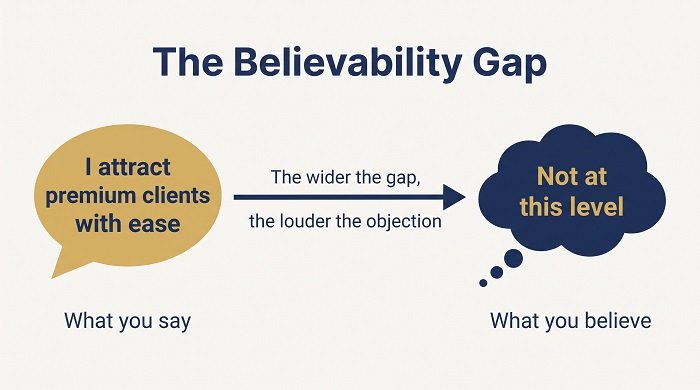
Positive affirmations fail high-earning business coaches when the statement you repeat sits further from your real belief than your mind will accept. The gap is rarely about general confidence. It’s about a specific number, a specific stage, or a specific level of visibility.
Here’s how it plays out. You coach clients through fear every week, yet a higher fee makes your stomach drop. In the car, you say, “I attract premium clients with ease.” A second voice answers, “Then why did last month’s launch stall?”
Three forces make this worse for coaches at your level:
- The believability gap. The distance between the statement and what you actually believe. The wider it is, the louder the objection.
- Identity pressure. You sell confidence for a living, so admitting doubt feels risky. Quiet doubt is exactly what affirmations bounce off.
- Comfort without action. Saying the sentence feels like progress, so outreach, pricing, or hiring waits another week.
In my 20+ years as a Board Designated Trainer, I’ve seen capable people polish the sentence for months while the belief underneath stayed untouched. Nothing is wrong with you. The tool is aimed at the wrong layer.
What Does the Research Say About Affirmations Backfiring?
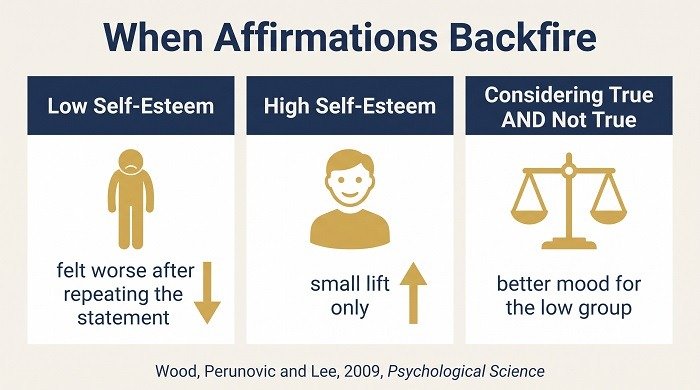
Research suggests affirmations can make people feel worse when the statement doesn’t match how they see themselves. In a 2009 paper in Psychological Science, Joanne Wood and colleagues asked participants to repeat “I’m a lovable person.” People with low self-esteem felt worse afterward than those who didn’t repeat it. People with high self-esteem felt better, but only to a limited degree.
The second finding matters more for you. When low-self-esteem participants focused on how the statement was both true and not true for them, they did better than those who focused only on how true it was. Letting the objection in worked better than shouting over it.
One scope note: these experiments studied people with low self-esteem, not business coaches. Most high-earning coaches have solid general confidence. The finding still points to the same mechanism: when a statement clashes with a felt belief, the clash wins.
There’s a second cost. Ellen Hendriksen, PhD, writing for Quick and Dirty Tips, notes that people whose affirmations don’t work often blame themselves. For a coach, that stacks on top of the pressure to look certain. Our post on how toxic thoughts undermine success goes deeper.
Why Does the Believability Gap Widen as You Earn More?
Each new income level resets what feels normal, and the belief behind it often lags. A coach may carry a belief like “clients pay this much, not more.” Affirming a bigger number doesn’t touch that belief. It collides with it.
You’re in good company. Fortune reported in 2024 that CEOs report imposter syndrome, citing a Korn Ferry survey. A 2025 survey of 227 entrepreneurs, reported by Founder Reports through Lonely Entrepreneur, found about half reported anxiety and nearly a third reported imposter syndrome. The sample is small, so treat it as a signal and not a verdict. In Canada, a 2025 MaRS Discovery District survey of health sciences founders found only 12 percent had sought professional mental health support.
Darren G. is a useful example. He came to James with a well-paying job and a stubborn sense of being stuck, blocked around promotions, raises, and starting his own business. Working through his goal blocks and limiting beliefs shifted how he thought and acted, and his relationships improved too. If this sounds familiar, mastering self-doubt is a good next read.
Can Positive Thinking Reduce Your Effort?
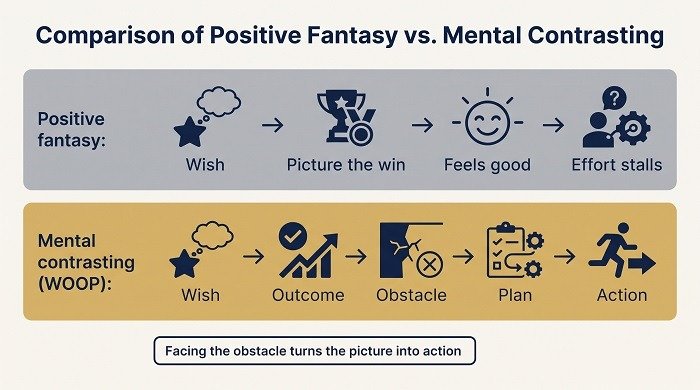
Yes, in some cases. Psychologist Gabriele Oettingen has spent more than two decades studying motivation, and a summary of her work reports that positive fantasies can lower effort because the pleasant picture feels like partial success. Her fix is mental contrasting, which pairs the desired outcome with the obstacle in the way.
The method is called WOOP: Wish, Outcome, Obstacle, Plan. According to the same summary, people with attainable goals put in more effort when they contrast, while people with unrealistic goals let go sooner. Both results save you time.
Picture a coach who visualizes a fully booked calendar every morning. It feels great, and it quietly replaces the awkward work of outreach. Add the obstacle (“I freeze when I have to ask for the call”) and a plan (“I send five messages before 10 a.m.”), and the picture starts pulling you into action.
What Works Better Than Affirmations?
Values-based self-affirmation has stronger evidence than repeating a claim about yourself. It asks you to reflect on what matters to you, such as family, craft, or contribution, instead of announcing that you’re excellent.
Carnegie Mellon researchers found that chronically stressed students who wrote briefly about their top value solved problems under pressure about as well as low-stress students. A separate study led by David Creswell with 85 participants found lower cortisol responses to a lab stressor after values affirmation. These were student and lab samples, so treat them as promising, not proven for your calendar.
Wording helps too. Hendriksen describes a 2010 study in which people followed through more when they asked “Will I?” than when they declared “I will.” A question invites your own reasons instead of resistance.
Try This: Before your next high-stakes call, write two sentences about why this work matters to you. Then ask yourself, “What will I do in the first five minutes?” Skip any claim about how great you are.
How Does NLP Change the Beliefs Affirmations Can’t Reach?
NLP works on the belief itself, including how it’s held and what it connects to, rather than stacking a competing sentence on top. Three tools show up often in coaching work with business owners:
- Logical Levels. Maps whether a doubt sits at the level of environment, behaviour, capability, belief, or identity. “I can’t charge that” is often an identity statement dressed up as a pricing problem.
- Reframing. Changes the meaning attached to an event, such as a stalled launch, so it reads as information, not a verdict.
- Anchoring. Links a resourceful state to a physical cue so you can reach it before a sales call.
Mike L. came to James with constant self-doubt and second-guessing that spilled into his work and relationships. Using NLP techniques to clear the mental noise, he began speaking with more confidence and listening more clearly at work. For a fuller walkthrough, see overcoming limiting beliefs with NLP. Expect practice, not magic: with consistent work, many people see change build over three to six months.
Affirmations vs Alternatives: Which Fits a Business Coach?
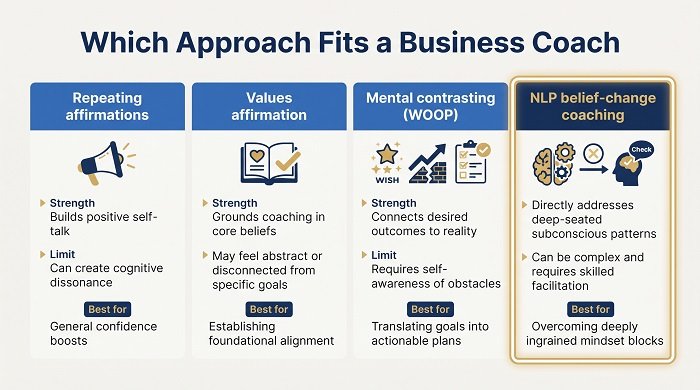
Repeating affirmations is the quickest option and the most likely to clash with a stubborn belief. Values writing and WOOP are low-cost supports. Belief-level coaching takes more time and goes after the root.
| Approach | How It Works | Strength | Weakness | Best For |
| Repeating affirmations | Repeat a positive claim daily | Fast, free | Can trigger the objection voice | A statement you half believe |
| Values affirmation | Write about a core value | Backed by lab studies | Doesn’t change a specific belief | Before high-pressure moments |
| Mental contrasting (WOOP) | Pair the wish with the obstacle and a plan | Turns motivation into action | Needs honest obstacle naming | Goals that stall at planning |
| NLP belief-change coaching | Shift the belief and its meaning | Targets the root of patterns | Needs guided practice and time | Income ceilings, identity-level doubts |
Who Should Use Affirmations?
Affirmations suit you when:
- The statement describes something you already mostly believe, such as “I’m prepared for this call.”
- You want a short state change before a presentation or sales conversation.
- You tie the statement to a value and follow it with action.
Who Should Avoid Affirmations?
Skip them, or change approach, when:
- The statement describes a level you don’t yet believe you’ve earned.
- The ritual helps you postpone outreach, pricing changes, or hard conversations.
- The practice leaves you feeling worse or more self-critical.
- You’re dealing with persistent anxiety, low mood, or burnout. Please speak with a licensed health professional. Coaching complements that care and doesn’t replace it.
The 5-Step Belief-First Reset Framework
The 5-Step Belief-First Reset gives you an order of operations. Each step takes 5 to 10 minutes.
Step 1: Name the Objection
Write what your inner critic says when you imagine the goal, such as “Not at this level.” Naming it takes away its surprise.
Step 2: Anchor to a Value
Write two sentences on why this work matters to you. This steadies you and supports Pillar 1, Clarity of Vision.
Step 3: Contrast the Wish and the Obstacle
Use WOOP: state the wish, picture the best outcome, name the main inner obstacle, then write an if-then plan.
Step 4: Reframe the Belief
Ask what you would have to believe for the objection to be true, then list the experiences that contradict it. For deeper work, see how to overcome mindset blocks.
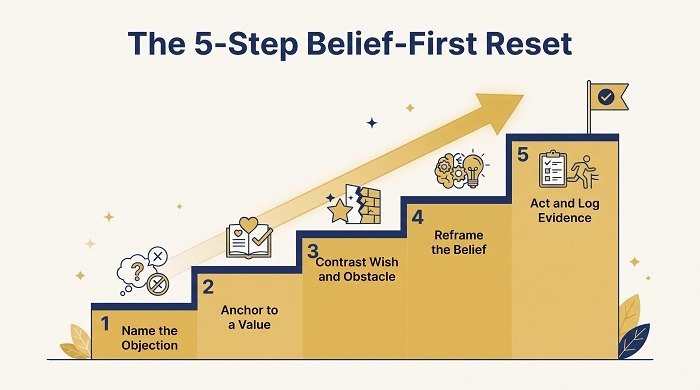
Step 5: Act and Log Evidence
Take the smallest visible action within 24 hours and record what happened. Evidence rebuilds belief better than repetition. This draws on Pillar 3, Courageous Action.
Frequently Asked Questions
Do positive affirmations work for business coaches?
Sometimes, when the statement is close to what you already believe. For bigger claims about income or status, research suggests they can backfire and trigger an inner argument. Pair any affirmation with a value and an action.
Why do affirmations make me feel worse?
A statement that clashes with your belief invites a counterargument, and that counterargument can be louder than the statement. Try acknowledging both what’s true and what isn’t.
What should high-earning coaches do instead of affirmations?
Start with a values reflection, use WOOP to contrast the goal with your real obstacle, and take one small action. For recurring patterns such as an income ceiling, belief-level coaching goes after the root.
How is NLP belief change different from affirmations?
Affirmations add a new sentence. NLP examines the existing belief, what it means to you, and what it protects, then shifts it with tools like reframing and anchoring. It works best with practice and a qualified trainer.
Are there times when affirmations help?
Yes. Believable, present-focused statements such as “I’ve prepared for this” can steady you before a session. Treat them as a short state change, not a replacement for action.
Conclusion
Positive affirmations still have a place for business coaches as a short state change. The deeper work sits in the belief underneath. When you name the objection, anchor to your values, face the obstacle, and act, the numbers you’re aiming for start to feel believable.
If you’re ready to work on the belief that’s capping your income or visibility, book a business coaching conversation with James. Your transformation starts today, so take the first step.