

The silent ceiling is the plateau that forms in a coaching or consulting business when the owner’s hours become the growth constraint. It is silent because nothing visibly breaks. Revenue holds, clients stay, the calendar stays full. Nothing looks like failure, so the instinctive response is to add more hours, which reinforces the ceiling instead of breaking it.
Aligned leaders stop adding hours because they test the causal relationship first: whether they are plateaued not despite the sixty hours, but because of them. Every hour spent working inside the business is an hour unavailable for the few decisions that would actually move it.
Breaking the ceiling takes three things working together, not one. Psychology first, because the programming that makes delegating, raising prices and saying no feel unsafe will quietly cancel any plan you write. Then strategy, meaning ruthless elimination. Then structure, so the business stops routing every decision through one person.
Key Takeaway:
- The silent ceiling is a business growth plateau caused by the owner’s limited time and capacity, not necessarily a lack of market demand or strategy. Revenue may remain stable while longer working hours fail to produce meaningful growth. [1]
- Why overworking stops working: Productivity does not increase linearly with working hours. Excessive workloads can reduce decision-making quality, while limited capacity leaves business owners without the time needed to implement high-impact strategies. [2]
- Why delegation often fails: Hiring help does not solve the problem when owners continue controlling critical decisions, client communication, pricing, and execution. Address the underlying beliefs that make letting go feel unsafe, then build systems that distribute responsibility effectively. [1]
- What to do: Eliminate low-value activities before adding new strategies, simplify offers, delegate decision-making, and protect recovery time. Align your calendar with the work only you can do, then build repeatable systems that allow the business to operate without constant owner involvement. [1]
- When to rethink the approach: If your business has not established reliable demand, the constraint may be marketing rather than capacity. Likewise, if you have genuine spare capacity and too few leads, focus on demand generation instead of cutting activities that support growth. [1]
Bottom Line: Breaking the silent ceiling requires more than working harder or hiring help. Rebuild the psychology, strategy, and structure of your business in that order. Eliminate low-value work, delegate meaningful decisions, and create systems that let you grow without adding more hours.
- Source: Unleash Your Power – The Silent Ceiling: Why Aligned Leaders Stop Hustling
- Source: The Economic Journal – The Productivity of Working Hours
What Is the Silent Ceiling in a Coaching or Consulting Business?
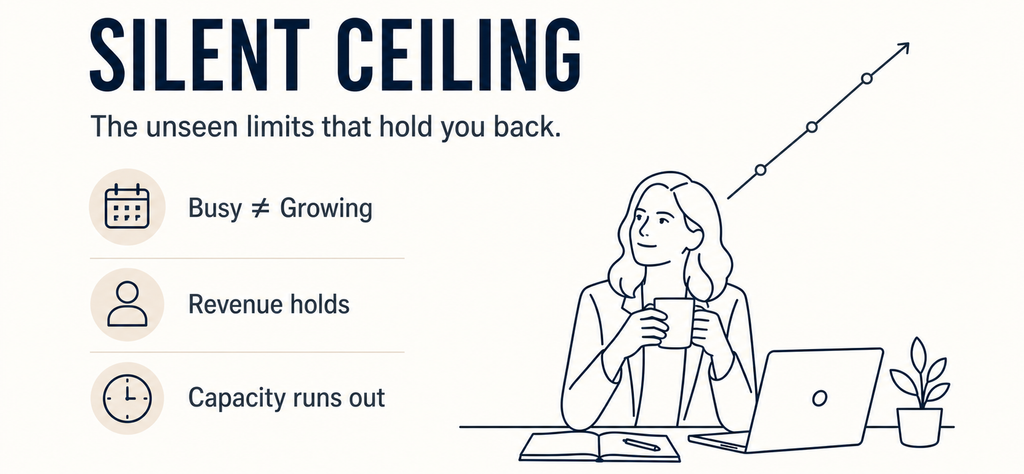
The silent ceiling is a growth limit created by the owner’s capacity rather than by the market. It has no alarm attached. Nothing collapses, no client leaves badly, no month falls off a cliff. The business simply stops moving and stays stopped.
You can usually date it. A year that climbed, then a year that looked identical, then another. Same revenue band, same client count, same Sunday evening feeling. The plan changed three times; the numbers did not.
What makes it silent is that every input still looks correct. In a May 2026 survey of 1,000 small business owners, more than eight in ten said they had sacrificed their health, relationships, or mental well-being for the business, and roughly four in ten described themselves as exhausted but staying anyway. Exhausted but staying is not a failure state, which is exactly the problem. It is stable enough to live in for years.
Why Does Adding Hours Stop Producing Results?
Because output does not scale with hours in a straight line. The relationship bends.
Stanford economist John Pencavel, analysing worker output in research published in The Economic Journal, found the relationship is non-linear: below a threshold, output tracks hours closely; above it, output keeps rising at a steadily decreasing rate. Past a point, additional hours stop buying additional results. A 2026 review in the Emory Economics Review applies the same logic to overwork, noting that measured exhaustion predicts performance decline rather than merely describing how tired someone feels.
For a coach or consultant, this bites harder than it does on a factory floor. Your product is judgement, and when judgement degrades, you do not see a defect rate. You see it eighteen months later, in decisions you should have made faster. Look honestly at how your hours are actually structured before concluding the market is the problem.
Is a Business Plateau a Strategy Problem or an Hours Problem?
At this stage, an hours problem can look remarkably like a strategy problem. Sometimes the reverse is true. But for an owner already working sixty hours, the hours deserve to be tested first.
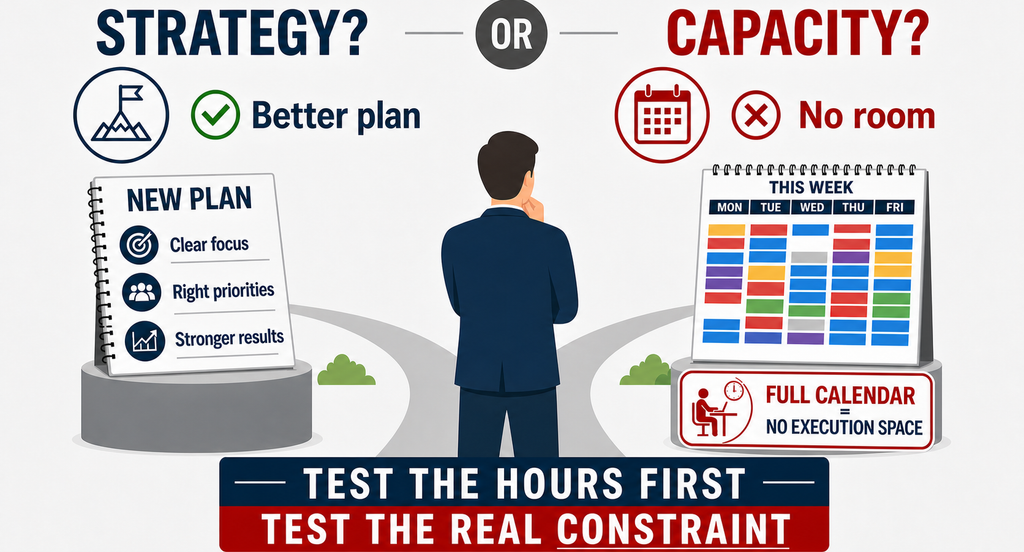
Here is the test. If someone had handed you a genuinely better strategy eighteen months ago, would you have had the room to implement it? Not the intelligence. The room. Most owners at the ceiling would have squeezed it into a full calendar, implemented it badly, and moved on to the next one.
For the leader at this ceiling, being stuck may have less to do with a lack of strategy than with having no capacity left to execute one. That is the causal claim worth testing before any other: that you are stuck because of the sixty hours, not despite them. The overwhelm may not be a side effect of the plateau. It may be the plateau.
I know how that sounds from someone selling a solution, so here is where I learned it. My fifth business looked successful from the outside. I was working eighty-hour weeks, on anxiety medication, calling it success because I could not think of what else to call it. I had built a prison with a nice view. What ended it was not a business insight. It was my niece asking why I did not visit anymore, and having no answer I could say out loud.
Marcus (name changed) arrived with an impressive business, a real team and a reputation people would envy. He was also miserable, and convinced the answer was a better offer. It wasn’t. He went from twenty clients to nine premium ones, and from sixty hours a week to thirty. Revenue went up.
Twenty clients down to nine. Sixty hours down to thirty. Revenue up. Same man, different mountain.
What Does “Aligned” Actually Mean for a Leader?
Alignment is not a feeling and it is not a morning routine. It means your calendar, your offer and your capacity point at the same outcome, so doing your work stops requiring you to override yourself.
Most writing on aligned leadership describes the destination and skips the mechanism. Lead with clarity. Protect your energy. All true, and all useless to someone whose Thursday is already booked solid by other people’s needs. Nobody stays misaligned because they never heard that alignment is good.
The working definition is narrower: you are aligned when the things you do most often are the things only you can do, and the rest has somewhere else to live. That is a structural condition, not a mindset. You can feel wonderfully intentional and still be the bottleneck in every process you own.
And here is the uncomfortable part. If your business would visibly degrade after four days without you, you do not have an alignment problem to reflect on. You have a design problem to fix. That is good news, because design problems have known solutions and vague spiritual deficits do not.
Why Can’t You Just Delegate Your Way Out of the Ceiling?
Because delegation is a psychological act before it is an operational one, and most owners try to solve it operationally.
The evidence is not subtle. Gallup studied 143 Inc. 500 chief executives and found those with high delegator talent posted a three-year growth rate 112 percentage points higher than low delegators, with roughly a third more revenue. Only about one in four employer entrepreneurs shows the talent naturally.
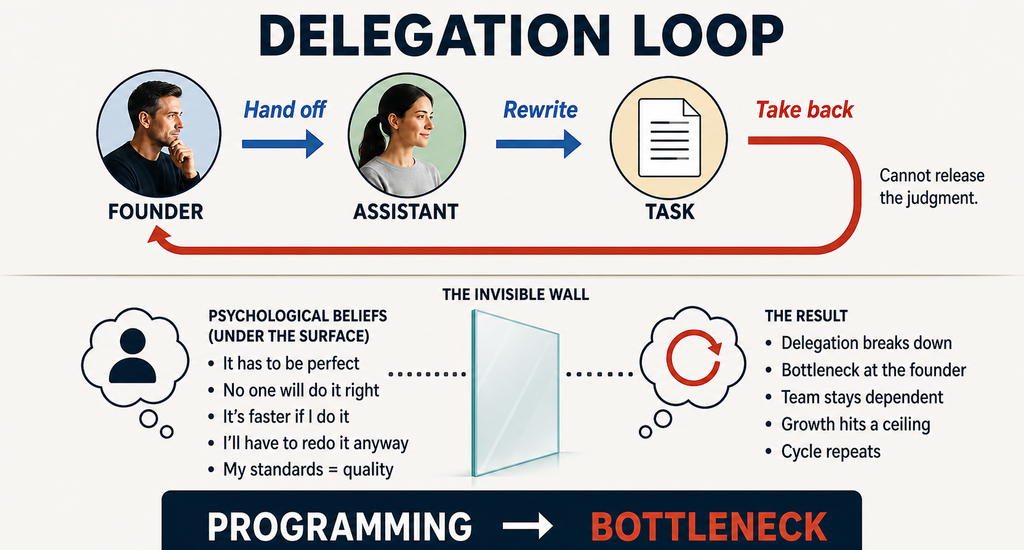
So you hire the assistant. Then you rewrite what they send you. You take the call back just this once, because the client asked for you specifically. You keep the proposal, the pricing conversation and the difficult email, because those are the important ones. Six weeks later, same work, new payroll line.
That is not a discipline failure. It is programming doing its job. Underneath sit rules you never consciously wrote: that disappointing someone is unbearable, that being needed is the same as being valuable, that charging more requires permission you have not been given, that staying busy is safer than the bold move you keep postponing. Until those get rewritten, the beliefs running underneath your decisions will veto every system you install.
You can’t delegate what your unconscious won’t release. That’s why the VA didn’t fix it.
What Do Aligned Leaders Do Instead of Adding Hours?
They subtract first. Addition is the reflex at the ceiling; subtraction is what works, because you cannot install anything into a calendar with no space in it.
Nik (name changed) had built seven income streams chasing stability, and she was exhausted and barely moving. She eliminated five. Within ninety days, revenue had nearly tripled, with fewer hours and fewer clients.
Seven revenue streams down to two, and revenue nearly tripled. Less complexity, more money. Exactly how this is supposed to work.
They also treat recovery as an input rather than a reward. Research on psychological detachment, meaning genuinely switching off rather than merely stopping typing, links it to both wellbeing and job performance, and incomplete recovery means arriving at the next day already depleted. Which is why non-sleep deep rest belongs on a workday, not only a weekend.
For me that looks specific and slightly ridiculous written down. Dinner at home with my phone in another room. Martial arts twice a week. A thirty-six-minute nap I do not apologise for. That is not indulgence. It is the reason the four hours afterwards are worth anything.
Then, and only then, they add. Systems, positioning, price. Scaling without adding hours stops being a paradox once elimination is done. It is just sequencing.
The Overworked Operator vs. The Aligned Leader
The difference is not effort or ambition. Both work hard and want the same things. The difference is what each does when the plateau appears.
| Particulars | The Overworked Operator | The Aligned Leader |
|---|---|---|
| Response to a plateau | Adds hours, an offer, a channel | Removes activity until the constraint is visible |
| What a free hour becomes | More client work or admin | The decision postponed for months |
| View of capacity | Something to stretch | Something to design around |
| Delegation | Hands off tasks, keeps every judgement call | Hands off judgement, programming rewritten first |
| What the calendar shows | Everything urgent, nothing chosen | Few things, chosen deliberately |
| Where the ceiling ends up | Fixed at personal capacity | Moved off the owner entirely |
The question is which direction the last six months moved you.
Data & Findings
Finding 1: Output-to-hours is non-linear. Pencavel’s analysis shows output rising proportionally below a threshold and at a decreasing rate above it. Implication: at higher workloads, additional hours become progressively less productive.
Finding 2: Delegator talent tracks with growth rates. Among the 143 Inc. 500 chief executives Gallup studied, those with high delegator talent outgrew low-delegator peers by 112 percentage points over three years, and only around a quarter of employer entrepreneurs show the talent naturally. Implication: high delegator talent is associated with a measurable growth difference, and it is a trainable capacity rather than a fixed trait.
Finding 3: The personal cost is near-universal. In the Patriot Software survey, 84.4% reported sacrificing health, relationships or mental wellbeing; 45.8% named family time; 28.7% reported lasting damage to a close relationship. Implication: whatever you call normal is being paid for somewhere, usually at home.
Finding 4: Recovery predicts performance, not just mood. The detachment literature links switching off to wellbeing and to work performance. Implication: protecting recovery is a business decision, not a lifestyle one.
The 5 Shifts to Freedom: The Method That Breaks the Silent Ceiling
The 5 Shifts to Freedom is the journey. The 3 Pillars are the mechanism underneath it, and the two are never separated, because a framework without a mechanism is just branding.
Performance Psychology rewires the programming that makes delegating, pricing and refusing feel unsafe. Freedom-First Business Strategy cuts the eighty percent of activity stealing your time so the twenty percent can produce. Freedom-First Business Structure redesigns operations, so you are no longer the bottleneck. Strategy without psychology is another unfinished course. Psychology without strategy doesn’t pay the bills. Structure without both is a prettier prison.
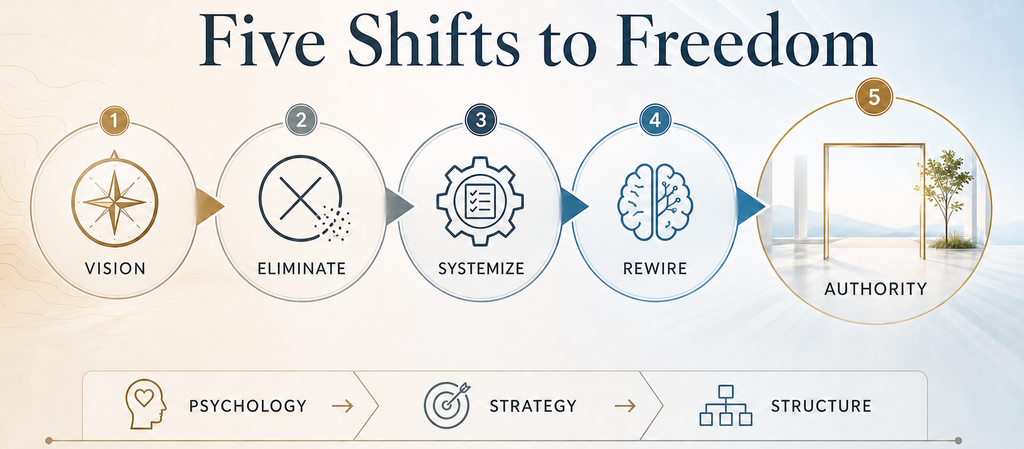
Vision Alignment: Get precise about what you actually want, not what you assumed you were supposed to want.
Ruthless Elimination: Cut the activity producing nothing. This is where the calendar space comes from, and nothing else works until it exists.
Systems That Scale: Build leverage so the business no longer runs through you and your expertise no longer lives only in your head.
Mindset Unlock: Dismantle the programming sabotaging execution, reconditioning work, not affirmations.
Magnetic Authority: Position yourself so the right clients recognise you immediately, and charge premium prices without negotiating with yourself first.
Sixteen weeks. Month one feels slower than you want, which is normal, because change takes longer than people expect when the thing being changed is a default.
Who Should Use This?
Coaches, consultants and wellness practitioners who have already proven they can build something. You have clients, a reputation and results you can point at. You are working fifty to sixty-plus hours, the business has stopped moving, and at least two strategy changes have failed to hold. If four days unreachable would genuinely worry you, you are the right reader.
Who Should Avoid This?
Avoid this if you are pre-traction and have not yet found something people reliably pay for. Your constraint is demand, not capacity, and cutting activity now would cut the wrong things. Avoid it if you have real idle capacity and a quiet pipeline, which is a marketing problem. And avoid it if you want a tactic to bolt onto the current setup. This is a rebuild, and it does not work as a garnish.
Frequently Asked Questions
Is the silent ceiling the same as burnout?
No. Burnout is depletion in the person; the silent ceiling is a structural limit in the business created by the owner’s hours. They often travel together, but the ceiling can persist for years in someone functioning perfectly well, which is what makes it easy to miss.
How do I know if my plateau is an hours problem rather than a marketing problem?
Check for spare capacity. If a wave of new clients arrived next month and you could not serve them without working more hours, the constraint is capacity, and more marketing would only make the ceiling more painful. Real idle capacity plus a quiet pipeline is a marketing problem and should be treated as one.
Can I break the silent ceiling by hiring a virtual assistant?
Rarely on its own. An assistant removes tasks, but the ceiling is usually held in place by the judgment calls you will not release, not by the admin. Most owners hire help, keep every decision, and end up doing the same work with a payroll line attached.
Does working fewer hours mean growing more slowly?
Not necessarily. The evidence on diminishing returns suggests more hours do not automatically produce more output, while Gallup’s study of Inc. 500 chief executives found high delegator talent associated with substantially stronger growth than low delegator talent. That is the bet this method makes: working less is not the reward for scaling; it is the mechanism, because it frees the capacity high-leverage decisions require.
How long does it take to rebuild a business around fewer hours?
The core work runs sixteen weeks, sequenced as clarity, then liberation, then amplification. Month one usually feels slower than expected because elimination comes before building, and removing things produces no visible progress. It produces the space everything after it depends on.
The Choice
The silent ceiling does not break on its own, and it does not break by being worked at harder, because effort is the material it is built from. It breaks when psychology, strategy and structure get rebuilt in that order.
You already know you are capable of more. The question is whether next year looks different from this one, or identical to it for the fourth time running.
Book a Freedom Blueprint Call. We’ll find the one thing that’s actually keeping you stuck, whether your ceiling is psychological, strategic or structural, and what has to change first. No pitch unless you ask for one.