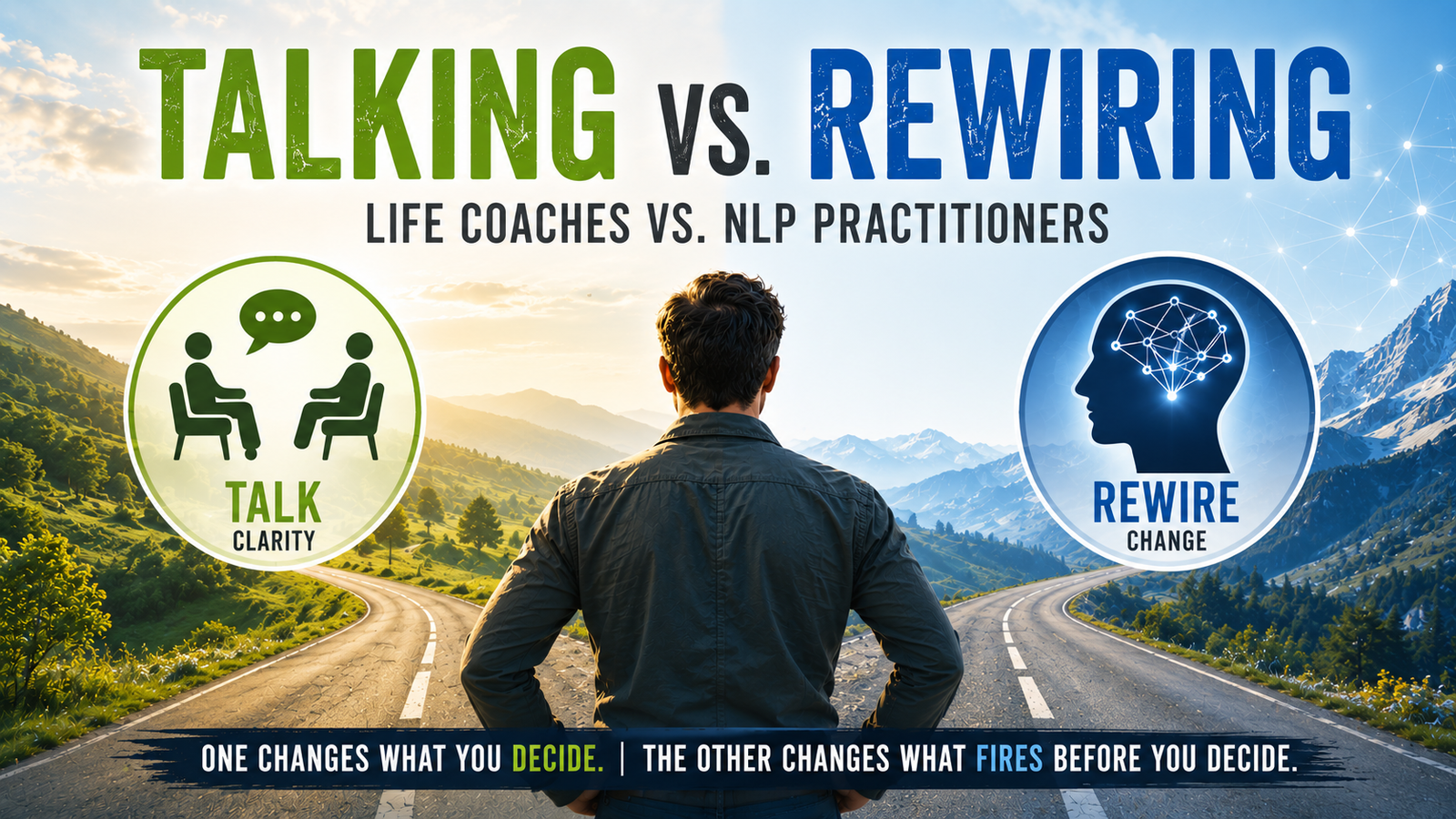
A life coach and an NLP practitioner work on two different layers of you.
A life coach works at the deliberate layer: the goals you can name, the decisions you can articulate, the plans you can write down. Sessions run on questions, reflection and accountability. It is genuinely effective when the thing standing between you and the outcome is clarity or follow-through.
An NLP practitioner works at the automatic layer: the responses that fire before you’ve decided anything. The tightening in your chest before you quote your real price. The instinct to reach for the task yourself rather than hand it over. Sessions run on pattern work rather than conversation.
Neither is a senior version of the other. Both fields are largely unregulated: coaching has no licensing body, and NLP certifications come from private training organisations, not a governing board. In this blog i will discuss on Life Coaches vs. NLP Practitioners, from Talking vs. Rewiring angle! Let’s dive in!
Key Takeaway:
- Life coaches and NLP practitioners address different layers of behaviour. Life coaching focuses on conscious goals, decisions, reflection, and accountability, while NLP practitioners work with automatic reactions, triggers, and learned behavioural patterns. Neither is inherently better; the right choice depends on what is keeping you stuck. \[1\]
- Why insight may not be enough: Understanding what you should do creates intention, but intention does not always translate into action. Strong habits, repeated behaviours, and familiar environments can override conscious decisions, especially when exhaustion reduces your capacity for effortful change. \[1\]
- How NLP pattern work operates: Identify a specific trigger-response-behaviour sequence, interrupt the automatic reaction while it is happening, and rehearse a more useful response. The goal is targeted behavioural change, not a personality transformation or instant cure. \[1\]
- Which approach should you choose? Work with a life coach when you need clarity, direction, goal-setting, or accountability. Consider targeted pattern work when you know exactly what to do but repeatedly cannot act on it. If the problem is structural, such as an unsustainable business model or inadequate systems, strategy and operational support may be more appropriate. \[1\]
- When to be cautious: NLP has a limited and mixed research base, and its benefits have sometimes been overstated. It is not a substitute for licensed therapy or medical care. People with diagnosable mental health conditions should seek qualified clinical support, and anyone promising a guaranteed one-session cure deserves scrutiny. \[1\]
Bottom Line: Life coaching helps you clarify what you want and move toward it, while NLP pattern work aims to address automatic reactions that can override your intentions. Choose the approach that matches your actual obstacle, and combine psychological work with practical strategy and structure when lasting change requires more than insight.
What’s the actual difference between a life coach and an NLP practitioner?
The difference is not depth or seniority. It’s which system each one is designed to reach.
What a life coach works with
Life coaching operates on material you can consciously access: goals, values, stated obstacles, and the gap between what you said you’d do and what you did. The tools are powerful questions, structured reflection and accountability.
The research supports it. A meta-analysis in the Journal of Occupational and Organizational Psychology found that coaching produced positive effects across organisational outcomes, strongest on affective outcomes and weakest on skill-based ones. Work in the Journal of Positive Psychology found that coaching’s largest effect was on goal-directed self-regulation.
Read that carefully, because it’s the whole article in one line. Coaching is strongest at helping you regulate toward a goal. Real skill, widely needed and not the same thing as dissolving the reaction that stops you.
What an NLP practitioner works with
Neuro-linguistic programming targets the layer underneath. The premise is that language, internal imagery and physical state are tied to learned behavioural patterns, and that those patterns can be interrupted and re-associated rather than merely discussed.
In practice: less talking about the problem, more doing something with it in the room. What do you see, where do you feel it, what happens immediately before the avoidance. Then a technique gets applied to that sequence directly.
Where the two overlap in practice
Most working practitioners aren’t purists. Plenty of life coaches have NLP training, and most NLP practitioners coach. If you’re weighing this alongside other options, business coaching and life coaching aren’t the same thing either and in practice, the two approaches are routinely combined.
Ask what actually happens in a session. That answer beats any label on the website.
Why doesn’t insight alone change your behaviour?
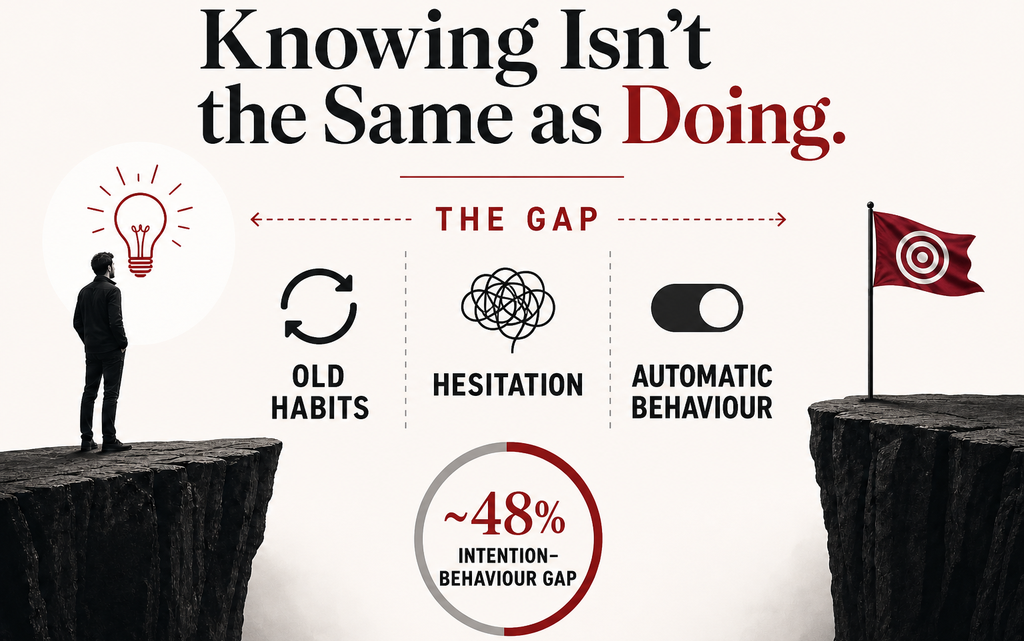
Because insight produces intention, and intention is a weak predictor of behaviour.
This is one of the better-measured findings in behavioural science. A synthesis summarised by the US National Cancer Institute reported that goal intentions accounted for roughly 28% of the variance in behaviour across more than 400 studies, and that people acted on their good intentions only about half the time. A 2023 meta-analysis of nearly 30,000 participants put the overall intention–behaviour gap at 47.6%, concluding that translating a positive intention into action is close to a coin flip.
So when your last coach helped you see clearly that you need to raise your prices, that worked. The seeing worked. The seeing was never the bottleneck.
The finding that explains everything
Research on habit strength found that intentions predicted behaviour when habits were weak, but people with strong habits performed behaviours frequently in stable contexts and repeated their past behaviour regardless of what they intended. The usefulness of intentions as a predictor declined as habit strength increased.
Read that again with your own business in frame. You’ve been over-delivering, under-charging and grabbing the task back for years same office, same desk, same pressure. That isn’t a preference. That’s a deeply grooved pattern in a stable context, which is precisely the condition under which intentions stop predicting anything.
Why this hits hardest when you’re already exhausted
The same body of research found that roughly 45% of daily behaviours are repeated in the same physical location almost every day, and that when people are depleted, they have less capacity for effortful decisions and fall back on habit cued by context.
Which means the 60-hour week isn’t just the symptom. It’s the thing removing your capacity to break the pattern that produces it. You’re stuck BECAUSE you’re working 60 hours the overwork is the mechanism holding the whole thing in place.
What does “rewiring” actually mean?
Strip the mystique off and it means changing what a trigger is attached to.
A pattern has a shape: a cue, an automatic internal response, a behaviour. Client asks for a discount → tightening, a flash of “they’ll walk” → you discount. That sequence runs in under a second, and by the time you’re conscious of it you’re already explaining your reasoning.
Pattern work interrupts the sequence while it’s live. The practitioner gets you into the exact state, not describing it from a safe distance, actually in it then breaks it and rehearses a different response until the new one gets there first.
That’s the honest version. Not magic, not a personality transplant. Interruption and rehearsal, applied to something specific enough to catch.
Is NLP scientifically proven?
No. And you deserve a straight answer on this before anyone takes your money.
The clinical evidence is thin. A systematic review in the British Journal of General Practice concluded that there is little evidence that NLP interventions improve health-related outcomes a conclusion the authors attributed to the limited quantity and quality of the available research rather than to robust evidence of no effect. Canada’s health technology agency reached a firmer verdict in its review of NLP for anxiety, depression and PTSD: no clinical evidence was identified supporting its use for those conditions.
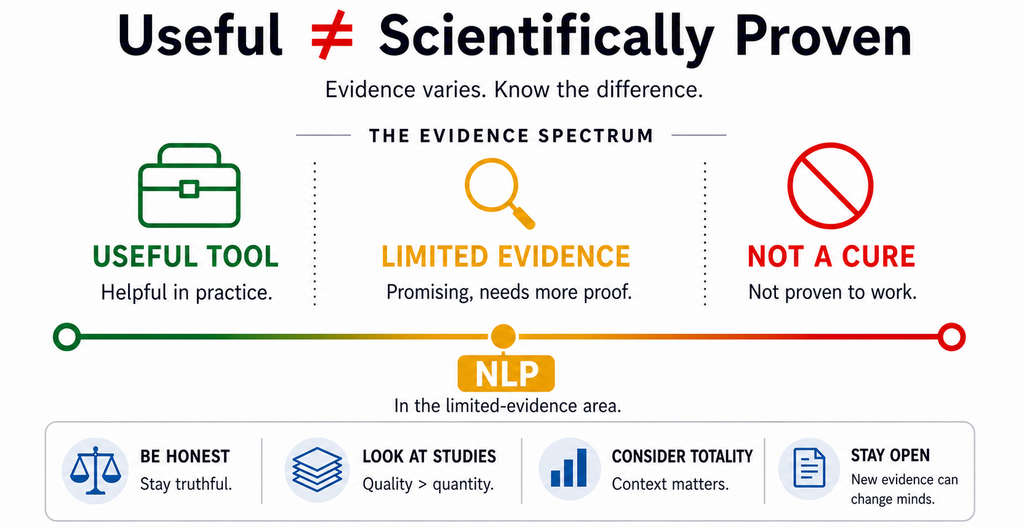
The workplace picture is more favourable but still shaky. A systematic review in Human Resource Development Quarterly found positive psychological outcomes, including improved self-esteem and stress management, with large effect sizes across the seven included studies but concluded that the benefits of NLP have been both overpromised and undersupported.
Overpromised and undersupported. That’s a fair description of an industry that sells certifications on the promise of curing phobias in an afternoon, and James would sign that criticism himself.
The position that follows: the tools are genuinely useful for the narrow job of interrupting a rehearsed reaction. They are not therapy, not a cure, not a substitute for strategy. Anyone claiming otherwise is selling you a certificate.
Which one do you actually need?
Route yourself by what’s actually stuck.
If you don’t know what you want yet
Take the coach. Genuinely. When the problem is unclear priorities, a fuzzy definition of success, or a vision inherited from someone else, conversation is the correct tool. No amount of pattern work will tell you what you want.
If you know what to do and you’re doing it
You need neither. You need a strategist or an operations hire. Save your money.
If you know what to do and you’re not doing it
This is where talking stops working, and it’s where most established practitioners actually live.
Jennifer (name changed) came in with an extraordinary background and real expertise, charging a fraction of what her peers charged. She knew she should raise her prices. She’d known for two years. She’d talked it through with more than one coach. She simply could not make herself do it.
The work wasn’t affirmations. It was deep reconditioning of the response that fired every time she said a number out loud. Within 60 days, she had doubled her prices and more than doubled her revenue same expertise, same market, different self-concept.
Doubled her prices in 60 days. The strategy was never her problem. Her programming was.
Why overworked founders usually need both: plus a third thing nobody sells
Psychology on its own is feel-good work that doesn’t pay the bills. Strategy on its own is another unfinished course in your downloads folder. Structure without either is just a prettier prison a beautifully documented business that still runs entirely through you.
David (name changed) was brilliant at his craft and completely trapped by it. Everything routed through his head. After thirty days of getting his expertise out of it and into a documented process, his assistant took over most of his inbox, and he took his first two-week holiday in five years while revenue went up.
First two-week holiday in five years, and the business grew while he was gone. That’s what happens when your expertise stops living in your head.
That needed all three: the pattern work to release control, the strategy to decide what mattered, the structure to hold it. Two out of three buys you a better mood and the same calendar. That’s what this looks like applied to running a business.
Life coach vs. NLP practitioner: side-by-side
If you only remember one distinction: coaching changes what you decide; pattern work changes what happens before you decide.
| Particular | Life Coach | NLP Practitioner |
|---|---|---|
| Works with | Conscious goals, decisions, accountability | Automatic responses, triggers, rehearsed reactions |
| A session looks like | Questions, reflection, planning | Eliciting a live state, interrupting it, rehearsing a new one |
| Best at | Clarity, direction, follow-through, momentum | Reactions that override intention: freezing on price, gripping control |
| Can’t do | Shift a pattern you’ve run for a decade by discussing it | Tell you what you want, or build you a business model |
| Credentialing | Unregulated; voluntary bodies only | Certified by private training organisations, not a licensing board |
| Evidence base | Meta-analytic support for goal-directed outcomes | Positive workplace signals; thin, methodologically weak clinical research |
| Ideal user | Capable, unclear, needs direction and structure | Clear on the move, physically unable to make it |
Who should work with an NLP practitioner?
- You can name the exact move you’re avoiding, and you’ve been avoiding it for more than a year
- You’ve hired a coach before and the insight was real but the behaviour didn’t move
- The block shows up in your body first: the tightening before the price conversation, the reflex to grab the task back
- You want a specific reaction changed, not general life improvement
- You’d rather do something in the session than describe something
Who should avoid this route?
- You’re dealing with a diagnosable mental health condition. Anxiety disorders, depression, PTSD and trauma belong with a licensed clinician. Canada’s health technology agency found no clinical evidence supporting NLP for those conditions, and it’s worth understanding how this differs from traditional therapy before you choose.
- You want a cure in one session. That promise is the loudest signal in the industry that you’re in the wrong room.
- Your problem is genuinely structural. No pattern work fixes an offer nobody wants or a business model that requires 60 hours by design.
- You’re not clear on what you want yet. Start with the conversation. Pattern work needs a target.
- You want someone to hold you accountable weekly. That’s coaching. Ask for coaching.
Data & Findings
| Finding | What the research shows | Source |
|---|---|---|
| Intention predicts behaviour poorly | Goal intentions explained about 28% of behavioural variance across 400+ studies; people acted on good intentions roughly half the time | National Cancer Institute research summary |
| The gap is measurable | A meta-analysis of nearly 30,000 participants put the intention–behaviour gap at 47.6% | Feil et al., systematic review and meta-analysis |
| Habit overrides intention | Where habits were strong, past behaviour repeated regardless of intention; intentions guided action mainly where habits hadn’t formed | Neal, Wood & Quinn, Current Directions in Psychological Science |
| Context does the driving | Around 45% of daily behaviours recur in the same physical location almost every day | Wood & Neal, Psychological Review |
| Coaching has real support | Coaching showed positive effects across organisational outcomes, strongest on affective measures | Jones, Woods & Guillaume, JOOP |
| NLP’s evidence is mixed | Positive workplace psychological outcomes, but benefits judged overpromised and undersupported | Kotera, Sheffield & Van Gordon, HRDQ |
The mechanism: Shift 4, Mindset Unlock
Pattern work isn’t a standalone product here. It sits inside The 5 Shifts to Freedom psychology first, then strategy, then structure because you can’t delegate what your unconscious won’t release, and you can’t scale on psychology alone.
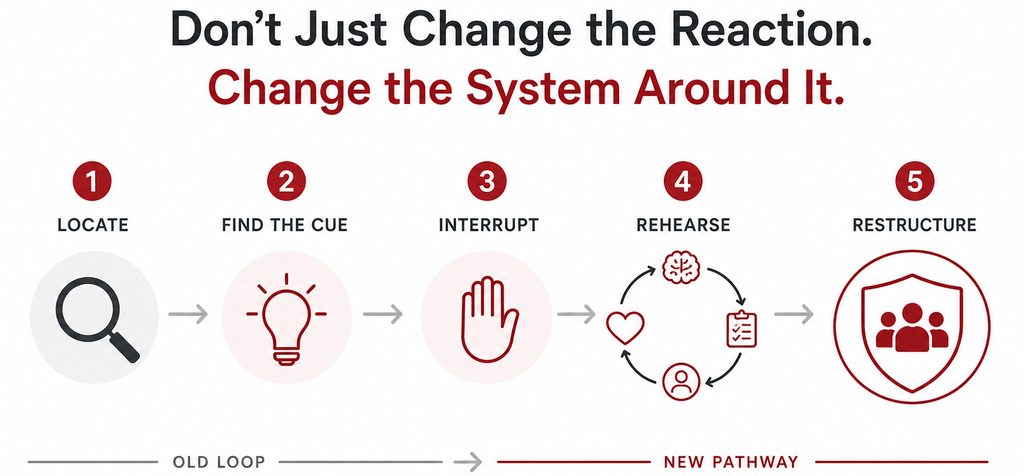
Locate the pattern, not the belief. Not “I have a confidence issue.” Instead: when a client pushes back on price, I discount within four seconds. The specific patterns that keep undercharging in place are always this concrete once you look.
Find the cue. Every automatic response has a trigger. Identify what fires immediately before the behaviour.
Interrupt it live. Not in retrospect, and not in theory. In the state, while it’s running.
Rehearse the replacement. Repetition in a stable context is how the old pattern got installed. It’s how the new one installs too.
Change the structure so the cue stops firing. This is the part the standalone practitioner never does, and it’s the difference between a good session and a changed year.
Frequently Asked Questions
Can a life coach also be an NLP practitioner?
Yes, and many are. NLP certification is a training people add to a coaching practice rather than a separate profession. What matters is whether they actually use the pattern tools in session or just list the credential on their About page. Ask what a session looks like minute by minute.
Is an NLP practitioner better than a life coach?
No, they’re built for different jobs. A practitioner working on your automatic reactions when what you actually need is clarity about your direction will waste your time as thoroughly as a coach discussing a pattern you’ve run for a decade. Match the tool to what’s stuck.
How long does pattern work take to show results?
Individual reactions can shift quickly, sometimes in a session or two, because you’re changing one specific sequence rather than rebuilding a personality. Durable change in how you run your business takes longer, because the environment that cued the old pattern has to change too. Be sceptical of anyone promising permanence in an afternoon.
Do I need certification checks before hiring either one?
Certification tells you someone completed a course, not that they’re good. Neither field has a licensing board that can strike someone off. Weight referrals, a clear explanation of method, and a specific answer to “what will we actually do?” are far above the letters after the name.
Is NLP the same as therapy?
No. Therapy is delivered by licensed clinicians who can assess and treat diagnosable conditions and are accountable to a regulatory college. NLP practitioners are not clinicians and should not be treating mental health conditions. If you’re weighing the two, the boundary matters more than the technique.
I’ve already tried coaching and it didn’t stick. Was it a waste?
Almost certainly not. Coaching usually does its job it gets you clear. What it can’t do on its own is release a pattern strong enough to override your intentions, or rebuild the structure that keeps cueing it. The clarity you already bought is the foundation; it just wasn’t the whole build.
The honest close
James had read everything. He’d trained in the tools. He could have sat across from someone in exactly his situation and walked them through it competently while working 80-hour weeks himself, on anxiety medication, calling it success. Knowledge was never his shortage.
What changed it was his niece asking why he doesn’t visit anymore.
These days he’s home for dinner with his phone in another room, and he takes a 36-minute nap without apologising for it. Not because he stopped caring about the business. Because he stopped confusing understanding the problem with dismantling it.
If you’ve read this far, you probably already know which side of the life coach vs. NLP practitioner question you’re on. You know the move. You haven’t made it.
Book a Freedom Blueprint 30 Minutes Call. We’ll find the one thing that’s actually keeping you stuck. No pitch unless you ask for one.