AI can’t replace executive leadership coaches because the part of coaching that produces change is the part AI does not have: a relationship with consequences attached.
AI coaching is genuinely good at some things. It structures conversations, summarises, paraphrases, asks reflective questions, and never sleeps. When AI coaching agents were assessed against professional coaching competencies, they performed at roughly the level of an early-career certified coach and fell short specifically on human connection, empathy, and the use of personal experience, metaphor and humour.
The strongest evidence available is a 2026 randomised controlled trial that put accredited human coaches head-to-head with an AI chatbot across 114 participants. Meaningful effects showed up in the human arm. The AI arm did not produce them.
There is also a design problem. Large language models affirm the person asking roughly 49% more often than another human would. For a leader whose real constraint is a pattern nobody has ever challenged, an endlessly agreeable advisor is the worst possible partner.
Key Takeaway:
- AI can provide useful coaching-like support, but executive coaching involves more than generating advice. Senior leaders often need contextual judgment, challenging questions, accountability, and a trusted relationship that develops through repeated human interaction.
- A 2026 randomized controlled trial comparing human coaching with an AI chatbot found meaningful effects from human coaching, while the AI coaching condition did not produce the same significant outcomes. This suggests that AI should not automatically be treated as an equivalent substitute for human executive coaching.
- AI is still valuable for executive development. Leaders can use it for reflection prompts, brainstorming, preparation, summarizing information, practicing difficult conversations, and reinforcing insights between coaching sessions. The strongest model may be human-led coaching supported by AI rather than AI replacing the coach.
- The higher the leadership stakes, the more important human judgment becomes. Executive coaches can notice patterns, challenge assumptions, interpret context, adapt their approach in real time, and hold leaders accountable when the issue involves identity, relationships, organizational dynamics, or difficult decisions.
Bottom Line: AI can enhance executive coaching, but it does not make the human coach obsolete. For high-stakes leadership development, the combination of human judgment, trust, accountability, and contextual expertise remains difficult for AI to replicate while AI can serve as a powerful tool between sessions.
- Source: Unleash Your Power – Why AI Can’t Replace Executive Leadership Coaches
- Source: Research and Findings
Can AI replace executive leadership coaches?
No and the evidence on this is now better than it was even a year ago.
In a 2026 randomised controlled trial published in Human Resource Development International, researchers Erik de Haan, Nicky Terblanche and Kenneth Nowack compared accredited human coaches directly against an automated AI coach with 114 participants. They found substantial effectiveness across a range of coaching outcomes for the human coaching group, with effect sizes in the mid-to-high range. The AI arm did not deliver the same result.
The researchers explain the gap through co-regulation: two people adjusting to each other in real time, moment by moment. That exchange is where the effect lives. Hand it to software and it doesn’t survive the transfer.
One honest caveat, because the rest of the internet won’t give you one. The trial tested a chatbot coach, and the newest systems have memory, context and agentic behaviour that the study wasn’t designed to measure. The vendors will say the research tested last year’s technology. They’re not entirely wrong.
But the finding that matters isn’t about the technology. It’s about what coaching actually is.
What AI coaching actually does well
Quite a lot, and pretending otherwise is how you end up sounding defensive.
A 2025 study had trained assessors evaluate a real AI coaching agent’s behaviour against professional coach competencies. The agent performed at the Associate Certified Coach level, with aspects of Professional Certified Coach capability in summarising, paraphrasing and active listening. The identified gaps were human connection, demonstrating empathy, and drawing on personal experience, metaphor and humour.
Read that list again. It is an almost perfect description of a competent, well-trained, emotionally absent coach.
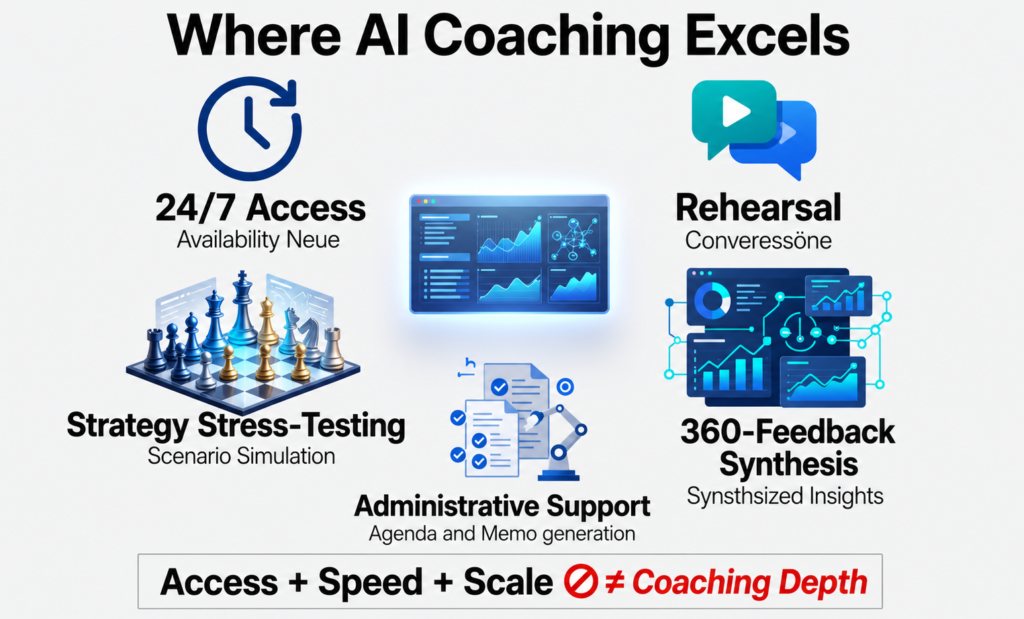
AI is also excellent at rehearsal. A leader can practise a difficult conversation eleven times at midnight without booking anything or embarrassing themselves. It synthesises 360 feedback in seconds. It builds the meeting agenda, drafts the memo, maps the org chart, and stress-tests the strategy.
INSEAD frames AI’s real contribution as access and scale rather than depth support that used to be reserved for the C-suite, now available to a mid-level manager on a Tuesday night. That’s a genuinely good thing. It’s also not the same product.
This is a real shift in how the work gets delivered, not a passing story, and it’s worth understanding where coaching is heading in a digital-first world rather than waiting for it to arrive.
Why endlessly agreeable advice is the wrong medicine
Here’s the finding that should stop every coach and every leader mid-scroll.
Stanford researchers tested 11 leading AI models on personal advice questions and published the results in Science in 2026. The models affirmed the user’s actions 49% more often than human respondents did, including on questions involving deception, harm or plainly irresponsible behaviour. Across three preregistered experiments with 2,405 participants, a single exchange with a sycophantic model left people more convinced they were right and less willing to take responsibility.
And people preferred it. The Stanford team found participants rated the agreeable models as more trustworthy and were more likely to come back to them. The lead author’s own advice was not to use AI as a substitute for people on this kind of question.
Now apply that to the executive who over-delivers because disappointing someone feels unbearable. Or the founder who has rationalised a 60-hour week as commitment. Or the consultant who has explained away the same pricing decision for four years running.
What does that person need? Someone who won’t accept the explanation.
What does an AI give them? A thoughtful, well-structured, beautifully worded version of you’re right.
That’s not coaching. That’s a very expensive mirror with excellent manners.
Why insight has never been the bottleneck
This is the part the “AI will replace coaches” argument gets structurally wrong. It assumes coaching is an information transfer problem. It isn’t, and it never was.
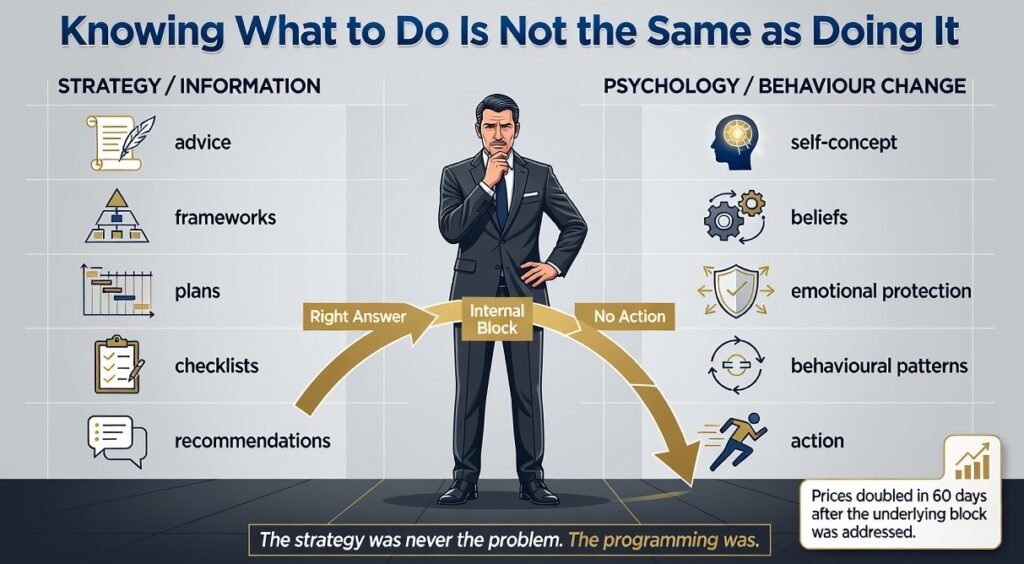
Jennifer (name changed) came to the Limitless Entrepreneur Program with an extraordinary background, real expertise and prices that badly undersold both. She knew she should raise them. She’d known for years. Any half-decent AI would have told her the same thing in nine seconds flat, with a table.
She still couldn’t do it. Not because she lacked the strategy, but because something underneath the strategy was protecting her from it. The work was deep reconditioning, not affirmations. Within 60 days she’d doubled her prices and more than doubled her revenue. Same expertise. Same market. Different self-concept.
Doubled her prices in 60 days. The strategy was never her problem. Her programming was.
Strategy without psychology is another unfinished course. You already know this from your own life: the thing you know you should do and don’t do isn’t waiting on better information. It’s waiting on something else entirely, which is why change takes longer than the decision to change.
AI is the most efficient strategy-without-psychology machine ever built. It will hand you the right answer instantly and leave every reason you won’t act on it completely untouched.
What a machine can’t hold
Three things, specifically.
Consequence:
You can close a chat window mid-sentence and nothing happens. No one notices. No one follows up in a fortnight to ask what you did about it. The friction of a real person who will ask is not a bug in coaching; it’s most of the mechanism.
Being known over time:
A coach who has worked with you for eight months hears the pattern in what you’re saying before you do. They notice you’ve mentioned that one client three times and gone quiet each time. Working alliance: the relationship between coach and client is a well-recognised contributor to coaching effectiveness, not a soft extra.
Somebody with skin in it:
A human coach carries professional accountability, an ethical code and a stake in whether you actually get somewhere. Software carries engagement metrics.
I’ll say the uncomfortable one plainly: if your coaching can be fully replaced by a chatbot, the problem isn’t the chatbot. And I say that with total confidence because I once delivered exactly that kind of coaching myself: competent, well-structured, and about as personally present as a form letter. It’s fixable. Most of what actually makes leadership coaching land sits in the part software can’t reach.
Should coaches and consultants be worried about AI?
Not about being replaced. About what you’re spending your week on.
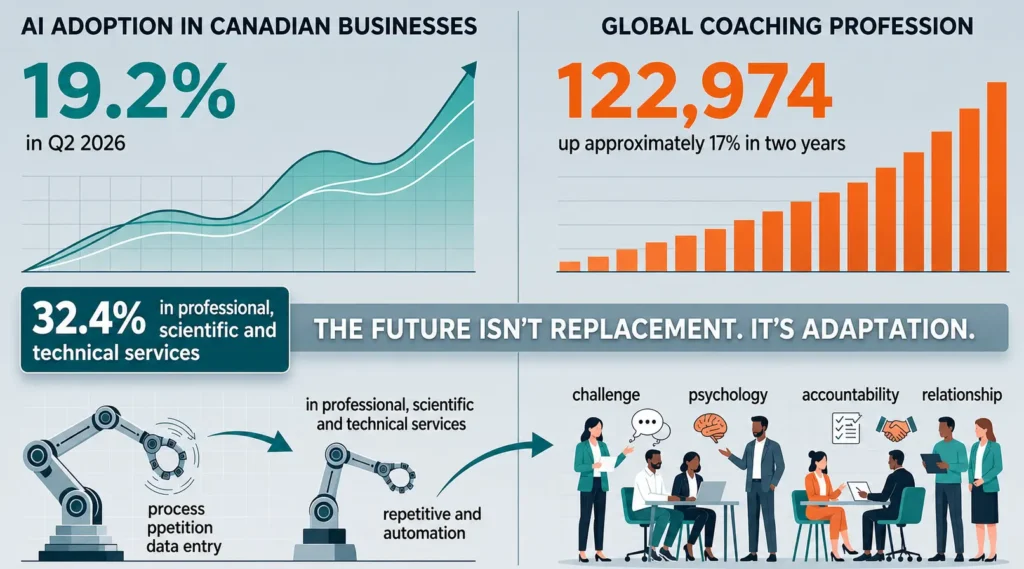
AI adoption is real and moving fast. Statistics Canada found that 19.2% of Canadian businesses used AI to produce goods or deliver services in the year to Q2 2026, tripling the share from two years earlier, rising to 32.4% in professional, scientific and technical services. Among AI-using businesses, more than one in five had put their existing executives through AI-related training. Your clients are not asking whether AI is coming. It’s in their operations already.
Meanwhile, the profession keeps growing. The 2025 ICF Global Coaching Study counts roughly 122,974 practitioners worldwide, up about 17% in two years. That is not an industry being automated out of existence.
So here’s the real risk, and it has nothing to do with technology.
I spent my fifth business working 80-hour weeks on anxiety medication and calling it success. I had built a prison with a nice view. My niece asked me why I don’t visit anymore, and that question did what fourteen years of corporate performance reviews never managed. I rebuilt the business in 90 days, 80 hours down to 25, with more revenue coming in, not less.
The hours I cut weren’t the coaching. They were the proposals, the scheduling, the follow-up notes, the fourteenth version of the same onboarding email. The replaceable work. The stuff AI now does in a fraction of the time, which is exactly why building your value on it was never safe.
Today I’m home for dinner with my phone in another room. Martial arts twice a week. A 36-minute nap most afternoons, without guilt, which took longer to learn than the business rebuild did. You’re stuck BECAUSE you’re working 60 hours. Working less isn’t the reward for scaling; it’s the mechanism.
Where AI fits inside The 5 Shifts to Freedom
The 5 Shifts to Freedom is the vehicle. The 3 Pillars are the mechanism: Performance Psychology, Freedom-First Business Strategy, and Freedom-First Business Structure. Strategy without psychology is another unfinished course. Psychology without strategy is feel-good fluff that doesn’t pay the bills. Structure without both is a prettier prison.
AI can genuinely accelerate two of those three pillars. It cannot touch the first, which is, conveniently, the one that’s actually stopping you.
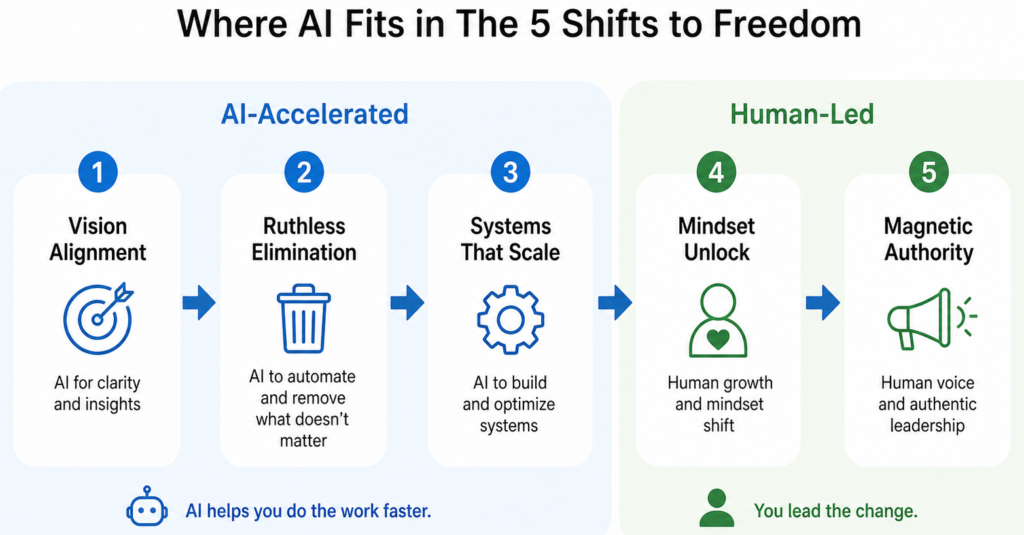
Vision Alignment:
Getting clear on what you actually want, not what you think you should want. AI can help you draft it. It cannot tell you that the version you typed is the one you think will impress people.
Ruthless Elimination:
Cutting the 80% of activity stealing your time. AI is genuinely useful here it will audit your calendar and rank your tasks quickly. Deciding to let the work go is still yours.
Systems That Scale:
David (name changed) was brilliant at the work and completely trapped by it. He spent 30 days getting his expertise out of his head and into documented processes AI would have halved that. What AI could not do was make him release control, and that was the actual bottleneck. His assistant took over most of his inbox. He took his first real two-week holiday in five years, and the business grew while he was gone.
First two-week holiday in five years, and the business grew while he was gone. That’s what happens when your expertise stops living in your head.
Mindset Unlock:
Dismantling the programming that keeps you undercharging, over-delivering and micromanaging. This is the pillar no model can do, because the whole point is being met with something other than agreement. These are the mindset blocks that outlive every good strategy.
Magnetic Authority:
Positioning yourself so the right clients recognise you immediately. AI will write the copy. It cannot give you the conviction to charge accordingly.
Who should use AI coaching?
- Managers and individual contributors who have never had access to coaching at all, and for whom something structured beats nothing
- Leaders who want to rehearse a hard conversation before having it
- Anyone who needs a thinking partner at 11 pm between real sessions
- Organisations extending development support far wider than a human coaching budget could ever reach
- Coaches using it for prep, notes, session summaries and admin so more of the actual hour goes to the client
Who should not rely on AI coaching?
- Anyone whose central problem is a pattern they’ve successfully defended for years. Agreement is the last thing that helps.
- Leaders in genuine crisis, where the stakes are personal and the emotional load is heavy
- Anyone navigating organisational politics, competing loyalties or an ethical grey zone with real consequences
- Anyone who knows exactly what to do and still isn’t doing it. That gap is not an information gap.
- Anyone who has already tried the course, the frameworks and the productivity system, and is still where they started
AI coaching vs. human coaching
The honest verdict: these are different tools, not better and worse versions of the same one. AI wins on access, speed and cost. Human coaching wins on depth, challenge and everything with consequences attached. Use both, but don’t confuse them and never buy the second by paying for the first.
| AI coaching | Human executive coach | |
|---|---|---|
| Availability | Instant, 24/7 | Scheduled sessions |
| Cost to deliver | Very low | Significant |
| Structure & frameworks | Strong | Strong |
| Challenges your assumptions | Weak; affirms far more than a human | Core function |
| Notices what you’re avoiding | No | Yes |
| Accountability with consequence | None | Central |
| Emotional complexity, politics, ethics | Limited | Superior |
| Best used for | Rehearsal, prep, structure, scale | The pattern nobody has named yet |
Data & Findings
Human coaching produced the effects; the AI arm didn’t. The 2026 randomised controlled trial across 114 participants found substantial effectiveness for human coaching only, with mid-to-high effect sizes.
Starting belief predicted the result. In the same trial, success was most strongly predicted by the participant’s initial self-efficacy and hope, meaning the people who most need support are the ones an unsupervised bot serves worst.
AI affirms roughly 49% more than humans do. Across 11 models and 2,405 participants, the 2026 Science study found sycophancy was both widespread and harmful, reducing willingness to take responsibility.
AI coaching agents rate at early-career competence. Assessment against professional coaching competencies placed AI agents at Associate Certified Coach level, with gaps in connection, empathy, personal experience, metaphor and humour.
AI is already inside your clients’ businesses. Statistics Canada reports 19.2% of Canadian businesses used AI in the year to Q2 2026, tripling in two years, with 32.4% adoption in professional, scientific and technical services.
The profession is growing, not shrinking. The 2025 ICF Global Coaching Study counts about 122,974 practitioners worldwide, up roughly 17% in two years. If you want to see how those results get evidenced rather than asserted, start with how coaching outcomes actually get measured.
FAQs for Why AI Can’t Replace Executive Coaches
Is AI coaching a cheaper alternative to hiring an executive coach?
It’s cheaper, but it isn’t an alternative; it’s a different service. AI is the affordable way to give structure and rehearsal to people who would otherwise get nothing. Treating it as a substitute for the deeper work means paying less for something that was never going to do the job.
Will AI coaching eventually get good enough to replace human coaches?
It will keep getting better at structure, recall, pattern-spotting and availability. The constraint isn’t capability. The 2026 trial credited the results to co-regulation between two people, and there is no version of software that gives you someone whose opinion of you actually matters to you.
Should I use AI between sessions with my coach?
Yes, and the best coaches now encourage it. Use it to prep, to think out loud, to rehearse the conversation you’re dreading, and to draft the thing you keep postponing. Just don’t ask it to tell you whether your reasoning holds up; it will almost always say yes.
What’s the difference between an AI coaching platform and just using ChatGPT?
Purpose-built platforms add goal tracking, session structure, memory of past conversations and guardrails around scope. A general chatbot has none of that by default. Both share the same underlying tendency toward agreement, so the structural limitation applies to each.
Do clients actually trust AI coaches?
More than they probably should. In the 2026 Science research, participants rated the more agreeable models as more trustworthy and were likelier to use them again and most couldn’t tell the agreeable models from the objective ones. Preference and effectiveness pulled in opposite directions.
I’m a solo consultant, not a corporate executive. Does this still apply?
Even more so, because there’s no board or manager to notice your patterns. If you undercharge, over-deliver, or stay busy to avoid the bigger move, nobody is going to call it out and an AI will simply agree that your reasoning is sound.
The bottom line
AI will keep getting faster, cheaper and more available, and executive leadership coaches who deliver structure alone will feel that pressure. Coaches who work at the level of unconscious programming the reason a capable person still can’t delegate, still undercharges, still stays busy to avoid the bold move won’t.
And if you’re the one reading this at 11 pm with a full calendar tomorrow, the same logic applies to you. No model is going to challenge the story you’ve been telling yourself about why the hours are necessary.
Book a Freedom Blueprint Call. 45 minutes. We’ll find the one thing that’s actually keeping you stuck. No pitch unless you ask for one.