
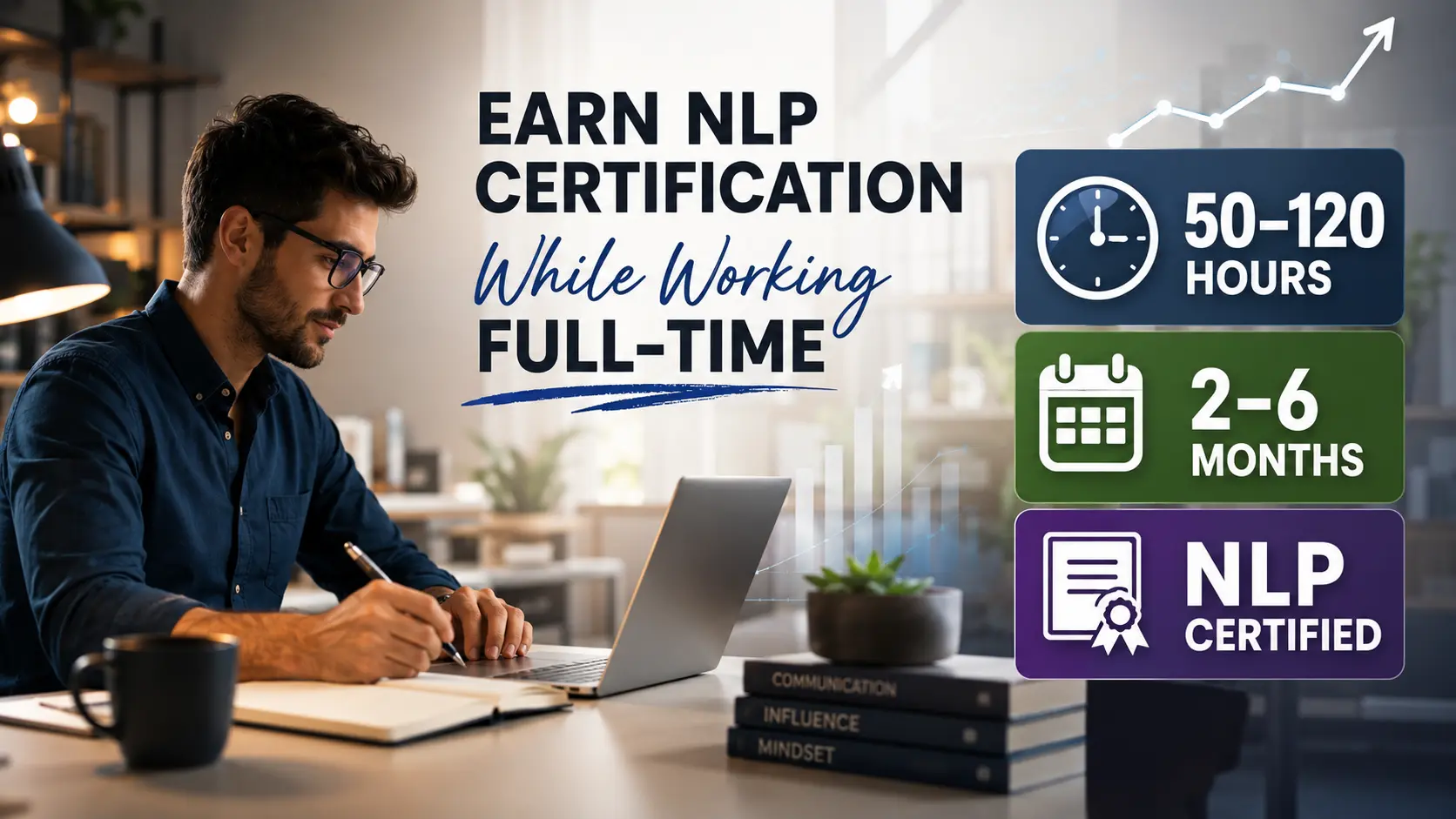
A lot of professionals spend years saying the same thing.
“I’ll get NLP certified when work slows down.”
The problem is, work doesn’t slow down. The project ends and another one starts. The quarter closes and a new one opens. Life fills every gap you give it. And somewhere in the back of your mind, that goal keeps sitting there, waiting.
Here’s what most people don’t realize: NLP certification doesn’t require pausing your life. Thousands of working professionals complete it while holding down full-time jobs, running businesses, and raising families. The path exists. You just need to know what it looks like.
In this guide, you’ll learn how long NLP certification actually takes, which training format fits a busy schedule, what to look for in a quality program, and whether the investment is genuinely worth it for where you are right now.
Key Takeaway:
- Yes, you can earn an NLP certification while working full-time by choosing a program designed for busy professionals. Flexible schedules, modular training, and blended learning formats allow you to build practical NLP skills without leaving your current job. [1]
- Success depends on selecting a high-quality program that includes live instruction, hands-on practice, experienced trainers, and ongoing mentorship. Practical application is far more valuable than completing a fast, theory-only certification. [1]
- Balancing work and certification requires consistent time management. Setting aside dedicated study periods, practicing NLP techniques between sessions, and immediately applying new skills in your workplace or personal life helps reinforce learning and improve long-term retention. [2]
- Before enrolling, compare program duration, accreditation, trainer credentials, class schedules, and post-certification support. Investing in a reputable training provider ensures your certification delivers meaningful personal and professional value long after the course ends. [2]
Bottom Line: Working full-time doesn’t have to delay your NLP journey. With a flexible, practice-focused certification program and consistent commitment, you can develop valuable communication, coaching, and leadership skills while continuing to advance your career.
- Source: Unleash Your Power – Can You Get NLP Certified While Working Full-Time?
- Source: FAQs Section
Can You Get NLP Certified While Working Full-Time?
Yes. The majority of professionals who earn NLP Practitioner certification do it while remaining fully employed.
Depending on the program, certification can be completed through weekend intensives, evening classes, live online training, self-paced online learning, or hybrid models that combine both flexibility and live interaction. Most NLP Practitioner certifications require approximately 50 to 120 training hours, which translates to a few concentrated weekends, a few months of online study, or a short intensive format. The schedule is more workable than most people assume.
The bigger barrier isn’t time. It’s the belief that the time isn’t there.
Why Busy Professionals Keep Delaying NLP Certification
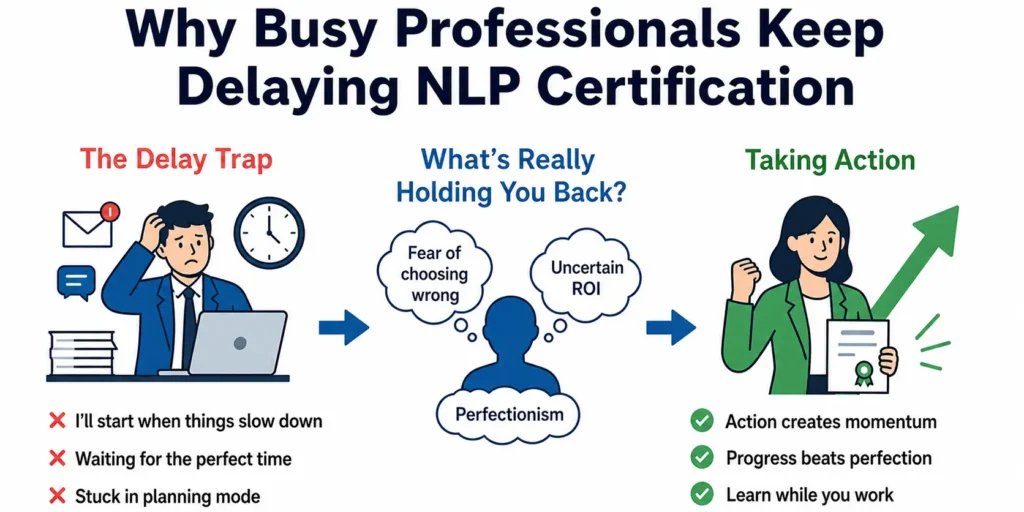
The “I’ll Do It When Things Slow Down” Trap
This is the most common reason professionals stall. They’re not uninterested. They’re waiting for the right moment. And the right moment keeps not arriving.
The irony is that this is exactly the kind of thinking NLP training helps you dismantle. Waiting for perfect conditions is a pattern, not a circumstance. High performers in every field don’t wait for the stars to align. They build the structure first and let momentum follow.
What’s Actually Keeping You Stuck
Beyond a busy calendar, there are usually a few things running underneath: worry about choosing the wrong program, uncertainty about whether the investment will pay off, and a quiet perfectionism that says you’ll do it better when you’re ready. These aren’t calendar problems. They’re mindset patterns. And they tend to respond well to action, not more planning.
Darren G. came to James’s program at a point that felt like a wall. Good career, solid income, but stuck just short of what he actually wanted. He felt like something was holding him back from the next level, but couldn’t name it. After working through the program and identifying the goal blocks underneath that frustration, things shifted. His thinking changed, his relationships improved, and the career ceiling he’d been hitting started to lift. He enrolled while working. He didn’t wait.
How Much Time Does NLP Certification Actually Take?
Typical NLP Practitioner Time Commitment
Here’s a realistic breakdown of what NLP Practitioner certification requires:
| Activity | Estimated Hours |
| Live Training | 30 to 80 hours |
| Practice Sessions | 10 to 30 hours |
| Reading and Review | 10 to 20 hours |
| Total | 50 to 120 hours |
For context, that’s comparable to a few college courses or a professional development program. Spread over a few months, it’s very manageable.
What “7 to 25 Days of Training” Really Means
You’ll see program descriptions that reference “7 to 25 days of training,” which sounds like a significant block of time. In practice, this breaks down very differently depending on the format. An intensive program might compress those days into two concentrated weekends. A weekend-spread format might run across three months of Fridays, Saturdays, and Sundays. An online program might deliver the same hours across evening sessions and self-paced study. The total training time is the same. The question is how it’s packaged.
NLP Practitioner vs Master Practitioner Timeline
If you’re planning your full certification path, here’s how the two levels compare:
Practitioner covers foundational NLP techniques and typically runs 7 to 25 days of training. Most working professionals focus here first and treat it as a complete qualification. Master Practitioner builds on that foundation with advanced language patterns, modeling, and values-level change work, and typically requires 9 to 20 additional days. Most people advance to Master Practitioner once they’ve had time to integrate and apply what they learned at the Practitioner level.
Certified Fast vs Certified Well
There’s a meaningful difference between a program that gets you through the hours quickly and one that builds real competency. NLP is a doing skill. Reading about rapport and actually building it with someone are two different things. The best programs prioritize practice, give you live interaction with a trainer, and include assessments that require you to demonstrate what you’ve learned. Speed matters less than depth. A certification that took three extra months to complete but gave you genuine skill will serve you far longer than one you rushed through.
Understanding Your NLP Training Options
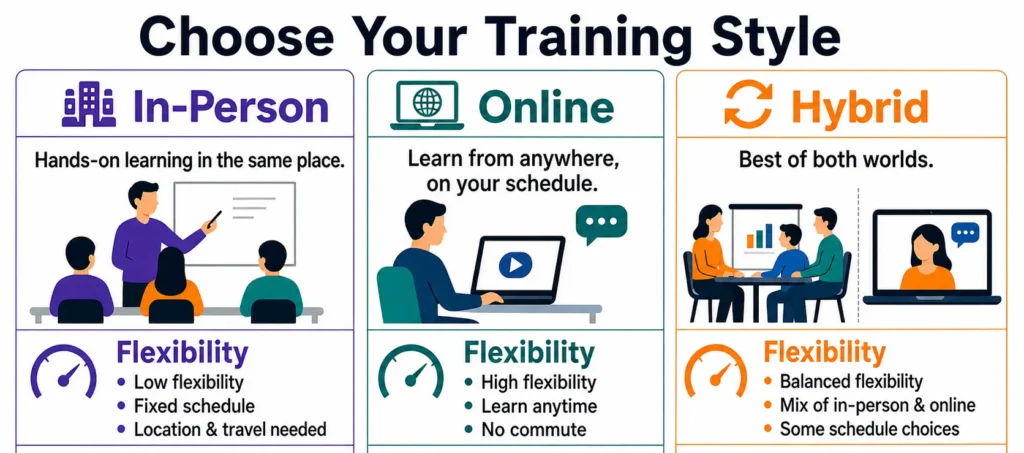
Intensive In-Person Programs
These programs compress certification into a short, focused block. Some intensive formats can certify you in as little as four to seven days, which makes them an appealing option if you can take a short run of vacation days or find a long-weekend program. The immersive environment is a genuine advantage. You’re practicing with other students, getting real-time feedback, and building skills in a way that’s hard to replicate through a screen. The tradeoff is that you need a concentrated window of availability.
Best for: Professionals who can take a focused block of time and want an immersive, fast-paced experience.
Online NLP Certification Programs
Online programs have matured significantly. The better ones include live Zoom sessions, small-group breakout practice, and direct access to a trainer. Self-paced online formats typically run three to six months, which gives you the flexibility to study on your own schedule without sacrificing depth. What to watch for: programs built entirely on pre-recorded video. NLP requires live practice. If there’s no live interaction in the curriculum, the skill development suffers.
Best for: Professionals with unpredictable schedules who need maximum flexibility without sacrificing live interaction.
For a deeper look at how the two formats compare, see Differences Between NLP Training Online and In-Person.
Hybrid Programs
Hybrid formats combine self-paced learning with scheduled live sessions and, in some cases, in-person components. They tend to offer the best balance for working professionals: you’re not locked into a rigid schedule, but you still have accountability, live practice, and a trainer who knows your name.
Best for: Professionals who want flexibility without losing the quality of live coaching and structured support.
How to Fit NLP Certification Into a Full-Time Work Schedule
The scheduling challenge is real, but it’s also very solvable. The professionals who complete certification while working don’t have more time. They just make different decisions about how they use it.
The Weekend Warrior Strategy
If you work Monday through Friday, weekends are your runway. Many NLP certification programs structure training across Friday evenings and weekends, which keeps your workweek clean and turns your weekends into an investment period. This works particularly well for professionals, parents, and entrepreneurs who can protect their weekends for a defined season, knowing it’s temporary.
Using Vacation Days Strategically
If you’re looking at an intensive format, a few well-placed vacation days can unlock a program that would otherwise be inaccessible. Taking four or five days off around a long weekend, for example, can cover the core training block of an intensive program. You don’t need a two-week sabbatical. You need focused pockets of time.
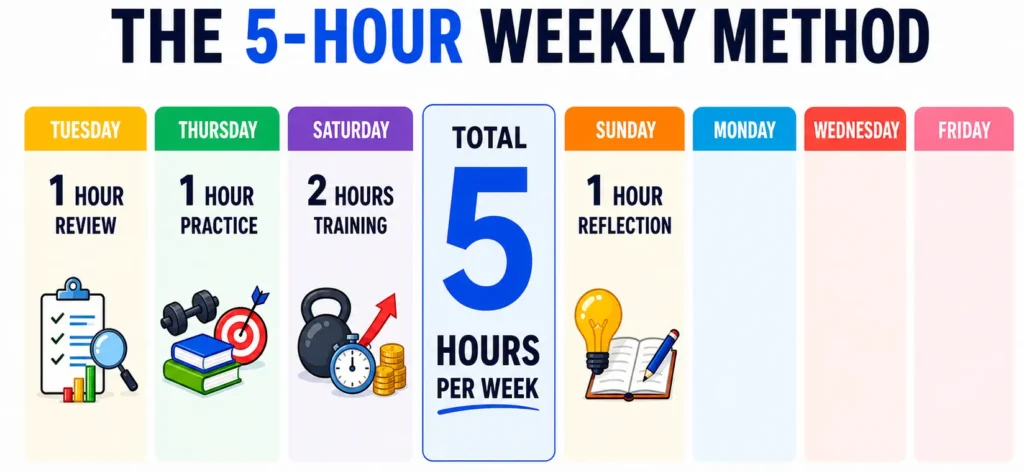
The 5-Hour Weekly Study Method
If you’re in a longer online program, building a consistent weekly rhythm is what separates people who complete it from people who drift. Here’s a simple structure that works:
| Day | Activity | Time |
| Tuesday | Review and reading | 1 hour |
| Thursday | Live session or practice | 1 hour |
| Saturday | Training or skill practice | 2 hours |
| Sunday | Reflection and application planning | 1 hour |
Five hours a week. That’s it. Maintained consistently over three to six months, it’s enough to complete most online NLP Practitioner programs without your work or family life taking a hit.
Try This: Block these four time slots in your calendar right now as recurring events. Label them “NLP Training.” Don’t leave them as intentions. Put them on the calendar before the program starts, and treat them the way you’d treat a client meeting.
Building a Support System
The professionals who finish tend to have people around them who understand what they’re doing and why. That might mean a direct conversation with your partner about what the next few months will look like, finding an accountability partner in your cohort, or connecting with a study group. The support structure doesn’t need to be elaborate. It just needs to exist.
How Much Does NLP Certification Cost?
Typical Investment Range
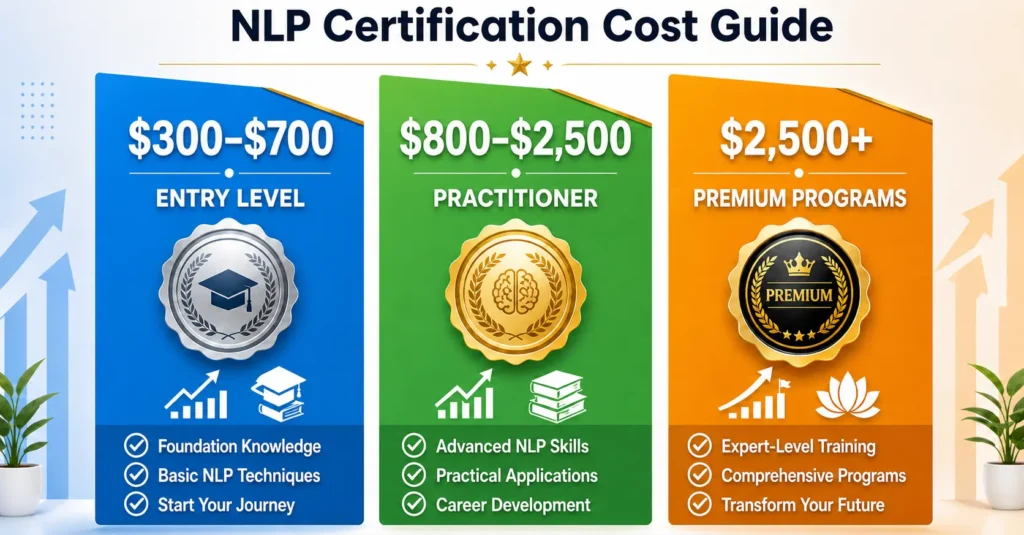
Costs vary depending on the program’s level, trainer experience, and delivery format. Here’s a general breakdown:
Entry-level programs ($300 to $700):
Usually self-paced online only. More accessible, but limited in live interaction and practical depth.
Mid-range programs ($800 to $2,500):
Includes live training components, assessments, and trainer access. This range covers most reputable NLP Practitioner programs.
Premium programs ($2,500 and up):
Typically include combined Practitioner and Master Practitioner paths, in-person intensive components, and extended post-graduation support.
What Influences Program Pricing
The main cost drivers are the trainer’s experience and credentials, accreditation by a recognized body, the number of live training hours included, and what kind of ongoing support is available after you complete the program. A program priced at $700 with zero live interaction and no practical assessment is not the same investment as one priced at $1,800 with a certified trainer, live coaching sessions, and a structured competency demonstration.
Why the Cheapest Option Isn’t Always the Best Value
NLP skills are worth developing well. A certification you can actually use, one that gives you real tools for communication, influence, and belief change, pays dividends across every conversation, every team interaction, every client session you’ll ever have. The ROI isn’t just financial. It shows up in how you lead, how you communicate, and how you move through challenges. For more on what that ROI actually looks like in practice, this breakdown of NLP certification for professionals goes into the specifics.
What to Look for in an NLP Certification Program
The right program comes down to trainer quality, practical application, and genuine support, not just price or speed.
Accreditation and Industry Recognition
Because NLP isn’t government-regulated, accreditation from a recognized body is how you gauge quality. Look for programs recognized by the ABNLP (American Board of Neuro-Linguistic Programming), INLPTA (International NLP Trainers Association), or aligned with ICF (International Coaching Federation) standards. These aren’t just logos. They signal that the curriculum, trainer qualifications, and assessment standards have been reviewed against international benchmarks.
Live Training vs Pre-Recorded Content
If a program is built entirely on video recordings you watch at your own pace, that’s a signal worth heeding. NLP is fundamentally a skills-based discipline. Rapport, anchoring, reframing, the Meta Model: these aren’t things you learn by watching someone else do them. You need to practice them, receive feedback, and adjust. Live sessions, whether in-person or on Zoom, are what make the difference between someone who knows about NLP and someone who can actually use it.
Trainer Experience Matters
The trainer shapes everything. Before enrolling, find out how long they’ve been teaching NLP, what their real-world coaching or practice experience looks like, and what results their graduates have achieved. A trainer with 20 years of experience and a body of genuinely transformed clients teaches differently than someone who completed their own certification recently. In over 20 years of working with clients, what I’ve consistently seen is that the depth of skill development follows the depth of the teacher. Choose accordingly.
Ask These 7 Questions Before Enrolling
Try This: Before you shortlist any program, run through these seven questions for each one you’re considering. Write down the answers. The gaps will make the decision obvious.
- Who accredits this certification?
- How many live training hours are included?
- How much practice is required, and how is it structured?
- Are assessments included, and what do they involve?
- What support is available after graduation?
- Who specifically teaches the training?
- What have graduates gone on to achieve?
For a side-by-side look at available options, see NLP Certification Programs.
Who Should NOT Pursue NLP Certification Right Now?
NLP certification is genuinely powerful. It’s also not the right move for everyone at every moment.
It may not be the right fit right now if you’re looking for a quick credential to list on a resume without applying what you learn. If you’re expecting a regulated mental health qualification, NLP certification is not that. If you genuinely don’t have five hours a week to dedicate over the next few months, pushing through a program while chronically under-resourced tends to produce a certificate but not competency.
The best results come from professionals who are ready to practice what they learn in real conversations, with real people, starting during the training itself. That willingness to implement is what separates the people who transform from the people who simply collect something and move on.
Data and Findings
The demand for NLP-trained professionals isn’t guesswork. The numbers behind the coaching and personal development industry point clearly to where this field is heading.
According to ICF and PwC data compiled by EntrepreneursHQ, the global coaching market was valued at $6.25 billion in 2024 and is projected to reach $7.30 billion by 2025. Revenue from professional coaching has grown 60% since 2019. The number of active coaches worldwide is expected to grow from 145,500 in 2024 to approximately 167,300 by 2025, more than doubling the 2019 figure of 71,000.
What this means for professionals considering NLP certification: the market for coaching, leadership development, and communication training is growing, and it’s growing fast. Certified practitioners are in a stronger position to move into this space, whether as internal leaders, external coaches, or consultants.
A few data points that stand out:
- Certified coaches earn approximately 28% more than non-certified counterparts, according to industry benchmarks compiled by Gitnux
- 73% of clients and organizations now expect coaches to hold recognized credentials before engaging
- Executive coaching delivers an average 788% ROI, making it one of the highest-return professional development investments tracked
- 60% of business coaching clients report measurable increases in revenue or productivity following coaching engagements
For working professionals, this data reinforces what James has observed across 20 years of training: NLP certification isn’t just a personal development milestone. It’s a professional asset that compounds over time. The skills you build during certification don’t stay in the training room. They show up in every negotiation, every difficult conversation, and every leadership moment you navigate.
Is NLP Certification Worth It for Working Professionals?
Benefits Within Your Current Role
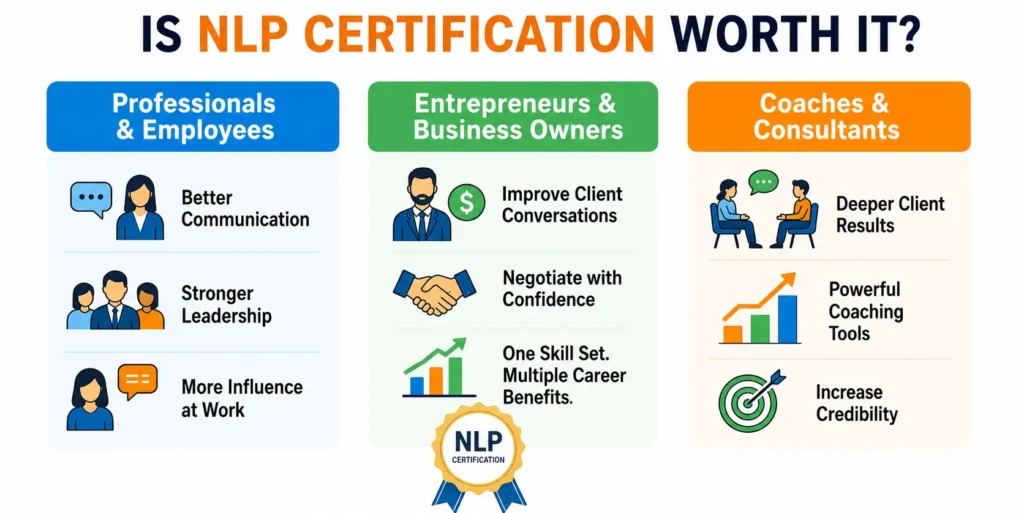
The skills you develop through NLP Practitioner training are immediately applicable at work. A better rapport means your ideas land better. Clearer internal communication means less emotional noise when decisions get hard. An understanding of how people process language means you lead, manage, and influence with far more precision. Many professionals report measurable career gains within months of completing their training, and the communication tools tend to stay with you long after the credential itself.
Benefits for Entrepreneurs and Business Owners
If you’re running a business, NLP certification is an investment in your most important tool: how you communicate. Client conversations become more effective. Negotiations become less adversarial. Your ability to understand what someone actually needs, not just what they say they need, sharpens considerably. These are skills that compound across every business interaction you’ll ever have. For a closer look at how NLP applies in business contexts, NLP for Business outlines the direct applications.
Benefits for Coaches and Consultants
If coaching is part of your current role or a direction you’re exploring, NLP certification adds a structured, evidence-based toolkit to your practice. Techniques like anchoring, timeline work, and reframing give coaches measurable ways to help clients shift patterns that talk-based approaches can take months to move. It deepens your credibility and, more importantly, your effectiveness.
Real Stories from Professionals Who Took the Leap
Darren G.: From Stuck to Breakthrough
Darren had a good job and a decent salary, but something kept blocking the next level. He couldn’t get the promotion, couldn’t build the business, couldn’t shake the feeling that something was holding him back. After working with James and doing the deeper work of identifying and dismantling his goal blocks, things shifted in a way he hadn’t anticipated. His thinking changed. His relationships improved. The career trajectory he’d been frustrated about started opening up. He did this while working full-time. The program didn’t require him to step away from his career. It made his career better.
Heather Chetwynd: From Confusion to Clarity
Heather came to James’s NLP Practitioner training already familiar with NLP, having completed training elsewhere. But she left her previous program feeling confused about how everything fit together. James’s course gave her that missing clarity. She not only mastered how the tools connected but walked away with unexpected business insights and a sharper sense of direction for her professional future. She described leaving with a genuine toolkit rather than a collection of techniques she wasn’t sure how to use.
What Can You Do After Becoming NLP Certified?
Apply NLP Immediately in Your Current Role
You don’t need to change careers to benefit. Leaders use NLP to communicate with more precision and less friction. HR professionals use it to handle difficult conversations more skillfully. Sales teams apply it to build rapport and understand client needs more deeply. Managers use it to motivate and retain people in ways that actually work. The techniques become part of how you show up at work every day.
Expand Into Coaching or Consulting
NLP Practitioner certification is a solid foundation for moving into coaching. Combined with a formal life or business coaching credential, it positions you to work with clients professionally, whether as a side practice or a full career transition. Many of James’s graduates have used their NLP certification as the first step toward building their own coaching businesses. Life Coach Training Certification in Canada outlines what the next step looks like after the Practitioner.
Continue Your Professional Development
Once you have your Practitioner certification, the path forward includes NLP Master Practitioner, which deepens the advanced tools and moves you into modeling excellence and values-level change work. Combining NLP training with leadership certification or a formal coaching credential positions you at the intersection of communication mastery and professional authority. For more on why continuous learning is essential at every stage of your career, that piece goes deeper into the mindset behind staying in forward motion.
Frequently Asked Questions
Can I get NLP certified online?
Yes. Many accredited NLP programs offer live online, self-paced, or hybrid certification formats. The key is finding a program that includes live interaction, not just pre-recorded video, since NLP is a skills-based practice that requires feedback and real-time practice to develop properly.
How long does NLP Practitioner certification take?
Most programs require 50 to 120 hours total and can be completed in two to six months while working full-time, depending on the format you choose. Intensive in-person programs can compress the training into a shorter concentrated window of four to seven days.
Is NLP certification worth it for someone with a full-time job?
Yes. The communication, leadership, and mindset skills developed through NLP Practitioner training apply immediately to any professional role. Certified practitioners also earn approximately 28% more than non-certified counterparts, and many professionals report measurable career improvements within months of completing their training.
What’s the difference between NLP Practitioner and Master Practitioner?
NLP Practitioner covers the foundational techniques: rapport building, anchoring, reframing, the Meta Model, and basic timeline work. NLP Master Practitioner builds on that foundation with advanced language patterns, modeling, and values-level change work. Most professionals start with Practitioner and advance to Master Practitioner once they’ve had time to integrate and apply what they’ve learned.
Does my employer need to know I’m getting NLP certified?
No. Most professionals complete NLP certification independently during evenings and weekends. That said, many organizations support professional development and may be willing to contribute to the cost. It’s worth asking your HR department, especially if you frame the certification around communication, leadership, or team effectiveness.
Conclusion
NLP certification is closer than most people think. The timeline is realistic. The formats are flexible. The skills are immediately applicable.
What it actually takes is a decision, a schedule, and a program worth your time. Most professionals who complete it while working full-time will tell you the same thing: the hardest part was starting. Once they did, the question stopped being “Do I have time for this?” and started being “Why did I wait so long?”
If you’re ready to explore what NLP training looks like for your specific situation, NLP Training in Canada is a good starting point. You can also reach out directly to talk through the right certification path for where you are right now.
Your transformation is waiting. The schedule can be built. Take the first step.
Unleash Your Power: Stand Out, Take Action, and Create the Success You Want.