

Ontario corporate profits rose 7.6% in Q4 2024, according to the Financial Accountability Office of Ontario. Yet talk to most service business owners across the province and you’ll hear a different story: flat margins, tight cash flow, and a creeping sense that the harder they work, the less they keep.
The gap isn’t explained by the economy. It isn’t the tariff pressure, rising operating costs, or a shortage of clients. The 2025 Ontario Economic Report from the Ontario Chamber of Commerce found that 78% of Ontario businesses cite the cost of living as their top concern, but high-performing service firms are navigating these same conditions and protecting their margins anyway.
The difference is how those businesses are designed. Their pricing structure. Their overhead discipline. And yes, the decisions their owners are willing to make.
This article breaks down what 60%+ gross margins actually look like in a service business, why most firms plateau well below that, and the practical shifts in structure and thinking that separate the ones who get there from the ones who don’t. You’ll walk away with a clear picture of what’s working and what to change first.
Key Takeaway:
- Service businesses in Ontario often achieve higher profit margins than product-based companies because they operate with lower inventory costs, fewer supply chain expenses, and stronger pricing flexibility. [1]
- The highest-margin service sectors typically include consulting, coaching, SaaS support services, marketing agencies, accounting, legal services, and specialized B2B expertise businesses. [2]
- Profitability depends heavily on labor efficiency, pricing power, recurring revenue, and the ability to productize services instead of relying entirely on hourly work. [3]
- Many Ontario service businesses improve margins by using automation, AI tools, standardized delivery systems, and retainers that increase revenue without proportionally increasing labor costs. [4]
- The most scalable service businesses focus on niche expertise, recurring client relationships, and operational efficiency rather than competing primarily on low pricing.
Bottom Line: Ontario service businesses can achieve strong profit margins when they combine specialized expertise, recurring revenue, and efficient delivery systems. Businesses that reduce dependency on hourly labor and improve operational leverage typically scale the fastest and most profitably.
- Source: Most Profitable Service Business Models
- Source: Shopify Canada – Most Profitable Businesses
- Source: SCORE – Improving Small Business Profit Margins
- Source: Reddit – High Margin Service Businesses That Scale
What Is a Realistic Profit Margin for an Ontario Service Business?
Before chasing a number, it helps to understand what you’re actually measuring and where most businesses genuinely land.
Industry Benchmarks: What Most Businesses Actually Achieve
Most service businesses in Canada operate in the range of 20 to 30% gross margin. That’s not a failure. It’s the reality for firms that haven’t made deliberate structural decisions around pricing and cost. Consulting firms, digital agencies, and specialised professional services can operate between 40 and 80% gross margin when they’re structured well, according to IBISWorld industry profitability benchmarks. The spread is wide because margins are driven by design, not luck.
You can dig deeper into what healthy profit retention looks like for Ontario businesses over at how much profit a small business should keep, a useful starting reference before you benchmark your own numbers.
What “60%+ Gross Margin” Actually Means in Real Dollars
Gross margin measures how much revenue remains after you subtract your direct delivery costs: the labour, materials, and tools tied directly to producing your service. It doesn’t include your overhead yet.
If your business generates $200,000 in revenue and your direct delivery costs total $80,000, your gross margin is 60%. That leaves $120,000 to cover operating expenses and generate profit. At scale, this becomes significant. A firm generating $800,000 in revenue at 60% gross margin has $480,000 to work with after delivery costs. The same revenue at 25% gross margin leaves just $200,000. That’s a $280,000 difference from the same client base.
Why Service Businesses Can Outperform Retail and Manufacturing
Service businesses carry structural advantages that most owners underuse. There’s no inventory burden eating into margins. There’s no factory floor to maintain. The primary input is expertise and time, both of which can be priced based on value delivered rather than cost incurred. That pricing flexibility is the foundation of high-margin service businesses, but most owners never fully leverage it.
Why Most Service Businesses Plateau at 20 to 30%
If the ceiling is higher, why do most firms stay low? Three structural patterns show up consistently.
The Hourly Billing Ceiling
When you bill by the hour, your revenue is capped by the hours you can sell. More clients mean more hours, which eventually means hiring to keep up. Overhead rises. Margins compress. The business grows in complexity without growing in profitability.
Hourly billing also creates a counterintuitive trap: the more efficient you get at delivery, the less you earn. There’s no financial reward for solving a problem faster when the client is paying for your time.
Underpricing Rooted in Competitive Comparison
Many Ontario service owners price by looking sideways at what competitors charge rather than looking at the value they actually create. This “market rate thinking” keeps pricing anchored to the floor of the industry rather than the ceiling of what high-value clients are willing to pay.
The result is a discount cycle. Owners compete on price, attract clients who value price over outcome, and build a business that’s hard to grow without constantly adding volume. As service pricing research consistently shows, premium providers often earn significantly more than market average while working with better clients and fewer headaches.
Labour Burden: An Ontario-Specific Reality Most Owners Miss
This one trips up a lot of Ontario business owners. The true cost of an employee isn’t their hourly wage. Once you layer in CPP contributions, EI premiums, WSIB assessments, benefits, and payroll administration, the fully loaded cost of an employee in Ontario typically runs 20 to 35% above their base wage. If you’re pricing labour at the base rate without accounting for this, you’re systematically underpricing every job that involves employees or contractors.
The Real Reason Your Margins Are Stuck
Once the structural issues are addressed, what remains? For many service owners, the sticking point is internal.
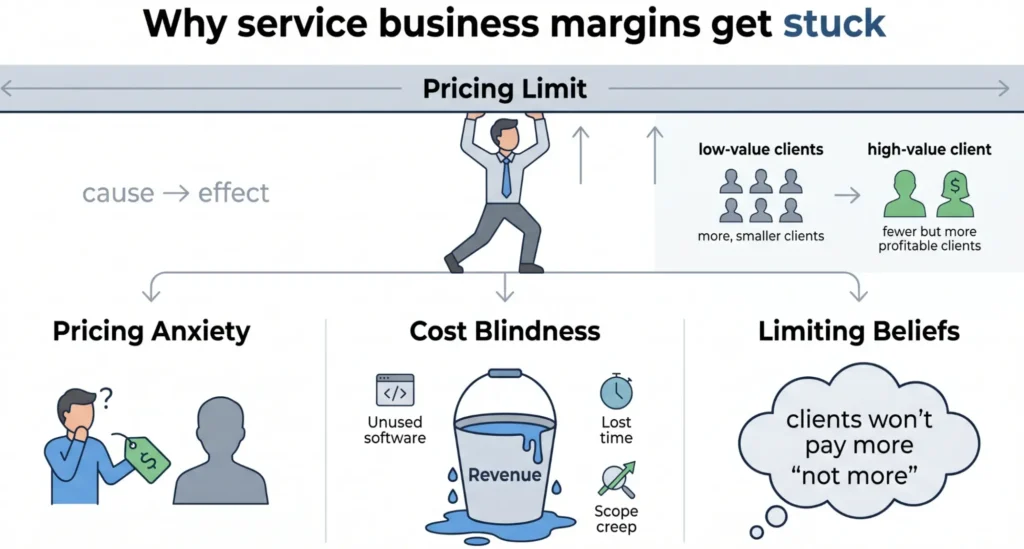
Pricing Anxiety and Undercharging Behaviour
Fear of losing clients is one of the most common reasons Ontario service owners undercharge. It feels rational: if I raise prices, I might lose business. But the math usually tells a different story. Losing one low-margin client to make room for one high-value client at a higher rate can improve profitability without adding a single new hour of work.
The discount dependency cycle is its own trap. Once you start discounting to close deals, clients come to expect it. The business trains itself to attract price-sensitive buyers, exactly the clients least likely to refer, least likely to stay, and least likely to value the results you deliver.
Cost Blindness in Service Delivery
Research shows that businesses typically only use about half the software they pay for. That means real money leaking out every month in redundant subscriptions, underused tools, and platforms no one opened this quarter. Beyond software, service businesses lose margin through untracked admin time, unbilled scope creep, and delivery inefficiencies that never make it onto an invoice. A quarterly cost audit often finds 10 to 20% of expenses that can be trimmed without any impact on service quality.
A Psychological Ceiling on Pricing Decisions
This is the part most business articles skip. The price you charge isn’t just a financial decision. It’s a reflection of what you believe your services are worth. If there’s an internal story running that says “clients won’t pay that” or “I’m not established enough to charge more,” that story sets a ceiling that no pricing strategy can break through on its own.
You can learn more about how these internal patterns show up in business decisions in this piece on overcoming limiting beliefs with NLP, a practical starting point for business owners who suspect the block is internal.
Try This: Write down the price you charge for your core service. Then write the price you’ve always thought about charging but talked yourself out of. Ask yourself: what would have to be true for that higher price to be reasonable? Most owners find the gap between those two numbers isn’t a market problem. It’s a confidence problem.
Why Pricing Confidence and Decision Psychology Affect Profitability
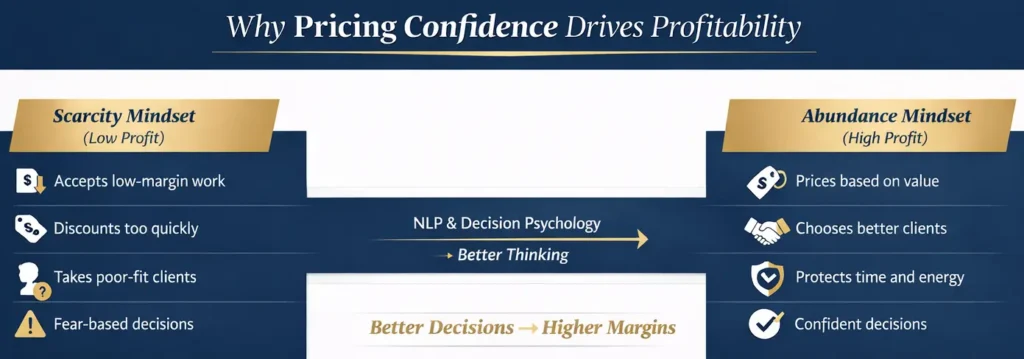
Scarcity vs. Abundance in Business Decision-Making
A scarcity mindset accepts low-margin work because something feels better than nothing. It says yes to clients who are a poor fit because it fears the pipeline drying up. It discounts because it doesn’t fully believe in the value being delivered.
An abundance mindset makes decisions from a different frame. It recognises that taking low-margin work blocks the time and energy needed to attract high-value work. It sets pricing based on outcomes delivered, not fear of rejection. The business that learns to operate from abundance, even before the revenue fully reflects it, consistently outperforms the one that stays in scarcity.
NLP and Belief Reconditioning in a Business Context
NLP (Neuro-Linguistic Programming) isn’t about positive thinking. It’s a structured approach to identifying the internal patterns that drive decisions and replacing the ones that don’t serve you with ones that do. In a business context, this means working through the belief systems around pricing, worth, and risk that keep owners charging less than the value they create warrants.
With more than 20 years of working with business owners as a Board Designated NLP Trainer, James has seen this pattern across hundreds of clients: the strategy is solid, but execution stalls because the internal narrative is running interference. You can explore how NLP supports business performance directly in this guide on NLP for business.
When the Shift Is Real: A Client Story
Darren G. came to James feeling stuck. He had a good job but felt blocked from the abundance he was working toward: unable to break into promotions, build his own business, or understand why results weren’t matching his effort. Through working with James to identify and eliminate goal blocks and limiting beliefs, Darren experienced radical shifts in his thinking and behaviour. Profitability, relationships, and direction all improved as a direct result of clearing the internal patterns that had been quietly running the show. That’s what decision psychology looks like in practice: not motivation, but restructured thinking that changes the choices you make day to day.
Pricing Model Comparison: Hourly vs. Value-Based vs. Retainer
One of the fastest levers for margin improvement is the pricing model itself. Here’s how the three most common models compare for Ontario service businesses:
| Pricing Model | How It Works | Margin Potential | Best For | Main Risk |
| Hourly Billing | Client pays per hour of work | Low to moderate (20 to 35%) | Variable scope, early-stage businesses | Income ceiling; efficiency is punished |
| Value-Based Pricing | Price set by outcome delivered, not time spent | High (50 to 80%+) | Specialized expertise with measurable results | Requires strong client relationships and pricing confidence |
| Retainer / Recurring | Fixed monthly fee for ongoing access or deliverables | Moderate to high (40 to 60%+) | Ongoing advisory, support, or content services | Scope creep if boundaries aren’t clearly defined |
The highest-margin Ontario service businesses typically combine value-based project pricing with retainer relationships. They earn well on projects and build recurring income that smooths cash flow and reduces pricing pressure month to month.
How to Build a High-Margin Service Business in Ontario
Value-Based Pricing vs. Hourly Billing
The core shift is moving from pricing based on time to pricing based on outcome. If your service saves a client $150,000 a year, what’s a fair price for that? Probably not $95 an hour. Value-based pricing asks: What is the economic value to the client of the result I deliver? Your price should be a reasonable fraction of that value, not a reflection of how many hours you logged.
This shift requires knowing your clients’ business objectives well enough to quantify your impact. It also requires the confidence to present that number without apologising for it.
The 60-15-15 Operating Framework
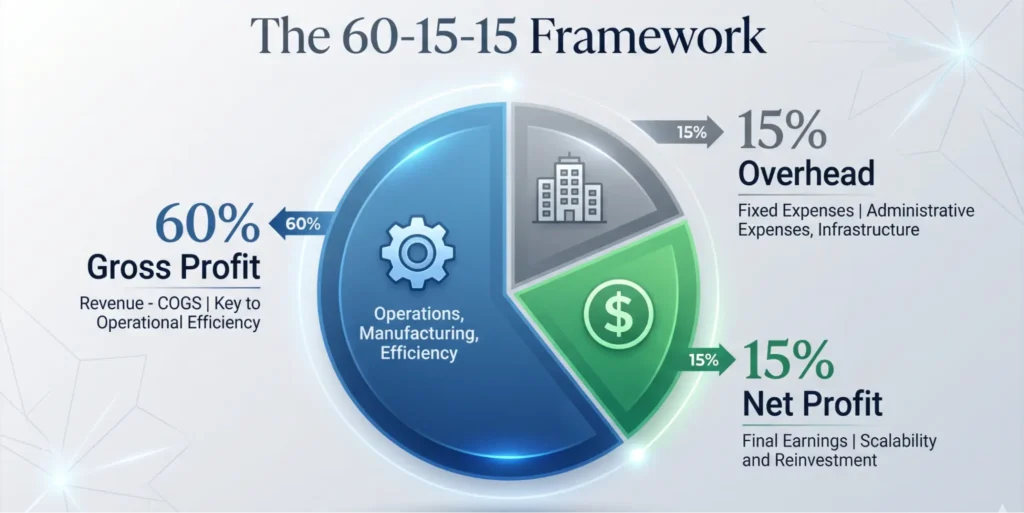
This is a useful structural target for service businesses aiming at sustainable high-margin operation, drawn from professional services profitability guidance:
- 60% goes to gross profit (after direct delivery costs)
- 15% covers operating overhead (admin, rent, software, marketing)
- 15% is your target operating profit before tax
That leaves a buffer for taxes, variable costs, and reinvestment. If your current numbers look nothing like this, you now know where to look first. For guidance on what to do with profit once you’ve built it, the article on smart reinvestment strategies is worth a read.
Eliminating Margin Leaks
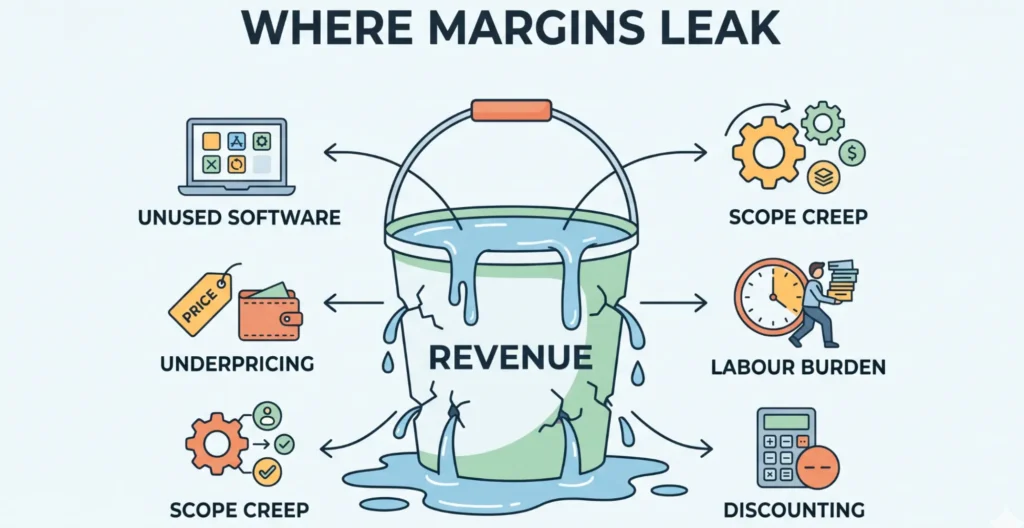
The fastest path to better margins isn’t always raising prices. Sometimes it’s stopping the bleed. Common leaks in Ontario service businesses include unbilled scope creep, software subscriptions that aren’t delivering ROI, admin time that doesn’t get tracked or invoiced, and low-margin client relationships that consume time disproportionate to their revenue.
A quarterly service line audit, calculating the fully loaded cost of each service against the revenue it generates, often reveals which offerings are actually driving profit and which ones are dragging it down.
Try This: Pull your last three months of work. For each client or project, calculate the total hours spent (including admin, revisions, and communication) multiplied by your true hourly cost. Compare that to the revenue earned. You’ll likely find one or two relationships that are quietly costing you money. That’s where the margin conversation starts.
What High-Margin Service Owners Do Differently
They Prioritise High-Value Clients
High-margin service businesses often serve fewer clients for more revenue. They make deliberate decisions to say no to clients who are a poor value fit, not because they’re turning away money, but because they understand that low-margin relationships occupy capacity that could serve better clients. The goal isn’t more clients. It’s better for clients.
They Use Retainers and Recurring Revenue Models
Predictable recurring income changes the psychology of the whole business. When you’re not starting from zero each month, you make better decisions: less discounting, more selective intake, less desperation-driven pricing. Retainer structures also signal a deeper, more integrated relationship with clients, which tends to increase both retention and referral rates.
They Calculate True Cost Per Service Line
High-margin owners know their numbers. Not just top-line revenue, but the fully loaded cost of each service, including labour burden, delivery time, overhead allocation, and hidden admin. This clarity allows them to make confident pricing decisions because they’re not guessing at their own profitability.
Why Mindset Alone Isn’t Enough But Still Matters
Here’s what’s important to say clearly: a mindset shift without structural change won’t move your margins. If your pricing model is fundamentally broken, believing more strongly in your value won’t fix it.
But a strategy without the psychological capacity to execute it tends to stall, too. Owners who know they should raise prices but can’t bring themselves to do it. Owners who know they should exit low-margin client relationships but keep finding reasons not to. The gap between knowing and doing is almost always a decision psychology problem, not an information problem.
Addressing both layers, the structural and the psychological, is what produces lasting margin improvement. The strategy creates the opportunity. The mindset determines whether you take it. You can dig into the business mindset side of this at mastering mindsets for business.
Putting It All Together: The Real Path to Higher Margins
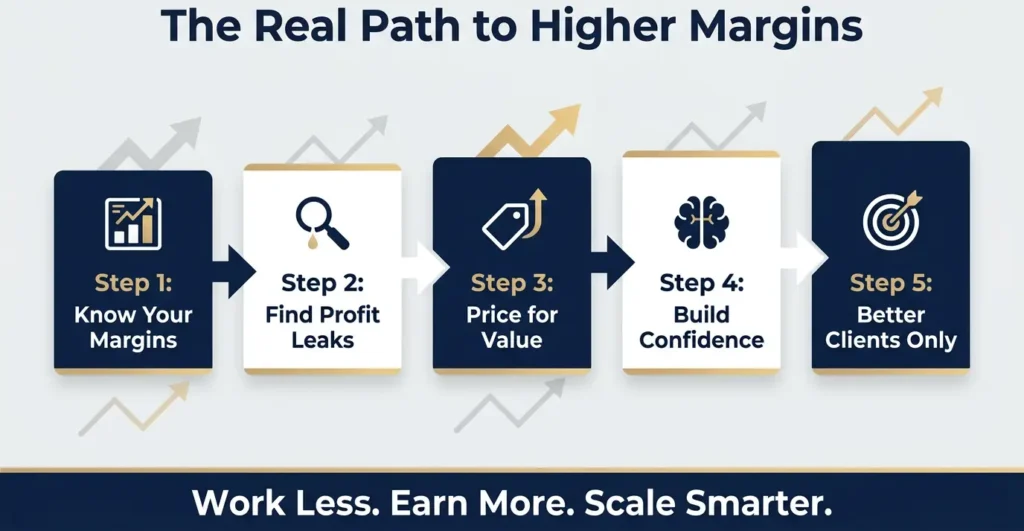
You don’t fix margins in one move. But there’s a clear sequence that works.
Step 1: Understand your actual benchmark.
Where are your gross margins now, by service line? What’s realistic to target, and over what timeframe?
Step 2: Find the structural leaks.
Audit costs, calculate true labour burden, and identify which clients and services are actually profitable.
Step 3: Upgrade your pricing model.
Move toward value-based pricing where possible. Test a higher price point on your next proposal and observe what happens.
Step 4: Work on decision confidence.
Identify where pricing anxiety or limiting beliefs are showing up in your business decisions. That’s the internal work, and it’s worth doing.
Step 5: Select better clients, not more clients.
One high-value relationship can replace three low-margin ones without adding a single hour to your week.
This is the work that builds a service business worth owning: one that pays you well, gives you time, and doesn’t require you to run harder just to stay in place.
If you’re ready to work on the decision-making layer alongside the strategy, James works with Ontario business owners through NLP training, business coaching, and the proven frameworks that have supported genuine transformation over more than 20 years.
Unleash Your Power: Stand Out, Take Action, and Create the Success You Want.
Data and Findings: What the Numbers Show
Here’s a snapshot of what the research tells us about service business margins across current industry sources. The pattern is consistent: margin gaps are rarely caused by demand. They’re caused by structure, pricing model, and cost visibility.
| Data Point | Finding | Source |
| Ontario corporate profits | Rose 7.6% in Q4 2024 | Financial Accountability Office of Ontario |
| Ontario business confidence | Doubled from 13% to 26% in 2024, but 48% still lack confidence | Ontario Chamber of Commerce 2025 OER |
| Typical service business gross margin | 20 to 30% for most firms | IBISWorld / Homebase Benchmarks |
| Consulting and specialized services | Can reach 60 to 80% gross margin when structured well | Bennett Financials |
| Software waste in business | Companies use roughly 50% of the software they pay for | Expense to Profit |
| Ontario labour burden | Fully loaded employee cost runs 20 to 35% above base wage | WSIB and CRA employer contribution guidelines |
| Value-based vs. hourly pricing | Premium providers can earn 200 to 500% more than market average | FieldCamp Service Pricing Guide |
Frequently Ask Question
What is a good profit margin for a service business in Ontario?
Most Ontario service businesses operate at a 20 to 30% gross margin. High-performing firms in consulting, digital services, and specialised professional services can reach 40 to 60%+ through deliberate pricing structure and overhead discipline. The right target depends on your service type, client profile, and cost base, but any service business operating below 20% gross margin has structural issues worth investigating.
How do I calculate gross profit margin correctly?
Gross profit margin is calculated by subtracting your direct delivery costs (labour, materials, and tools tied to producing the service) from your revenue, then dividing by revenue and multiplying by 100. Example: $200,000 revenue minus $80,000 direct costs equals $120,000 gross profit. Divided by $200,000 and multiplied by 100, your gross margin is 60%. Don’t include overhead in this calculation. That comes out later at the operating margin stage.
Why do most service businesses undercharge?
Undercharging typically comes from three sources: pricing based on what competitors charge rather than value delivered, fear of client pushback when prices are raised, and an internal belief that “clients won’t pay more.” All three are addressable, but the third often requires more than a spreadsheet. It requires working through the decision psychology that’s setting an invisible ceiling.
What is included in labour burden costs in Ontario?
In Ontario, the true cost of an employee extends well beyond their wage. Canada Pension Plan (CPP) contributions, Employment Insurance (EI) premiums, Workplace Safety and Insurance Board (WSIB) premiums, benefits, and payroll administration typically add 20 to 35% to a base wage. Many service business owners price labour at the base rate and wonder why jobs aren’t as profitable as expected. That’s usually the reason.
Can mindset really affect business profitability?
Not directly, but indirectly, yes, in significant ways. Pricing decisions, client selection, the willingness to say no to low-margin work, and the ability to hold firm on price in a negotiation are all decisions influenced by internal belief systems. A business owner who believes deeply in the value they deliver will make systematically different decisions than one operating from scarcity and self-doubt. Over time, those decisions compound into margin differences that show up clearly on a P&L.
Conclusion
Most Ontario service businesses don’t have a demand problem. They have a design problem.
The owners who reach 60%+ gross margins aren’t working harder or catching lucky breaks. They’ve made a set of deliberate decisions: how to price, which clients to take, where overhead is quietly bleeding out, and what internal beliefs are quietly running the show beneath every quote they send.
That’s the work this article has laid out. Benchmarks that give you an honest picture of where you actually stand. A structural framework that tells you where the money is going and why. Pricing model shifts that stop trading time for dollars. And a clear-eyed look at the psychology layer that determines whether any of the strategy actually gets executed.
None of this requires a complete business overhaul overnight. It starts with one honest look at your numbers, one pricing conversation you’ve been avoiding, one client relationship you already know isn’t working.
The service business you want to be running is built one decision at a time. The question is whether the decisions you’re making today are moving you toward 60% margins or keeping you stuck at 20.
If you’re ready to work through both the strategy and the mindset that drives it, James works with Ontario business owners through business coaching and NLP training built on more than 20 years of real-world results.
Unleash Your Power: Stand Out, Take Action, and Create the Success You Want.