
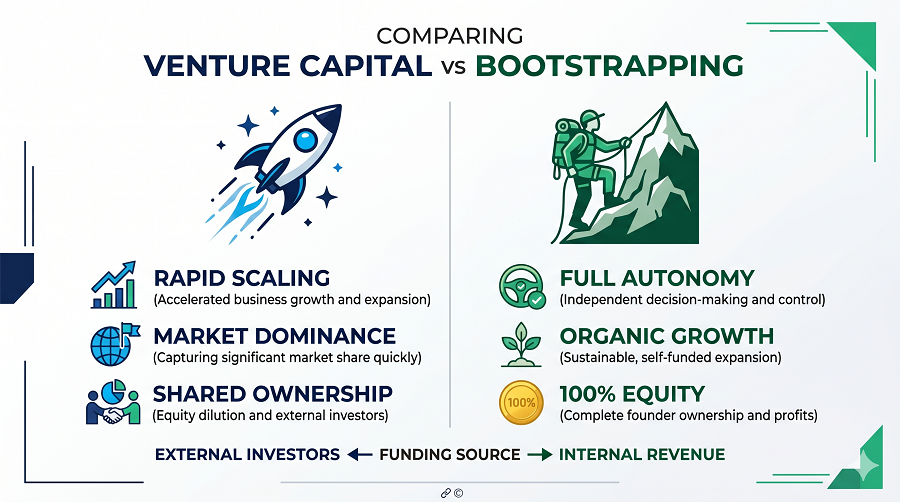
Bootstrapping is better for founders who want full control, lower risk, and steady growth, while venture capital is better for startups that need rapid scaling and large upfront investment.
Venture capital and bootstrapping are two fundamentally different approaches to funding a Canadian business and the right choice depends on what you’re building, how fast, and what you’re willing to give up to get there.
Key Takeaway:
- For most Canadian entrepreneurs (especially coaches, consultants, and service-based businesses), **bootstrapping** is the smarter path — it gives you full ownership (average 73% equity at exit), complete control, and access to $5 billion in non-dilutive government funding like SR&ED and IRAP. [1]
- Venture Capital offers fast growth, networks, and shared risk but comes with heavy equity dilution (average 18% at exit), loss of control, pressure to exit, and is extremely difficult to get in Canada (only ~3% of startups succeed, mostly in Ontario, BC, and Quebec). [1]
- Use the **OWNS Framework** to decide: Ownership goals, What market you’re in, Next 5 years vision, and Starting position (revenue-ready vs. heavy R&D). Bootstrap if you want control and can generate revenue in 12–18 months; seek VC only for capital-intensive, scalable tech with clear exit potential. [2]
- A hybrid approach (bootstrap to product-market fit, then raise VC) often preserves the most equity and aligns best with long-term success. [2]
Bottom Line: Most Canadian founders should bootstrap using personal resources and non-dilutive grants for full control and higher ownership. Reserve venture capital for rare, high-scale opportunities — clarity on your vision and business model is more important than chasing funding.
Venture capital provides substantial external funding in exchange for equity and, often, board-level input on your strategic decisions. Bootstrapping means growing on your own resources, personal savings, early revenue, and Canada’s generous non-dilutive programs like SR&ED and IRAP without surrendering ownership or control.
For most Canadian entrepreneurs, especially coaches, consultants, and service-based founders, bootstrapping is the stronger starting point. VC becomes relevant when your model is capital-intensive, winner-take-all, and you have a clear exit strategy aligned with investor expectations.
The first question isn’t “where do I get funding?”, it’s “what does success actually look like for me?”
Why This Decision Matters More in Canada
The VC-versus-bootstrapping debate plays out differently in Canada than almost anywhere else in the world. Getting it right here means understanding three structural realities that most general-purpose guides skip entirely.
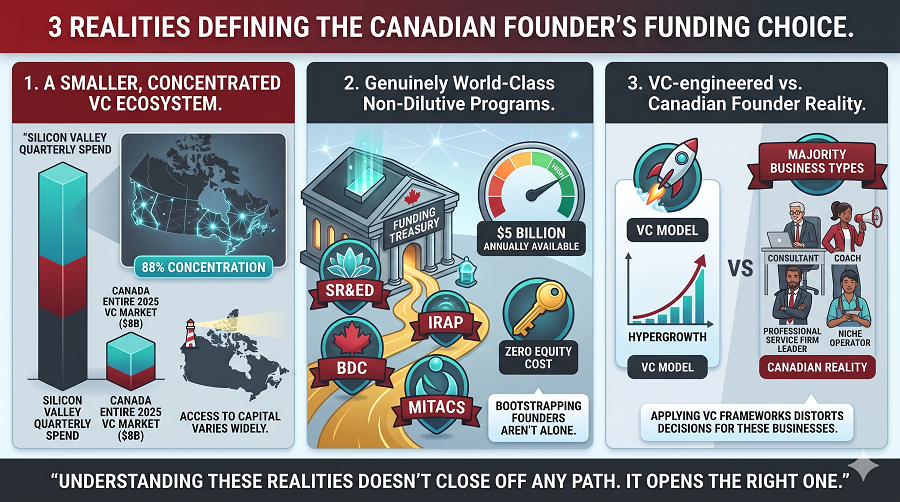
The VC Ecosystem is Smaller and More Concentrated:
Canada’s entire venture capital market deployed $8 billion in 2025. For context, that is roughly what Silicon Valley spends in a single strong quarter. Ontario, BC, and Quebec absorb 88% of that capital. If you’re building elsewhere, or outside the ICT and life sciences sectors that dominate deal flow, the accessible VC market is a fraction of what national headlines suggest.
Canada’s Non-Dilutive Programs Are Genuinely World-Class:
SR&ED, IRAP, BDC, and Mitacs collectively make nearly $5 billion available annually to Canadian founders, with no equity cost. No comparable ecosystem exists in the US at this scale for early-stage companies. Canadian bootstrappers aren’t going it alone; they’re leveraging a structural funding advantage that most American founders simply don’t have access to.
Service-Based and Coaching Founders Dominate Canada’s Entrepreneurial Landscape:
VC is engineered for capital-intensive, hypergrowth technology companies. The majority of Canadian entrepreneurs (coaches, consultants, professional service firms, niche B2B operators) are building businesses that VC was never designed to fund. Applying a VC framework to a fundamentally different business model doesn’t just waste time; it can distort the very decisions that would have made the business thrive on its own terms.
Understanding these three realities doesn’t close off any path. It opens the right one. With that context set, here’s how the two approaches actually compare.
What Is the Difference Between Venture Capital & Bootstrapping?
Venture capital (VC) is external funding from professional investors, such as VC firms, angels, or syndicates, in exchange for equity in your company. They provide capital, and often strategic networks, in return for ownership and a voice in major decisions.
Bootstrapping means building your business using your own resources: personal savings, reinvested revenue, sweat equity, and non-dilutive government programs. You grow on your own terms, at your own pace, with no equity given away.
The distinction runs deeper than money. It’s about who controls the direction of your business, on what timeline, and toward what definition of success. That’s a question of vision, not just math.
Pros and Cons of Bootstrapping in Canada
Why Bootstrapping Works
- Full ownership: No equity dilution, no board approval required on decisions that should be yours.
- Financial discipline: Limited capital forces you to build a business that actually works, not one that burns through a runway.
- Access to Canada’s non-dilutive ecosystem: SR&ED, IRAP, BDC, and Mitacs put nearly $5 billion annually into Canadian companies, with zero equity cost.
- Sustainability-first culture: Bootstrapped businesses are built to survive, not to impress investors at the next round.
- Equity at exit: Research shows bootstrapped founders retain an average of 73% ownership at exit, compared to just 18% for VC-backed founders.
Where Bootstrapping Has Limits
- Slower scale: Without a capital injection, aggressive hiring, marketing, and geographic expansion take longer.
- Personal financial exposure: You’re often funding growth from your own savings or credit, which carries real personal risk if things go sideways.
- Capital ceiling: Certain markets require upfront investment that no grant or early revenue can realistically match.
Pros and Cons of Venture Capital in Canada
What VC Gives You
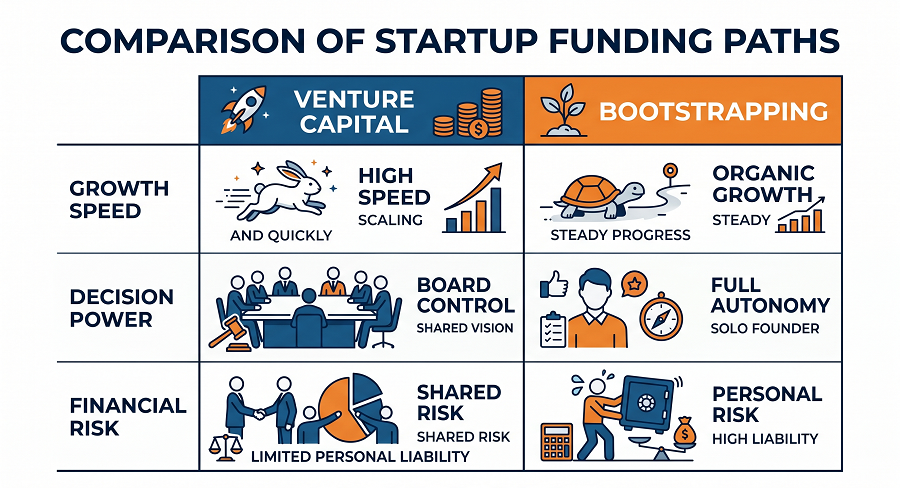
- Speed: A significant capital injection lets you hire fast, market aggressively, and capture market share before competitors can react.
- Networks: Strong VC firms bring portfolio relationships, customer introductions, and future fundraising credibility.
- Shared risk: Investors carry financial exposure alongside you, reducing the personal stakes if the venture struggles.
- Credibility signal: A strong VC partner can open doors that bootstrapped companies often have to knock on longer.
What VC Costs You
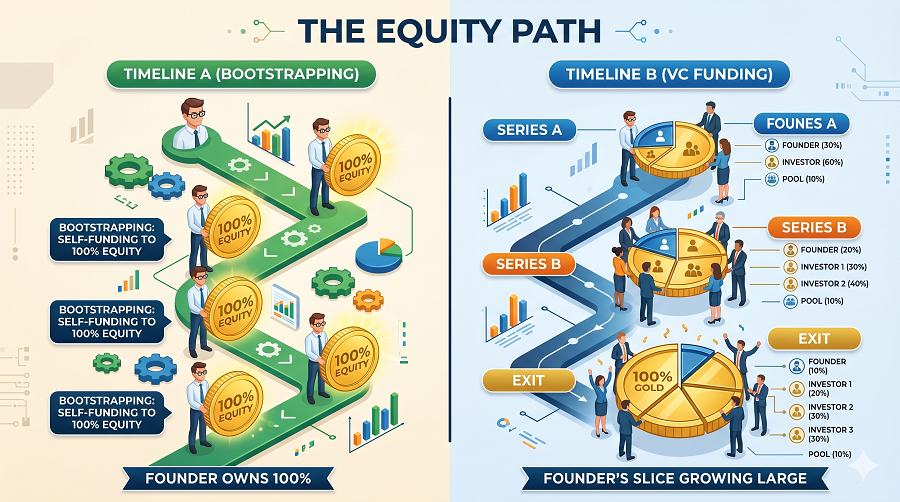
- Equity dilution: Each round reduces your ownership stake, compounding across Series A, B, and beyond.
- Control trade-off: Investors often require board seats and approval rights on hiring, spending, and strategic pivots.
- Exit pressure: VC funds are structured around liquidity events. Your 10-year vision may not fit their 5-year fund cycle.
- Time cost: The fundraising process is consuming. Months spent pitching are months not spent building.
How Realistic Is VC Funding for Canadian Entrepreneurs Right Now?
Harder than most founders expect and the middle is disappearing.
The CVCA’s full-year 2025 data tells the real story: $8 billion was deployed across 571 deals in Canada last year. On the surface, that sounds healthy. But look closer: megadeals of $50 million or more accounted for roughly two-thirds of all capital raised. A single $1-billion deal for autonomous vehicle startup Waabi represented more than a quarter of all Q4 venture investment.
This is Canada’s version of the Series A Crunch and it’s real. Investors are concentrating capital at two ends of the spectrum: tiny pre-seed bets and “safe” late-stage companies with proven fundamentals. The middle rounds, Series A and B, have dropped sharply. For the average Canadian founder building a solid, growing business that doesn’t fit the VC hypergrowth mould, the market is structurally thinner than the headline numbers suggest.
Early-stage access is especially tight. Pre-seed and seed investment declined by approximately 15% year-over-year through the first three quarters of 2025, sitting at levels consistent with 2020. The average VC deal now runs about CAD $14 million, far above where most early-stage founders realistically enter.
Geography compounds this. Ontario, British Columbia, and Quebec absorb roughly 88% of all Canadian VC dollars. If you’re building outside these hubs, the accessible market is a fraction of the national total.
The honest bottom line: only around 3% of startups globally ever secure venture capital. Spending months pitching for a round you’re unlikely to close may cost more than it’s worth in time, momentum, and focus.
What Canadian Grants Can Replace or Supplement VC Funding?
Here’s what most founders don’t fully grasp: Canada has one of the most generous non-dilutive funding ecosystems in the world. Between SR&ED, IRAP, and Mitacs alone, nearly $5 billion annually flows to Canadian companies with zero equity cost. As the VC window has tightened, more founders are treating these programs as strategic capital, not a fallback.
Key Non-Dilutive Programs for Canadian Founders:
- SR&ED (Scientific Research and Experimental Development): Is Canada’s largest federal tax incentive. Eligible Canadian-controlled corporations can reclaim up to 69% of R&D labour costs. If you’re doing technically uncertain work, software, product testing, or process innovation, you likely qualify and many founders leave this on the table entirely.
- IRAP (Industrial Research Assistance Program): Non-repayable grants covering up to 80% of eligible salaries and 50% of contractor costs for approved R&D projects. IRAP is particularly powerful for early-to-mid-stage companies validating a technical product or process.
- BDC (Business Development Bank of Canada): Provides loans and growth capital specifically designed for Canadian entrepreneurs who want to scale without diluting ownership.
- Mitacs: Subsidizes hiring graduate researchers and professors at up to 50% of their salary. Ideal for founders who need technical R&D horsepower without the full hiring cost.
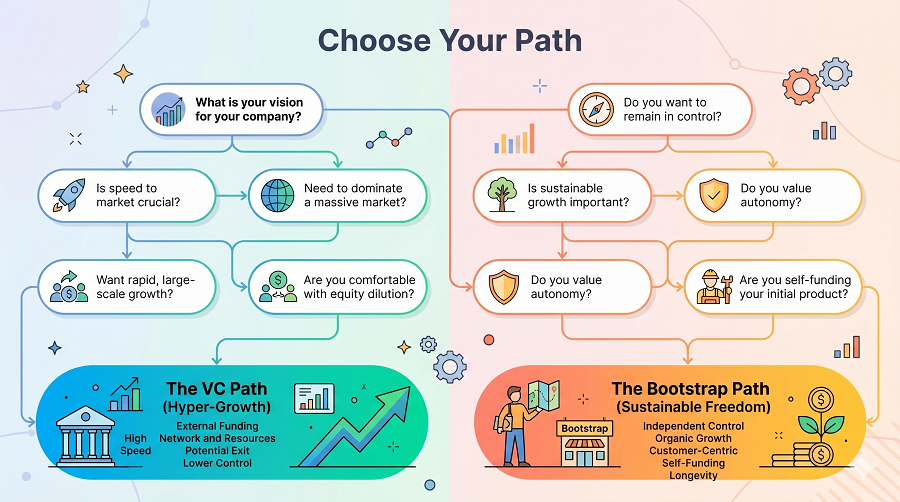
How Do You Decide? The OWNS Framework
Most founders approach this decision backwards; they ask “which path is available to me?” before asking “which path is right for me?” The OWNS Framework flips that. Four questions, answered honestly, will tell you more than a dozen pitch meetings.
Ownership (Equity vs. Control)
How much of your company are you genuinely willing to give up and what control are you willing to cede alongside it?
What Market (Niche vs. Blitzscale)
Is your market a winner-take-all race where speed defines survival, or a relationship and expertise-driven space where precision beats capital?
Next 5 Years (Legacy vs. Exit)
Are you building something to own for decades, or positioning for an acquisition or IPO within a defined investor timeline?
Start Position (Revenue-ready vs. R&D heavy)
Can you realistically generate meaningful revenue within 12–18 months, or does your model require significant capital before a single dollar comes in?
Run through these four questions, write your answers down, don’t just think them. Where your answers land will tell you clearly whether bootstrapping, VC, or the Hybrid Path is the natural fit. The decision most founders agonize over for months usually clarifies in under an hour when the right questions replace the noise.
Who Should Bootstrap?
Bootstrapping is the right path when:
- Your business can generate meaningful revenue within 12–18 months of launch
- You’re in a service-based, coaching, consulting, or niche B2B market where relationships and expertise drive sales
- You value ownership and control over board-approved speed
- You operate outside Ontario, BC, or Quebec, where VC access is structurally thinner
- Your customer acquisition cost is manageable without a capital injection
- You qualify for SR&ED, IRAP, or other non-dilutive Canadian programs, which can replace early-stage VC for many tech-adjacent businesses
- You’re building a coaching or consulting business, these are high-margin, low-overhead models that compound well under founder ownership
Who Should Seek Venture Capital?
VC makes strategic sense when:
- You’re building in a capital-intensive, winner-take-all market, deep tech, biotech, infrastructure-level software, where the first to scale captures the market permanently
- Your model requires significant investment before generating any meaningful revenue
- Network effects or scale economies mean speed is an existential competitive factor
- You have a genuine, defined exit strategy, acquisition or IPO and authentic alignment with a 5–7 year investor timeline
- You’ve already validated product-market fit and need fuel to accelerate, not a fire to start
- You’re building in Ontario, BC, or Quebec and fit the sectors where Canadian VC is actively deploying ICT, AI and life sciences, per CVCA’s 2025 sector data
Side-by-Side: Bootstrapping vs. Venture Capital
| Factor | Bootstrapping | Venture Capital |
| Ownership retained | 100% yours entirely | Diluted each round raised |
| Decision control | Full no board approval needed | Shared with investors & board |
| Growth speed | Organic, cash-flow paced | Accelerated by capital injection |
| Exit pressure | None build on your timeline | Built into the investor model |
| Personal financial risk | Higher (your capital at stake) | Shared with investors |
| Canadian funding edge | SR&ED, IRAP, BDC, Mitacs grants | VC funds, angels, CVCA network |
| Best suited for | Coaches, consultants, niche B2B, SaaS | Deep tech, biotech, winner-take-all |
| Equity at exit (avg) | ~73% retained | ~18% retained |
Ownership at exit averages sourced from Allied Venture Partners research on bootstrapped vs. VC-backed founder outcomes.
The Mindset Layer: Why Most Founders Choose Wrong
Here’s what the spreadsheet-based articles never say: the most common reason founders choose VC isn’t that their business needs it. It’s that they don’t fully believe they can build something extraordinary on their own.
In over 20 years of working with entrepreneurs, I’ve seen the same pattern surface repeatedly. Founders pursue external investment not because the numbers demand it, but because they’re seeking external validation, a VC stamp of approval that tells them their idea is real, their ability is sufficient, and their risk is justified. They’re outsourcing confidence to investors because they haven’t yet done the inner work to own it themselves.
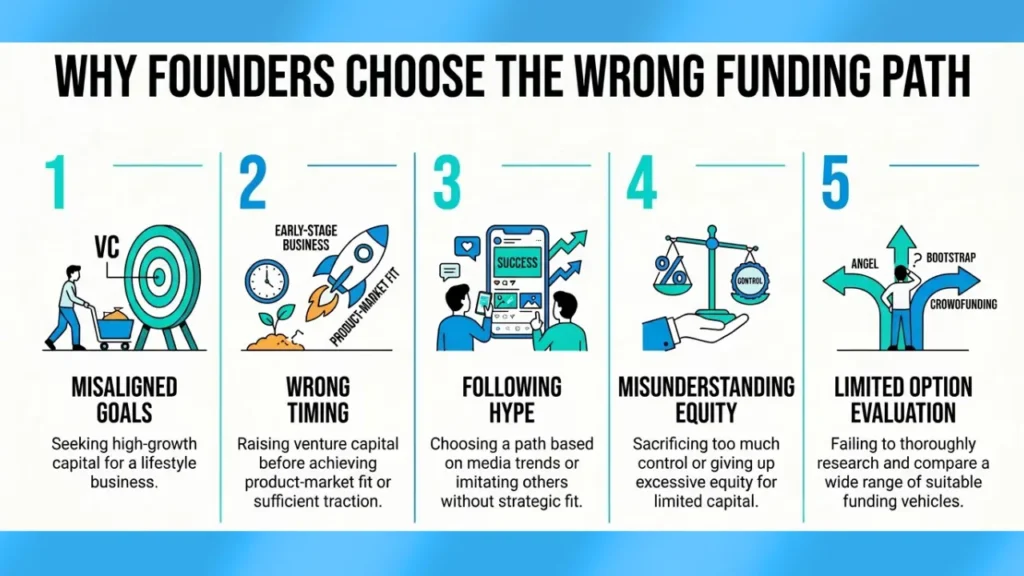
That’s a goal block and it’s one of the most expensive beliefs a founder can carry.
Darren G. came to James feeling stuck in exactly this pattern. He had a stable career, market knowledge, and genuine ambition to build his own business but something kept pulling him back from the leap. He couldn’t unlock the raises, the promotions, or the business he could see clearly from the outside. Through James’s coaching, Darren identified the goal blocks and limiting beliefs that were running his decisions beneath the surface. Once those dissolved, the shift was radical not just in his thinking, but in his actions, his relationships, and his revenue. He built the business on his terms, not waiting for external permission.
The funding decision most founders agonize over for months often clarifies quickly once the limiting beliefs underneath it are surfaced and cleared. The real question was never VC or bootstrapping. It was: “Do I believe in my ability to build this without someone else’s money backing me first?”
When the answer becomes a genuine yes built from clarity and self-trust, not bravado, the path forward becomes obvious. If you’re circling this decision, that’s not an information problem. It’s a vision clarity problem and that’s exactly what a discovery call with James is designed to solve.
The Right Path Is the One You Can Lead With Conviction
The funding decision that serves you best isn’t the one with the best headline. It’s the one aligned with what you’re building, what you value, and who you want to be as a founder.
Most Canadian entrepreneurs who chase VC don’t need it; they need a clearer vision, stronger self-trust, and the tools to execute decisively without external capital validating their idea first. And most founders who dismiss bootstrapping underestimate what Canada’s non-dilutive ecosystem makes possible when treated as a strategic layer rather than a last resort.
Whatever path you’re considering, start with clarity, not capital. If you’re ready to cut through the noise, identify the goal blocks slowing you down, and make the funding decision that’s genuinely right for your business, a discovery call with James is where that starts.
Ready to make the right call with confidence?
Book a discovery call with James and get clear on your path forward.
Frequently Asked Questions
Is bootstrapping or venture capital better for Canadian coaches and consultants?
For coaches and consultants, bootstrapping is almost universally the stronger fit. These are high-margin, relationship-driven businesses that can generate meaningful revenue quickly and don’t need the capital intensity that VC requires. Canada’s IRAP, BDC, and SR&ED programs can supplement early-stage growth without costing any equity, making bootstrapping a fully resourced, not merely scrappy, path.
What is Canada’s Series A Crunch and how does it affect my funding options?
CVCA data through 2025 shows capital concentrating at the extremes of the funding spectrum, either tiny pre-seed deals or massive late-stage megadeals. The middle rounds, Series A and B, have dropped sharply. This means the typical “raise seed, get customers, raise Series A” playbook is harder to execute in Canada today. For most founders, this makes the Hybrid Path bootstrapping to PMF, then raising a stronger sequencing strategy than raising early and hoping the middle market re-opens.
What is SR&ED and can my Canadian business claim it?
SR&ED (Scientific Research and Experimental Development) is Canada’s largest federal tax incentive for R&D. Canadian-Controlled Private Corporations doing technically uncertain work, software development, product prototyping, process innovation an reclaim up to 69% of eligible labour costs. It’s non-dilutive, retroactive, and significantly underused by founders who assume it only applies to traditional R&D labs. If your business involves any form of technical experimentation, it’s worth assessing your eligibility.
How does NLP coaching help with the VC vs. bootstrapping decision?
NLP (Neuro-Linguistic Programming) helps founders identify and dissolve the limiting beliefs and goal blocks that distort funding decisions. Many founders pursue VC not because the business requires it, but because they haven’t yet built the self-trust to bet fully on their own ability to generate revenue. James’s coaching process surfaces these blocks directly and once they’re cleared, the right funding path typically becomes obvious rather than agonizing.
Can I switch from bootstrapping to VC later once I’ve proven my model?
Yes, and this sequencing often produces the best outcomes. Bootstrapping first gives you leverage: a proven model, a revenue track record, and capital efficiency that makes you a far stronger VC candidate when you’re ready. Investors prefer founders who’ve built with discipline and de-risked the core assumptions. The Hybrid Path isn’t a compromise; it’s the strategy that preserves the most equity while still accessing the capital that accelerates growth when the timing is genuinely right.
Is bootstrapping better than venture capital?
Bootstrapping is better for founders who want full control, lower risk, and steady growth, while venture capital is better for startups that need rapid scaling and large upfront investment.