
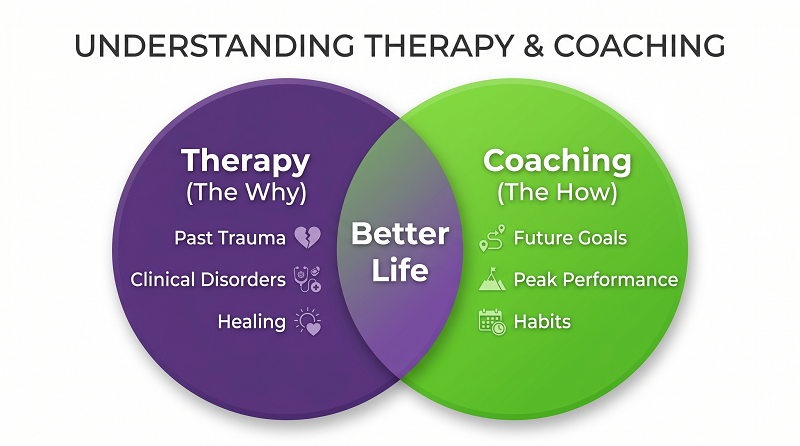
Life coaching vs therapy is a common question when people explore personal development and mental health support. Life coaching and mental health therapy serve fundamentally different purposes. Therapy involves a licensed professional who diagnoses and treats clinical mental health conditions such as depression, anxiety, and PTSD using evidence-based clinical interventions. Life coaching is a forward-focused partnership that helps mentally healthy individuals gain clarity, build confidence, and take decisive action toward personal or professional goals. The professional line is drawn at diagnosis and treatment: coaches do not diagnose, prescribe, or treat mental illness. Ethical coaches recognize when a client’s needs exceed coaching scope and refer them to a qualified mental health professional. NLP-trained coaches use structured communication and behavioral techniques to help clients reframe limiting beliefs while maintaining clear boundaries with clinical practice.
Key Takeaway:
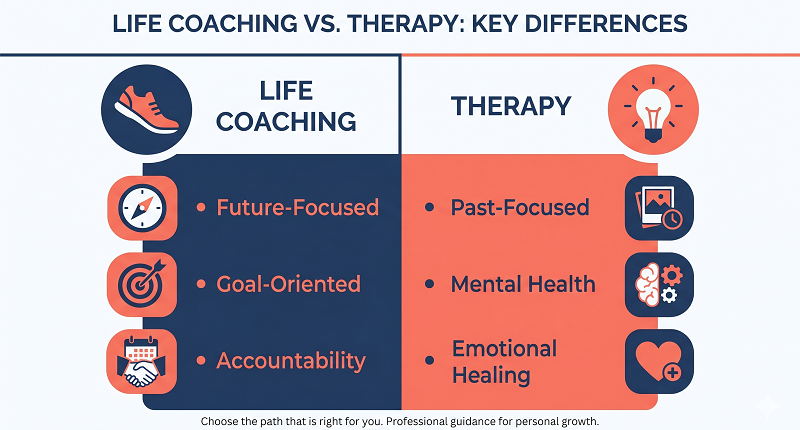
- Life coaching and therapy serve different purposes: Therapy focuses on healing past trauma, mental health issues, and emotional wounds, while life coaching is future-oriented — helping you set goals, overcome limiting beliefs, and take action to create the life you want. [1]
- You don’t need to be “broken” to benefit from coaching. Many high-functioning people use coaching to gain clarity, boost confidence, improve performance, and accelerate personal or professional growth. [1]
- Choose therapy if you’re struggling with anxiety, depression, trauma, or emotional pain. Choose life coaching if you feel stuck, want to achieve specific goals, improve habits, or level up in career, relationships, or personal development. [2]
- Many people benefit from both — therapy to heal the past and coaching to build the future. They complement each other rather than compete. [2]
Bottom Line: Therapy helps you heal what’s broken. Life coaching helps you build what’s possible. Knowing the difference allows you to choose the right support for where you are right now — and many people thrive when they use both at different stages of life.
Why the Line Between Coaching and Therapy Matters More Than Ever
You have probably heard someone say they are working with a life coach, a therapist, or maybe both. With the global coaching market now valued at over seven billion dollars and record shortages of licensed mental health professionals, the boundaries between these professions feel blurrier than ever.
Both coaches and therapists help people navigate challenges and create meaningful change. But what they are trained to do, legally permitted to do, and how they approach your situation are fundamentally different. This article draws a clear line between life coaching and mental health therapy, explains where NLP coaching fits in, and helps you choose the right support for where you are right now.
What Is the Core Difference Between Life Coaching and Mental Health Therapy?
The most important distinction comes down to two words: clinical authority. Therapists are licensed professionals trained to assess, diagnose, and treat mental health conditions listed in the Diagnostic and Statistical Manual of Mental Disorders. They work within strictly regulated frameworks, carry professional liability insurance, and are subject to oversight by governing bodies.
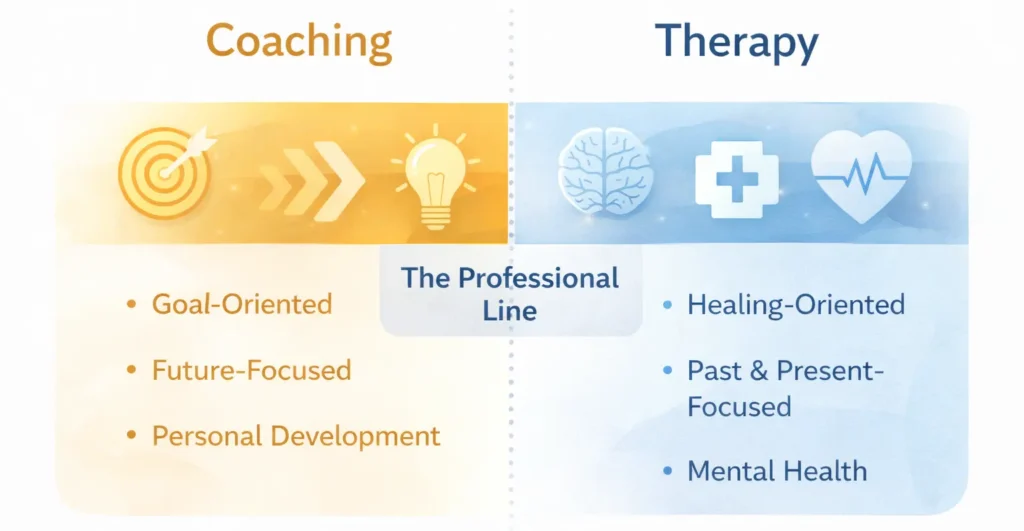
Life coaching operates in a fundamentally different space. Coaching is a collaborative, forward-focused partnership designed to help you identify goals, overcome obstacles, and take action. Coaches work with individuals who are mentally healthy and ready to build, not individuals who require clinical treatment.
Think of it this way: therapy often explores why a problem developed, digging into past experiences and emotional wounds that need healing. Coaching focuses on how to move forward, asking where you want to go and what your next step looks like. This does not mean coaching is superficial. Skilled coaches help you confront deeply held limiting beliefs, restructure communication patterns, and build the confidence to take courageous action. But they do so without diagnosing conditions or prescribing clinical treatment.
Life Coaching vs Therapy: Quick Comparison
| Factor | Life Coaching | Mental Health Therapy |
| Primary Focus | Future goals and personal growth | Mental health diagnosis and treatment |
| Practitioner | Certified life coach or NLP practitioner | Licensed therapist, psychologist, or counselor |
| Regulation | Largely self-regulated (ICF, ANLP) | Strictly regulated by government bodies |
| Methods | Goal setting, mindset work, accountability, NLP techniques | CBT, EMDR, psychodynamic therapy, clinical interventions |
| Duration | Short to medium term (weeks to months) | Short to long term (months to years) |
| Ideal For | Growth, clarity, confidence, leadership | Anxiety disorders, depression, trauma, PTSD |
| Insurance | Generally not covered | Often covered by health insurance |
As this comparison shows, the professional line between coaching and therapy is primarily defined by clinical diagnosis and treatment authority.
Can a Life Coach Help with Anxiety, Depression, or Trauma?
This is one of the most important questions anyone considering coaching should ask. There is a meaningful difference between clinical mental health conditions and the everyday stress that comes with growing, leading, and building a life you are proud of.
Clinical conditions like generalized anxiety disorder, major depressive disorder, PTSD, and active addictions require the expertise of a licensed mental health professional. These conditions involve neurological, biochemical, and psychological complexity that falls outside the training and ethical scope of a life coach.
Situational stress, on the other hand, is something coaching addresses exceptionally well. Career pressure, confidence challenges, leadership growing pains, decision paralysis: these are the arenas where coaching delivers transformational results. In over twenty years of coaching, I have watched clients move from feeling invisible in meetings to commanding rooms with quiet authority.
Here is where ethical responsibility comes in. Research cited by NPR in partnership with licensed clinical social workers suggests that 25 to 50 percent of people working with a life coach may have mental health conditions requiring higher-level support. This is why screening, awareness, and a willingness to refer are not optional but foundational to ethical practice.
How NLP Coaching Differs from Psychotherapy
Neuro-Linguistic Programming is a communication and behavioral framework built on the connection between neurological processes, language, and learned behavioral patterns. In coaching, NLP provides powerful tools for helping clients understand how they create their internal experience and how to change it.
An NLP practitioner is not automatically a therapist. The Association for Neuro Linguistic Programming makes this clear: obtaining an NLP certificate does not qualify someone as a therapist unless they have also met the rigorous requirements of a recognized psychotherapy body. NLP training typically involves 120 to 130 hours focused on communication frameworks and belief change patterns, not clinical diagnosis.
That said, working with a skilled NLP coach can feel deeply therapeutic. Techniques like reframing, anchoring, and belief change help clients break through limitations held for years. The key difference is intention and scope: NLP coaching helps you move from where you are to where you want to be, without diagnosing or treating mental illness.
When I work with clients using NLP, we identify the internal programs running in the background, the ones telling you that you are not good enough or that success is for other people. Then we replace them with patterns that serve your goals. This is the territory of coaching: empowerment through deliberate change.
When Should a Life Coach Refer a Client to a Therapist?
Every ethical coach encounters moments where a client’s needs exceed what coaching can provide. Recognizing these moments and acting on them is one of the most important responsibilities in the profession.
The International Coaching Federation’s Code of Ethics, updated in April 2025, mandates that coaches operate within the boundaries of their competence and refer clients when their needs warrant it. Common referral triggers include persistent emotional distress, severe anxiety or depression symptoms, trauma responses surfacing during sessions, significant impairment in daily functioning, and any expression of suicidal thoughts or self-harm.
Try This: The Ethical Referral Conversation
- Acknowledge what the client is experiencing with genuine empathy. Let them know you see their struggle.
- Be transparent. You might say: “I believe a licensed mental health professional could support you more effectively with what you are experiencing right now.”
- Offer to pause coaching temporarily, not abandon the client. Make it clear that you are still in their corner.
- Provide two or three referrals to licensed professionals if possible, giving the client choice and agency.
- Follow up. Check in with the client after the referral to see how they are progressing.
Referring a client is not a failure. It is one of the most powerful things you can do as a coach because it puts their well-being above everything else.
Can You Work with a Life Coach and a Therapist at the Same Time?
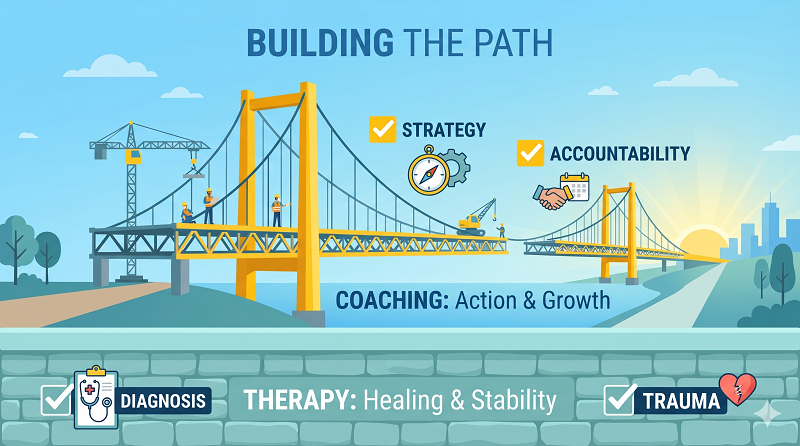
Yes, and for many people this complementary approach delivers the best outcomes. Therapy provides the space to heal emotional wounds and develop coping strategies. Coaching provides the structure to translate those insights into action, building goals, strengthening accountability, and creating forward momentum.
Consider someone recovering from professional burnout. A therapist helps them process the emotional exhaustion and rebuild psychological resilience. A coach helps them redesign their career direction and develop the leadership skills to prevent the cycle from repeating. The key is clear communication between the client and both professionals, so everyone understands their role.
What Training and Credentials Separate Coaches from Therapists?
Licensed therapists complete graduate-level education in psychology, counseling, or social work. They accumulate thousands of supervised clinical hours before qualifying for licensure exams regulated by government bodies. Violating professional standards can result in license revocation and legal action.
Life coaching has no centralized regulatory body. However, reputable coaches pursue recognized certifications through organizations like the International Coaching Federation, which requires documented training hours, mentorship, and examination. For NLP practitioners, bodies including the ANLP and ABNLP provide standards and accreditation. A qualified NLP Practitioner certification typically requires 120 to 130 hours of study and practical assessment.
This is one reason I advocate strongly for rigorous training. When you invest in a properly certified coach, you are working with someone who has committed to ethical standards and knows exactly where their professional boundaries lie.
The 4-Point Clarity Check Framework
Not sure whether coaching, therapy, or both is right for you? Use this self-assessment to find clarity before you commit.
Step 1: Check Your Starting Point
Am I in crisis or in growth mode? If you are experiencing persistent emotional distress, panic attacks, or difficulty functioning day to day, therapy should be your first step. If you feel stable but stuck or ready to build something bigger, coaching is likely the right fit.
Step 2: Check Your Focus
Is your daily life significantly impaired? When emotional challenges interfere with self-care, work, or relationships to the point where basic routines are difficult, a licensed mental health professional should be part of your support team.
Step 3: Check Your Functioning
Do you need to heal from the past or build toward the future? Therapy specializes in processing unresolved experiences. Coaching specializes in designing what comes next. If both apply, consider working with both professionals.
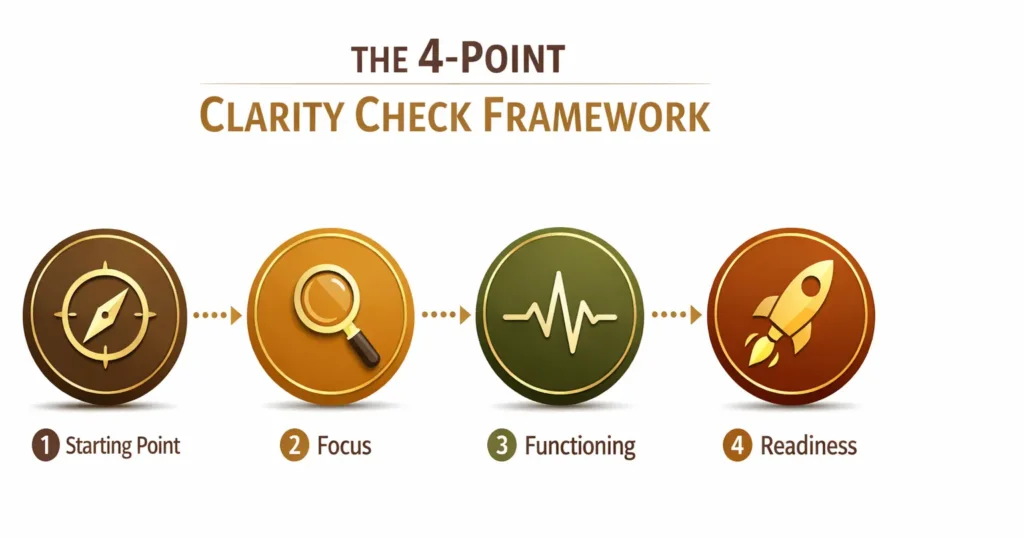
Step 4: Check Your Readiness
Are you prepared for goal-driven action and accountability? Coaching requires active participation: setting goals, completing exercises, and taking measurable steps forward. If you are ready to move, coaching accelerates your progress dramatically.
Try This: Run the Clarity Check Right Now
Grab a piece of paper. Write one sentence for each step: your starting point, your focus, your functioning level, and your readiness for action. The pattern will tell you whether you need a coach, a therapist, or both. If you are unsure, book a discovery call with a qualified professional who will help you determine the right path.
Who Should Choose Life Coaching?
Life coaching is the right choice when you are mentally healthy and ready to take action. Ideal candidates include professionals seeking career clarity, entrepreneurs building or scaling a business, individuals who feel stuck despite no clinical mental health concerns, people who want accountability and structured support, and anyone looking to break through limiting beliefs.
One of my clients, Darren G., came to me feeling hopeless and purposeless despite a well-paying job. He knew something was blocking him from the promotions and business ownership he wanted but could not identify it. Through coaching, we exposed the goal blocks and limiting beliefs holding him back. The shifts were radical: not just in his thinking, but in his relationships and sense of possibility. Darren was not clinically unwell. He was stuck. And coaching gave him the tools to get unstuck.
Who Should Choose Therapy Instead?
Choose therapy as your starting point if you are experiencing persistent depression, anxiety disorders, including panic attacks, trauma responses or PTSD symptoms, active addiction, emotional instability that impairs daily functioning, or any thoughts of self-harm. This is not a weakness. Therapy is a clinical support system staffed by trained professionals who have spent years learning how to help with exactly these challenges.
Therapy and coaching are not an either-or decision. Many people start with therapy to stabilize and heal, then add coaching to build forward momentum. The right combination depends entirely on where you are right now.
Data and Industry Insights
The demand for both coaching and mental health services is growing rapidly. According to the ICF’s 2025 Global Coaching Study, the global coaching market reached approximately 7.3 billion dollars with over 122,000 active certified coaches worldwide. The U.S. life coaching market alone was valued at nearly two billion dollars in 2024, growing at roughly five percent annually. The ICF reports that 73 percent of coaches say their clients now expect a coaching certification or credential.
At the same time, mental health demand continues to outpace supply. This is precisely why the ethical line between professions matters more than ever. As the coaching industry grows, the professionals who thrive will be those who understand their scope, invest in proper training, and maintain the integrity to refer when a client needs more than coaching can provide.
Frequently Asked Questions
What is the difference between therapy and life coaching?
Therapy is conducted by licensed professionals who diagnose and treat clinical conditions such as anxiety, depression, and trauma. Life coaching is a forward-focused partnership helping mentally healthy individuals achieve goals through clarity, accountability, and action.
Can a life coach help with anxiety?
Coaches can help with situational stress and performance anxiety from career pressure or life transitions. Clinical anxiety disorders require a licensed therapist. Ethical coaches screen for these conditions and refer when needed.
Is NLP coaching a form of therapy?
No. NLP coaching uses communication and behavioral techniques to reshape limiting beliefs and improve goal alignment. It is not designed to diagnose or treat psychological conditions and operates within a coaching framework, not a clinical one.
Can someone work with both a coach and a therapist?
Yes. Many people find this complementary approach effective. Therapy provides space for emotional healing while coaching provides structure, accountability, and forward momentum toward goals.
How do I know if I need a coach or a therapist?
Use the 4-Point Clarity Check: assess your starting point (crisis vs. growth), your focus (heal vs. build), your daily functioning (impaired or stable), and your readiness for action. If functioning is impaired, start with therapy. If you are stable and seeking growth, coaching fits.
The Bottom Line
Life coaching and mental health therapy are not competitors. They are complementary forces serving different roles in your development and well-being. Therapy heals. Coaching builds. When you understand where the professional line is drawn, you make better decisions about which support you need.
If you are ready for forward-focused action, clarity, and accountability, coaching may be exactly what you are looking for. If you need to process and heal from deeper emotional challenges, start with a licensed therapist and know that coaching will be there when you are ready to build.
Want to explore whether coaching is the right next step? Book a free discovery call with James R. Elliot. No pressure. Just an honest conversation about where you are and how to move forward. Unleash Your Power: Stand Out, Take Action, and Create the Success You Want.