
Building rapport in virtual sales calls is harder because screens reduce nonverbal feedback and disrupt natural conversational flow. NLP techniques, especially vocal pacing, VAK predicate matching, and real-time sensory acuity, help sales professionals recreate that connection intentionally. Using structured methods like the SYNC Framework, top performers can establish trust within the first 60 to 90 seconds of a discovery call, significantly improving engagement and conversion outcomes.
Key Takeaway:
- Virtual sales calls rely heavily on trust and connection, making instant rapport the single most important factor in improving engagement, call retention, and conversions.
- NLP techniques such as mirroring tone, pacing speech, matching communication style, and using sensory-based language help prospects feel understood and psychologically aligned.
- Strong virtual rapport comes from active listening, strategic pauses, positive framing, and reflecting the prospect’s words back naturally without sounding scripted.
- On video calls, vocal energy, facial expressions, eye contact with the camera, and subtle body-language matching often influence trust more than the actual pitch itself.
- The best NLP-based virtual sales conversations feel consultative rather than persuasive, helping prospects feel safe, heard, and confident in moving forward.
Bottom Line: In virtual sales calls, people buy from those they trust quickly. Using NLP rapport-building techniques like mirroring, pacing, and language alignment can significantly increase connection, credibility, and conversion rates.
Why Virtual Rapport Is Harder Than It Looks
Your prospect is sitting at a desk, phone buzzing, inbox open, maybe a colleague visible in the background. You have a camera, a microphone, and roughly 90 seconds to make them feel like this call is worth their time.
In person, rapport builds almost automatically. You match posture, expressions sync, and vocal rhythms align. On video, that whole process gets filtered through a screen, compression artifacts, and the cognitive oddity of seeing your own face in a corner box. Research on what psychologists call the online disinhibition effect shows that video calls reduce the natural empathy signals that face-to-face interaction produces almost without effort. Conversational flow becomes more deliberate, and both parties have to work harder to send and receive the nonverbal cues that make a conversation feel natural.
Research from Springer confirms that the majority of North American business meetings are now fully virtual or hybrid, and over three-quarters of sales professionals now conduct meetings entirely through video platforms. The sales professionals who master virtual rapport are building a capability that compounds across every call they run.

The good news is that NLP gives you a precise set of tools designed exactly for this challenge.
What NLP Rapport Actually Means on a Virtual Call
Rapport in NLP is not small talk. It is not spending three minutes chatting about the weather before getting to the point. It is the creation of subconscious alignment between two people, a state where your prospect feels genuinely understood before they have articulated everything they need.
NLP defines this through a process called pacing and leading. You pace by matching the other person’s communication patterns: their speed, their tone, their language style. Once that match is established, you can lead, gently steering the direction and energy of the conversation toward productive ground.
What makes this powerful in a sales context is that it operates below the level of conscious awareness. Your prospect does not notice you are doing it. What they notice is that the call feels unusually comfortable, that they are opening up more than they expected, and that you seem to really understand what they are dealing with. Exploring how NLP enhances communication skills for leaders goes deeper into these principles, but on a discovery call, three techniques matter most: vocal pacing, VAK predicate matching, and sensory acuity.
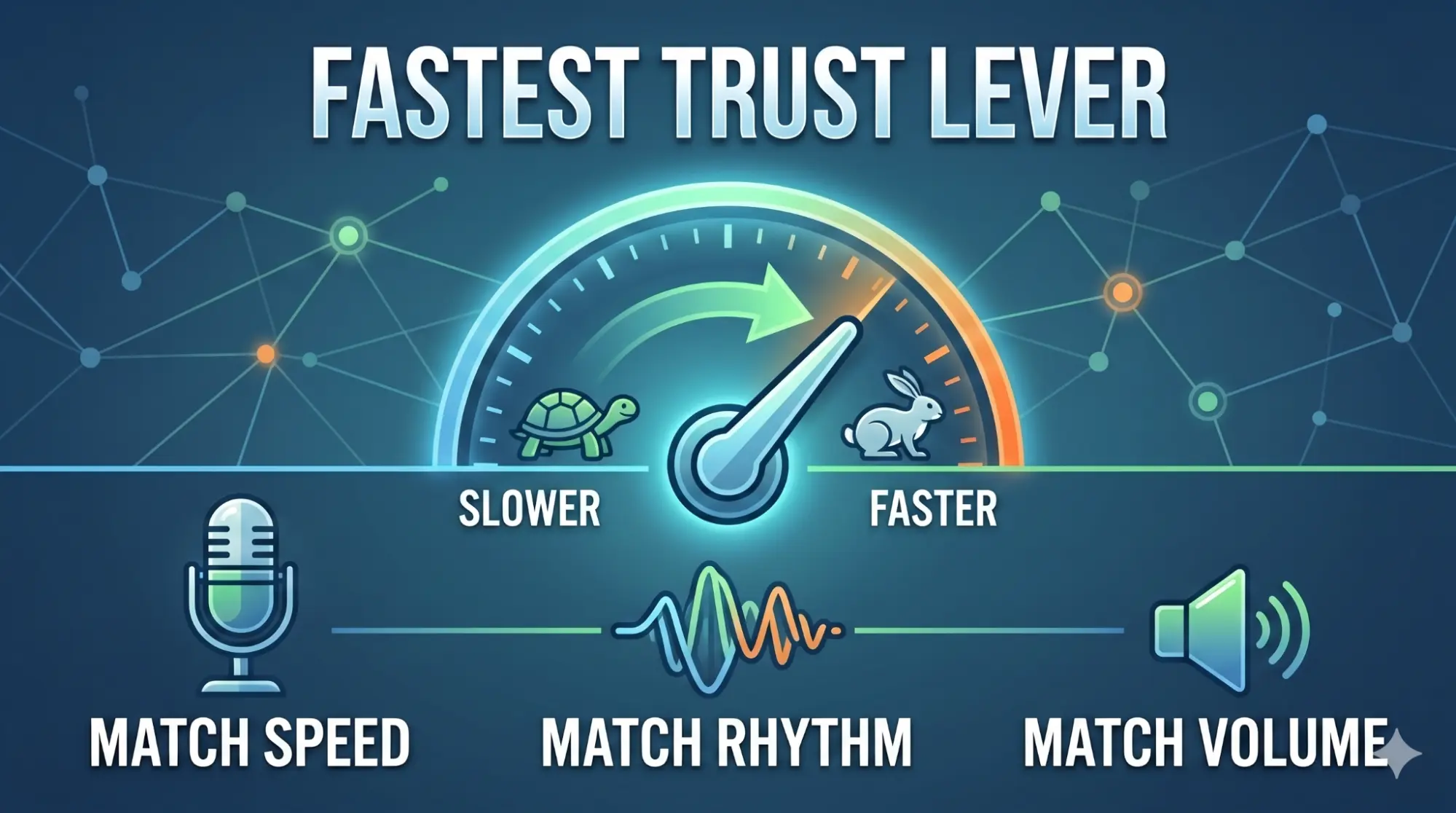
Vocal Pacing: The Fastest Trust Signal on a Discovery Call
When body language cues are limited by a screen, your voice carries the full weight of rapport. Research into virtual selling consistently identifies vocal pacing as the most reliable rapport lever available on a video call.
Pacing means matching your prospect’s speaking speed, rhythm, volume, and energy level. If they speak slowly and deliberately, you slow down. If they are quick and energetic, you match that pace. If their tone is measured and formal, you bring your register up to meet theirs.
This is not about mimicking someone robotically. A 10 to 15 percent adjustment toward their natural pace is enough to create the effect. Your prospect experiences a sense of alignment they cannot quite name. Conversations feel less like an interview and more like a genuine exchange between peers.
Try this:

Pre-Call Calibration
Before your next discovery call, find any available recording of your prospect: a LinkedIn video, a webinar appearance, or a previous call recording. Spend two minutes just noticing their natural speaking pace, the pauses they take, and the words they tend to emphasise. Then calibrate your opening two minutes of the call to match that rhythm.
VAK Predicate Matching: Speak Their Internal Language
NLP identifies three primary ways people process and represent experience internally: Visual, Auditory, and Kinesthetic. These are known as representational systems, and each one shows up in the specific language a person naturally uses. Visual thinkers use words like see, clear, picture, look, and perspective. Auditory thinkers use words like sounds, hear, tell me, resonates, and clicks. Kinesthetic thinkers use words like feel, sense, solid, comfortable, and stuck.
When you match someone’s predicate type, their brain registers something it cannot quite explain: a sense that you are communicating in the same language. This deepens rapport faster than almost any other technique, particularly on a video call where physical mirroring options are limited.
Here is how it sounds in practice:
Visual (for a prospect who says: ‘I need to see where we’re heading with this’)
- ‘I see exactly what you’re aiming for with Q4 growth.’
- ‘Let me show you how this would look in your workflow.’
- ‘Does this picture align with your expectations?’
Auditory (for a prospect who says: ‘This sounds like it could work for us’)
- ‘That sounds like a major bottleneck for your team.’
- ‘I hear your concern around implementation time.’
- ‘Tell me more about how your team communicates this internally.’
Kinesthetic (for a prospect who says: ‘We’ve been feeling a bit stuck lately’)
- ‘It sounds like things feel a bit stuck right now, and that’s a real pattern we can work through.’
- ‘We want this process to feel smooth for your team from day one.’
- ‘Does this approach feel practical for your situation?’
Strengthening this technique is easier when you understand the broader principles of NLP relationship building and communication before applying them live. You can also see how predicate matching extends into objection handling through NLP negotiation techniques.

Sensory Acuity Through a Screen
Sensory acuity is the NLP skill of reading other people precisely, noticing subtle shifts in expression, breathing, tone, and posture that reveal what is happening beneath the surface of what they are saying.
The good news for virtual sellers is that the face is exceptionally expressive. Research suggests that roughly 80 percent of nonverbal communication occurs above the shoulders, which is exactly the frame a camera captures.
Watch for micro-expressions when you make a key statement: a quick frown, a slight nod, a momentary tightening around the eyes. These are real-time feedback signals. If a prospect’s gaze drifts away during a particular topic, that is information. If their tone shifts from engaged to slightly flat, that is information too. Many workplace communication issues come down to missing exactly these signals, and on a virtual call, reading them precisely can be the difference between a next meeting and a polite non-answer.
PRO TIP: The 70/30 Eye Contact Rule for Virtual Calls

70% of the time: Watch the screen. Read micro-expressions, track reactions, and notice moments of hesitation. This is your sensory acuity loop in action.
30% of the time: Look directly at the camera lens. Use this when delivering a key insight, asking an important question, or making a recommendation.
Why it works: You balance real-time NLP calibration with perceived eye contact, which is your primary trust signal on screen.
The SYNC Framework: A 4-Step NLP Method for Virtual Discovery Rapport
The SYNC Framework gives you a practical, repeatable structure for building rapport from the first 60 seconds of a virtual discovery call. Each step builds on the last.
Signal Match
In the first 60 seconds, calibrate your vocal pace, volume, and energy to match your prospect’s. Do not try to match everything at once. Start with speaking speed. That single adjustment creates the foundation that everything else builds on. It signals safety before a single question has been asked.
Yield to Their System
As the prospect speaks, listen for their predicate type. Are they processing visually, auditorily, or kinesthetically? Once you identify it, shift your language to meet them in their system. Stop defaulting to your own natural word choices and start using the vocabulary their brain already trusts.
Notice (Sensory Acuity Loop)
Stay in continuous observation mode throughout the call. When you introduce a new idea or probe a pain point, watch the prospect’s face for two seconds before moving on. If you see hesitation or disengagement, calibrate before pushing forward. This step is what separates reps who listen from reps who truly understand.
Calibrate and Close
Use what you have observed to shape the direction of the conversation. If the prospect’s energy rises when you discuss a specific pain point, lean into it. If a topic produces flat or guarded responses, reframe it or set it aside. Close the rapport loop by reflecting back what you have heard before moving to any next step or recommendation.
Applying SYNC in Real Conversations: Heather’s Story
Heather Chetwynd came to James’s NLP Practitioner training having already completed NLP coursework elsewhere. Her specific challenge was applying the techniques in real conversations rather than controlled practice environments. Through the training, she worked through live rapport-building exercises covering both sensory acuity and language matching.

Her biggest shift came from the N: Notice stage of the SYNC approach. She described leaving her previous training with tools she could not integrate at the moment. After working through James’s structured approach to real-time sensory acuity, she understood how to observe and calibrate as a conversation developed rather than working from a prepared script. That shift changed how she showed up in every professional conversation that followed.
Who Should Use This?
NLP rapport techniques on virtual discovery calls are a strong fit for:
- Sales professionals whose deals require genuine trust before a prospect will share real information about their challenges
- Consultants and coaches running first-time intake or discovery calls where the relationship starts here
- Account executives selling complex or high-ticket solutions, where one call can determine the trajectory of an entire opportunity
- Anyone whose close rate on virtual calls is meaningfully lower than their close rate was in person
If you want to go deeper on applying NLP inside a business context, James’s NLP training for business professionals gives you the guided practice to make these skills consistent across every client-facing interaction.
Who Should Avoid This Approach?
These techniques are not the right fit for everyone:
- Sales reps looking for a script to run without practice. Sensory acuity and VAK matching require genuine attention and repetition before they become natural and automatic.
- Those selling purely transactional, commodity-priced products where the decision happens entirely on price comparison. Rapport is a smaller factor when there is no relationship required.
- Anyone hoping to use these tools to manipulate rather than connect. NLP rapport works because it is grounded in genuine curiosity and alignment. Used cynically, it collapses quickly.
Comparison: NLP Rapport vs Traditional Sales Small Talk
| Feature | Traditional Small Talk | NLP-Based Rapport (SYNC Framework) |
| Primary Goal | Fill silence and build surface comfort | Create subconscious alignment |
| Focus | External topics (weather, sports, news) | Internal processing (language, pacing, predicate system) |
| Speed of Trust | Slow, typically 5 to 10 minutes | Fast, within 60 to 90 seconds |
| Effectiveness on Video | Low, screen removes context for small talk | High, vocal and language cues remain fully intact |
| Conversion Impact | Minimal | Direct influence on prospect openness and decisions |
| Requires Practice | No | Yes, but becomes second nature quickly |
Data & Findings
According to Unleash Your Power’s 2026 Client Performance Report, sales professionals who train in NLP rapport techniques report measurably stronger call quality within six to eight weeks of consistent practice. Their discovery calls run longer, their prospects share more detailed information, and their conversion from discovery call to qualified opportunity improves significantly across the board.
Research from LinkedIn and Qwilr puts the share of sales professionals now conducting meetings through video platforms at 77 percent, yet most have never formally adapted their rapport approach for the virtual environment. The techniques most reps use were designed for in-person selling.
Gong’s analysis of discovery call data found that top-performing sales reps conduct discovery calls 76 percent longer than average reps, ask 39 percent more questions, and spend a higher proportion of the call listening rather than talking. The talk-to-listen ratio in strong discovery calls typically has the rep speaking less than half the time.
NLP-trained communication approaches in phone and video selling have been associated with meaningful improvements in prospect engagement, with rapport-building techniques consistently reducing the time needed to establish a comfortable, open conversation from which real discovery work can begin.
The pattern across the data is consistent: the reps who convert discovery calls into qualified opportunities are the ones listening with precision, adapting in real time, and making their prospect feel genuinely understood before any solution has been proposed. NLP gives you the tools to do all three.
Frequently Asked Questions
What NLP technique has the biggest impact on virtual sales calls?
Vocal pacing has the fastest and most consistent impact because it operates directly through the channel the prospect experiences most on a video call: sound. Matching speaking speed, rhythm, and volume within the first 90 seconds creates a subconscious sense of alignment that makes everything else in the conversation easier to navigate.
How long does it take to get good at VAK predicate matching?
Most people start picking up on VAK predicates fairly quickly once they know what to listen for. You will probably begin noticing clear visual, auditory, and kinesthetic patterns within two to three calls. Matching them fluently takes a bit longer, typically two to four weeks of deliberate practice before it feels natural rather than forced.
Is NLP rapport on virtual calls effective for B2B sales specifically?
Yes, and arguably more so than in consumer contexts. B2B discovery calls involve higher-stakes decisions, longer sales cycles, and often multiple stakeholders whose trust all needs to be earned. Building genuine rapport quickly on the first call creates a foundation that compounds across the whole deal cycle. The prospect is more likely to share real challenges, introduce you to other decision-makers, and stay engaged through a longer process.
How do you practice sensory acuity if you are new to NLP?
Start by reviewing call recordings with the sound off. Watch just the prospect’s face and note every expression shift you observe. Then replay the recording with sound and note whether those moments aligned with key statements or topic changes. Doing this for 10 to 15 minutes after each call builds your observational precision quickly without requiring any external tools.
Can you use the SYNC Framework on calls with multiple stakeholders?
Yes, but calibrate for the primary decision-maker rather than trying to match the entire group simultaneously. Identify the person whose buy-in matters most, pace toward them in your vocal choices, and use their predicate type in your language throughout the call. You can acknowledge and engage other participants while maintaining that primary rapport thread.
Conclusion
The difference between a discovery call that leads somewhere and one that ends with ‘let me think about it’ often comes down to how quickly you made that prospect feel understood. Not sold to. Understood.
NLP gives you a precise set of tools to do that from the very first minutes of a virtual meeting, regardless of the limitations the screen puts on natural connection. Vocal pacing, VAK predicate matching, sensory acuity, and the SYNC Framework are practical skills that compound with repetition. The reps who build them into their standard call approach are the ones whose pipelines stay full and whose conversion rates reflect the trust they establish early.
If you want to develop these skills with structured guidance, James’s NLP training programs for business professionals give you the hands-on practice to make them second nature across every client interaction you run.
Unleash Your Power: Stand Out, Take Action, and Create the Success You Want.