
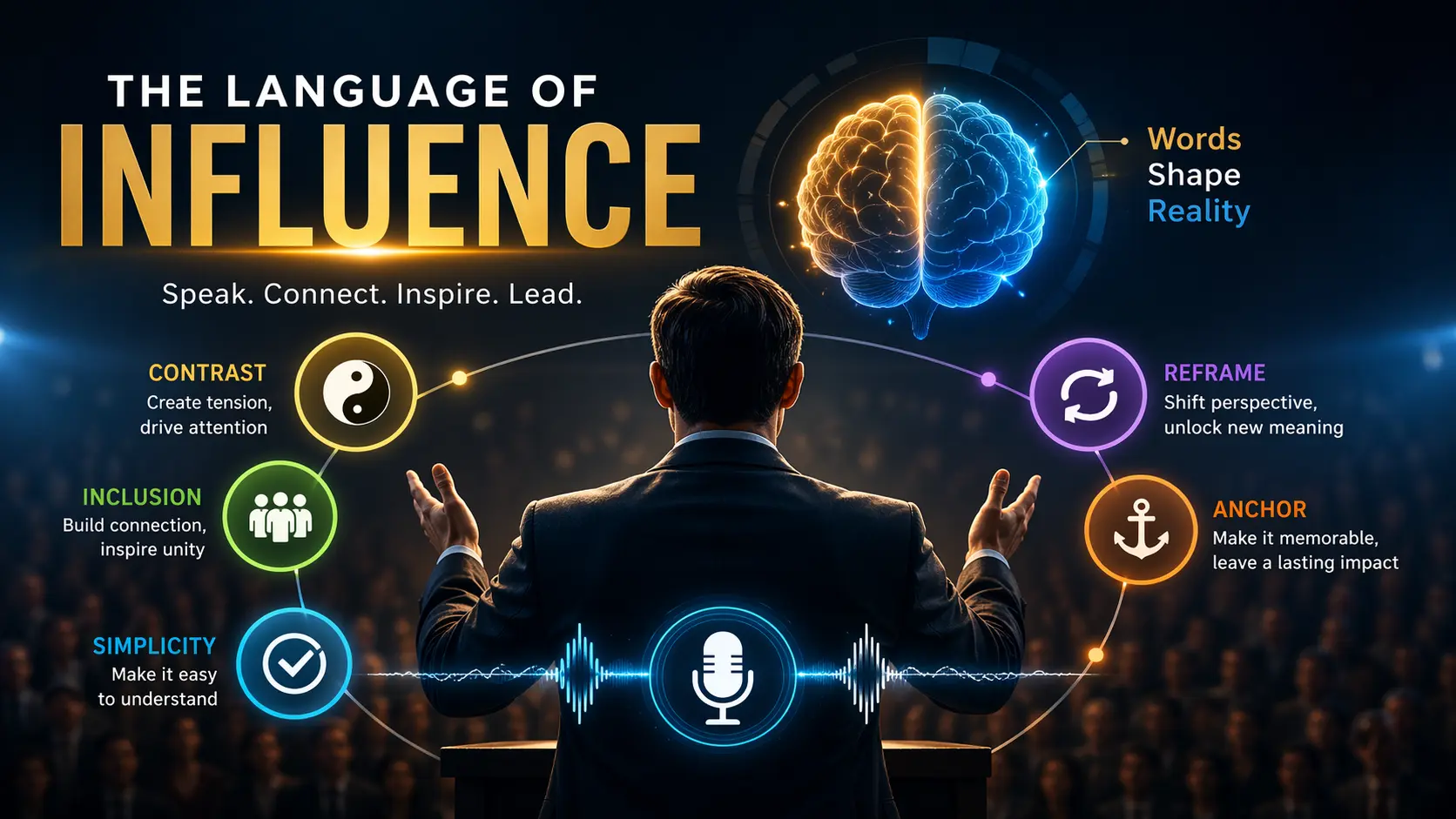
The world’s most persuasive communicators, including Barack Obama, Steve Jobs, and Oprah Winfrey, use identifiable linguistic patterns to influence audiences. These include contrast (tension and resolution), inclusive language (“we”), simplicity (cognitive ease), emotional storytelling, and reframing. Communication science and NLP frameworks show these patterns increase trust, memorability, and action, making them essential tools for leaders, coaches, and entrepreneurs.
Key Takeaway:
- Persuasive communicators use intentional language patterns to build trust, capture attention, and make their message easier for others to understand and act on.
- Key patterns include mirroring communication style, using sensory-rich words, asking precise questions, and framing ideas in ways that align with the listener’s values and goals.
- Strong persuasion is less about “convincing” and more about creating emotional clarity, reducing resistance, and helping people see a clear path forward.
- The most effective communicators adjust tone, pace, and wording based on whether the other person responds best to visual, auditory, or feeling-based language.
- Consistent use of these patterns improves influence in leadership, sales, coaching, and everyday conversations by making people feel heard and understood.
Bottom Line: Persuasive communication patterns work by aligning language with how people naturally process information, increasing trust, clarity, and influence in every conversation.
- Contrast: creates tension and attention.
- Inclusion: builds connection and trust.
- Simplicity: reduces cognitive effort and increases belief.
- Reframing: shifts meaning and perception.
- Anchoring: ties emotion to a repeatable message.
What Makes a Communicator Truly Persuasive?
Most people assume great communicators are just born that way. Something about their presence, their energy, or their voice. But when you actually study the language these people use, you find something more useful than talent: repeatable patterns.
Obama, Jobs, and Oprah are three of the most studied communicators of the past half-century. They operate in completely different arenas and their styles feel nothing alike. Yet underneath the surface, they use the same core linguistic structures to move audiences from passive listeners to active believers. Once you know what to look for, you start seeing these patterns everywhere.
Persuasion is not about speaking loudly, using fancy vocabulary, or projecting confidence. It is about structure, delivery, and psychology working together. This article breaks down the specific patterns each of these communicators relied on, explains why those patterns work at a neurological level, and shows you how to put them to work in leadership, sales, coaching, and presentations.
Pattern Summary
| Communicator | Core Pattern | Example | Business Application |
| Obama | Contrast + Inclusion + Rhythm | “Yes, we can.” | Vision-setting, team alignment |
| Jobs | Simplicity + Rule of Three | “1,000 songs in your pocket” | Sales pitches, proposals |
| Oprah | Emotional contrast + Storytelling | Struggle to transform | Coaching, branding, leadership |
Barack Obama: Contrast, Inclusion, and Rhythmic Persuasion

Obama’s communication sits inside three interlocking patterns. The first is contrast. He rarely described a problem without immediately framing a possibility alongside it. Where we are becomes the setup. Where we could go becomes the release. This structure pulls listeners into tension and then resolves it in a way that feels earned rather than forced.
The second pattern is inclusion. Obama built, as political communication researchers have documented, a communication style centered on “we,” “us,” and “our.” Not because it sounded diplomatic, but because inclusive language activates collective identity. When an audience hears “we,” they stop feeling addressed and start feeling involved. That psychological shift changes how receptive they are to everything that follows.
The third pattern is anaphora, which is rhythmic repetition. Think of “Yes we can” not just as a slogan but as a linguistic device. The repetition creates momentum and builds emotional inevitability. By the third repetition, audiences are not just listening, they are anticipating. That anticipation converts into energy, and energy converts into action.
The modal verb “can” matters too. It signals possibility rather than obligation. Linguistics research shows that words like “can” and “will” evoke positive emotional associations in listeners in a way that directive language simply does not.
How to apply this in business
Use contrast in leadership communication. Frame the current reality honestly, then shift into possibility language. Replace “here is what we need to do” with “here is where we are, and here is where we are capable of going.” Use rhythmic repetition in presentations to land key messages, not as a gimmick, but as a genuine tool for retention.
Steve Jobs: Simplicity, Cognitive Ease and Persuasive Clarity

Jobs was not the most technically gifted person in any room he walked into. He became one of the most influential communicators in business history because he understood something most executives miss: simplicity persuades.
When Jobs introduced the iPod, he did not say “a 5 GB hard drive with 1,000-song capacity in a 6.5-ounce enclosure.” He said “1,000 songs in your pocket.” Same product. Completely different psychological impact. Communication researchers studying cognitive ease have found that ease of processing makes ideas feel more believable and trustworthy. When something is easy to understand, the brain signals safety. Complexity does the opposite.
Jobs also used the rule of three consistently. Three stories at Stanford. Three product features at every launch. Three reasons to make a decision. The rule of three works because it is the smallest number of items that creates a pattern in the mind while remaining easy to retain.
His reframing ability was equally powerful. After being fired from Apple, Jobs did not describe it as a failure. He publicly reframed it as the most liberating thing that had ever happened to him, crediting the experience with giving him the freedom to build NeXT and Pixar. That reframe was not spin. It was a genuine linguistic restructuring of meaning, and it showed audiences that the same event can carry a completely different weight depending on how it is positioned.
How to apply this in business
Audit your communication. Are you leading with features or with meaning? Replace technical language with benefit language. Structure your next pitch, proposal, or team update around three clear points. When something goes wrong, practice reframing the setback into a teachable moment rather than a stopping point. NLP techniques for personal development go deeper into exactly this kind of reframing work.
Oprah Winfrey: Emotional Precision and the Power of Opposites

Oprah’s communication is often described as empathetic and warm. That is accurate but incomplete. Her effectiveness comes from something more structural: the deliberate use of opposites.
Communication researcher Daniel Coyle identified this as the engine of her storytelling. Oprah consistently places contrasting images next to each other: young and old, poor and powerful, pain and triumph. These contrasts are not accidental. They create narrative tension, and tension creates engagement. The brain is hardwired to resolve tension. When Oprah places struggle next to transformation, the listener leans in because the mind wants to know how those two things connect.
Her emotional arc design is equally precise. She moves audiences through a deliberate sequence, starting with relatable difficulty, building to honest reflection, and landing on possibility. That arc mirrors the structure that NLP practitioners use in coaching contexts and that James R. Elliot applies across his 20+ years of transformation work.
Oprah also uses vulnerability as a trust mechanism, not as performance. Self-disclosure, when genuine, signals that a communicator has nothing to hide. That signal lowers resistance in the listener. Combined with her use of simple, repeatable refrains (“Their time is up” became instantly iconic in four words), Oprah gives audiences something to hold onto long after the speech ends.
How to apply this in business
Structure conversations around opposites. Where is the tension in what you are presenting? Name the gap between the current reality and the desired outcome and let that gap breathe for a moment before you offer the resolution. In coaching contexts, holding space in that tension is where transformation begins. This connects directly to how NLP enhances communication skills for leaders.
The NLP Decode: What These Communicators Are Actually Doing

The patterns above are not unique to famous people. They are documented structures within Neuro-Linguistic Programming (NLP), the field developed by Richard Bandler and John Grinder through the study of highly effective therapists and communicators.
At the core is pacing and leading. Pacing means matching the emotional state of your audience before attempting to shift it. Every great communicator does this. Obama acknowledged collective grief before offering hope. Jobs acknowledged that current products were frustrating before revealing something better. Oprah named real pain before guiding audiences toward a different perspective. Pacing is what makes leading feel earned rather than imposed.
The Milton Model, one of NLP’s core frameworks, describes what linguists call “artfully vague” language. Phrases like “many people find…” or “when you’re ready to…” allow listeners to fill in meaning from their own experience. This increases emotional resonance because the listener personalizes the message without being told to. Obama frequently used this structure in his language. So did Jobs, particularly in product launches.
Anchoring ties a specific emotional state to a word, phrase, or gesture. Obama’s “Yes we can” is a textbook anchor. Jobs’s “One more thing…” became one of the most recognizable anchors in product marketing history. Oprah’s closing refrains work the same way. The repeated phrase accumulates emotional weight each time it is used.
Heather Chetwynd, who trained with James after prior NLP training elsewhere, described coming away with a toolbox that suddenly made sense in a way it had not before. She gained clarity not just on the techniques but on how they fit together as a coherent system of communication. That integration is what separates people who know about these patterns from those who can actually use them.
For executives and coaches managing workplace communication challenges, NLP is not a theory. It is a practical translation layer between good intentions and real influence.
Data and Findings
- The persuasive impact of these patterns is not anecdotal.
- Stories are up to 22 times more memorable than facts alone, according to research by Dr. Jennifer Aaker at Stanford Graduate School of Business. That finding explains why Jobs led product launches with stories rather than spec sheets, and why Obama opened major speeches with narrative before pivoting to policy.
- 95% of purchase decision-making takes place in the subconscious mind, according to Harvard Business School professor Gerald Zaltman, published in his book How Customers Think. This is why language that works at a subconscious level, through pacing, presuppositions, and simplicity, outperforms purely logical persuasion in almost every business context.
- In a survey of 150 CEOs conducted by Harvard Business Review, 80% identified empathy as a key factor in leadership success. Oprah’s entire communication style, built on genuine listening and emotional attunement, is a masterclass in that principle in action.
Darren G., who worked with James after years of feeling blocked in his career and income, experienced a shift once his internal language around possibility changed. He described radical improvements in his thinking, behavior, and relationships. The external results followed the internal reframe. That is exactly what these patterns do when applied with intention.
The 5 Linguistic Levers of Persuasion

These five levers distill the patterns above into a framework you can apply immediately.
Lever 1: Contrast
Create tension before you offer resolution. Name the gap between where someone is and where they want to be before you present the path. Tension is not negative. It is the engine that makes resolution feel meaningful.
Lever 2: Inclusion
Replace “you should” with “we can.” Shared language activates shared identity, and shared identity reduces resistance. The moment an audience feels like part of a group rather than a recipient of instruction, their receptivity shifts.
Lever 3: Simplicity
Remove every word that does not add meaning. Plain language increases cognitive ease, and cognitive ease increases belief. If someone has to work to understand you, they are not in a state to be persuaded.
Lever 4: Reframe
Change the position of a problem and you change its weight. Every setback, objection, or piece of resistance carries a different meaning depending on how it is held. Practice finding the alternative frame before you need it in the room.
Lever 5: Anchor
Identify the one phrase, word, or image that captures the core of your message and use it consistently. Let it accumulate meaning across every interaction. The goal is not memorability for its own sake but a reliable emotional signal that primes your audience each time they encounter it.
Entrepreneurs who want to apply these levers in client conversations and negotiations will find practical starting points in NLP for entrepreneurs and top negotiation tips using NLP.
The Most Common Mistake: Sounding Smart Instead of Being Persuasive
Most professionals who struggle with communication are not struggling because they lack ideas. They are struggling because they prioritize complexity over clarity.
- Overcomplicating language signals effort but not understanding. The listener’s brain works harder and trusts less.
- Leading with features instead of meaning gives the audience information they cannot immediately feel. Information that cannot be felt is information that does not persuade.
- Talking at people rather than with them closes the conversational loop before rapport is established.
The insight here is direct: clarity persuades more than complexity. Obama, Jobs, and Oprah all simplified on purpose. That simplicity was not a limitation. It was the mechanism.
Who Should Focus on These Patterns?
These patterns matter most for:
- Coaches, consultants, and service providers whose income depends on converting conversations into clients.
- Executives who present to boards, investors, or large teams where influence determines outcomes.
- Sales professionals who need to move prospects from hesitation to commitment.
- Founders pitching to investors, partners, or early customers.
- Anyone who regularly leads meetings, mediates conflict, or drives team alignment.
If you use language in your work, and almost everyone does, this is not optional enrichment. It is a core professional skill.
Who Can Skip This for Now?
If you are in an early phase of building a product or business where the primary challenge is technical or operational rather than communicative, you can defer this work. Roles with minimal live or real-time communication, where written templates cover most interactions, are less immediately impacted.
That said, most professionals reach a point where communication becomes the ceiling. The earlier you start building these skills, the less that ceiling costs you.
FAQs:
What are the key linguistic patterns used by the world’s most persuasive communicators?
The most persuasive communicators, such as Barack Obama, Steve Jobs, and Oprah Winfrey, consistently use five core linguistic patterns: contrast, inclusion, simplicity, reframing, and anchoring. These patterns work because they align with how the brain processes information, creating emotional engagement, reducing cognitive load, and increasing memorability. Rather than relying on charisma, these communicators use structured language to guide attention, build trust, and influence decisions.
Why is simplicity so powerful in persuasive communication?
Simplicity increases persuasion because it reduces cognitive effort, making messages easier to process and more believable. Research in communication science shows that when information is easy to understand, the brain interprets it as safer and more trustworthy. For example, instead of using technical descriptions, simplifying a message into a clear benefit (like “1,000 songs in your pocket”) makes it instantly relatable and memorable. In short, clarity builds trust, and trust drives action.
How does contrast improve audience engagement?
Contrast improves engagement by creating tension and resolution, which naturally captures attention. When communicators present a gap between the current reality and a better future, the brain becomes motivated to resolve that gap. This structure is foundational in storytelling and persuasion because it activates curiosity and emotional investment. Effective communicators use contrast to frame problems clearly and position their message as the solution.
What is anchoring in communication, and why does it matter?
Anchoring is the practice of linking a specific emotion to a repeated word, phrase, or idea. Over time, this repetition builds a strong mental association, making the message more impactful and memorable. For example, phrases like “Yes we can” or “One more thing…” become emotionally charged signals that instantly reconnect audiences to a feeling or belief. Anchoring matters because it creates consistency, recall, and emotional resonance across multiple interactions.
How does Neuro-Linguistic Programming (NLP) influence persuasive communication?
Neuro-Linguistic Programming (NLP) influences persuasion by providing structured techniques like pacing and leading, reframing, and the Milton Model. These methods help communicators match the audience’s current state, guide them toward a new perspective, and use language that feels personal and meaningful. NLP bridges the gap between intention and impact, turning abstract communication skills into repeatable, practical tools.
Conclusion
Obama, Jobs, and Oprah did not become influential communicators by accident. They used specific, repeatable linguistic structures that NLP has studied, named, and made teachable. The good news is that these are skills, not gifts. They can be learned, practiced, and refined.
If you want to internalize these patterns at a level where they become instinctive rather than something you consciously reach for, NLP training is where that work happens. It is not a theory. It is practice.
Explore NLP training programs at Unleash Your Power to start building these skills with a Board Designated Trainer who has spent 20+ years applying them in real coaching, leadership, and business contexts.
Unleash Your Power: Stand Out, Take Action, and Create the Success You Want.