
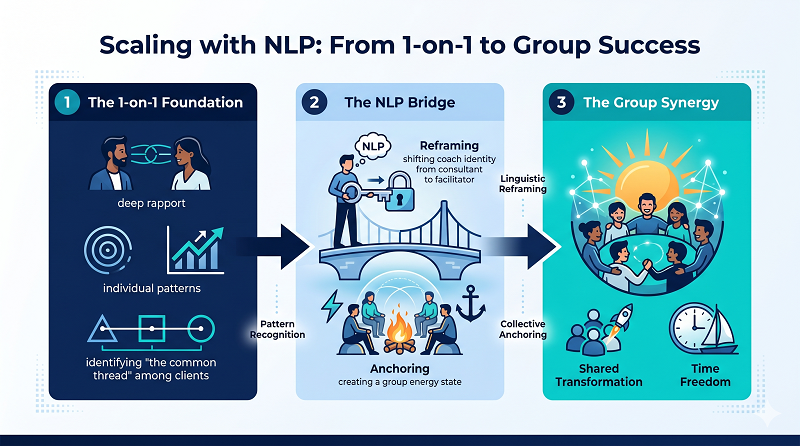
Scaling a coaching business from 1-on-1 sessions to group programs is one of the most impactful shifts a coach can make. Group coaching allows you to serve more clients, increase revenue per hour by two to five times, and create a community-driven transformation experience, without working more hours. The key is to package your existing methodology into a structured, repeatable framework that delivers consistent results. NLP techniques like anchoring, reframing, and rapport-building adapt powerfully to group settings, where shared learning accelerates breakthroughs.
Key Takeaway:
- Transitioning from 1-on-1 coaching to group programs is one of the smartest ways to scale your coaching business, increase income, and create more impact while working fewer hours. [1]
- Using Neuro-Linguistic Programming (NLP) techniques makes this shift smoother by helping you reframe limiting beliefs, build confidence in group delivery, design high-value group experiences, and create powerful transformations for multiple clients at once. [1]
- Key steps include: identifying your signature group program, using NLP to overcome fears of group coaching, structuring your offer for maximum value and scalability, leveraging group dynamics and shared breakthroughs, and marketing it authentically to your existing audience. [2]
- Coaches who successfully make this transition often double or triple their revenue while gaining more freedom and impact — the combination of strong positioning and NLP tools accelerates the process significantly. [2]
Bottom Line: Moving from 1-on-1 to group programs using NLP allows you to scale your coaching business faster, serve more people, and create higher income with less time — it’s a powerful leverage strategy when done with the right mindset, structure, and tools.
Start by identifying the transformation you deliver most consistently, build a cohort-based program around it, and price at 40–60% below your individual rate while serving 8–15 participants. Here’s the math: if you charge $200 per 1-on-1 session, a 10-person group at $2,000 each generates $20,000 for roughly the same 10-week time block. The coaching industry generated $5.34 billion in global revenue in 2025. Coaches who build scalable group models now position themselves for long-term, sustainable growth.
How to Transition from 1-on-1 Coaching to Group Programs
This shift isn’t just a business decision; it’s an identity shift. You’re moving from practitioner to architect, from delivering transformation one conversation at a time to designing systems that create transformation at scale.

Why Group Coaching Accelerates Results (For You and Your Clients)
Participants in group coaching don’t just receive your perspective; they gain eight, ten, or fifteen different viewpoints simultaneously. That’s leverage, and it accelerates breakthroughs in ways private sessions can’t replicate.
Group coaching creates what psychologists call “social proof of change.” When one participant shares a breakthrough, it rewires the belief systems of everyone watching. According to the ICF’s 2025 Global Coaching Study, the number of coach practitioners rose 15% since 2023 to reach 122,974 and 59% expect revenue growth driven by increased clients and sessions.
Group Coaching in Corporate and Leadership Settings
Group coaching is gaining serious traction inside organizations. Research from LinkedIn Learning’s 2025 report found that 88% of organizations are concerned about retention, with coaching-based development as their top strategy. A structured group program makes you far more attractive to corporate buyers than private sessions alone.
How to Price Your Group Coaching Program
Start with your 1-on-1 rate as your anchor. Group programs are typically priced at 40–60% below individual rates, serving 8 -15 participants per cohort. Most coaches land between $2,000 and $5,000 for a 6–12 week program. The rule of thumb: deliver at least 10 times the value of your price.
Consider tiered pricing, a base tier with group calls and curriculum, and a premium tier adding private check-ins and direct access. Here’s a detail many coaches miss: a percentage of your group clients will eventually upgrade to 1-on-1 coaching. As demand grows, you raise your private rates, too.
How to Structure a Group Coaching Program That Delivers
Structure separates a powerful group experience from a glorified Q&A call. You need curriculum (the “what”), facilitation (the “how”), and accountability (the “why they stay”).
The most effective launch model is cohort-based, with a fixed start and end date, where everyone progresses together. A practical structure: weekly group calls (60–90 minutes), pre-recorded content between sessions, and a private community for peer support. You teach the “information” through materials and use live sessions for coaching and real-time application. That’s how you set goals aligned with actual business growth without getting trapped delivering lectures.
Try this: Before your first cohort, run a beta group of 3–5 people at a reduced rate. Gather feedback, refine the flow, and collect testimonials. Then launch with proof.
How NLP Techniques Power Group Transformation
This is where NLP-trained coaches hold a decisive advantage. Most group facilitators rely on conversation and content. An NLP-trained coach uses the entire environment, verbal, nonverbal, and spatial, to create transformation.
Spatial Anchoring is one of the most underused group techniques. In a live setting, you anchor different emotional states to different locations in the room. Participants physically move between “current challenge” and “empowered future” spaces. Virtually, achieve this through visual cues, breakout rooms labeled by state, or guided visualization tied to physical movement. This is insider-level facilitation most coaches never learn.
Group Reframing works as a multiplier when you guide one participant through a reframe; everyone watching runs the same internal process. State Management through anchoring shifts an entire room’s energy in seconds.
Heather Chetwynd came to James with prior NLP training but couldn’t integrate the techniques into her work. After completing James’s NLP Practitioner course and practicing tools like sensory acuity and rapport-building, she walked away with unexpected business clarity and genuine excitement about applying NLP in professional practice. That’s the shift from knowing NLP theory to wielding it live.
The Revenue Math, 1-on-1 vs. Group Coaching

With 1-on-1 coaching, your revenue has a hard ceiling: maximum clients times maximum rate. Every new client adds another hour to your calendar.
A coach charging $200 per session who delivers 20 sessions weekly earns $4,000. That same coach running a 10-person group program at $2,000 per participant generates $20,000 per cohort while spending 2–3 hours weekly on delivery. The US business coaching industry reached $20 billion in 2025, and group-model coaches capture disproportionate growth.
But here’s the reality check most articles skip: revenue goes up, and so does operational complexity. You’re managing group dynamics, marketing to fill cohorts, and maintaining quality across more touchpoints. This is where Clarity of Vision and Continuous Growth become essential. You need systems before you need scale, otherwise you’re building a bigger burnout trap.
Darren G. experienced this tension firsthand. He came to James feeling stuck despite earning well, blocked from the growth he wanted. James identified the goal blocks and limiting beliefs keeping Darren locked in a revenue ceiling of his own making. After working through those blocks, Darren experienced radical shifts in his thinking, behavior, and relationships. The same blocks that cap your personal income cap your business growth.
Who Should Scale to Group Coaching?
You’re ready if you have a repeatable methodology delivering consistent 1-on-1 results, you feel energized by group dynamics, and you want to increase income without proportionally increasing hours. This path is especially powerful for coaches pursuing life coach training certification in Canada who want to build sustainably from the start.
Who Should Stay with 1-on-1 (For Now)?
If you’ve worked with fewer than three clients, stay in 1-on-1 mode; you need more pattern recognition. If your work requires deep individualized intervention like crisis support, private coaching remains your best format. And if you love the intimacy of 1-on-1 with no desire to manage groups, that’s valid. Not every coach needs to scale.
1-on-1 vs. Group vs. Hybrid: A Comparison
| Factor | 1-on-1 Coaching | Group Coaching | Hybrid Model |
| Revenue per hour | $150–$400 | $500–$2,500+ | $800–$3,000+ |
| Time commitment | 1 hour per client | 2–3 hrs per 8–15 clients | 3–5 hrs combined |
| Client experience | Deeply personalized | Community-driven, peer learning | Personal attention + group energy |
| Scalability | Hard ceiling | Highly scalable | High deep presence in each session |
| NLP application | Individual anchoring, reframing | Spatial Anchoring, group reframing, state management | Full NLP toolkit |
| Emotional energy | Highly deep presence in each session | Moderate shared by the group | Balanced varies by session |
Data and Findings
According to the ICF’s 2025 Global Coaching Study, the global coaching profession generated $5.34 billion in revenue, a 62% increase since 2019. Active practitioners reached 122,974 worldwide, up 15% since 2023. In North America, average session fees are approximately $272 per hour.
The US coaching market alone is estimated at $20 billion, with over 232,000 coaches operating across life, health, and executive coaching, more than double the count from 2016. Group coaching benchmarks show programs priced between $2,000–$5,000, with coaches reporting two to five times higher revenue per hour than 1-on-1 delivery.
The 5-Phase Scale-Up Framework

Phase 1–Clarify:
Map your transformation methodology. Document the frameworks and breakthroughs that happen most consistently. This becomes your program blueprint. Without clarity, you’re scaling confusion.
Phase 2–Communicate:
Package your methodology for group delivery modules, worksheets, and facilitation guides. Your communication needs to be clear enough that participants learn the “what” independently and use sessions for the “how.” This is where scaling a coaching business starts with a message that resonates at scale.
Phase 3–Courage:
Launch your beta cohort. Perfectionism kills more coaching businesses than bad marketing ever will. Take decisive action and learn in motion.
Phase 4–Presence:
Master group facilitation with NLP. Spatial Anchoring, group reframing, and state management become your competitive advantage. Your presence as a facilitator, not just a teacher, makes your program transformational.
Phase 5–Grow:
Systematize and iterate. Build onboarding sequences, scheduling automation, and feedback loops. Then run your next cohort better than the last. Growth isn’t a destination; it’s a discipline.
FAQs
1. How do I transition from 1-on-1 coaching to group programs?
To transition effectively, identify the recurring patterns and obstacles from your last 10–15 private sessions to form a structured, repeatable curriculum. You are ready to scale once you have achieved consistent results with at least three 1-on-1 clients, allowing you to move from a practitioner role to an “architect” of transformation. By packaging your methodology into a cohort-based program of 8–15 participants, you can leverage shared learning to accelerate breakthroughs while increasing your revenue per hour by two to five times.
2. What is the best pricing strategy for a scalable group coaching program?
The most effective pricing strategy is to use your 1-on-1 rate as an anchor and price your group spots at 40–60% below your individual rate, typically ranging between $2,000 and $5,000 for a 6–12 week program. This “sweet spot” ensures high-value perception while allowing you to serve a larger audience; for example, a 10-person group at $2,000 each generates $20,000 for the same time block as a single $200 session. To maximize growth in the $5.34 billion coaching industry, consider a tiered hybrid model that offers a base group curriculum alongside premium 1-on-1 check-ins.
3. How can NLP techniques like Spatial Anchoring improve group coaching?
Neuro-Linguistic Programming (NLP) gives coaches a decisive facilitation edge by using Spatial Anchoring and Group Reframing to manage the collective emotional state of a room. Spatial Anchoring involves assigning specific physical or virtual locations to different mental states, such as a “current challenge” space and an “empowered future” space, allowing participants to physically move through their transformation. Because group coaching creates “social proof of change,” guiding one participant through a reframe simultaneously rewires the belief systems of the entire cohort, making the intervention exponentially more powerful than private sessions.
4. Is group coaching more profitable than the traditional 1-on-1 model?
Group coaching is significantly more profitable and sustainable because it removes the “hard ceiling” where revenue is limited by the number of hours on your calendar. While the US coaching industry reached a $20 billion valuation in 2025, the highest earners are those who have shifted from selling time to selling a scalable system. By spending 2–3 hours weekly on group delivery instead of 20 hours on individual sessions, a coach can generate five times the revenue while reducing the risk of burnout and building a community-driven brand.
5. When is a coach officially ready to scale to a group coaching model?
A coach is ready to scale when they have a repeatable methodology that has delivered proven results for at least three individual clients, indicating enough pattern recognition to lead a group. Scaling requires a shift in focus toward operational complexity, meaning you must have basic systems for onboarding and peer support in place before adding more participants. If you find yourself teaching the same frameworks repeatedly in private sessions, you have already created a curriculum that is ready to be delivered to a cohort of 8–15 people for maximum impact.
Your Next Step
You already have the skills and the methodology. What you need is the structure, confidence, and NLP mastery to deliver transformation at scale. If you’re ready to build a coaching business that grows without burning you out, explore James’s life coach training certification in Canada where you’ll learn to design, deliver, and scale group programs powered by proven NLP techniques.
Your transformation starts today. Take the first step.