

A subconscious “no” in high-ticket sales is a refusal that has almost nothing to do with the reason given. The prospect says the price is too high, the timing is wrong, or they need to talk it over with a partner.
What is actually happening underneath is a fear response and research spanning millions of recorded sales conversations shows that most deals lost to “no decision” involve buyers who genuinely wanted the change and froze anyway, because the fear of making a mistake outweighs the fear of missing out.
There are three layers to decode. The stated objection. The fear sitting underneath it. And the layer almost nobody audits: the seller’s own hesitation, transmitted through tone, pace, and the compulsion to keep talking after saying the number out loud.
Key Takeaway:
- A subconscious “no” in high-ticket sales often reflects fear of making the wrong decision rather than the stated objection. Prospects may say the price is too high or they need time, while the deeper concern is uncertainty about whether the investment will produce the desired change. [1]
- The key distinction is between a real constraint and a fear-based objection. A genuine “no” is usually specific and stable, while a fear “no” tends to migrate from price to timing, authority, or another reason when the original concern is addressed. [1]
- Your own subconscious programming can influence the sales conversation through over-explaining, premature discounts, adding unnecessary bonuses, or filling silence immediately after stating the price. These behaviors can signal hesitation and increase buyer uncertainty. [1]
- What to do: After stating your price, pause for about four seconds and let the prospect respond. Ask a clarifying question, identify the underlying concern, and reduce the perceived risk of saying yes with a clear first milestone or expectations instead of immediately lowering the price. [1]
- When to rethink the approach: Do not treat every rejection as a subconscious fear response. If the offer is unproven, the pipeline is too small, or the prospect has a genuine budget or timing constraint, improve the offer, lead flow, or respect the buyer’s decision rather than pushing harder. [1]
Bottom Line: High-ticket sales objections are not always about price; they can reflect fear, uncertainty, or hesitation from either the buyer or seller. Instead of increasing pressure, pause, diagnose the real concern, reduce decision risk, and address the programming that shapes the conversation.
What is a subconscious “no” in high-ticket sales?
A subconscious “no” is a decision the prospect has already made emotionally, then dressed in a reason that sounds rational enough to end the conversation politely.
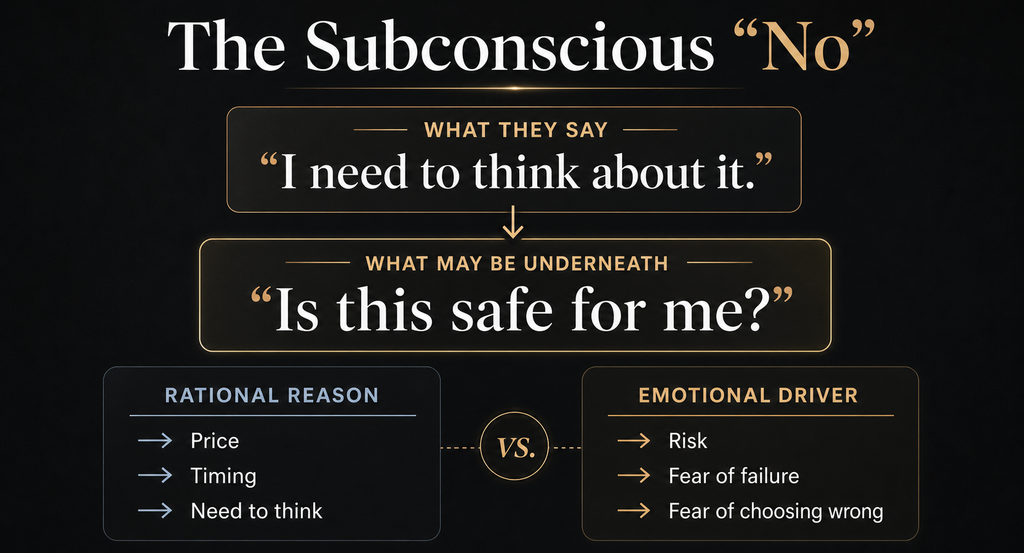
It matters more in high-ticket work than anywhere else because the stakes are personal. Someone buying a significant coaching or consulting engagement isn’t just spending money. They’re admitting they couldn’t fix it alone, and they’re picturing the version of themselves who spends that money and still doesn’t change. Change reads as costly and unsafe by default, which is why the current arrangement quietly wins so many decisions it has no business winning.
Here’s the part that will sting. You’ve been trained to treat every “no” as a problem in your handling. It usually isn’t. It’s a fear response you’re trying to argue with and you can’t argue someone out of a feeling they haven’t consciously named yet.
Why do prospects say “I need to think about it” when they already wanted to buy?
Because wanting the change and being able to commit to it are two entirely separate psychological events.
The largest study ever conducted on sales losses analysed more than two and a half million recorded conversations. Matt Dixon and Ted McKenna found that somewhere between 40% and 60% of deals end in no decision at all and of those, the majority were not lost to a preference for the status quo. They were lost to indecision. The buyer wanted to move. They said so. Then they didn’t.
The mechanism is specific: once someone has decided they want to change, they stop optimising for success and start optimising for not failing. They aren’t weighing your offer against a competitor. They’re weighing it against the humiliation of having chosen wrong.
Which means the entire playbook most of us were handed build more urgency, amplify the pain of staying stuck, follow up harder is the exact wrong medicine. Overcoming indecision requires dialling down the fear of buying, not dialling up the fear of not buying. Push a frozen person harder and they freeze more thoroughly.
Is a price objection ever actually about the price?
Sometimes, yes. And the coaching industry does you no favours by pretending otherwise.
There is a version of this advice that says every objection is a smokescreen and your job is to keep going until they cave. That’s not decoding. That’s just not listening with extra steps. Some people genuinely cannot allocate the money right now, and treating them as a puzzle to be solved is how you build a reputation you’ll spend years undoing.
The useful distinction is between an objection that carries information and one that carries emotion. Gong’s analysis of hundreds of millions of calls found that a small handful of objection categories account for roughly three-quarters of everything sellers hear: price, timing, authority, need, trust. When you hear the same five sentences all week, you stop hearing what’s actually underneath any of them.
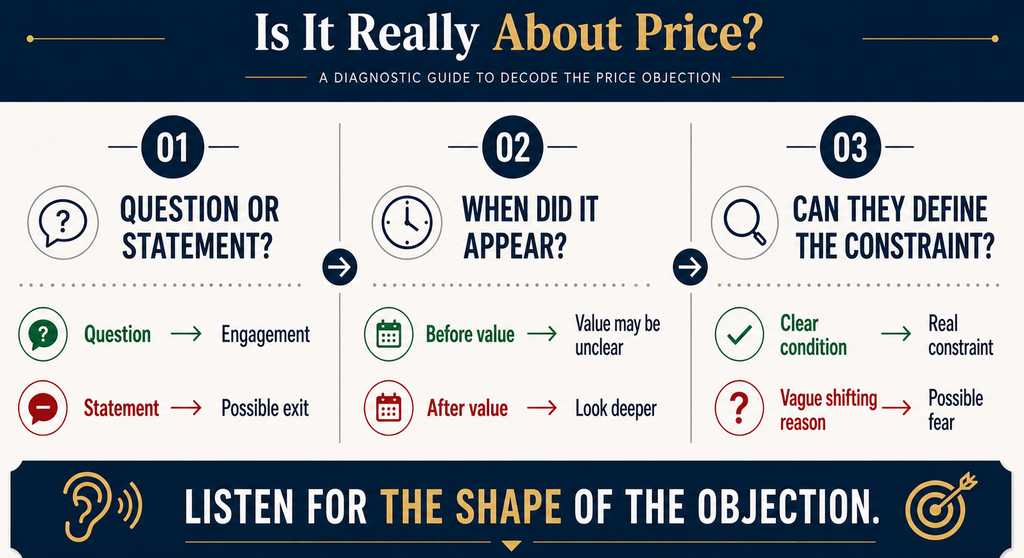
Three quick tests for whether the price objection is real:
- Did they ask a question about the price, or make a statement about it? Questions are engagement. Statements are exits.
- Did the objection arrive before or after you described the outcome? Before means you haven’t built the value yet. After means something else is happening.
- Can they tell you what they’d need to be true to say yes? A real constraint has a shape. A fear response usually doesn’t.
Try this: on your next call, when the price objection lands, say nothing for four seconds. Not as a technique. As a diagnostic. Watch whether they fill the silence with a constraint or with an apology.
How does your own unconscious programming show up on a sales call?
It shows up in the four seconds after you say the number.
Not in what you believe about money in the abstract. In behaviour that’s specific, observable, and almost entirely automatic:
- You say the price and then immediately keep talking.
- You discount before anyone has asked you to.
- You add a bonus session to justify a figure that didn’t need justifying.
- You over-explain the methodology because explaining feels safer than waiting.
- You send the follow-up email that says “no pressure at all!” which is you managing your own discomfort, not theirs.
None of this is a confidence problem you can affirmation your way out of. It’s programming that runs underneath your decisions before your conscious mind gets a vote.
And it’s audible. A doctoral study analysing sales dialogues found that emotional influence in these conversations flows predominantly from the seller to the buyer, not the other way around. You are setting the emotional temperature of the room. Emotional states transfer between people through mimicry and behavioural synchrony, whether or not anyone intends it, which means your flinch becomes their hesitation roughly a second and a half before either of you notices. Research on sales call anxiety has documented the same pattern from the other direction: anxious sellers take protective actions during customer contact that undermine the very outcome they want.
I’ll tell you where I learned this. There was a stretch in my fifth business where I could not say my own price without adding something to it. Never a big discount just a little something. An extra call. A shorter payment term. I told myself I was being generous. I was on anxiety medication, working 80-hour weeks, and calling it success, and the truth is I didn’t believe the number, so I sanded the edges off it before anyone could push back. Nobody was pushing back. I was pushing back, on myself, out loud, in front of the client.
Jennifer (name changed) came to me with the same pattern in a different costume. Extraordinary background, real expertise, badly undercharging, and she knew it. She’d read everything. She could recite the arguments for raising her prices better than I could. She just could not make herself say the higher number. What changed wasn’t a script; it was reconditioning work rather than another affirmation– the deep kind. Within sixty days, she’d doubled her prices and more than doubled her revenue. Same expertise. Same market. Different self-concept.
Doubled her prices in 60 days. The strategy was never her problem. Her programming was.
Why does working 60 hours a week make you worse at closing?
Because holding steady in an uncomfortable moment is a physiological capability, and you’ve been running yours into the ground.
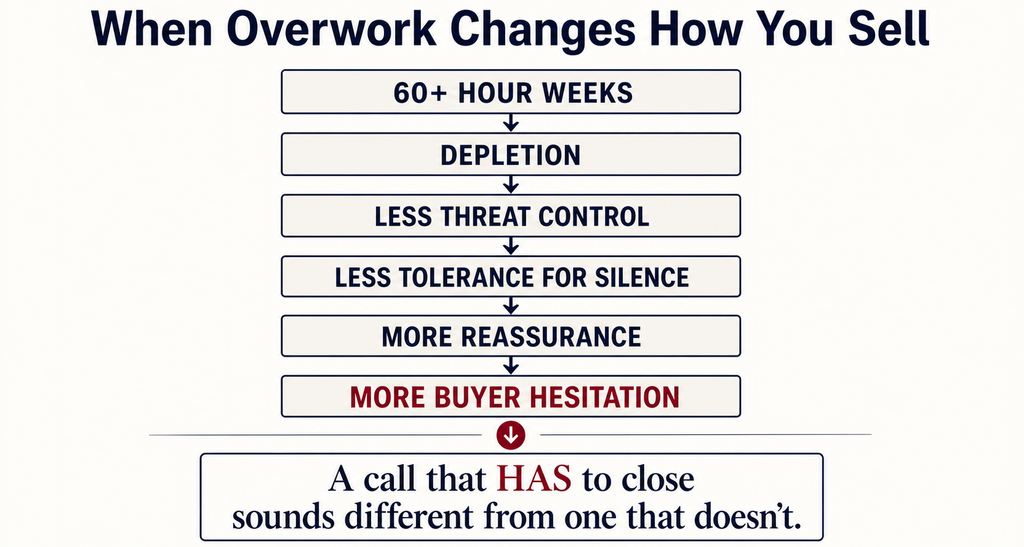
This is the causal claim, and it’s the one that tends to land badly. You’re not losing these sales despite the sixty-hour weeks. You’re losing them because of the sixty-hour weeks. The overwhelm isn’t the backdrop to your sales problem. It’s the mechanism.
Two things happen when you’re depleted. The first is neurological. A landmark Berkeley study found that after sleep loss, the brain’s threat centre responded roughly 60% more intensely, with a measurable breakdown in top-down control from the prefrontal cortex. The part of you that can sit in four seconds of silence after quoting a price is the part that goes offline first.
The second is structural. When you’re too busy delivering to build pipeline, every call has to close. And a call that has to close sounds different from one that doesn’t. That’s not mysticism; it’s tempo, it’s word count, it’s how quickly you move to reassure. Prospects don’t consciously detect neediness. They just feel slightly less safe and can’t say why.
The data on Canadian business owners is worth sitting with here. BDC’s 2025 survey found that more than a third report mental health challenges interfering with their ability to work at least once a week, rising to 60% among entrepreneurs under 40. These are not people who need a better closing framework. They need to stop being the bottleneck.
Working less is how you scale, including how you close. Not as a reward once the revenue arrives. As the mechanism that lets the revenue arrive.
I take a 36-minute nap most days. I’m not telling you that to sound relaxed. I’m telling you because the calls I take after it go measurably differently than the ones I used to take at 7 pm with my ninth coffee.
How do you tell a real “no” from a fear “no”?
Listen to what the objection is doing rather than what it’s saying.
A real no closes the loop. It’s specific, it’s calm, and it usually comes with a boundary attached: the budget is committed until Q2, we’ve already signed with someone, this isn’t the right season. It doesn’t need you to do anything except respect it.
A fear no keeps the loop open. It’s vague; it repeats; it moves when you address it; you handle the price and it becomes timing; you handle timing and it becomes a partner who needs consulting. That migration is the diagnostic. Fear doesn’t have a fixed address.
Gong’s research across 67,149 recorded sales meetings found that top performers pause longer after an objection and respond with a question rather than a monologue. There’s a reason that works, and it isn’t the technique. A question keeps the person in contact with their own reasoning. A monologue tells them you’ve stopped listening and started defending.
If you struggle to tell these apart in real time, it’s usually because you’re reading your own nervous system instead of theirs. Worth learning the difference between a gut instinct and a fear response in yourself first.
What should you do the moment you hear a subconscious “no”?
Reduce the risk of yes. Do not increase the cost of no.
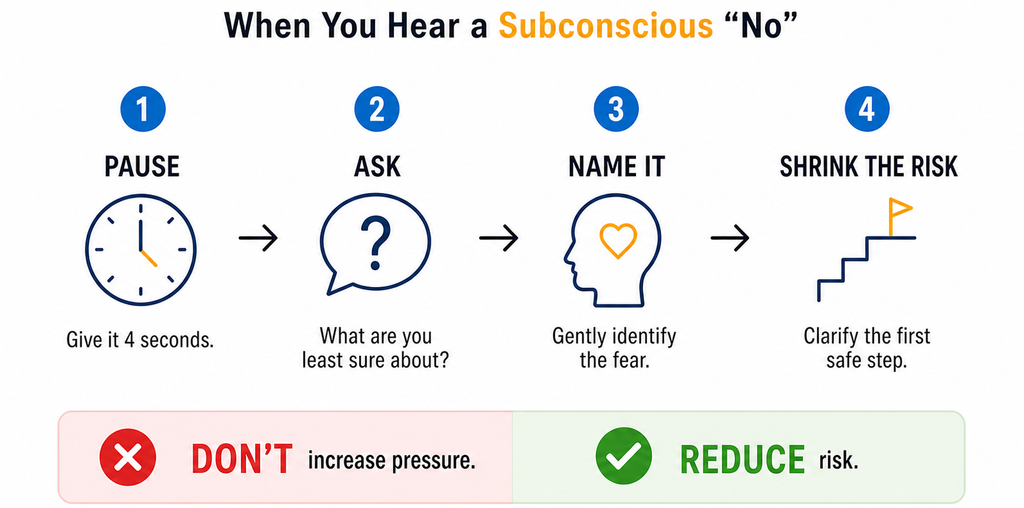
Try these four moves, in order:
- Pause. Four seconds. Let it be slightly uncomfortable. Most sellers lose the deal in this window by talking.
- Ask instead of answer. “What’s the part of this you’re least sure about?” You are not handling an objection. You are helping someone locate a feeling.
- Name the fear out loud, gently. “My guess is you’re less worried about the money and more worried about starting something you don’t finish.” When you say it first, it stops being shameful.
- Shrink the risk, not the price. A clear first milestone, an honest description of what week three looks like, what happens if it isn’t working. Discounting reduces the price of a decision they’re already afraid of. It does nothing to the fear.
Notice what’s absent: urgency, scarcity, a closing line. Those tools work on someone who prefers the status quo. On someone who is frozen, they are actively counterproductive and the conversation changes completely once the pressure comes out of it.
The three “no”s, side by side
Most sellers only ever work on the first column. The second is where the deals actually are. The third is where the pattern lives.
| Particular | Stated objection | Fear “no” | Your own “no” |
|---|---|---|---|
| What it sounds like | “That’s outside our budget this quarter.” | “Let me think about it and circle back.” | “…and I can be flexible on that.” |
| What’s underneath | A genuine constraint | Fear of choosing wrong, not fear of missing out | Programming that says the number is too much to ask for |
| What makes it worse | Ignoring it | Urgency, follow-up pressure, a harder close | Buying a better script |
| What actually works | Respect it, ask to revisit with a date | Pause, question, name the fear, shrink the risk | Reconditioning the programming, not rehearsing the words |
| Who owns the fix | The prospect | Both of you | You, entirely |
Who should use this?
- Coaches, consultants, and wellness practitioners selling significant engagements who have proven they can deliver, but watch qualified people evaporate after the price conversation.
- Practitioners who have already bought the sales training and found it didn’t move the number.
- Anyone who recognises the flinch, the reflex to soften, discount, or over-explain the moment the figure leaves their mouth.
- Established owners whose calendar is full and whose pipeline is thin, so every call carries more weight than it should.
Who should avoid this?
- If your offer isn’t proven yet, this isn’t your bottleneck. Go get results for people first. No amount of internal work makes an unproven offer sell.
- If you’re getting two calls a month, your problem is lead flow, not psychology. Fix the top of the funnel before you audit the bottom.
- If you want a script, this will frustrate you. There isn’t one here, deliberately.
- If you’re looking for permission to keep pushing harder on hesitant buyers, the research points the other way.
Data & Findings
| Finding | Figure | Source |
|---|---|---|
| Deals ending in no decision rather than a competitive loss | 40–60% | Dixon & McKenna, JOLT research, 2.5M+ conversations |
| Of those, share driven by indecision rather than status-quo preference | 56% | The JOLT Effect findings |
| Win rates at low buyer indecision vs. high buyer indecision | 45–55% vs. under 5% | Analysis of the JOLT dataset |
| Increase in threat-centre reactivity after sleep loss, with weakened prefrontal control | ~60% | Yoo, Gujar, Hu, Jolesz & Walker, Current Biology (2007) |
| Canadian business owners reporting mental health challenges interfere with work at least weekly | 36% (60% under age 40) | BDC 2025 survey |
| Recorded sales meetings analysed for objection-handling behaviour | 67,149 | Gong Labs |
Every figure above is drawn from published research. None of it is ours, and none of it is modelled.
Where this fits in The 5 Shifts to Freedom
The 5 Shifts to Freedom is the journey. The 3 Pillars are the mechanism that makes it hold: Performance Psychology, Freedom-First Business Strategy, and Freedom-First Business Structure. Strategy without psychology is another unfinished course. Psychology without strategy is feel-good fluff that doesn’t pay the bills. Structure without both is a prettier prison.
Every shift touches the sales conversation, and they run in order for a reason. Phases: Clarity, then Liberation, then Amplification.
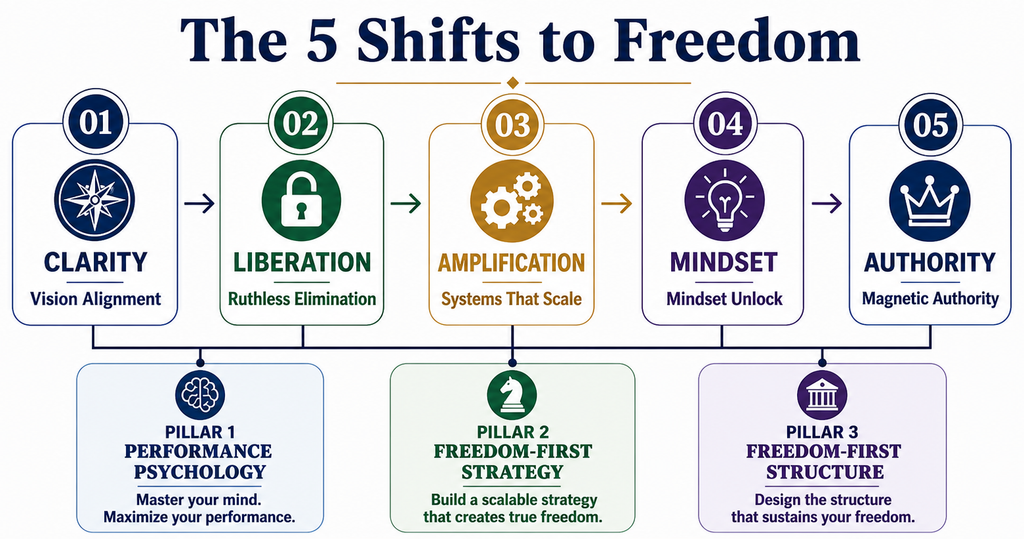
Vision Alignment
Before any of this is a sales problem, it’s a clarity problem. If you haven’t decided who you’re actually for and what you want the business to look like, you take calls with people you shouldn’t be talking to and a call with a poor-fit prospect produces a hesitation that no amount of decoding will resolve, because the hesitation is correct. Half the subconscious “no”s in a weak pipeline are the prospect being right. Getting clear on what you actually want, rather than what you think you should want, removes those calls from the calendar entirely.
Ruthless Elimination
This is where the neediness gets fixed at the source. When you’re delivering across too many offers and too many clients, there’s no room left to build pipeline, so every call has to close and a call that has to close sounds different. Cutting the 80% of activity that steals your time and energy isn’t a productivity exercise here. It’s what lets you walk into a sales conversation genuinely unattached to the outcome, which is the single hardest thing to fake.
Systems That Scale
As long as everything runs through you, you’ll keep taking your most important conversations at the end of your worst days. Building leverage so you’re no longer the bottleneck is what makes the four seconds of silence physically available to you. This is Pillar Three structure and it’s the reason mindset work alone doesn’t stick. You can recondition the flinch on Tuesday and reproduce it on Thursday if Thursday still has eleven hours of delivery in it.
Mindset Unlock
This is where the flinch gets dismantled. Not by rehearsing your pricing language, but by reconditioning the programming that makes the number feel unsayable in the first place. This is Pillar One doing its work, and it’s the difference between knowing you should raise your prices and being able to.
Magnetic Authority
This is where the sales conversation stops being a persuasion event. Tom (name changed) had twenty years of hard-won expertise and was effectively invisible in his market, undercharging for long programs because nothing about his positioning told the right people he was for them. Rebuilt around his own story and methodology, specific enough that the right clients recognised themselves in it, he moved to premium rates for focused engagements.
Twenty years of expertise, invisible. Then positioned properly, and the right clients came to him.
Not one of these five is a sales technique. That’s the point. You cannot script your way past programming, and you cannot recondition programming while running on four hours of sleep and a full delivery calendar. All three pillars, or none of it holds.
Frequently Asked Questions
Is the subconscious “no” just an excuse for bad sales skills?
No but it becomes one if you use it to dismiss every rejection. Some prospects genuinely can’t afford it or genuinely aren’t ready. The skill is telling the difference honestly, which requires you to be willing to hear a real no without arguing with it.
How do I know whether it’s my programming or theirs?
Look for the pattern across calls, not within one. If different prospects with different circumstances keep raising the same hesitation at the same moment, that consistency is pointing at you, not at them.
Won’t pausing after the price feel awkward?
Yes, at first. That discomfort is yours to hold, and holding it is the entire exercise. Most sellers rescue the prospect from a silence the prospect wasn’t actually struggling with.
Should I ever drop my price to close a hesitant buyer?
Discounting lowers the cost of a decision someone is afraid of making. It doesn’t touch the fear, and it teaches your best-fit clients that your pricing is a starting position. Reduce risk instead a clear first milestone, an honest account of what happens if it isn’t working.
How long does it take to change this pattern?
The behaviour can shift in weeks once the programming underneath is addressed directly. What doesn’t work is a decade of white-knuckling better scripts over the same unchanged reflex.
The one thing worth changing this week
You’ve probably been working on the wrong “no.” The stated objection is the least informative thing said on most sales calls, and the most-coached. The fear underneath it is where the deals are. Your own flinch is where the pattern is.
Start with the four seconds. On your next call, say the number and stop. Not to close harder to find out what’s actually in the room. Then go and look honestly at how many hours you worked the week your last three calls went sideways.
You already know you’re capable of more. The question is whether you’re going to keep buying scripts to sit on top of the thing that’s actually running the conversation.
The Freedom Blueprint Call. We’ll find the one thing that’s actually keeping you stuck. No pitch unless you ask for one.