
Subconscious rapport is the below-conscious coordination that occurs between two people in conversation: matched posture, pacing, breathing rhythm, and tone. In negotiation research, deliberately matching a counterpart’s mannerisms has produced measurably better outcomes for both sides, with trust doing the mechanical work.
But the same body of research shows the effect reverses when the matching becomes strong or noticeable. Liking drops. Trust drops. The person across the table starts quietly discounting everything you say.
Meanwhile, the foundational claims of classical NLP, such as preferred representational systems and eye-accessing cues, have not survived systematic review. The practical conclusion for a coach or consultant walking into a high-stakes room is this: rapport is a by-product of attention, not a technique you perform.
The variable that most reliably predicts what happens in that room is the state you arrive in. Anxious negotiators open lower, concede faster, and leave earlier. Fix the state, and the behaviour will follow.
Key Takeaway:
- Subconscious rapport is the process of building connection by aligning with how another person communicates, responds, and experiences an interaction. In NLP, rapport is presented as a foundation for effective communication, influence, and trust. [1]
- Mechanism: Rapport can develop through matching observable elements such as posture, gestures, breathing, voice tone, pace, and other communication patterns. The underlying idea is that perceived similarity can make interactions feel more natural and connected, often without conscious attention. [1]
- Key NLP method: Use pacing before leading. First observe and appropriately match the other person’s communication style, then gradually introduce changes in your own pace, tone, posture, or interaction style. Effective rapport depends on responsiveness rather than simply copying someone’s behavior. [1]
- What to do: Focus on genuine attention, active listening, and identifying common ground before attempting to influence an interaction. Practice noticing communication patterns and adapting your approach naturally rather than mechanically mimicking another person. [1]
- When to rethink: Rapport should not be treated as a shortcut for controlling people. Forced mirroring can feel artificial, damage trust, and distract from the real goal of understanding another person’s perspective. Use NLP rapport skills to improve communication, not to override another person’s autonomy. [1]
Bottom Line: Subconscious rapport is built through attentive observation, genuine connection, and appropriate communication matching. Build rapport first, then lead through responsive communication rather than relying on mechanical imitation or manipulation.
What Is Subconscious Rapport in NLP?
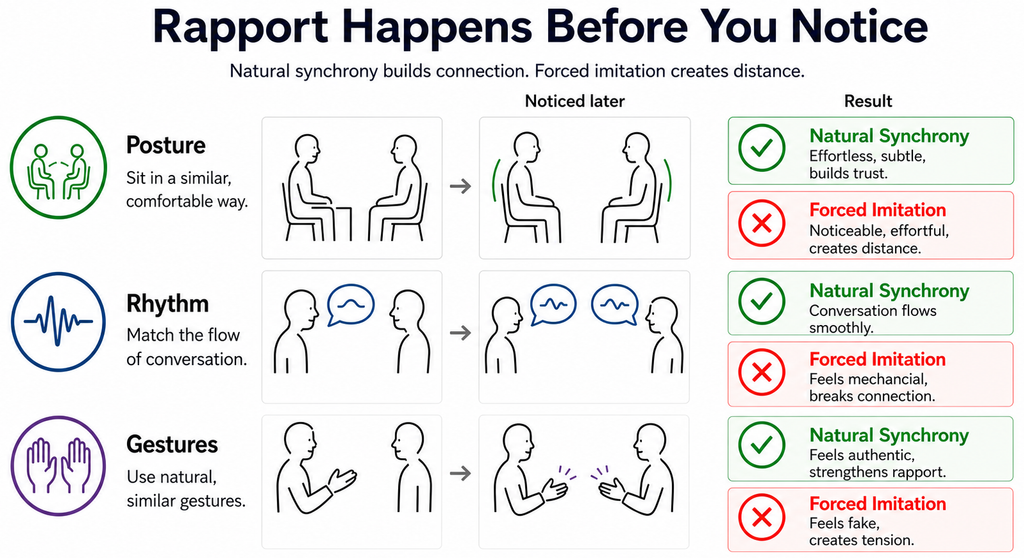
Subconscious rapport refers to the automatic behavioural synchrony that emerges between people who are genuinely engaged with each other. Nobody decides to do it. Posture converges, speech rhythm aligns, gestures start to echo.
Classical NLP took that observation and turned it into a technique stack: mirror the posture, match the predicates, pace and then lead. The observation was sound. The technique stack is where it gets complicated.
Harvard’s Program on Negotiation puts it honestly: nonverbal behaviour can be remarkably effective at building trust with a new counterpart, but it does not substitute for shared interests or an actual zone of agreement. Rapport opens a door. It doesn’t walk you through it.
We’ve covered how rapport actually gets built in a working relationship elsewhere. This article is about what happens to those foundations when the stakes rise and you’re tired.
Does Mirroring Actually Work in High-Stakes Meetings?
Yes, subtly, and the evidence is better than most people assume.
The clearest study comes from William Maddux, Elizabeth Mullen and Adam Galinsky, published in the Journal of Experimental Social Psychology. Across two experiments, negotiators who strategically mimicked their counterpart’s mannerisms secured better individual outcomes, and their pairs performed better overall. Mimickers created more value and then claimed most of the extra value they had created, without taking it from the other side.
The second experiment is the more interesting one. In a negotiation with no obvious solution available, mimicry helped negotiators surface compatible underlying interests and reach a deal at all. Trust was the mediating variable.
So the mechanism is real. Matching someone’s rhythm makes them more willing to tell you what they actually want. That’s the whole effect, and everything else in the NLP-applied-to-negotiation canon is downstream of it.
Why Do NLP Rapport Techniques Backfire in the Boardroom?
Because the effect has a ceiling, and past that ceiling it inverts.
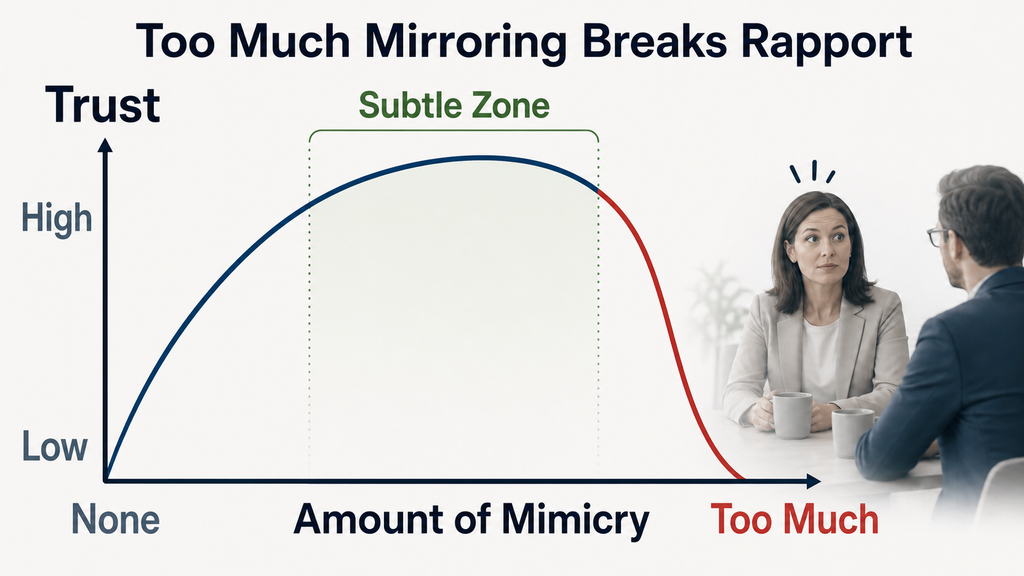
Researchers testing what they call the too-much-mimicry effect ran three experiments in which participants interacted with someone displaying no mimicry, subtle mimicry, or strong mimicry. Subtly mimicked participants liked their counterpart more. Strongly mimicked participants liked and trusted them less. And once participants became aware they were being mimicked, the damage showed up regardless of condition.
The technique is not the risk. Being caught performing it is.
Here’s the uncomfortable part. When you’re tired and quietly negotiating with yourself about whether you deserve the fee you’re about to name, you perform harder. You over-match. You nod too much. You lean in half a second too fast. The exact conditions that make you reach for the technique are the ones that make you execute it badly.
That’s why influence that doesn’t require performance holds up where technique falls apart.
What Does the Research Actually Support About NLP?
Split the field in two and it becomes clear.
The foundational NLP models have not held up. A systematic review in the British Journal of General Practice searched 1,459 titles, included ten experimental studies, and concluded there is little evidence that NLP interventions improve health-related outcomes, noting the finding reflects the limited quantity and quality of the research rather than robust proof of no effect. A separate critical review of NLP in coaching found the evidence for preferred representational system matching unsupportive, and the majority of published NLP papers to be conceptual guidance rather than research.
The underlying human mechanisms are better supported. Behavioural synchrony affects trust. Arousal reappraisal affects performance. Perspective taking affects negotiated outcomes. Those findings come from mainstream experimental psychology, not from inside the NLP literature.
James trained in NLP and still uses parts of it daily. He also thinks the field would be far more credible if practitioners said plainly which parts are load-bearing and which are decoration. Admitting the eye-movement model doesn’t replicate costs you nothing and buys the only kind of authority that survives a sceptical room.
Why Your State Decides the Room Before You Speak
Your internal state is the single most predictive variable in a high-stakes conversation, and it is set long before the meeting starts.
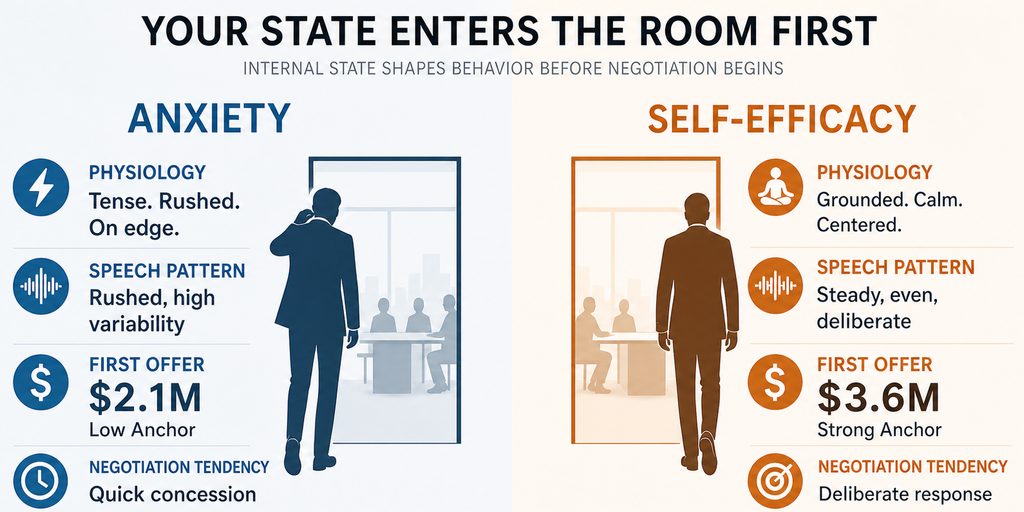
What Anxiety Does to Your First Offer
Alison Wood Brooks and Maurice Schweitzer ran four studies on this and the results are blunt. Compared with negotiators in a neutral state, anxious negotiators expected lower outcomes, made lower first offers, responded to counteroffers more quickly, exited earlier, and earned less. The harmful effect was moderated by self-efficacy a stronger belief in your own capability blunted it.
Nobody in those studies was mirroring badly. They just walked in tight.
The Programming Underneath
This is where “your unconscious programming is running your business” stops being a slogan and becomes an operating cost:
- You quote a number, then immediately explain why it’s reasonable
- You discount before anyone asks
- You add a deliverable mid-conversation to make the silence stop
- You take the 7 pm meeting because saying no feels worse than losing the evening
None of that is a rapport problem. It’s the programming underneath the price you quote, and no amount of posture matching touches it.
Jennifer (name changed) had an extraordinary background and real expertise, and she was badly undercharging. She knew she should raise her prices. She could not make herself do it. What changed wasn’t a script it was deep reconditioning work, not affirmations. Within 60 days she’d doubled her prices and more than doubled her revenue.
Doubled her prices in 60 days. The strategy was never her problem. Her programming was.
How Overwork Quietly Strips Your Authority
Exhaustion degrades the exact capacity that rapport depends on. This is the causal claim, and it’s the reason working less isn’t a lifestyle preference it’s a performance mechanism.
In a time-lagged study of 505 leaders published in Frontiers in Psychology, emotional exhaustion was linked to leadership behaviour through two mediators: negative affect and impaired perspective taking. Exhausted leaders got worse at modelling what was going on in someone else’s head.
Now pair that with a separate finding from Galinsky, Maddux, Gilin and White in Psychological Science: across three studies, perspective taking helped negotiators find hidden agreements and claim more value, while empathy did not and at times was actively unhelpful.
Put the two together. Perspective taking is what wins the room. Overwork is what removes it. You are not losing deals despite the 60-hour weeks. You are losing them because of the 60-hour weeks.
James spent his fifth business on 80-hour weeks and anxiety medication, telling everyone things were going well. By any external measure, he was successful. He was also the least persuasive he had ever been in a room, and it took him years to work out why. He trains before client calls now. Phone stays in another room at dinner. He takes a 36-minute nap without apologising for it, and he shows up with something left in the tank.
That last part is the whole competitive advantage. It isn’t a nicer life. It’s a better negotiator.
Who Should Use This Approach?
- Coaches and consultants who already deliver excellent work and lose rooms they should win
- Practitioners who undercharge, over-explain, or concede before being pushed
- Anyone who has studied influence techniques and found they evaporate under pressure
- Established operators running 50 to 60-plus hour weeks who have noticed their judgement in meetings getting worse
Who Should Avoid This Approach?
- Anyone looking for covert control over another person. Rapport that requires concealment fails on detection, and you will be detected.
- Anyone whose offer genuinely isn’t ready. State work will not fix a proposition the market doesn’t want.
- Anyone wanting a script to memorise before Thursday. This is reconditioning, and it takes longer than that.
- Anyone whose primary problem is lead volume rather than conversion. Different bottleneck, different fix.
Performed Rapport vs. Regulated Presence
Both use the same behavioural raw material. They diverge on where the behaviour comes from, and that difference is visible to the other person even when they can’t name it.
| Particular | Performed Rapport | Regulated Presence |
|---|---|---|
| Source | Conscious technique executed during the meeting | Internal state established before the meeting |
| Attention | On yourself and your execution | On the other person and the problem |
| Optimises for | Being liked | Being trusted |
| Failure mode | Detected as strategy; liking and trust both drop | Slower to build; requires actual preparation |
| Under pressure | Degrades; you over-perform when tense | Holds the work was already done |
| Ideal user | Nobody, long-term | Expert practitioners in high-stakes conversations |
The Mechanism: The 3 Pillars, Applied to the Room
The 5 Shifts to Freedom is the vehicle. The 3 Pillars are the mechanism that makes it work: Performance Psychology, Freedom-First Business Strategy, and Freedom-First Business Structure. Because strategy without psychology is just another unfinished course, and mindset without systems is a prettier prison.
For boardroom authority specifically, three steps carry the weight.
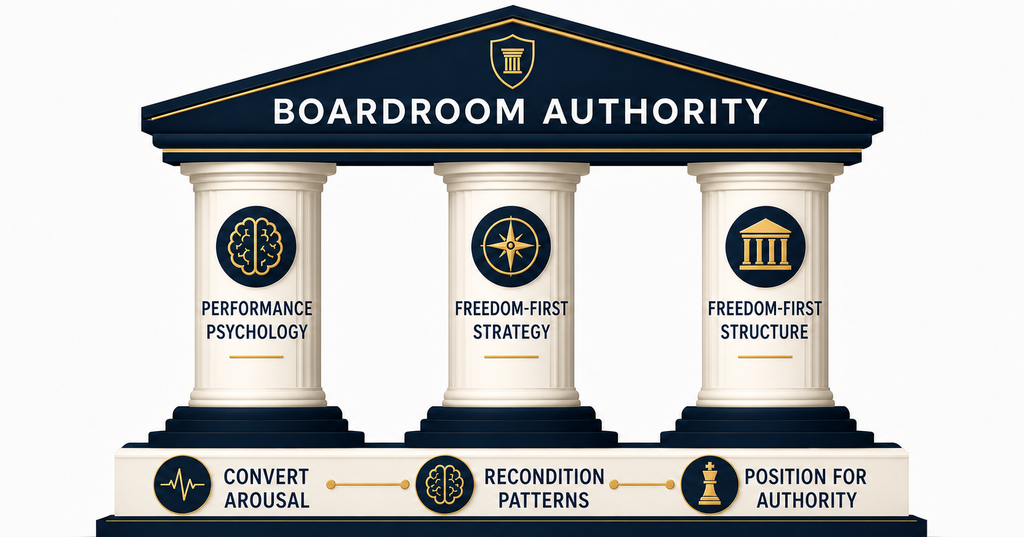
Convert the arousal instead of suppressing it
Fear to Excitement is one of the 6 Psychological Hacks, and the research independently backs it. Reappraising pre-performance anxiety as excitement beats trying to calm down, because the two states feel physiologically similar and the relabel is therefore believable to your own nervous system. Say “I’m excited” out loud before you walk in. It sounds ridiculous. It works, and it’s the same principle behind managing anxiety before you speak.
Recondition, don’t rehearse
Shift 4, Mindset Unlock, inside the Performance Psychology pillar. Rehearsing what you’ll say leaves the pattern intact; you’ll still soften the number, just more fluently. Reconditioning changes what you believe about the number before you’re in the room.
Position so authority isn’t something you assert
Shift 5, Magnetic Authority. Tom (name changed) had twenty years of hard-won expertise and was virtually invisible in his market. He rebuilt his positioning around his own story and methodology, specific enough that the right clients immediately recognised he was for them, and moved from undercharging for long programmes to premium rates for focused engagements.
Twenty years of expertise, invisible. Then positioned properly, and the right clients came to him.
Data & Findings
- Mimicking a counterpart produced better outcomes for both sides, mediated by trust. Maddux, Mullen & Galinsky, 2008
- Subtle mimicry raised liking; strong mimicry lowered liking and trust. Group Decision and Negotiation
- Little evidence that NLP improves health-related outcomes; limited research quality, not proof of no effect. Sturt et al., BJGP, 2012
- A Canadian review screened 399 citations and found no clinical evidence on NLP. Canada’s Drug Agency, 2014
- Anxious negotiators opened lower, conceded faster and earned less. Brooks & Schweitzer, 2011
- Reappraising anxiety as excitement beat calming down. Brooks, 2014
- In 505 leaders, exhaustion was linked to impaired perspective taking. Walsh & Arnold, 2018
- 36% of 1,510 Canadian business owners said mental health challenges interfered with their work weekly; 60% of those under 40. BDC, 2025
- Roughly one in five employed Canadians reported high work-related stress, mostly from heavy workloads. Statistics Canada, 2023
- 885 Canadian entrepreneurs were surveyed on the demands of running a business. CMHA & BDC
The clinical reviews mark what NLP hasn’t shown as a treatment, not a verdict on synchrony. The Canadian data measures capacity, not health.
Frequently Asked Questions
Is mirroring in a meeting manipulative?
It depends entirely on whether you’re concealing it. Behavioural synchrony that emerges from actually paying attention is not manipulation. A technique deployed covertly to produce compliance is, and the research suggests it fails anyway once detected, as liking and trust both drop.
Does NLP work?
Parts of it. The mechanisms borrowed from wider psychology, such as behavioural synchrony and arousal reappraisal, have independent experimental support. The models unique to NLP, particularly preferred representational systems and eye-accessing cues, have not held up under systematic review. Practitioners who say this out loud are more credible, not less.
How do I build authority in a room if I’m naturally quiet?
Authority isn’t volume. In negotiation research, the advantage goes to perspective-taking rather than emotional expressiveness or dominance. Quiet people are frequently better at it, provided they aren’t depleted.
What if I only have ten minutes before a big call?
Two things. Reappraise the nerves as excitement instead of suppressing them, and write one sentence on what the other person is actually trying to solve. Skip the mirroring plan entirely.
Can I fix this without changing my hours?
Partially, and it will keep slipping back. Emotional exhaustion is linked to impaired perspective-taking, the capacity the whole thing runs on. You can regulate your state for one meeting on willpower. Not for a quarter.
Is this only relevant to boardroom settings?
No. The same dynamics run a discovery call, a partnership conversation, or a rate negotiation with a long-standing client. The room just gets smaller.
The Room Was Never the Problem
You already know how to do the work. You’ve done it for years. The gap between what you’re worth and what you name out loud isn’t a communication skills gap, and another rapport technique won’t close it.
It closes when you stop walking into rooms empty. Working less isn’t the reward for building authority it’s the mechanism that produces it.
Book a Freedom Blueprint Call. We’ll find the one thing that’s actually keeping you stuck. No pitch unless you ask for one.