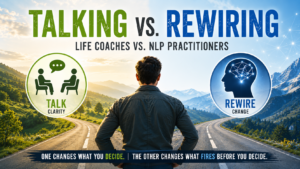

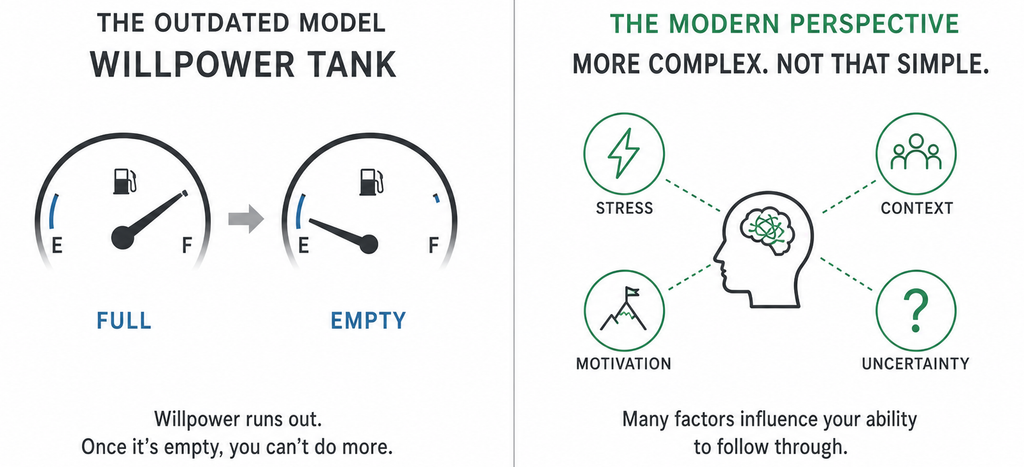
Willpower is not the reason you haven’t made the move that would scale your business. The popular model of willpower as a fuel tank that empties as you use it has largely failed to reproduce under rigorous testing, including a 23-laboratory attempt involving more than 2,000 participants.
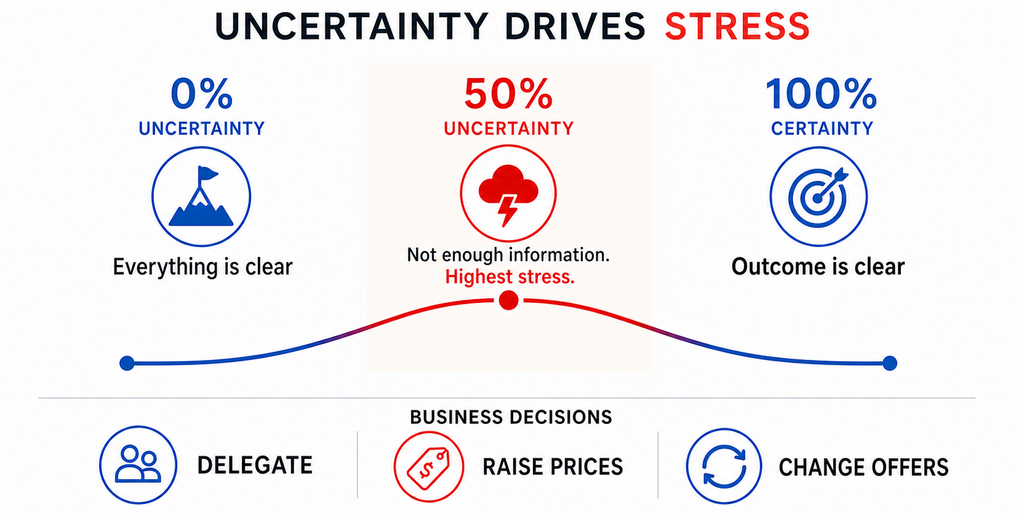
What replaces that simple model is a combination of learned habit, a measurable preference for the status quo, sensitivity to loss, and stress responses that make familiar behaviour feel safer than an uncertain alternative. Research indicates stress peaks not at certain danger but at roughly 50/50 odds. A known, exhausting week can therefore feel more tolerable than an unknown, better one.
Key Takeaway:
- The popular “willpower as a fuel tank” model is not well supported by rigorous replication. A 23-laboratory replication involving more than 2,000 participants found the ego-depletion effect negligible, suggesting that repeated struggles with discipline may reflect a flawed model rather than a lack of willpower. [1]
- Why people stay stuck: the brain tends to favour the status quo, weighs potential losses heavily, and treats uncertainty as stressful. An uncertain improvement can therefore feel more threatening than a familiar but exhausting routine, making delegation, price increases, or strategic change harder to execute. [1]
- Chronic overwork can reinforce the problem. Sustained stress can impair prefrontal functions involved in deliberate decision-making while strengthening habitual and emotional responses, meaning a 60-hour workweek can become part of the mechanism that keeps an established business operating the same way. [1]
- What to do: replace “try harder” with three practical shifts: recondition the learned response behind the behaviour, reduce unnecessary workload so change becomes manageable, and redesign business systems so critical decisions and tasks no longer depend entirely on you. [1]
- Make change specific with if-then planning. Instead of setting a broad goal such as “I will delegate more,” define the trigger and response: “If a task is outside my top three priorities, it goes to my assistant before I touch it.” Research reviewed in the article found implementation intentions consistently outperform goal intentions alone. [1]
Bottom Line: Scaling is not always a willpower problem. When familiar habits, uncertainty, and chronic stress keep you repeating the same patterns, reduce the load, change the learned response, and redesign the structure that keeps you stuck.
- Source: Unleash Your Power – The Willpower Myth: Why Your Brain Picks Safety Over Scale
- Supporting Source: PLOS ONE – Research on ego depletion and self-control
Is Willpower Actually a Limited Resource?
Probably not in the way you were taught.
The dominant model came from a 1998 experiment involving cookies and radishes: self-control is a muscle that tires, a tank that drains. Resist temptation in the morning and you’ll have less left by evening. Hundreds of studies appeared to support it.
Then people tried to reproduce it carefully. A coordinated attempt across 23 laboratories with more than 2,000 participants found the effect negligible, and subsequent reviews have documented a string of similar failures. A preregistered replication in PLOS One found neither the depletion effect nor the belief-based moderation meant to explain it. Despite more than 600 studies of apparent support, the field is now openly asking whether the effect is real at all.
The debate hasn’t closed. Some researchers argue the original manipulations were too mild and a refined version survives. But the strong popular claim that you have a fixed daily allowance and you ran out is not the settled science it was sold as.
Here’s why that matters, and it isn’t academic. If willpower were a tank, the solution would be obvious: manage it better, front-load hard decisions, protect your mornings. You’ve almost certainly tried that. It didn’t work because you failed at it, but because you were solving for the wrong variable.
If It Isn’t Willpower, Why Can’t You Make the Move?
Because your brain is comparing two options and isn’t scoring them the way you think.
Decision researchers have documented for decades that people disproportionately stick with the status quo in real, consequential choices health plans, retirement savings- where the stakes are obvious and the better option is right there. The current state gets a vote; nothing else gets.
Underneath that sits loss aversion. Giving something up costs you more psychologically than acquiring the same thing gains you. So when you weigh raising your prices, you aren’t weighing “more margin” against “same margin.” You’re weighing an uncertain gain against the vivid, immediate loss of a client who says no.
This isn’t a character flaw. Bluevine’s 2026 Business Owner Success research makes a related point: owners aren’t inherently risk-averse. Financial pressure just makes the risk feel too big to take. The pressure changes the maths.
Try this: write down the move you’ve been avoiding. Underneath it, write what you’d be giving up if you made it, not what you’d gain. That column is the one your brain has been reading.
Why Uncertainty Is the Real Threat
This is the part that reframes everything.
A study in Nature Communications had 45 volunteers turn over virtual rocks, some concealing a snake and a mild electric shock, while researchers tracked self-reported stress alongside cortisol, pupil diameter and skin conductance. Stress peaked when the chance of a shock was around 50/50, and was lowest at both 0% and 100%. As the UCL team put it, not knowing whether you’ll be shocked is worse than knowing you definitely will be.
Read that against your calendar.
A 60-hour week is a 100% outcome. You know exactly how it will feel. It’s awful, and it’s certain. Delegating the client work, doubling your rate, cutting three offers those are 50/50. Your nervous system, in the moment, doesn’t prefer the better outcome. It prefers the known one.
James spent years on the wrong side of that trade. Fifth business, 80-hour weeks, on anxiety medication and calling the arrangement success. He built a prison with a nice view and defended the architecture. What finally moved him wasn’t a strategy. It was his niece asking why he didn’t visit anymore.
That’s the thing about certainty. It’s comfortable right up until someone shows you the receipt.
Why Your 60-Hour Week Can Become the Bottleneck
Here’s where the causal claim gets teeth.
Neuroscientist Amy Arnsten’s work at Yale shows that even mild, uncontrollable stress can rapidly impair prefrontal cognitive function, with more prolonged exposure producing architectural changes in prefrontal dendrites. The prefrontal cortex is the machinery of deliberate change planning, holding a new intention, overriding an old response.
Now the part that matters most. The same stress signalling that degrades top-down prefrontal control simultaneously strengthens the emotional and habitual responses of the amygdala and basal ganglia. Two things move in opposite directions at once: the system you’d use to change gets weaker, and the system that repeats what you already do gets stronger.
So if your week is producing sustained stress with almost no recovery, the workload stops being just a symptom. It becomes part of the mechanism. You’re not failing to change despite the hours. The hours are shaping what your brain finds easiest to do, which is the same thing it did yesterday. It’s worth understanding how the brain learns to associate success with suffering, because most overworked owners have made that link without noticing.
You’re stuck BECAUSE you’re working 60 hours. That’s not a slogan. It’s a loop.
What This Looks Like Inside a Coaching or Consulting Business
The research becomes recognisable the moment you map it onto a Tuesday.
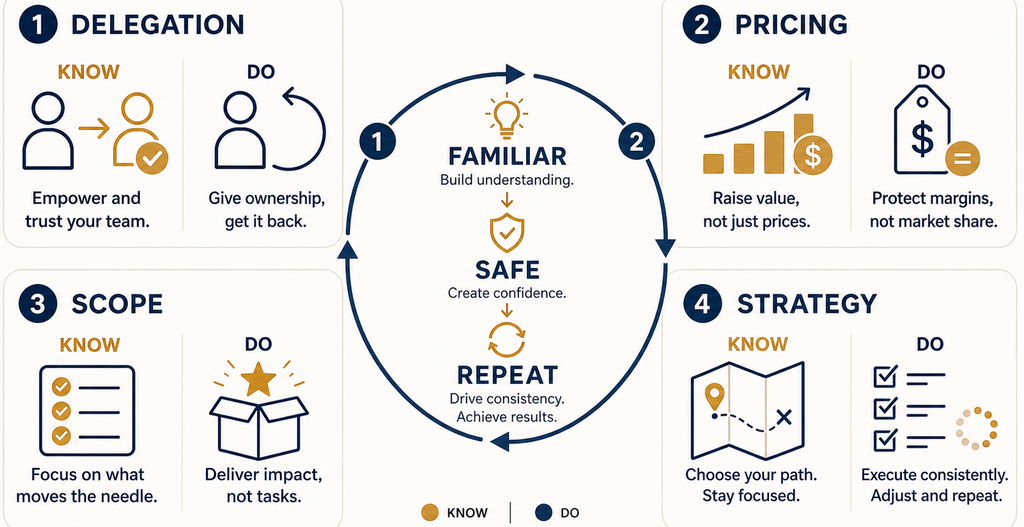
The delegation that never sticks
What you know: you shouldn’t be doing this task. What you do: take it back after the second imperfect version. What your brain gets: control and predictability. What it costs: scale.
The price you keep not raising
What you know: you’re undercharging. What you do: quote the old number again. What your brain gets: fewer objections, less uncertainty. What it costs: margin.
The over-delivery you call service
What you know: the scope needs a boundary. What you do: add one more thing. What your brain gets: reassurance that nobody is disappointed. What it costs: capacity.
The busy week that hides the bold move
What you know: one strategic decision matters more than everything else on the list. What you do: clear the inbox and tweak the offer page. What your brain gets: immediate completion. What it costs: growth. If that one lands, look harder at why you keep postponing the move that matters.
Jennifer (name changed) came in with an extraordinary background and real expertise, badly undercharging. She had known she should raise her prices for a long time. She did not lack information about pricing; she lacked the capacity to move through the uncertainty attached to changing it. After reconditioning work, not affirmations, she doubled her prices within 60 days and more than doubled her revenue. Same expertise, same market, different self-concept.
Doubled her prices in 60 days. The strategy was never her problem. Her programming was.
The first step is being able to name the patterns running underneath the behaviour instead of calling it laziness.
If Willpower Isn’t the Answer, What Is?
Three things, working together. Not one of them is sufficient alone, which is why so many owners have done the mindset work and the systems work and still feel stuck.
Rewire the learned response
The psychology layer reconditioning work that changes what a price increase or a handover actually feels like in your body. It’s the difference between knowing you should delegate and being able to. You can’t delegate what your unconscious won’t release. Most stalled strategies have a block underneath them that no amount of planning will move.
Cut the load until change is survivable
You cannot do that work from inside a 60-hour week. Ruthless elimination isn’t tidying; it’s removing the 80% of activity generating the stress that’s degrading the system you need for change. This is the pillar people skip, and the one the research most directly supports.
Rebuild the structure, so you’re not the bottleneck
Internal change doesn’t hold if the business still routes everything through you. David (name changed) was brilliant at the work and completely trapped by it. Thirty days to get his expertise out of his head and documented, and his assistant absorbed most of his inbox. He took his first real two-week holiday in five years, and revenue went up while he was gone.
First two-week holiday in five years, and the business grew while he was gone. That’s what happens when your expertise stops living in your head.
How Long Does This Actually Take?
Longer than the internet claims, and less long than you fear.
The often-cited 66-day figure comes from a study tracking people forming a single new daily behaviour. What it measured was automaticity of one specific behaviour, not brain rewiring in any broad sense. The median was 66 days, with a range from 18 to 254 depending on the person and the complexity of the behaviour. Simple behaviours settled quickly. Complex ones took far longer. Usefully, missing a single day didn’t materially derail the process, which is worth knowing if you’ve ever abandoned a change after one bad week. Change generally takes longer than most people are told, and expecting that is itself protective.
What reliably outperforms intention is planning the trigger. Across 94 independent tests, if-then planning produced a medium-to-large effect on goal attainment compared with holding the goal alone. Not “I’ll delegate more.” Instead: if a task lands that isn’t in my top three, it goes to my assistant before I touch it.
Try this: take the one behaviour you’ve failed to change three times. Write it as a single if-then sentence with a specific trigger. One sentence. That’s the whole intervention.
Who Should Use This Approach?
Owners who already know what to do and cannot get themselves to do it. If you’ve bought the course, hired the consultant, made the plan, and the plan is still sitting there, you have a response problem, not an information problem. This suits coaches, consultants and wellness practitioners with proven demand and a week that has stopped being survivable.
Who Should Avoid This Approach?
If you have a straightforward execution gap a task you simply haven’t scheduled ordinary discipline, a calendar block and an accountability partner will fix it faster and cheaper. It’s also the wrong tool if you’re pre-revenue and still testing whether anyone wants what you sell; that’s a demand problem. And if you’re in acute crisis, stabilise first with appropriate support. This work asks something of you, and it needs a floor to stand on.
Willpower vs. Rewire and Redesign
Neither column is effortless, and the right one depends on what’s actually blocking you. Discipline is a reasonable tool for a one-off gap. It’s the wrong tool for a pattern that keeps reasserting itself under pressure, which is most of what keeps established owners stuck.
| Particulars | Willpower / Discipline | Rewire and Redesign |
|---|---|---|
| Core assumption | You need more effort | Learned responses and environment shape behaviour |
| Main question | “How do I force myself?” | “What makes this behaviour feel necessary?” |
| Intervention | Push harder, schedule tighter | Change the response, cut the load, rebuild the structure |
| Short-term effect | Can genuinely increase output | Can reduce unnecessary effort |
| Long-term risk | Exhaustion and relapse into the old pattern | Requires deliberate redesign and sustained attention |
| Best suited for | Simple, one-off execution gaps | Repeated patterns that reassert under stress |
Data & Findings
- The fuel-tank model didn’t hold up. A 23-laboratory replication with more than 2,000 participants found the effect negligible, and preregistered attempts since have failed to reproduce it.
- Uncertainty drives peak stress, not certain danger. Across 45 participants, stress peaked at roughly 50/50 odds.
- Stress degrades the system you need for change. Mild uncontrollable stress rapidly impairs prefrontal function; prolonged exposure alters prefrontal architecture while strengthening habitual responding.
- Automaticity takes variable time. Median 66 days, range 18 to 254.
- Owners are not fine. In a 2026 survey of 1,000 small business owners, 53.5% lost sleep over the business at least a few times a week, and only 22.5% described their mental health as thriving.
The Framework: The 5 Shifts to Freedom and the 3 Pillars
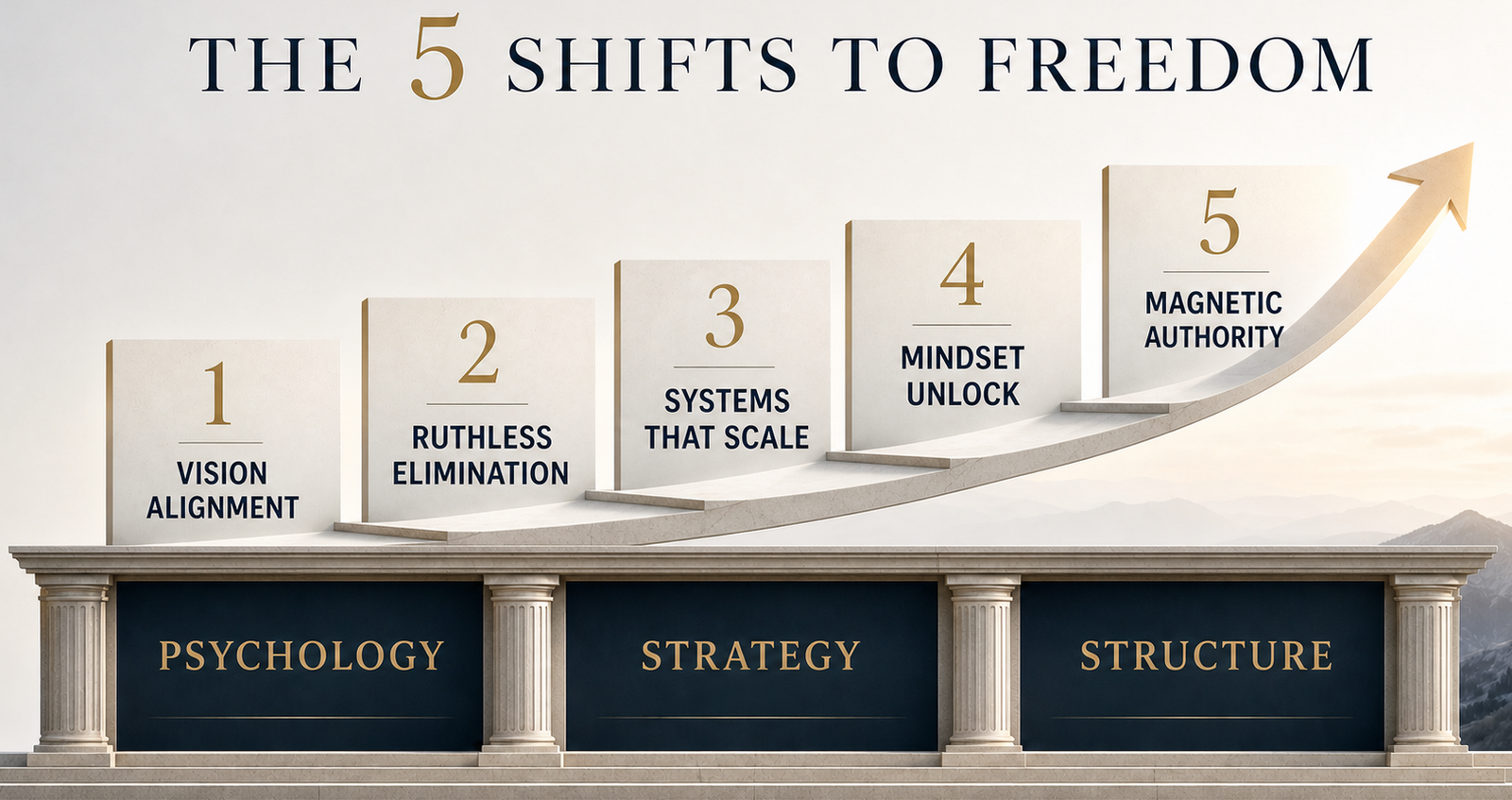
Keep the relationship simple. The 5 Shifts to Freedom are the journey. The 3 Pillars explain what makes that journey possible: performance psychology, freedom-first business strategy, and freedom-first business structure. Strategy without psychology is another unfinished course. Psychology without strategy doesn’t pay the bills. Structure without both is a prettier prison.
- Step 1: Vision Alignment: get clear on what you actually want, not what you think you should want.
- Step 2: Ruthless Elimination: cut the 80% of activity generating the load.
- Step 3: Systems That Scale: build leverage so you stop being the bottleneck.
- Step 4: Mindset Unlock: dismantle the programming that keeps choosing the familiar option.
- Step 5: Magnetic Authority: position yourself so the right clients recognise you and premium pricing stops feeling like a risk.
Frequently Asked Questions
Is willpower a myth?
Not entirely. Deliberate self-control is real. What’s shaky is the specific model of willpower as a finite daily resource that empties with use. That version has repeatedly failed replication, including in large preregistered multi-laboratory studies.
Why do I keep doing the thing I know is hurting my business?
Because the familiar option is certain and the better option isn’t. Status quo preference, loss sensitivity and stress-driven reliance on habit all push in the same direction. Knowing the right answer and being able to execute it are governed by different systems.
Does working fewer hours actually help me scale?
It’s the mechanism, not the reward. Sustained stress impairs the cognitive control you need to make and hold a new decision. Cutting the load restores the capacity to change. Working less is how you scale, not what you get afterwards.
How is this different from mindset coaching?
Mindset work alone changes how you feel about the problem. This approach pairs reconditioning with strategic elimination and structural redesign, because internal change doesn’t hold if the business still routes every decision through you.
How long before I notice a difference?
Some things shift quickly; a single if-then plan can change behaviour within a week. Making a new behaviour automatic takes longer and varies widely between people and behaviours. Expect months, not days, and expect the timeline to be uneven.
The Move You’ve Been Avoiding
You are not undisciplined. You’re running an intelligent, well-trained system that has correctly identified change as risk, in a body with no recovery left to absorb risk. That’s solvable, and it isn’t solved by wanting it more.
James still runs a business. He’s also home for dinner most nights with his phone in another room, and he takes a 36-minute nap without apologising to anyone for it. Not because he found more willpower. Because he stopped asking willpower to do a job it was never built for.
The Freedom Blueprint 30 Minutes Call. We’ll find the one thing that’s actually keeping you stuck. No pitch unless you ask for one.