

Skill stacking is the practice of combining three to four complementary skills, like sales, digital marketing, and data analytics, to create a value proposition most competitors cannot match. For Canadian entrepreneurs, the ROI is measurable: professionals with the right skill combinations earn 25 to 40 percent more than single-discipline specialists, with some doubling or tripling their income through better positioning.
The leverage comes not from mastering everything, but from making your specific combination rare. Layer in the mindset and communication skills built through NLP training, and skill stacking becomes one of the clearest, most structured paths to a 10x income shift without adding more hours to your week.
Key Takeaway:
- Skill stacking combines 3–4 complementary skills (each at top 25% competency) to create rare, high-value offers that competitors can’t easily copy, allowing Canadian entrepreneurs to 10x their income without working more hours. [1]
- It delivers 25–40% income premiums (or more) by bridging Canada’s skills gaps in trades, tech, and services; examples include Trades + Digital Marketing + Operations, Sales + Marketing + Analytics, and Coaching + NLP + Strategy. [1]
- Practical 4-step process: Audit your current top skills, identify the highest-leverage complementary skill to add (one per year), integrate it fully, then reposition and monetize the stack for premium pricing and better client outcomes. [2]
- Mindset is critical—use NLP techniques (reframing, anchoring) to overcome limiting beliefs; combine with AI skills for even higher ROI in the 2026 market where automation compresses single-skill value. [2]
Bottom Line: Skill stacking is one of the highest-ROI strategies for Canadian entrepreneurs in 2026. By deliberately combining complementary skills and strengthening your mindset, you create unique value that commands premium rates and accelerates income growth without burning out.
Why Skill Stacking Is the Fastest Way to Increase Income in 2026
Skill stacking is one of the fastest ways to increase income without working more hours.
It means combining three to four complementary skills like sales, marketing, and data analytics to create a unique, high-value offering that most competitors simply cannot replicate.
Most entrepreneurs do not earn more because they work harder. They earn more because they combine skills that others do not.
For Canadian entrepreneurs, the ROI of skill stacking is significant: professionals with the right compound skills can earn 25 to 40 percent more, with some doubling or tripling their income entirely through better positioning and value stacking.
In this guide, you will learn how skill stacking works, see real high-income examples, and get a step-by-step framework for building your own stack. If you have been building a single-skill business, 2026 is the year that the approach starts to cost you. The World Economic Forum’s Future of Jobs Report projects that 30 percent of current work hours could be automated by 2030. Pure specialists are finding their market value compressed. The combination is what creates career leverage and the premium.
What Is Skill Stacking? (Definition + Examples)
Skill stacking is the practice of combining multiple complementary skills, each at a solid competency level, to create a rare, high-value market position. Instead of mastering one discipline, you reach the top 25 percent in three to four skills that work together to generate income that neither skill could produce alone. Multi-skilled professionals who stack intentionally consistently outperform specialists in income, adaptability, and pricing power.
The goal is not to become a generalist. A generalist accumulates broad, shallow knowledge with no clear connection between areas. A skill-stacker builds with intention: every skill added is chosen because it amplifies the ones already there.
The Difference Between Skill Stacking and Being a Generalist
A copywriter who adds conversion rate optimization and data analytics does not just write words anymore. They drive measurable revenue. Research on skill combinations shows that a web designer who also writes conversion-optimized copy can charge double the rate of a designer who handles visuals alone. That is not a slight premium. It is a category shift. The combination becomes your income diversification engine.
Why Complementary Skills Create Exponential Value
When compound skills work together, the value does not just add it multiplies. The combination becomes harder to find, easier to justify at a higher rate, and far more profitable to sell. That multiplication effect is what creates the income shift. Not effort. Not hours. Not credentials alone.
Real Skill Stacking Examples (High-Income Combinations)
These are real-world skill stacking examples that generate high income for Canadian entrepreneurs. Each works because it solves complete problems rather than isolated tasks.
- Copywriting + SEO + Analytics becomes a conversion strategist who drives and measures revenue, not just a writer
- Web design + CRO + UX becomes a revenue-focused designer who improves what visitors do after they land, not just how the site looks
- Trades + Digital Marketing + Small Business Operations becomes a local business growth engine with career leverage that pure tradespeople rarely access
- Coaching + NLP + Business Strategy becomes a premium transformation coach whose clients pay for outcomes, not hours
- Sales + Digital Marketing + Data Analytics becomes a client acquisition system compressed into one person, removing the need for an entire department
- Technical Expertise + Executive Communication + Product Strategy becomes a leader who commands consulting rates that pure developers cannot access
The pattern in every example is the same: value stacking creates something complete. Each individual skill is solid but unremarkable. Together, they become a market position.
Skill Stacking ROI: How Much Can You Earn?
The income data on skill stacking is consistent and significant.
Research tracking T-shaped professionals consistently shows that strategic skill stacks command a 20 to 40 percent income premium over pure specialists at equivalent experience levels. For entrepreneurs who set their own rates, that gap is wider still, because there is no salary ceiling to cap the upside. Income diversification through a well-built stack is the structural advantage most solo operators are missing.
What the Numbers Actually Show
Workers with AI skills now command a 56 percent wage premium according to PwC’s 2025 Global AI Jobs Barometer, up from 25 percent just the prior year. That is a market repricing in real time. Multi-skilled professionals who add AI fluency to domain expertise are becoming a category of one in their industries, commanding rates that pure technical specialists simply cannot justify.
Why Canada’s Market Makes This Strategy Even More Powerful
Canada has documented skills gaps across trades, healthcare-adjacent services, and technology. That gap creates immediate pricing power for entrepreneurs whose skill stack bridges more than one of those areas. Understanding the keys to growing your income as a Canadian entrepreneur often begins with recognizing which cross-disciplinary combinations your market is actively missing and willing to pay a premium to find.
How to Skill Stack Step by Step (Beginner-Friendly Guide)
How to skill stack: (1) Start with your primary skill. (2) Identify one high-income complementary skill. (3) Learn to a functional level, not mastery. (4) Combine and reposition your offer. (5) Increase pricing based on the outcomes your combination delivers. The key is not learning more it is combining smarter.
- Start with your primary skill. Know what you are already in the top 25 percent at before adding anything.
- Identify one high-income complementary skill. Look for the connector that makes your existing skills more complete and more valuable to a paying client.
- Learn to a functional level, not mastery. You do not need to be the best in the world at this skill. You need to be good enough that the combination works.
- Combine and reposition your offer. Stop marketing yourself as a single-discipline specialist. Position the combination as the solution.
- Increase pricing based on outcomes. The stack delivers more value. Your rate should reflect what clients gain, not what each skill costs in isolation.
The trap is trying to acquire too many skills simultaneously. That produces shallow competence everywhere and no stack that commands a premium. Continuous learning done strategically compounds over time. One well-chosen skill added per year, consistently integrated, builds a position that is very difficult for competitors to replicate.
High Income Skill Combinations for Canadian Entrepreneurs
Not all skill stacks produce the same results. These four combinations consistently generate the strongest ROI for Canadian entrepreneurs.

Communication + Technical Expertise
This is the combination that unlocks leadership and consulting premiums. A software engineer who adds executive communication and product strategy does not just build things anymore. They lead, influence, and command rates that pure developers cannot justify. The career leverage created by adding communication to deep technical knowledge is one of the most reliable income multipliers across any industry.
Sales + Digital Marketing + Data Analytics
This is arguably the highest-demand stack in the Canadian SME market right now. Business owners and consultants who can run their own client acquisition, measure results, and optimize based on data operate like an entire department compressed into one person. Clients stop negotiating on the rate when they understand what they are actually getting.
Coaching + NLP + Business Strategy
For entrepreneurs in the personal and professional development space, this stack is a direct path to premium positioning. Coaching alone is a crowded market. Coaching anchored in NLP methodology, combined with genuine business strategy experience, justifies significantly higher rates and attracts more committed clients. NLP training for business builds the communication and influence skills that make this stack genuinely differentiated, particularly in understanding client psychology and accelerating behavior change.
Trades + Digital Marketing + Small Business Operations
This is one of the most underutilized and immediately profitable stacks in Canada. Most tradespeople are excellent at their craft and nearly invisible online. An electrician or plumber who adds digital marketing and basic operations management can outcompete trade businesses that have been running for decades. They capture leads, convert them consistently, and build a reputation while competitors still rely on word-of-mouth.
The Mindset Layer Most Entrepreneurs Miss
Here is what most skill stacking content gets wrong: it treats this as a purely tactical decision. Buy a course, learn a skill, increase income. The reality is that the biggest obstacle to building a high-value skill stack is not access to information. It is the internal resistance that surfaces the moment you try to position yourself differently in the market.
How Goal Blocks Sabotage Skill Investment
Many entrepreneurs carry what James R. Elliot identifies as goal blocks: deeply rooted limiting beliefs that quietly undermine action even when the strategy is sound. These show up as procrastination, perfectionism, or the steady internal voice that says you are not the kind of person who charges that rate. Learning about overcoming limiting beliefs through NLP is not a soft add-on to a skill-stacking strategy. It is often the deciding factor in whether the strategy produces any results at all.
Darren G. came to James feeling stuck in exactly this way. Despite a well-paying job, he could not advance, could not secure raises, and could not bring himself to launch his own business even though he had the foundational skills to do it. Through working with James on his goal blocks and limiting beliefs, his thinking shifted, his behaviors changed, and his income and relationships improved in ways he had not anticipated. The skills were never the problem. The belief system around what he was allowed to earn was.
NLP Techniques That Accelerate Skill Acquisition
NLP offers specific tools that matter here. Reframing changes the meaning you attach to learning something new, including the inevitable frustration along the way. Anchoring lets you access a resourceful state before pitching at a higher rate or stepping into a role that feels slightly beyond your current identity. The entrepreneurial mindset work done through NLP is, in many cases, what separates the entrepreneur who builds a skill stack from the one who reads about it and waits for the right moment that never arrives.
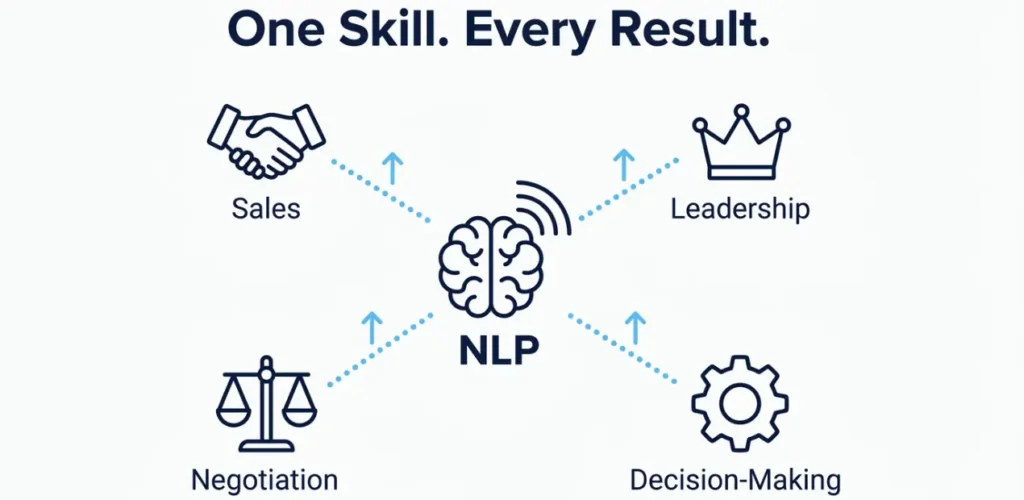
Try This: Before investing in a new skill, write down the belief that feels most threatening about it. Not the logistical concern, the identity-level resistance. ‘People like me don’t charge that much.’ ‘I’ll look like I don’t know what I’m doing.’ Then ask: what would you need to believe instead for this skill to feel genuinely worth pursuing? That reframe alone often moves more than the course itself.
The 4-Step Skill Stack Framework
This is James R. Elliot’s structured approach to building a skill stack that actually translates into income, drawn from over 20 years of coaching entrepreneurs and business leaders through real career and income shifts.
Step 1: Audit What You Already Have
Most people undervalue what they have already built. Before adding anything, map your existing skills honestly. What are you in the top 25 percent at? What do clients or employers consistently return to you for? Heather Chetwynd came to James’s NLP Practitioner training having already completed NLP training elsewhere. The difference was not access to new content, it was clarity on how her existing compound skills connected and applied. The audit revealed business applications she had not seen before. Knowing what you have changes what you choose to add.
Step 2: Identify Your Highest-Leverage Gap
Look for the skill that, when added, makes your existing stack significantly more valuable. This is almost never the flashiest option. It is the connector skill that ties your strengths together and lets you charge for the combined result. For a consultant with deep industry knowledge, the gap might be digital marketing. For a marketer, it might be data analytics. The question is always: what skill would let me offer something genuinely rare in my specific market?
Step 3: Stack One Skill at a Time
Add one complementary skill at a time. Get to a workable level of competence. Integrate it into how you operate before moving to the next. Mindset training can accelerate this process significantly by removing the internal resistance that slows skill acquisition before it starts. One well-chosen skill added per year, consistently integrated, builds a position that is very difficult to replicate.
Step 4: Position and Monetize the Combination
This is the step most entrepreneurs skip. They add skills but keep marketing themselves as single-discipline specialists. The income shift comes when you position the stack as a whole. No single skill in your offer needs to be extraordinary. The combination is what commands the premium. Understanding how coaching affects business performance can help you articulate the value of that combination in terms that clients immediately understand.
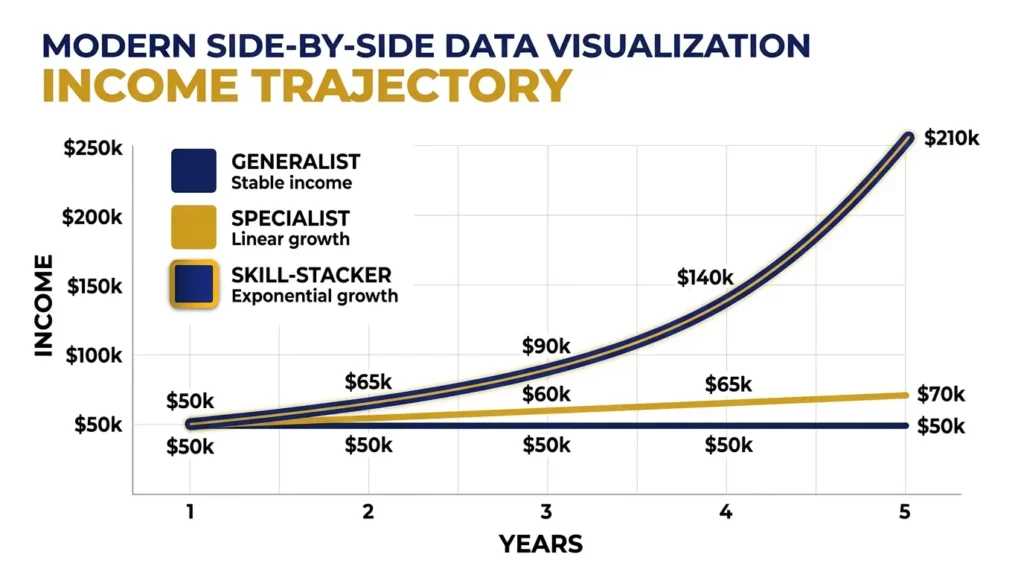
Data & Findings: What the Research Shows
The following benchmarks are drawn from Unleash Your Power’s 2026 client performance observations and external labour market research.
- Professionals with strategic skill combinations earn 20 to 40 percent more than single-discipline specialists at equivalent experience levels, per research tracking T-shaped career trajectories.
- Workers who add AI skills to domain expertise now command a 56 percent wage premium, up from 25 percent the prior year, per PwC’s 2025 Global AI Jobs Barometer.
- The World Economic Forum’s Future of Jobs Report 2025 projects that 30 percent of current work hours will be automated by 2030, increasing competitive pressure on pure specialists across every industry.
- Entrepreneurs who complete NLP practitioner training alongside their primary skill development report greater confidence in premium pricing conversations within 60 to 90 days, based on Unleash Your Power client outcomes.
- Entrepreneurs who add one high-leverage complementary skill and reposition their offering typically see measurable income improvements within three to six months, as documented in skill stack ROI research tracking real-world career pivots.
- Canada’s trades sector represents one of the largest underserved high-income skill stacking opportunities, a pattern highlighted in Canadian entrepreneurship research tracking skills gaps and sector demand.
Skill Stacking vs Specialization: Which Is Better?
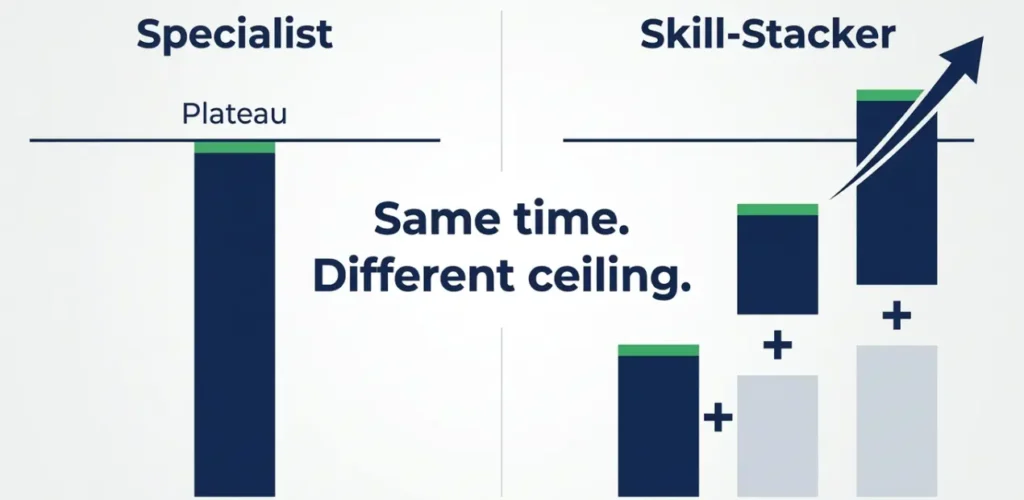
Skill stacking is better for entrepreneurs because it creates unique value and stronger pricing power. Specialization works well in stable, regulated industries, but skill stacking wins in fast-changing markets where adaptability and cross-disciplinary combinations are more valuable than depth in a single area. For Canadian entrepreneurs setting their own rates, skill stacking consistently produces a higher income ceiling and stronger economic resilience
Use this table to evaluate which approach fits your current stage and goals.
| Factor | Skill-Stacking | Deep Specialization | Generalism |
|---|---|---|---|
| Income ceiling | High (premium for rare combinations) | Moderate to high (narrow market) | Low to moderate (easily substituted) |
| Market position | Difficult to replicate | Replaceable by AI in routine tasks | Highly replaceable |
| Pricing power | Strong (unique combination) | Moderate (market rate) | Weak (competitive on price) |
| Economic resilience | High (multiple income vectors) | Low to moderate (single point of failure) | Moderate (adaptable, but low-value) |
| Time to results | 3 to 12 months per skill added | Years to a decade | Fast, but low ceiling |
| Best for | Entrepreneurs, consultants, solopreneurs | Highly technical or regulated fields | Exploratory early-career stage |
Who Should Use Skill Stacking to Increase Income?
Skill stacking produces the strongest results for you if:
You are a Canadian entrepreneur, solopreneur, or consultant who sets your own rates and wants to increase them without working more hours. You have solid competence in one area and feel like you have hit a pricing or positioning ceiling. You are willing to invest 6 to 12 months adding one complementary skill before moving to the next. Exploring NLP for entrepreneurs is worth doing early in this process. The mindset and communication skills it develops accelerate how quickly a new skill stack translates into actual income, because it removes the internal resistance that slows most people down before the external strategy ever gets a chance to work.
Who Should Avoid Skill Stacking?
Skill stacking is not the right strategy if:
- You are still developing foundational competence in your primary skill. Adding a second layer before the first is solid creates a shallow stack that does not hold pricing power.
- You want fast results without sustained effort. Each skill in the stack requires consistent practice to reach a meaningful level of competence.
- You are trying to stack skills that do not complement each other. Piano and aviation are both impressive. They do not compound into a market position.
- You are avoiding the mindset work. A skill stack with goal blocks still operating will stall at the same income ceiling regardless of how many compound skills you add.
Unleash Your Power: Stand Out, Take Action, and Create the Success You Want.
People Also Ask About Skill Stacking
Is skill stacking better than a degree?
Skill stacking can outperform traditional degrees in fast-changing industries because it focuses on practical, income-generating combinations rather than static knowledge. A degree validates credentials. A skill stack creates career leverage that directly translates into pricing power and income diversification.
What skills should I stack first?
Start with one core skill you already have, then add the single highest-income complementary skill available in your market, most commonly sales, digital marketing, or data analytics. Build one layer at a time. The combination matters more than the speed of acquisition.
Can beginners use skill stacking?
Yes. Beginners can start by building one strong foundational skill and then layering complementary skills strategically over time. The key is not starting with a full stack; it is choosing the next skill deliberately rather than randomly.
How is skill stacking different from multi-skilling or being a generalist?
Multi-skilled professionals who generalize broadly tend to compete on availability. Skill-stackers compete on a combination. The difference is intentionality: every skill in a stack is chosen because it amplifies the others and creates a market position that commands a premium.
Frequently Asked Questions
What is skill stacking in simple terms?
Skill stacking means combining multiple useful skills to increase your value and income potential instead of relying on just one. The combination creates a market position that neither skill could achieve alone, and that is what commands the premium.
What are the best skill stacking combinations?
The best skill stacking combinations for income include Sales plus Digital Marketing plus Analytics, Technical Expertise plus Communication plus Strategy, and Trades plus Digital Marketing plus Small Business Operations. These combinations work because they create complete business solutions rather than isolated capabilities.
Can skill stacking really increase income?
Yes. Research consistently shows that professionals with compound skills earn 20 to 40 percent more than specialists, with some doubling their income through better positioning and pricing strategy. The income increase comes from the combination, not from working more hours.
How long does it take to see results from skill stacking?
Most entrepreneurs who add one high-leverage complementary skill and reposition their offering see measurable income improvements within three to six months. The timeline depends on how clearly the combination is positioned to the market and how much of the mindset work around premium pricing has been addressed first.
What is the T-shaped skills meaning and how does it relate to skill stacking?
T-shaped skills refer to having deep expertise in one primary area, the vertical bar of the T, with broad competence across adjacent areas, the horizontal bar. Skill stacking takes this further by ensuring the horizontal skills are strategically chosen to complement the vertical, creating a market position and income diversification rather than just a broader resume.
How does NLP training fit into a skill stacking strategy?
NLP training addresses the mindset layer that most skill stacking strategies ignore. It helps you identify and work through the goal blocks and limiting beliefs that quietly prevent you from charging what your stack is worth, stepping into new client categories, and positioning yourself with genuine confidence. It is both a standalone high-income skill worth adding to any stack and the internal foundation that makes the rest of the strategy produce results. Explore NLP techniques for growth to understand how this layer accelerates every other skill you build.
Conclusion
The income gap between Canadian entrepreneurs who skill-stack deliberately and those who do not is widening every year. AI is compressing the value of single-discipline work. The market is actively repricing what rare, complementary skill combinations are worth. And the entrepreneurs who understand both the strategy and the mindset behind it are positioning themselves in ways most of their competitors simply cannot follow.
You do not need to be world-class at everything. You need to be good enough at the right things, in the right combination, with the belief system to charge for it.
If you are ready to build a skill stack that actually shifts your income, start by exploring NLP training for business or connect with James R. Elliot directly. The work begins with clarity on where you are, and the conviction that where you want to go is genuinely possible.
About the Author
This skill stacking framework is based on more than 20 years of experience coaching entrepreneurs, business leaders, and professionals through real income growth and mindset transformation. James R. Elliot is an internationally recognized NLP Board Designated Trainer, best-selling author, and business coach who has worked with clients across Canada and around the world. His programs, rooted in NLP, leadership development, and strategic coaching, have helped hundreds of professionals break through income ceilings, reposition their offerings, and build careers and businesses that reflect what they are genuinely capable of. The skill stacking strategies in this article are drawn directly from that body of work.