
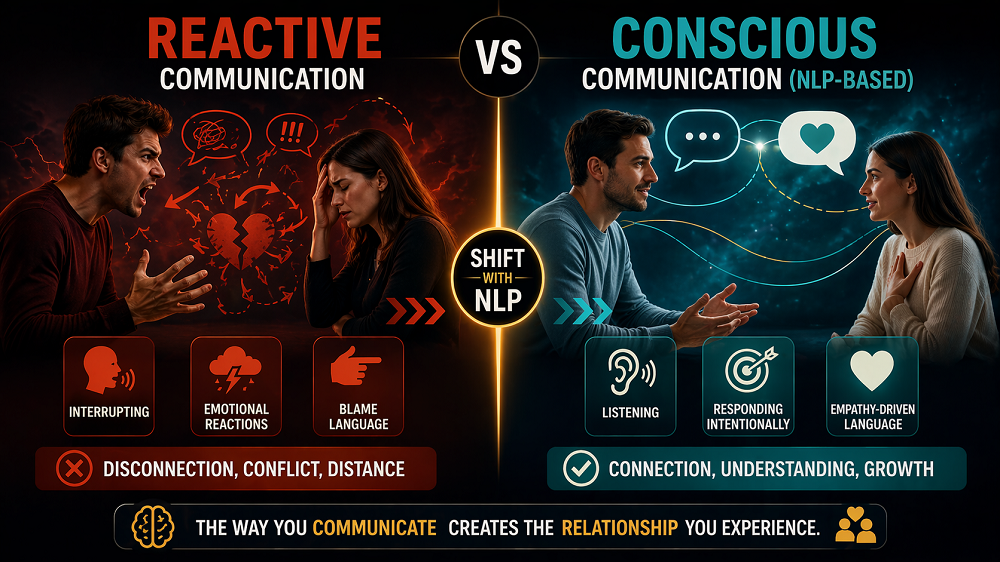
NLP improves communication in personal relationships by enhancing emotional awareness, empathy, and clarity. Through techniques like mirroring, reframing, and anchoring, it helps partners understand each other better, express emotions more effectively, and resolve conflicts with compassion instead of defensiveness.
Most relationship problems aren’t about love.
They’re about communication.
And most people are using the wrong tools to fix it.
This is where NLP changes everything.
Let’s explore how NLP techniques can strengthen your connection with your loved ones and turn daily interactions into opportunities for understanding rather than frustration.
Key Takeaway:
- Neuro-Linguistic Programming (NLP) improves personal relationships by enhancing communication, emotional awareness, and empathy. Techniques like mirroring, reframing, and anchoring help individuals understand each other better and build stronger emotional connections. [1]
- How it works: NLP focuses on identifying communication patterns, emotional triggers, and behavioral responses, allowing individuals to shift from reactive communication to intentional, connection-driven interactions. [1]
- Best use cases: NLP is highly effective for resolving recurring conflicts, improving communication in relationships, and rebuilding emotional connection between partners, friends, or family members. [2]
- When to be cautious: NLP is not a replacement for therapy in cases involving deep trauma, severe trust issues, or mental health conditions. Its effectiveness depends on consistent practice and willingness from both individuals. [2]
Bottom Line: NLP provides practical tools to improve communication, reduce conflict, and build deeper relationships—but real results come from consistent application and genuine intention to connect.
- Source: Unleash Your Power – NLP & Personal Relationships
- Source: Unleash Your Power – NLP Training & Insights
Is NLP Effective for Improving Personal Relationships?
Yes, NLP is highly effective for improving personal relationships because it helps individuals communicate more clearly, understand emotional cues, and respond rather than react. However, its effectiveness depends on consistent practice and genuine intention to improve connection.
Understanding NLP and Its Role in Relationships

NLP (Neuro-Linguistic Programming) explores the connection between the brain (neuro), language (linguistic), and behavioral patterns (programming). In relationships, it teaches you to notice how people communicate, not just what they say.
By applying NLP tools, couples can:
- Decode emotional cues more accurately
- Replace reactive behaviors with mindful responses
- Express needs and boundaries without blame
- Strengthen trust through genuine understanding
Essentially, NLP turns everyday conversations into conscious exchanges that build connection rather than conflict.
1. Mirroring and Matching: Building Emotional Rapport
Mirroring is one of the most practical NLP tools for improving relationship dynamics. It involves subtly reflecting your partner’s body language, tone, and energy level to create subconscious alignment.
Why it helps: When done authentically, mirroring makes your partner feel seen and understood. It signals empathy and emotional attunement, helping to dissolve defensiveness and foster openness.
Example: If your partner is speaking softly and slowly about a difficult topic, you naturally match their tone and pace. This shows respect for their emotional state and helps them feel safe sharing.
2. Sensory Language: Speaking Their Inner “Love Language”
NLP recognizes that people communicate through three main sensory channels visual (seeing), auditory (hearing), and kinesthetic (feeling). Understanding your partner’s dominant mode can make your words more impactful.
Why it helps: When you “speak their language,” your partner feels more connected. For example:
- Visual types respond to “I see what you mean.”
- Auditory types like “That sounds wonderful.”
- Kinesthetic types connect with “I feel close to you.”
Exercise: Notice the sensory words your partner often uses, and mirror them naturally in your responses.
3. Reframing: Turning Arguments into Opportunities
Reframing means shifting your perspective to see a situation differently. Instead of labeling your partner’s behavior as “annoying” or “uncaring,” you reframe it as an expression of their stress or unmet need.
Why it helps: Reframing reduces blame and encourages compassion. It allows both partners to focus on understanding rather than judging, turning potential arguments into moments of growth.
Example: Instead of “You never listen,” try “I think we both get caught up sometimes, can we slow down and talk this through?”
4. Anchoring Positive Emotions

Anchoring helps you associate positive emotions with physical cues such as touch, tone, or phrases that you can use in moments of tension.
Why it helps: Anchoring creates emotional safety. When you anchor warmth or calmness to a shared gesture, such as holding hands or a gentle phrase like “we’re okay,” it helps both partners regulate emotions during conflict.
Example: You might squeeze your partner’s hand whenever you want to reconnect after a disagreement. Over time, that gesture becomes a powerful emotional reset.
5. Meta-Model Questioning: Listening Beyond Words
The Meta-Model in NLP is a questioning technique that helps clarify vague or emotionally charged language. Instead of reacting to what’s said, you gently ask questions to understand the deeper meaning behind it.
Why it helps: It prevents misunderstandings by encouraging clarity and empathy. It shows your partner that you care about what they really mean.
Example: If your partner says, “You don’t care about me,” you might ask, “Can you tell me what made you feel that way today?” This invites dialogue instead of defensiveness.
How NLP Transforms Communication
| NLP Technique | Problem It Solves | Relationship Benefit |
| Mirroring & Matching | Emotional disconnection | Builds trust and empathy |
| Sensory Language | Miscommunication | Enhances emotional intimacy |
| Reframing | Blame and judgment | Encourages compassion |
| Anchoring | Emotional reactivity | Promotes calm and safety |
| Meta-Model Questions | Misunderstandings | Deepens understanding |
Why NLP Works So Well for Relationships
Unlike typical communication tips that focus only on “what to say,” NLP focuses on how we think, feel, and respond. It helps partners become emotionally intelligent communicators who listen with presence, speak with clarity, and connect with intent.
When you integrate NLP into your daily interactions, you begin to notice patterns in your tone, reactions, and assumptions, and you gain the power to change them. Over time, this leads to more respectful, supportive, and emotionally fulfilling relationships.
How to Improve Communication in a Relationship
Improving communication starts with active listening, emotional awareness, and clarity in expression. NLP techniques like mirroring and pacing help build trust and ensure both partners feel heard and understood.
How NLP Helps Resolve Relationship Conflicts
NLP helps resolve conflicts by shifting perspective through reframing and reducing emotional reactions. This allows both individuals to approach problems logically and empathetically.

Best NLP Techniques for Relationships
- Mirroring – builds rapport
- Reframing – changes perspective
- Anchoring – creates positive emotional states
Can NLP Save a Relationship?
NLP can significantly improve communication and emotional connection, which may help repair relationships. However, it requires effort from both individuals and is not a guaranteed solution for deeply rooted issues.
When Should You Use NLP in Relationships?
- When communication breaks down
- When conflicts repeat frequently
- When emotional connection feels weak
When NLP May Not Be Enough
- Severe trust issues
- Deep emotional trauma
- Lack of willingness from both partners
Data & Insights: Why Communication Matters in Relationships
Research consistently shows that communication quality is one of the strongest predictors of relationship success. Miscommunication and emotional misinterpretation are among the leading causes of conflict, which NLP directly addresses by improving clarity, empathy, and emotional awareness.
FAQs
What is NLP in relationships?
NLP in relationships refers to using communication and behavioral techniques to improve understanding, emotional connection, and conflict resolution between individuals.
Does NLP really work for couples?
Yes, NLP can be effective for couples when both individuals actively practice the techniques and focus on improving communication and empathy.
Can NLP fix communication issues?
NLP can significantly improve communication issues by helping individuals express themselves clearly and understand others better.
How long does NLP take to work?
Results from NLP can be seen quickly with practice, but long-term improvement depends on consistency and application in real situations.
Final Thoughts
NLP is a powerful tool for improving personal relationships by transforming how people communicate, understand emotions, and respond to conflict. While it’s not a replacement for therapy in complex situations, it provides practical techniques that can significantly strengthen connection and trust.
When you apply these techniques consistently, communication stops being a battle for being right and becomes a bridge to being closer. With practice, NLP doesn’t just improve how you talk, it reshapes how you love.